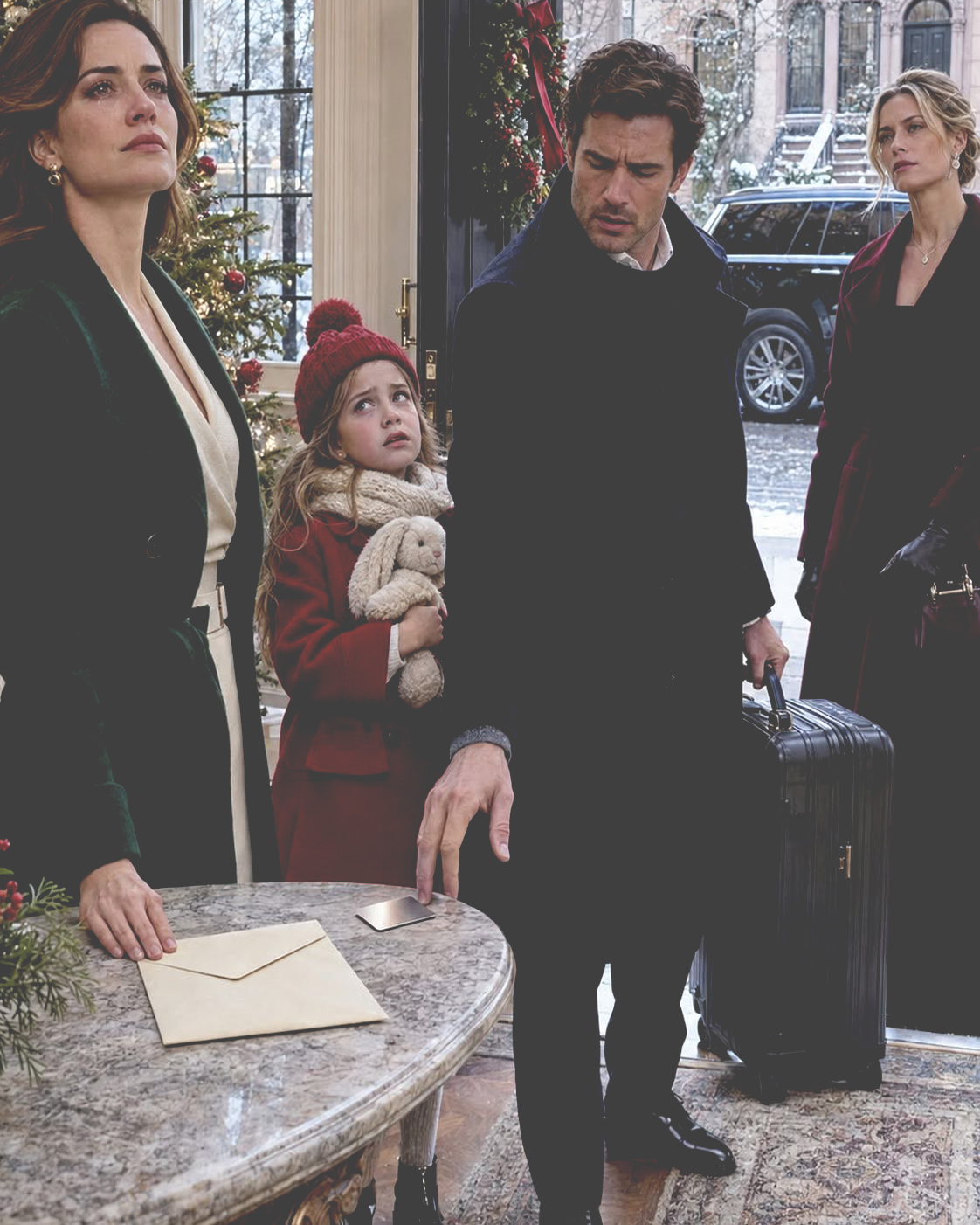
The Holiday I Almost Paid For: The Message Before Dawn- My husband was pulling our seven-year-old daughter’s suitcase toward the front door when he looked at me and said, “You’re not her mother. You’re a glorified babysitter.” A black SUV waited at the curb, its engine idling in the cold. Inside sat his former wife, Paige, ready to take their daughter, Lily, on a Christmas trip to Park City. My husband, Mason, expected me to cover the remaining expenses before he filed for divorce. He had no idea that the thick envelope on the entry table held a letter from my attorney,
or that the small metal card he slipped into his wallet would stop working before he reached the airport. Ten days earlier, I might have begged him to reconsider. I might have reminded him that Lily and I had planned to bake cookies, watch old holiday movies, and take the train downtown to see the Christmas lights. I might even have offered to pay for the trip if he would only let me stay in her life. By the morning he left, I had learned that pleading with someone who had already decided to use your love against you only makes it easier for them to keep doing it. The trouble
began over dinner. Mason set down his fork and announced that Lily would spend Christmas with Paige in Utah. “I’m going too,” he added. “She needs her real parents for the holiday.” I had already taken vacation days. Lily and I had talked for weeks about our plans, and she had drawn a paper angel for the tree whose crooked face was meant to watch the front door. “We didn’t discuss this,” I said.
Mason cut another piece of steak. “There wasn’t anything to discuss.”
Lily sat very still between us, her fingers tightening around her fork.
When I asked why he had made the decision without me, Mason leaned back and gave me the little smile he used when he thought he had the upper hand.
“You don’t get a vote. You have no legal claim to her. If you can’t accept that, maybe we should make the divorce easier and get it over with.”
Lily whispered, “Dad, stop.”
He didn’t look at her. He watched me instead, waiting for me to panic, because he knew that the thought of losing Lily frightened me more than the thought of losing him.
For years, I had tried to be careful not to replace Paige. Paige was Lily’s mother. I was Natalie: the one who packed school lunches, learned to braid hair from online videos, sat by the bed when Lily had a fever, and knew she would eat dried cranberries but pick every raisin out of a cookie.
Mason had been happy to let me do all of that while his event-planning business struggled and my salary from a children’s arts foundation covered most of our household expenses. Now that my bond with Lily might persuade me to keep paying, he suddenly remembered I was not her mother.
So I folded my hands in my lap and said, “If that’s what you want.”
For one brief moment, he looked disappointed. He had expected tears or bargaining. Then his face settled again.
“We’ll talk after the trip,” he said.
That night, long after he went upstairs, I came down to look at the Christmas tree. The paper angel Lily had made at school leaned slightly to one side at the top. She had insisted it face the front door so it could watch everyone come home.
While I stood there, my laptop chimed with an email from a man I barely knew. Andrew, Paige’s husband, had been polite at school events, but we had never shared more than a few words.
His message contained one sentence: “You and I are being used by the same two people. Call me before they leave.”
Below it was an audio file.
I sat at the kitchen island and pressed play. A chair scraped across a hard floor. Andrew’s voice followed, strained but controlled.
“Paige, I need you to explain why your Park City reservation lists Mason as your companion and why his company is billing expenses to my account.”
Paige laughed softly. “You’re making this more complicated than it needs to be.”
Then Mason spoke.
“The trip has nothing to do with you, Andrew.”
“It has plenty to do with me when I’m paying for it,” Andrew replied.
Paige sighed. “Natalie is covering most of the holiday expenses. You’re helping with the business side.”
“I never agreed to fund your reunion with your former husband.”
A pause followed. Then Mason said, “You’re both being dramatic about money you can afford to spend.”
His voice was familiar: relaxed, almost affectionate, and completely certain that any objection would eventually fade.
Andrew asked whether I knew Mason planned to leave me.
“She knows things aren’t working,” Mason said.
“That isn’t what I asked.”
Paige cut in. “She’ll be upset, but she’ll manage.”
Then Mason explained their timing. They would get through Christmas, let the trip make everything seem natural, and sort out both marriages in January.
When Andrew asked what would happen to Lily, Mason answered without hesitation.
“She’ll adjust.”
Paige said Lily would enjoy the holiday and that the new arrangements would be easier once everyone accepted them. Then Mason added the words that made the kitchen seem to close in around me.
“Natalie won’t make trouble while Lily’s involved. She’ll do anything to stay in that little girl’s life.”
I pressed a hand to my mouth.
The recording continued. They discussed a financing opportunity for Mason’s business, an investment proposal, and a loan that would use my townhouse as security. Andrew asked whether I knew my home had been discussed with a lender.
Mason did not answer at first.
“You don’t understand the arrangement between my wife and me,” he finally said.
“Then help me understand why a document with her name on it went to a broker without her signature.”
The recording ended soon after.
I played it again, then once more. I heard their plans in the casual phrases they used: the holiday expenses, the marriages, the house. They weren’t talking about me as a person who had loved them in different ways. They were talking about a source of money they expected to remain available until they were finished with me.
At 2:41 a.m., I called Andrew.
“Did you listen?” he asked.
“Yes. Is it real?”
“Yes. I was there when I recorded it.”
He had confronted Paige after finding unexplained charges on their accounts. He had also learned that Mason had been seeking a business loan and that a proposal involving my property had been sent to a broker.
The townhouse had belonged to my grandmother. I had inherited it before Mason and I married, and I had spent years repairing its old pipes and restoring its narrow courtyard. Lily learned to ride her bicycle there. It was where my grandmother taught me to make soup and where I had built a home for the three of us.
“He can’t borrow against it without me,” I said.
“He shouldn’t be able to,” Andrew replied. “But someone gave the broker details about the property. You need a lawyer.”
I remembered Mason asking for a mortgage statement and an insurance document the month before. He had said he needed examples for a client. At the time, I had thought nothing of it.
“He told me Lily needs her real parents,” I said, and my voice finally broke.
Andrew was quiet. Then he said, “She needs adults who won’t turn her love into a transaction.”
That was when I cried. Not because the truth had become more painful, but because someone had finally named what was happening without asking me to excuse it.
After we hung up, I opened my financial records. For months, I had covered most of the household expenses while Mason explained that his business was about to recover. I had stopped asking for details because every question seemed to make him feel inadequate.
That night, I understood that my silence had not protected his dignity. It had protected his secrets.
At six in the morning, Lily came into the kitchen in striped pajamas, carrying her stuffed rabbit, Juniper, by one ear.
“Why are you awake?”
“I couldn’t sleep, sweetheart.”
She climbed onto a stool and looked at the papers scattered across the island.
“Are you and Dad mad at each other?”
I closed my laptop. “We’re having a difficult time.”
Her face changed. “Did I do something?”
“No. Absolutely not.”
She glanced down at Juniper. “Dad says grown-ups decide.”
“Sometimes they do.”
“Even when they’re wrong?”
Despite everything, I almost smiled. “Especially then, unfortunately.”
For the first time that morning, she smiled back. Then she leaned against me while pale winter light gathered at the windows.
I didn’t know whether Mason and I would still be married by spring. I didn’t know whether Paige would let me see Lily if the marriage ended. I didn’t know what had already happened with the loan proposal.
But I knew I could no longer act as though the man upstairs was the same person I had married.
The Price of Being Needed
That afternoon, I met with an attorney named Miriam Cole. She listened while I explained the trip, the recording, and the financial documents. When I finished, she folded her hands on a legal pad.
“Before we talk about what your husband deserves, we need to establish what he can access.”
I told her about the townhouse and showed her the deed, the mortgage records, and the financial papers from our marriage. The house had been mine before Mason and I married. That did not mean every question about renovations or shared expenses would be simple, Miriam explained, but it did mean Mason could not treat the property as though it belonged to him.
She advised me to preserve the recording, review my accounts, and contact the lender through proper channels. She also made clear that I could not count on the law to recognize the relationship I had built with Lily as a parent’s relationship.
“That doesn’t mean your bond with her isn’t real,” she said. “It means we need to keep her out of the conflict as much as possible.”
The advice hurt because it was honest. I wanted a guarantee that loving Lily would be enough to keep her in my life. Miriam could not give me one.
She could help me protect my home and my finances. She could also remind me that no one should make a child feel responsible for a separation between adults.
After the meeting, I called my older sister, Jenna. I told her about the recording and the proposed loan. She asked first whether Lily was safe, then whether I was.
“I’m coming Saturday,” she said.
“You don’t have to.”
“I know. I’ll bring cookies.”
That evening, Mason came home while I was putting groceries away. He was on the phone, talking about a financing opportunity.
“The timing shouldn’t be a problem,” he said. “I’ll have the final paperwork after Christmas.”
When he ended the call, I asked what kind of financing he meant.
“You don’t understand my business,” he replied.
There was a time when I would have apologized for asking. Instead, I set the groceries on the counter and said nothing.
In the days that followed, I started paying attention to the small things Mason expected me to do: pick up his dry cleaning, organize a plumber’s visit, handle a bill he had left beside my laptop. None of them seemed serious on its own, but together they showed how thoroughly our household had arranged itself around his convenience.
When he said Lily needed new ski clothes, I suggested he and Paige make a list.
He stared at me. “I assumed you’d order everything.”
“I’m sure you can handle it.”
His irritation was immediate.
“Are you still sulking about Christmas?”
“No,” I said. “I’m not preventing you from getting Lily what she needs.”
He walked away, confused that I had not argued.
Jenna arrived on Saturday with two tins of cookies and the look of someone trying hard to remain polite. She spent the afternoon decorating gingerbread stars with Lily, who used enough icing to make each one look like a tiny winter landscape.
Once Mason left for what he called a client meeting, I showed Jenna the documents and let her hear the recording. She listened with her jaw clenched.
Afterward, she asked if I still loved him.
“I think I love the man I believed he was,” I said.
She took my hand. “Then give yourself time to grieve that.”
That evening, Miriam called with an update. A broker had received an inquiry about using my property to secure a substantial loan. No loan had been completed, but the broker’s records included an electronic acknowledgment bearing my name, and the information needed to be checked carefully.
The next day, I reviewed more of Andrew’s documents. Paige and Mason had met privately for months. There were hotel reservations in Connecticut and Boston, restaurant charges, and a car service receipt showing them traveling together. Some items could have been explained on their own. Together, they told a story neither of them had offered me.
One photograph showed Mason wearing a luxury watch he had bought during the same period he had asked me to postpone replacing our washing machine until his next invoice came through.
The watch itself did not matter. What hurt was remembering that I had believed we were making sacrifices together.
The afternoon before Lily’s departure, I found her sitting on her bedroom floor, arranging sweaters and stuffed animals beside her open suitcase.
“Dad says I can only take two,” she said.
“Then Juniper should choose a traveling companion.”
She selected a small blue bear. “Benjamin knows how to be brave.”
As we folded pajamas, she asked, “Are you going to be here when I come back?”
I stopped moving.
“Why wouldn’t I be?”
“Mom told Dad that things were going to be different after Christmas.”
I drew a slow breath. “Whatever happens between the grown-ups, none of it is because of you.”
She searched my face. “Even if I want everybody to stay?”
“Even then.”
She leaned into me. After a moment, she whispered, “You’re not my mom, but you’re my Maya.”
My eyes filled. “Yes,” I said. “I am.”
That night, I found a drawing beneath the paper angel on the tree. Lily had drawn our townhouse with glowing yellow windows and three figures at the door. Above it, in purple letters, she had written, EVERYBODY COMES HOME.
Then Andrew sent a document from the broker. The electronic acknowledgment had been filed while I was at Lily’s winter concert. The broker’s records linked it to a device associated with Mason’s office.
I forwarded it to Miriam. She confirmed that she would notify the broker that I had not authorized the application and would ask that the records be preserved. She also advised me to suspend Mason’s access to the metal card connected to my personal account before he left.
That night, I placed a thick envelope on the entry table. It held Miriam’s letter and the financial documents she had prepared. Beside it, I left the card.
Then I went upstairs and watched Lily sleep beside Juniper.
I had been afraid that standing up for myself meant abandoning her. Now I understood that staying true to myself was the only way I could be there for her without teaching her that love required a person to accept anything.
The Envelope at the Door
On the morning Mason left, the house smelled of coffee, pine, and the cinnamon rolls Lily had asked me to make. Outside, a thin layer of snow clung to the iron railings.
Mason moved through the rooms as though the day belonged to him. He checked his phone, asked whether the driver had arrived, and reminded me to put the trash out.
Then he came into the kitchen.
“Did you increase the spending limit on the card?”
“No.”
He frowned. “Why not?”
“You didn’t ask me to.”
He gave a humorless laugh. “We’re not going to argue about money at Christmas.”
“Then we won’t.”
He seemed unsettled by how little I said.
When the SUV arrived, Paige was waiting inside in a cream coat. Mason came downstairs wearing the camel-colored coat I had given him the previous winter. Lily stood between us in her red hat, clutching Juniper.
Mason picked up the metal card.
“Good,” he said, slipping it into his wallet. “Make sure the property taxes are paid before January.”
“They’re already scheduled.”
I knelt to check that Lily’s inhaler was in the front pocket of her bag. I reminded her about her gloves and the blue bear beside Juniper.
“Will you answer if I call?” she asked.
“Whenever I can.”
She put her arms around my neck. For a few seconds, every document and every lie disappeared, and I held only the child who wanted to know whether home would still feel familiar when she returned.
Mason cleared his throat. Lily stepped back.
He looked at me and said the words I once feared I would never hear.
“You’re not her mother. You’re a glorified babysitter.”
Lily’s face went pale.
I looked at him. “She doesn’t need to hear adults insulting each other.”
Then I turned to her. “Go enjoy the snow, sweetheart.”
Mason reached for the suitcase. I pointed to the envelope.
“That’s for you.”
He picked it up. “What is this?”
“Something you need to read.”
His expression changed. “What did you do?”
“I found out what you’ve been doing.”
He glanced toward Lily. I did not continue. She did not need to hear about the broker, the recording, or the way her parents had discussed the people who loved her.
“You can speak with my attorney,” I said.
He stared at me. “Your what?”
“My attorney.”
For the first time, his confidence faltered. Then the driver opened the SUV door, and Mason carried the suitcase outside.
At the threshold, Lily turned and waved. I waved back. The SUV pulled away, leaving the house quiet and smelling of cinnamon rolls.
I cried at the kitchen island after they left. I cried for the years I had spent trying to build a family out of promises that meant different things to each of us. I cried because Lily had heard her father dismiss me, and because I had wanted so badly to belong that I had mistaken being useful for being safe.
Then I washed the cups and called Miriam.
“They’ve left,” I said.
She asked whether I was safe, whether Mason had taken the letter, and whether we had argued.
“Not really,” I said. “He called me a glorified babysitter in front of Lily.”
“I’m sorry.”
“I wanted to say so much.”
“I imagine you did.”
“Instead, I told him to call you.”
“That was enough.”
I contacted the card issuer. Mason’s authorized access was suspended, and I began the process of reviewing the recent charges. Miriam had already notified the broker, and the lender confirmed that no loan secured by my townhouse had been completed.
Mason called three times. Then messages appeared on my phone.
What did you do to the card?
Paige is furious.
You’re making Lily’s Christmas miserable.
That last message hurt most. I had not stopped Lily from going on the trip. I had stopped paying for plans I had not agreed to.
I called Miriam and followed her advice to keep my response brief.
“Your access to my personal account has ended. Please direct financial and legal questions to my attorney. Lily’s necessary expenses remain your responsibility as her parents.”
Mason replied with an insult. Paige left a voicemail accusing me of creating an embarrassing situation at the airport. I saved both and forwarded them to Miriam without responding.
That evening, Jenna returned with an overnight bag. We ordered dinner and watched an old holiday movie, and for a while I didn’t have to talk about Mason.
Near midnight, Lily called from the hotel. Her face appeared between two pillows, with Juniper tucked under her chin.
“Juniper survived the airplane,” she announced.
“I’m very glad.”
She told me about the snow, the hotel lobby, and a dog she had seen downstairs. Then her expression turned serious.
“Dad is mad. Mom is mad too. Is it because of me?”
“No, Lily. Nothing the adults are upset about is your fault.”
She rubbed Juniper’s ear. “Dad said you’re being difficult.”
I chose my words carefully. “Sometimes grown-ups disagree about things children don’t need to solve.”
She nodded slowly.
“Are you still my Maya?”
“Yes.”
“Even if Dad says no?”
“I will always care about you. Nobody can make that untrue.”
Before we hung up, she asked whether the crooked paper angel was still on the tree. I carried my phone to the living room and showed it to her.
“It’s watching the door,” she said.
“That’s right.”
When the call ended, I began to cry again. Jenna wrapped her arms around me.
“Maybe the thing you’re afraid of losing won’t disappear as easily as Mason thinks,” she said.
I looked at her. “She isn’t mine.”
“No,” Jenna replied. “She isn’t property. And neither are you.”
On Christmas morning, the house was silent enough for me to hear the radiator ticking. I wanted to call Mason and apologize just so Lily could be back in the kitchen opening presents. Then I remembered the envelope, the loan proposal, and his words at the door.
A familiar Christmas was not worth the price of pretending none of that had happened.
Lily sent me a video from the hotel. She was wearing the blue-and-white bracelet she had made for me at the children’s club. A purple letter stood in the center.
“It says M for Maya,” she said. “The blue beads are snow.”
I watched the video three times. Then I thanked her and told her I loved it. I didn’t ask where Mason was or whether he and Paige were arguing. Lily deserved to enjoy her holiday without being asked to carry messages between adults.
That evening, she sent a photograph of herself between her parents in the snow. Her smile was real. I wrote back, “You look beautiful, sweetheart. Have the happiest time in the snow.”
A row of crooked heart emojis came back.
What We Kept
Mason returned to the city a few days after Christmas, without Lily. I was reviewing financial documents with Miriam over a video call when he walked into the townhouse.
“You really hired a divorce lawyer,” he said.
“Yes.”
He looked tired and angry. He asked why I had canceled his card and claimed I had ruined a legitimate business opportunity.
“Did you submit information about my home without asking me?” I said.
He looked away. “That isn’t how business works.”
“Did you?”
“I was trying to create a future for us.”
I opened the folder beside my laptop. “While planning to divorce me?”
His face changed.
He tried to explain that he and Paige had history, that raising Lily together was complicated, that his business was under pressure. Each explanation seemed to ask me to forget the part where he had planned to use my money and my fear of losing Lily to keep me compliant.
“Did you expect me to pay for the trip?” I asked.
“We’re married.”
“That doesn’t answer the question.”
He leaned forward. “You always said Lily came first.”
“She does. That’s why I won’t make her part of a lie.”
He accused Andrew and me of conspiring against them. I reminded him that he and Paige had discussed ending both marriages while using our money.
For a moment, he had nothing to say. Then he leaned back and asked whether we could keep things normal until the paperwork was complete.
I understood what he meant: he wanted to stay in the townhouse, have me handle the bills, and avoid uncomfortable conversations.
“No,” I said. “We need to arrange a proper separation.”
He stood and picked up his bag. At the door, he said, “You got too attached to Lily.”
“Maybe,” I replied. “But being attached to someone isn’t a weakness.”
He left. I sat alone in our bedroom afterward, remembering our first trip together, when we had eaten sandwiches on the floor after Mason’s dinner burned on a broken stove. The memory was real. So was the life we had built. But the good years did not require me to keep living inside the damage that followed.
On New Year’s Eve, Lily came back. She ran through the front door and threw her arms around me.
“I have your bracelet!”
She pulled the little pouch from her backpack. Inside was the blue-and-white bracelet with the purple letter M. I held it carefully.
“It’s perfect.”
Paige waited at the doorway. She looked tired.
“She asked about you every day,” she said.
I nodded. “I answered whenever she called.”
Paige looked toward the stairs. “You’ve made this much more complicated than it needed to be.”
“I didn’t make the choices that caused this.”
She looked away. A moment later, Lily appeared at the top of the stairs.
“Mom, can Maya keep my bracelet forever?”
Paige’s expression softened, just slightly.
“Of course.”
It was a small gesture, but it was the first time she had acknowledged my place in Lily’s life without trying to diminish it.
That evening, Lily asked whether Mason and I were getting divorced.
“Yes, sweetheart,” I said.
Her eyes filled. “Because of me?”
“No.”
“Because I went to Park City?”
“No. Your dad and I have problems in our marriage that are between us.”
She looked down at Juniper. “Do you still love me?”
“Yes.”
“Even if you’re not married to Dad?”
“Yes.”
She asked whether she would still visit. I told her I hoped so, but her parents would have to arrange it.
Then she whispered, “I thought if I was good enough, nobody would leave.”
I knelt beside her and held her hands.
“Lily, you never have to be good enough to stop grown-ups from making their own decisions. You are already enough.”
She leaned into me, and I held her while fireworks began popping across the city.
The divorce took months. There were records to review, accounts to separate, and explanations to request about the financing proposal. The broker’s documents showed that the electronic acknowledgment had come from a device associated with Mason’s office. He eventually acknowledged that he had advanced the inquiry without my informed consent. No loan had been completed, and no new claim had been placed on my home.
The financial process was slow and ordinary. There was no dramatic hearing where Mason confessed everything. There were statements, negotiations, and careful reviews of transfers and charges. In the end, the agreement resolved certain disputed expenses without making me responsible for his business or giving him ownership of the townhouse.
I felt relief, not triumph. I was glad the house remained safe. I was also glad to stop treating every new problem as mine to solve.
Andrew and I stayed friends, but neither of us needed to turn that friendship into a life built around shared resentment. He began volunteering at a youth science program. When he told me the cardboard bridges the children built were sometimes unreliable, I laughed for the first time in months.
“At least cardboard bridges are honest about their weaknesses,” he said.
By spring, Paige had moved to a smaller apartment, and she began allowing Lily to visit me. At first, the visits were short: an afternoon at the park, a library trip, cupcakes decorated with far too many sprinkles. I thanked Paige for arranging them and never treated them as a victory over her.
In May, Paige lingered in my hallway after dropping Lily off.
“She talks about you all the time,” she said.
I waited.
“I thought it would be easier if she stopped seeing you.”
“Easier for whom?”
Paige lowered her eyes. “For me, probably. I didn’t like the idea that she needed someone else.”
I answered carefully. “You’re her mother. Nothing about my relationship with Lily changes that.”
Paige looked at me for a long moment.
“I used to think you were trying to become more important than me.”
“I was trying to love the child who lived in my house.”
She nodded. It was not an apology, and it did not repair what had happened, but it was the beginning of a conversation in which Lily mattered more than the adults’ pride.
In June, I attended Lily’s school performance. Paige and Mason sat near the front. Andrew and I found seats a few rows behind them. No one made a scene. We were simply four adults in an auditorium, waiting for a little girl to sing.
Lily came onto the stage and scanned the audience. She found her mother, then her father, then Andrew, and finally me. Her face lit up. She waved both hands before remembering she was supposed to stand still, and the audience laughed as her teacher gently guided her back into place.
After the performance, Lily brought her paper certificate to each of us. Nobody asked her to choose whom to show first. She hugged us all.
That summer, I took a vacation by myself for the first time in years. I rented a small cottage beside a lake in Vermont. I read on the porch, walked along the shore, and ate dinner when I was hungry. I had thought solitude would feel like punishment. Instead, it felt like discovering a room in my own life I had never entered.
When I returned, I felt steadier. Not fearless, and not entirely healed, but more able to imagine a future that didn’t have to resemble the one I had lost.
By autumn, the divorce was final. I bought myself a small bunch of white tulips from the corner market and placed them on the kitchen table. The townhouse was quiet. Outside, yellow leaves drifted along the sidewalk.
A few weeks later, Mason sent me a letter. He wrote that he had been angry for a long time and had allowed himself to believe my financial stability meant his choices carried fewer consequences. Then he wrote, I was wrong to make you feel the years you spent loving Lily counted for nothing.
I read the sentence several times. I did not mistake it for complete forgiveness or a return to what we had been. But I was glad he had finally acknowledged something he once used to hurt me.
As Christmas approached, Lily asked whether I still had the star-shaped cookie cutters. She wanted to watch the old movie about the talking snowman and asked if the paper angel could go back on the tree.
“Yes to all three,” I said.
Then she asked whether we could see the big tree downtown.
The previous year, that had been one of our plans before Mason announced the trip. The memory still hurt, but it no longer frightened me.
“I think we can arrange that.”
Lily squealed and ran to tell Paige. A few days later, Paige called to ask whether she could join us for part of the outing.
“I think that would be nice,” I said, and meant it.
On a Saturday in December, the three of us took the train into the city. Lily wore a blue coat and a red hat, with Juniper peeking out of her backpack. Paige bought hot chocolate. I brought pretzels and dried cranberries.
When Lily complained that the snack Paige had packed contained raisins, I laughed. Paige looked surprised, then laughed too.
Beneath the towering Christmas tree, Lily stared up at the lights.
“It’s bigger than I thought.”
Paige smiled. “It always is.”
Lily took one of my hands and then her mother’s. For a little while, we stood together beneath the lights without trying to explain the past or promise what would happen next.
As we walked away, she asked, “Was this one of our old plans?”
“Yes,” I said.
“I’m glad we didn’t lose it.”
I squeezed her hand. “Me too.”
That evening, I returned to the townhouse. The paper angel still sat at the top of the tree, her crooked face turned toward the front door. I had repaired one wing with a small piece of tape.
The house was not what it had been a year earlier. Mason was gone. The marriage had ended. The financial questions had taken months to settle. But the home was still mine, and the love I had given Lily had not disappeared because two adults had tried to use it.
The next morning, Lily arrived for a visit carrying a small cardboard box.
“Don’t look!”
When she opened it, I found a new paper angel inside. Its wings leaned in opposite directions, and a gold halo sat crookedly above enormous blue eyes.
“She’s for you,” Lily said.
I looked at the old angel on the tree. “What about the other one?”
“That one watches everybody come home.”
“And this one?”
She thought for a moment. “This one watches you.”
My throat tightened.
“Why does she need to watch me?”
Lily shrugged. “Because sometimes you’re here by yourself.”
I knelt beside her. “Being by myself isn’t always sad.”
She considered that, then nodded.
“Okay. Then she can watch you be happy.”
I lifted her so she could place the new angel beside the old one. She adjusted their crooked wings and turned them toward the room.
“Now they’re watching everybody,” she said.
I looked at the two angels, then around the room. I had lost things. I had grieved them. I had rebuilt. And I no longer believed that surviving meant keeping everything exactly as it had been.
Sometimes survival meant allowing a false future to fall away so a real one could begin.
Lily tugged at my sleeve.
“Can we make cookies now?”
“Absolutely.”
“Without raisins?”
“Not a single raisin.”
“With cranberries?”
“With extra cranberries.”
She hurried toward the kitchen, calling for Juniper to come help. I followed more slowly, glancing back once at the tree. One angel watched the door; the other watched the room.
For a long time, Mason and Paige had believed my love for Lily made me powerless. They thought my fear of losing her would keep me obedient. They mistook patience for surrender and generosity for weakness.
But a marriage ending did not mean my life had ended, and a child’s affection was never theirs to own.
Lily reached for my hand. I took it without a bargain or a promise attached. There was only love, freely given, and the quiet knowledge that it was enough.