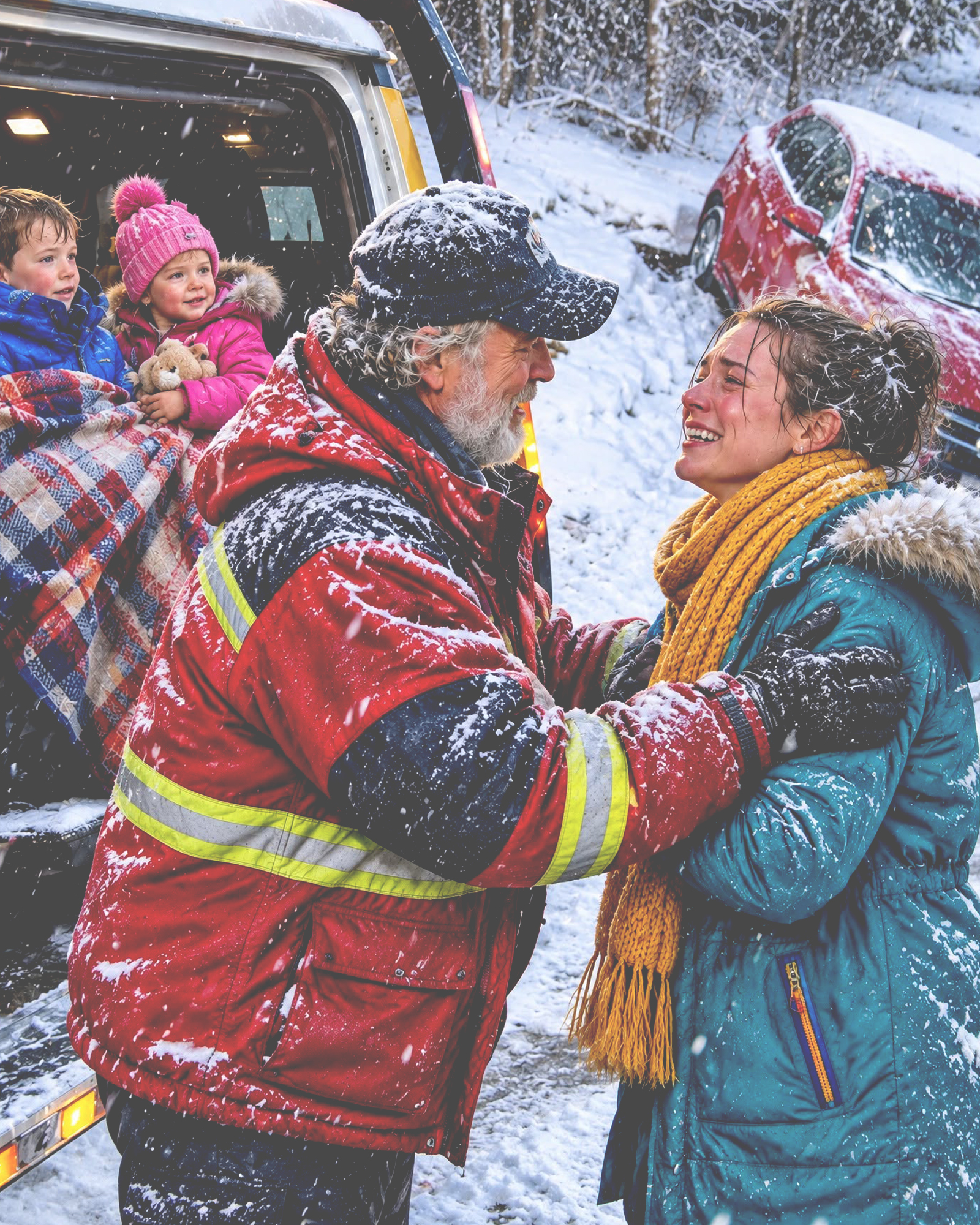
PART 1 — My Boss Put a $400 Price on a Christmas Eve Rescue: At 2:04 on Christmas Eve morning, a woman called our tow company from a ditch west of Grand Forks. It was four degrees outside, her engine had stopped, and there were two little kids in the back seat. When my boss told her how much it would cost to get them out, she counted the money in her purse and came up with thirty-six dollars. My name is Ernie Palko. I was sixty-one that winter, and I’d been driving a tow truck in Grand Forks, North Dakota, for twenty-eight years. I worked nights, which meant I
heard most of the calls people hoped they’d never have to make. There were dead batteries outside hospitals, cars spun into medians, and people who’d been sitting on the shoulder so long they forgot to tell me which direction they’d been driving. Behind my seat, I kept three wool blankets, a thermos, and an old child’s car seat. My late wife had put the first blanket there after I came home one morning and told her about a woman I’d picked up wearing slippers. The woman had been on her way to work before dawn and had spent forty minutes with her feet tucked beneath her
to keep them warm. “You never know who you’ll pick up,” my wife told me. She added the other blankets over the years. After she died, I still took them out every spring to wash and fold them. I always put them back before my next shift, even if it was seventy degrees outside. Vic Tamblyn owned the company. He could remember what a winch repair had cost him nine winters ago, and he knew exactly how long a driver could leave a truck idling before he’d see it in the fuel bill. If you spent enough years around him, you learned there were things he kept track of closely and things he preferred nobody bring up.
His daughter was one of those things. She’d left town six years earlier after a fight with him, and I couldn’t remember hearing him say her name since. There was an empty picture frame on his desk. Whenever he wiped down the desk, he picked up that frame and cleaned around it like there was still a photograph inside.
The storm came down from Canada that evening. By midnight, Highway 2 was closed, and from where I sat in our yard, I could barely see the gate. I was finishing my coffee when the dispatch line rang. Calls went to Vic’s cell first and rolled over to my truck if he missed them. When he picked up, I could hear the conversation over my speaker.
“Please,” a woman said. “I went into the ditch on Highway 2. I’m about ten miles west of town. I have two little kids with me, and I can’t get the car started.”
Vic asked if she needed a tow. She said yes so quickly I wondered how long she’d already been trying to reach somebody.
“Christmas Eve emergency rate is four hundred dollars,” he told her. “Cash or card, up front.”
There was a rustling sound, like she was trying to open something one-handed. When she spoke again, her voice was quieter.
“I have thirty-six dollars. My card’s maxed out. I can give you what I have now and pay the rest after Christmas.”
From somewhere near the phone, I heard a child crying. The woman tried to soothe them, then came back on the line and said she could give us her name and address if that would help.
“No payment, no tow,” Vic said. “Call your husband.”
“I don’t have a husband anymore. Please, sir. They’re so cold.”
“Try 911.”
He hung up. I called him before he had time to put his phone down.
“Vic, it’s four degrees. That road’s closed. Even if she gets through to somebody, those kids could be out there a long time.”
“We’re a business, Ernie. A customer wants a truck, she pays for a truck.”
“I’m going.”
For a second I thought he might relent. Twenty-eight years gives you a good ear for a man’s silences, and this one lasted long enough for me to hear the wind rattling the truck door.
“You leave that yard without a paid ticket,” he said, “and you don’t bother coming back.”
I set the phone down, reached behind my seat to make sure the blankets were there, and started the truck.
PART 2 — I Found Two Children Under One Thin Blanket
On a clear night, ten miles west of town was a short run. That morning it took me forty minutes. Snow was blowing across Highway 2 so hard that sometimes the only thing I could make out was the next reflector, and by the time I reached it, I was already looking for the one beyond. I kept peering down into the ditches, afraid I’d drive straight past her.
Then I caught a dim light below the shoulder. A small red car had gone nose-first down the slope, and snow had already piled up against its front doors. I parked where I had room to work, got out, and made my way down to the driver’s side. I had to brush snow off the glass before I could see anyone inside.
When I knocked, the driver turned toward me. She lowered the window about an inch, just enough for me to hear her.
“Did he send you?”
“I heard your call. I’m Ernie. Can you get your door open?”
She tried the handle. The door moved a little and stopped against the snow. I cleared enough of it with my boots to pull the door wider. Up close, I could see a bluish tint around her lips, and she had both hands buried in the sleeves of her coat.
“My kids first,” she said.
The little boy looked about five. He was sitting pressed against his sister beneath a blanket so thin I could see the pattern on her pants through it. When I leaned into the back seat, he lifted one corner of the blanket and asked if I was taking both of them.
“Both of you,” I said. “Your mom’s coming too.”
I carried his sister up first and buckled her into the old car seat. She stirred when I tucked a wool blanket around her legs, then turned her face toward the warm air coming from the dashboard. When I went back for the boy, he was trying to fold the thin blanket. His hands were shaking too much to get the corners together, so I told him to bring it the way it was.
Their mother came up to the truck after us. She climbed into the cab and went straight to checking on the children, bending over each of them as if she needed to see for herself that I’d brought both up. Only then did she sit down. I poured cocoa into the cap of my thermos and handed it to her. She held it in both hands for a while before she took a sip.
“I can give you the thirty-six now,” she said. “I meant what I told the man on the phone. I’ll pay the rest.”
“Keep it in your purse. I’m going to get your car up here.”
She started to say something else, but the little girl reached for her, and she turned to take the child’s hand. I shut the cab door gently and went back out with the winch line.
Getting a car out of a ditch is slow work when you can see what you’re doing. I cleared enough snow to get to a solid attachment point, then eased the car uphill a little at a time. Each time I stopped to check the line, I could see the boy watching me through the cab window. At some point he pulled the wool blanket up over his nose, and all I could see were his eyes.
I took them to the truck stop motel at the edge of town. The desk clerk said a room was ninety dollars. The woman heard him and reached for her purse again. I already had my card out. I paid for the room and waited while she got the two children through the lobby, the girl on her hip and the boy trailing behind with his blanket.
Before she went down the hall, I asked for her name for the call sheet. She gave it to me, then spelled the children’s names while I wrote down their ages. I’d been thinking about the warmth in that room and whether the boy had dry socks. I wrote the name the way I’d written thousands of others, right beside the mileage and the time of the call.
Then she hugged me. She tried twice to get a thank-you out before she started crying.
“Merry Christmas,” I told her. “Go get some sleep.”
I put the clipboard back in the truck and drove to the yard. Vic was already there when I pulled in. He stepped out of the office as soon as my headlights crossed the window.
PART 3 — He Fired Me, Then Read the Name on the Call Sheet
Vic stood where I usually parked, so I stopped a few feet short and shut off the engine. He waited for me to climb out. He didn’t ask how the road was or whether I’d managed to reach the woman. He started with the truck.
“Fuel, winch time, and an emergency tow I’ll never get paid for,” he said. “I gave you a direct order. You’re done, Ernie.”
He’d been threatening to fire me for most of the drive, in one version or another, inside my head. Hearing him actually say it felt different. I’d spent twenty-eight winters in that yard. I knew which office drawer stuck when the weather turned damp and where to put my coffee so the vibration from the engine wouldn’t work it out of the cup holder. I’d expected to come back after Christmas and do all of it again.
“Fair enough, Vic.”
I worked the truck key off my ring and handed it to him. My wife’s blankets were still in the cab, one of them draped over the seat where the boy had been sitting. I was about to reach for them when Vic leaned past me and grabbed the clipboard.
“I need to log this,” he said.
He flipped to the call sheet. I watched his eyes move across the mileage and down to the customer’s name. His hand went still. Then he moved the clipboard closer to his face and read the same line again.
Customer: April Tamblyn. Children: Bodhi, 5. Sage, 2.
“Where did you take her?”
His voice had dropped so low that I almost asked him to repeat himself. I looked at the sheet, then back at him. There was only one reason he would be looking at that name like he’d just heard it spoken by somebody he thought he’d never see again.
“The truck stop motel,” I said. “Room six.”
Vic let the clipboard fall into the snow and hurried to his pickup. I picked up the board, brushed it off, and went to my own car. I could have gone home. I’d already handed over my key, and whatever happened next belonged to the two of them. But I remembered April asking whether he’d sent me, and I followed him to the motel.
He didn’t run once he reached the walkway. He slowed down outside Room 6 and stood there for several seconds before he raised his hand to knock. By the time the door opened, I’d caught up to him and stopped a few feet back, near the window.
April was still wearing the clothes she’d had on in the car. Sage was on her hip, her cheek resting against her mother’s shoulder. April looked at Vic for so long that I wondered whether she’d known all along who was on the phone. Then she opened the door a few more inches.
“Dad?”
Vic’s mouth moved before anything came out. I’d seen him make hard phone calls and deliver bad news, and he always knew how to start. That morning, standing outside a motel room with snow melting on his boots, he had to try twice.
“You called my line last night,” he said. “I didn’t know it was you. I heard you say your children were crying, and I still hung up.”
April looked down at Sage and adjusted the sleeve that had ridden up on her little arm. She didn’t tell him it was all right. She stood there and let him finish.
“I told you to call your husband,” he said.
“He left in June. I was coming home to see you.” She took a breath. “I figured if I knocked on Christmas morning, you might let me come in long enough to ask if we could start over.”
Vic put his hand over his mouth. He’d spent years telling drivers how much an hour of their time was worth. Now he was looking at his daughter and trying to say what he’d nearly done over four hundred dollars.
Bodhi edged into view behind his mother. I could see the top of his head first, then one socked foot as he stepped into the gap between her and the doorframe. He took a long look at Vic.
“Mom,” he asked, “is that Grandpa? The one in the picture?”
Part 4 begins below.
PART 4 — His Grandson Had One Thing to Tell Him
April nodded. Vic lowered his hand from his mouth, and Bodhi studied him with the solemn look children get when they’re deciding whether a grown-up is going to answer them honestly.
“Mr. Ernie came and got us,” he said. “He had cocoa. You should be nicer, Grandpa.”
Vic knelt right there on the wet concrete. He was wearing the same work pants he’d had on in the yard, and one knee went straight into the snow that had blown up against the door. He opened his arms and waited. Bodhi looked up at his mother, then stepped across the threshold and let his grandfather hold him.
It was the first time they’d ever touched. Vic closed his eyes and kept one hand flat against the boy’s back. Bodhi stood there with his arms around Vic’s neck, looking over his shoulder at the snow. Sage lifted her head to see what was happening, and April shifted her so she could get a better look at the man her brother was hugging.
I walked back to my car while they were still at the door. I’d seen April watch the heater vents in my truck the way people watch a clock when there’s somewhere they urgently need to be. Now she was inside a warm room, and her father had finally made it to her. I was ready to go home.
April told me later that they spent Christmas Day at Vic’s house. He decided to cook a turkey, the first one he’d attempted in six years. He burned it. She said the children were hungry enough to eat the sides, and Bodhi kept asking to see the family pictures. Every time Vic got up to check something in the kitchen, the boy followed him.
I kept thinking about a detail April had given me without realizing how much it would stay with me. Bodhi had recognized his grandfather from a picture. Somewhere in the six years they’d spent apart, she’d taken the time to show her son Vic’s face and tell him who he was. When I pictured the empty frame on Vic’s desk, I thought about the questions that boy must have asked her.
On December 26, my phone rang. I recognized Vic’s number and let it ring once more before I picked up. It was the first morning in years that I’d woken up without a truck key to keep track of, and I still hadn’t decided what I was going to do with myself when night came.
“Ernie,” he said, “come back to work. I’ll double your Christmas bonus.”
“I don’t want a bonus, Vic.”
He went quiet. Then he asked what I wanted, and this time he waited for my answer. I thought about the rustle I’d heard on the dispatch line. April had been going through her purse while her children cried, trying to come up with a number that would make a man send a truck.
“I want a rule for the next driver who hears a call like that,” I said. “If there are kids stranded with their family, we go get them. Nobody has to come up with money before we leave the yard.”
Vic asked if I meant on Christmas Eve.
“I mean any night. And I want it right over the dispatch phone, where whoever answers can see it.”
There was a long enough pause for me to hear him set something down on his desk. I didn’t fill it. I’d already told him what would bring me back, and I wanted him to have time to think about what he was agreeing to.
“All right,” he said finally. “Come in and help me put it up.”
When I got to the office, there was a sheet of paper on the desk, beside the empty frame. Vic had written the words by hand before I arrived. The lettering got smaller toward the right edge because he’d started too big, but every word fit.
FAMILIES WITH CHILDREN — NO CHARGE.
Vic stood on the bottom rung of a step stool while I told him when he had it straight. He taped the rule above the phone and pressed each corner down with his thumb. Then he came down, opened his desk drawer, and slid my truck key across to me.
I put it back on my ring. Out in the cab, the boy’s blanket was still lying across the seat. I took it home that morning to wash it. By the time I started my next shift, all three were folded behind my seat again.
PART 5 — The Next Christmas Eve, Vic Took the Call Himself
April moved back to Grand Forks with Bodhi and Sage in January. She took a job at the front desk of the tow company. The first time I came in and saw her sitting there, she was writing down the location of a stalled car and asking the driver what they could see from their window. She repeated the directions before hanging up, then turned the sheet toward me so I could read it.
Some afternoons Bodhi came by the yard. He wanted to know how the winch worked and why I wore different gloves to run the cable than I wore to drive. When he told me he was going to be a tow truck driver, he had one part of the job figured out already. He wanted to carry blankets, and he wanted them where he could reach them from the driver’s seat.
“How many?” I asked.
He looked into my cab and counted mine. “Three,” he decided.
Vic overheard him from the office doorway. He asked where Bodhi planned to keep his thermos, and Bodhi took that question seriously enough to climb onto the running board and point out the space he had in mind. The two of them stood there talking through it until April called the boy in to get his coat.
By the time another Christmas Eve came around, the sign above the dispatch phone had curled at one corner. April smoothed it down whenever she reached up to pin a note beside it. I’d stopped looking at it every time I walked in, the way you stop looking at a clock you’ve passed a thousand times. I still thought about the night Vic put it there whenever I drove that stretch of Highway 2.
The forecast called for snow. By evening, it had turned into a blizzard, and the wind was throwing it against the office windows hard enough that I could hear it from across the room. The calls started early and kept coming. Vic sat at the dispatch desk and picked up every one himself.
I heard him ask one driver whether she could get her heater going. He asked another where the car had left the road and whether everyone inside was able to get out. Between calls, he wrote down what he’d learned and passed the sheet to whoever was taking the truck. I never heard him ask how much money anyone had.
Around three in the morning, the phone rang again. I was in the office warming my hands around a cup of coffee. Vic picked up, listened for a few seconds, and pulled the clipboard toward him. When he asked how many people were in the car, he held his pen above the paper and waited for the whole answer.
Then he asked how far west of town they were.
I set my coffee down. I knew the road as soon as he started repeating the directions, and I reached for the coat I’d hung over the back of my chair. Vic looked up from the call sheet and pulled his own coat off the hook.
“I’ve got this one, Ernie.”
I hadn’t seen him take a truck out on a call in fifteen years. He still knew where the keys were, and he’d heard enough dispatch calls to know what the family needed. He tucked the clipboard under his arm and headed out into the yard. Through the office window, I saw him climb into the cab, then lean across the seat to check behind it.
I stayed by the phone. Every so often I looked out at the gate, where the yard light caught the snow blowing through the chain link. I remembered how small the taillights of April’s car had looked from the shoulder and how carefully her son had tried to fold that blanket before he let me carry him out. He’d been five years old, and somebody had taught him to take care of what little he had, even when his fingers were too cold to do it.
When headlights finally swung into the yard, I got up and opened the office door. Vic parked and climbed down slowly. Snow was packed into the creases of his coat, and he stamped each boot against the step before he came in. He took off one glove, found the call sheet under the clip, and handed it to me.
“Family of four,” he said. “Ditch on Highway 2.”
I looked down at the space where we recorded the charge. Vic had already filled it in. He gave me a little smile as he hung his coat next to mine.
“No charge.”