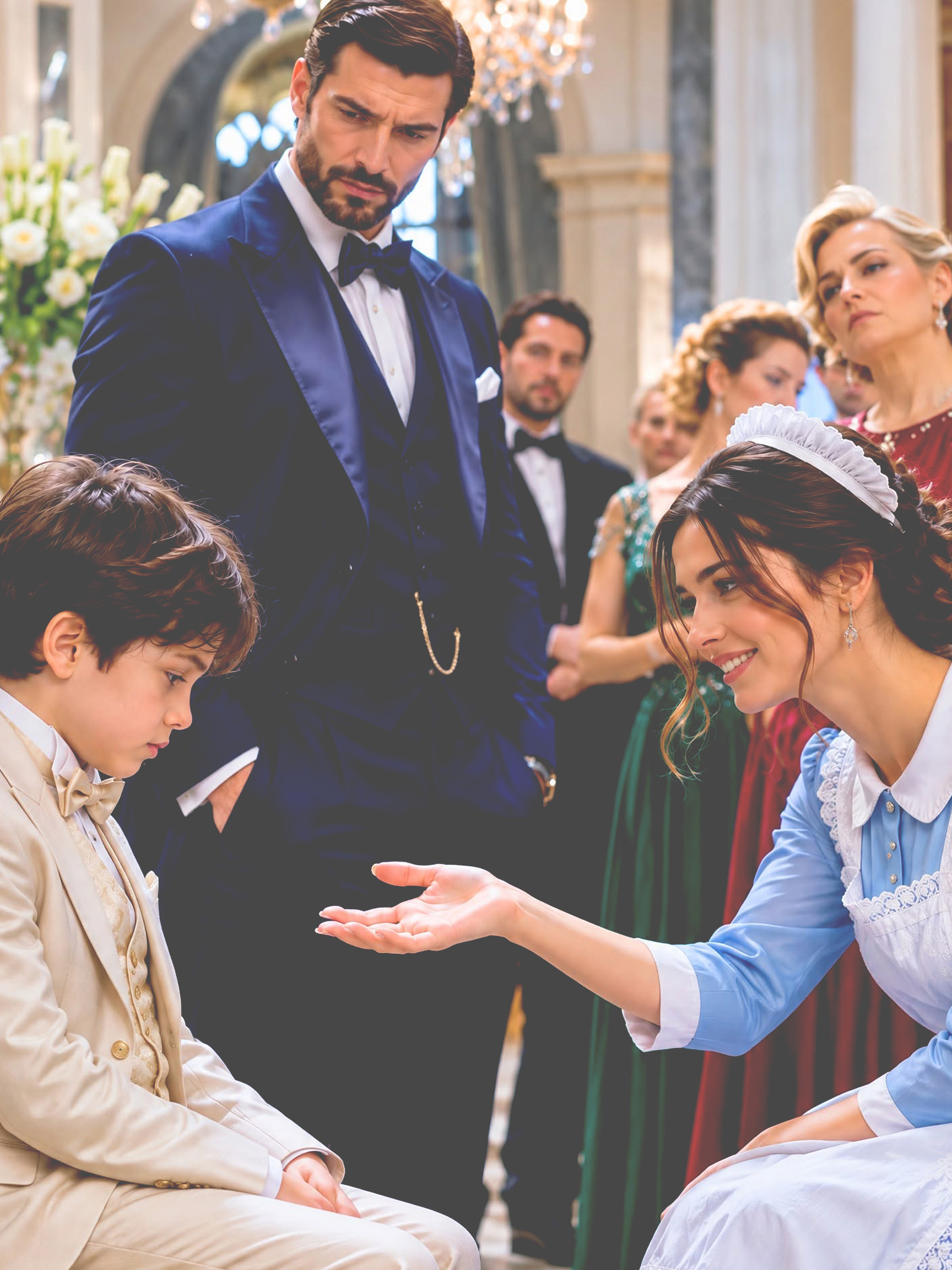
Part 1: Rich Kids Mocked a Millionaire’s Silent Son at a Wedding—Until a Pianist Did Something His Father Never Expected: “What’s wrong with you? Are you mu:te? Or are you just too stu:pid to dance?” The cruel question echoed across the elegant ballroom of a Newport wedding reception. Eight-year-old Noah Whitmore stood against a marble column, clutching a small wooden toy train. Two teenage boys in expensive suits laughed as he pressed his hands over his ears. “Come on, freak. Everybody else is dancing!” Noah stepped backward until his shoulders
touched the wall. His lower lip trembled, but he didn’t answer. Several adults noticed the confrontation. One woman glanced over before returning to her conversation. Another guest smiled awkwardly and looked away. Nobody intervened. At the grand piano near the dance floor, twenty-nine-year-old Emily Carter watched the scene unfold. She had been hired to perform at the wedding of a wealthy Newport family. The evening’s payment would equal nearly two weeks of her usual income, money she desperately needed. Her younger sister, Lily, was hospitalized in
Providence, and the medical bills were mounting. Emily had spent the previous afternoon reviewing payment arrangements with the hospital before driving to Newport for the performance. She couldn’t afford to lose this job. But watching those boys torment a frightened child made it impossible to continue playing. Emily lifted her hands from the keyboard. The sudden silence drew a few curious glances.
She stood and approached the boy slowly.
“Hi,” she said gently. “My name is Emily.”
Noah stared at her without speaking.
She noticed how tightly he held his toy train and how his eyes kept moving toward the speakers beside the dance floor.
“It’s pretty loud in here, isn’t it?”
He gave the smallest nod.
Emily crouched a short distance away, careful not to crowd him.
“You don’t have to talk to me. I just wanted to ask whether you’d like to dance.”
One of the teenagers snickered.
“Good luck with that. He doesn’t even talk.”
Emily turned toward him.
“That’s enough.”
Her voice was quiet but firm.
The boy rolled his eyes and retreated toward his friends.
Emily looked back at Noah.
“We don’t have to dance, either. We could just listen to something softer.”
For the first time, the little boy lowered one hand from his ear.
A waitress standing nearby leaned toward Emily.
“That’s Noah Whitmore,” she whispered. “His father owns half the commercial properties around here.”
Emily glanced toward the reception tables.
“Where’s his family?”
“His mother died two years ago. His father has hired all kinds of specialists, but Noah barely speaks anymore.”
The waitress lowered her voice.
“He doesn’t like crowds. Especially loud ones.”
Emily looked at the boy again.
Before her mother’s death, she’d studied music therapy and learned how familiar melodies could sometimes help people express feelings they struggled to communicate.
She also knew that a grieving child shouldn’t be pressured into performing for strangers.
So she extended her hand, palm upward.
“Would you like to walk over to the piano with me? We can stop whenever you want.”
Noah studied her face.
Then he looked at her open hand.
For several seconds, he remained completely still.
Emily waited.
Finally, he took one cautious step forward.
A few guests turned to watch.
Noah slowly reached toward her fingers.
But before their hands touched, a deep male voice interrupted them.
“Excuse me. Who gave you permission to approach my son?”
Emily turned.
A tall man in a tailored charcoal suit stood behind her, his expression severe.
She recognized him immediately from the photographs displayed throughout the reception.
James Whitmore.
Forty-five years old, a successful real estate developer, and one of the wealthiest businessmen in Rhode Island.
His gaze moved from Emily to Noah.
“Step away from him, please.”
Emily straightened.
“Mr. Whitmore, I wasn’t trying to upset him. Some older children were teasing him, and I thought—”
“I didn’t ask what you thought.”
The nearby conversations stopped.
James looked toward the wedding coordinator.
“Who hired this woman?”
Emily felt her stomach tighten.
She thought of Lily’s hospital bills and the paycheck she couldn’t afford to lose.
But before she could explain herself, Noah suddenly moved between them.
He gripped Emily’s hand with both of his.
Then, in a small but unmistakably clear voice, he spoke.
“Daddy, don’t be mean to her.”
James went completely still.
Noah looked up at his father.
“She’s nice.”
The entire group fell silent.
James stared at his son, his face losing all its color.
For two years, Noah had rarely spoken more than a few words at a time, and almost never without being prompted.
Now he had spoken on his own to defend a woman he’d met only minutes earlier.
James opened his mouth, but no words came.
And when Noah tightened his grip on Emily’s hand, his father realized that something extraordinary had just happened.
Part 2: The Millionaire’s Son Spoke for the First Time in Months—Then a Wedding Guest Called Him a Sick Child
“Daddy, please don’t make her leave.”
James Whitmore stared at his eight-year-old son, barely believing what he’d heard.
For two years, Noah had rarely spoken without being asked a direct question. Even then, his answers were usually limited to a nod or a whispered word.
But now he was holding a stranger’s hand and asking his father to protect her.
James slowly crouched in front of him.
“Noah, do you want to stay with this woman?”
The boy nodded.
“Can she play something quiet?”
James looked toward Emily Carter, the young pianist he’d just threatened to have removed from the wedding.
His expression softened.
“Would you mind?”
Emily glanced at Noah.
“Of course. But only if that’s what he wants.”
Noah tightened his grip on her fingers.
Together, they walked toward the grand piano.
Emily asked the wedding coordinator to lower the speakers near the dance floor. Then she sat at the keyboard and began playing a gentle melody.
Noah stood beside her, still clutching his wooden train.
The music was slow and simple, nothing like the loud dance songs that had filled the ballroom earlier.
After a minute, Noah moved closer.
“My mommy played something like that.”
Emily’s fingers slowed slightly.
James, standing a few feet away, lifted his head.
“What did you say, buddy?”
Noah looked at the piano keys.
“Mommy used to play when it rained.”
James swallowed hard.
His late wife, Sarah, had played their upright piano every Sunday afternoon. Sometimes Noah sat beside her, pressing random keys while she laughed.
After Sarah died, James had closed the music room because he couldn’t bear hearing anyone play her piano.
He hadn’t realized Noah might miss those afternoons just as much.
“Do you remember that?” James asked.
Noah nodded.
“She never made me dance.”
Emily looked at the boy.
“Then we won’t dance unless you want to. You can just listen.”
Noah stood quietly for several moments.
Then he began swaying gently to the melody.
A small smile appeared on his face.
James turned away, blinking rapidly.
He had spent enormous amounts on specialists, evaluations, and private appointments, hoping someone could help his son feel comfortable speaking again.
Yet this young woman had simply noticed that Noah was overwhelmed and given him a choice.
For a few precious minutes, the ballroom remained peaceful.
Then a man’s voice cut through the music.
“Honestly, I don’t understand why everyone has to make such a spectacle over one sick child.”
Emily stopped playing.
The speaker was an older relative of the groom, standing near the bar with several other guests.
He gave an irritated shrug.
“It’s a wedding. People came here to celebrate, not watch some special performance.”
Noah immediately stopped swaying.
His smile disappeared.
Emily stood and moved beside him.
“Noah hasn’t done anything wrong,” she said firmly.
The man raised his eyebrows.
“I wasn’t talking to you.”
“You were talking about a child who can hear every word you’re saying.”
Several guests looked down.
Emily continued.
“He was being mocked earlier, and nobody stepped in. Now he’s finally comfortable enough to enjoy the music, and you’re criticizing him for that, too.”
James turned toward the man.
“Were you watching when those boys were teasing my son?”
The relative hesitated.
“James, they’re just teenagers.”
“That wasn’t my question.”
The man looked away.
James surveyed the nearby guests, recognizing several people who had witnessed Noah’s humiliation.
Nobody offered an explanation.
He looked back at his son, who had pressed himself against Emily’s side.
For the first time that evening, James understood how alone Noah had felt in a room filled with people who knew his family.
He turned to the wedding coordinator.
“Please keep the music at a comfortable volume for the rest of the evening. And make sure those boys leave Noah alone.”
Then he approached Emily.
“Miss Carter, may I ask you something?”
“Certainly.”
“You’re not just a pianist, are you?”
Emily hesitated.
“I studied music therapy for several years.”
“Studied?”
“I had to leave school after my mother passed away. My younger sister became ill, and I needed to work full-time.”
James listened as she briefly explained Lily’s hospitalization and the cost of her treatment.
He looked toward Noah, who was examining the piano keys with quiet curiosity.
Then James spoke.
“I’ve spent two years looking for someone who could help my son. Would you consider working with him?”
Emily looked surprised.
“Mr. Whitmore, I haven’t completed my qualifications.”
“I’m not asking you to replace his doctors. I’m asking whether you can help us understand what makes him comfortable.”
Emily considered his words.
Then she looked directly at him.
“I might be able to help, but there’s something you need to understand first.”
James waited.
“Noah doesn’t just need specialists. He needs his father to be present, even on the days when he doesn’t say a single word.”
James looked toward his son.
Noah was sitting at the piano bench, carefully placing his toy train beside the keys.
For the first time, James wondered how many evenings he’d spent working late while his little boy waited at home.
And the realization hurt more than anything Emily could have said.
Part 3: The Millionaire Offered the Pianist a Job—But Her One Condition Forced Him to Face the Truth
James Whitmore had spent two years believing that money could solve his son’s problems.
He’d hired respected child psychologists, arranged private consultations, and paid for specialized programs. Whenever someone recommended another expert, James immediately scheduled an appointment.
But nobody had told him what Emily Carter had just said.
“Your son needs his father to be present, even when he doesn’t speak.”
James looked across the ballroom.
Noah was sitting quietly beside the piano, moving his little wooden train along the edge of the bench.
For a moment, James remembered how his wife, Sarah, used to sit on the floor with their son, building elaborate railway tracks across the living room.
After her death, those tracks had remained packed away in a closet.
James had convinced himself that keeping busy was the only way to survive his grief.
He hadn’t considered what his absence was teaching Noah.
“Are you saying I’ve neglected my son?” he asked quietly.
Emily hesitated.
“I’m saying he needs more than appointments and expensive programs. He needs someone who will sit beside him without expecting him to speak.”
James looked down.
“I work long hours.”
“I understand. But Noah doesn’t measure your love by how much money you spend.”
Her words stung.
He wanted to defend himself, but he couldn’t forget the way Noah had clung to Emily’s hand after knowing her for only a few minutes.
“What would you suggest?” he asked.
“Start with something small. Spend time doing what he enjoys. Let him decide whether he wants to talk.”
James glanced toward the piano.
“And the music?”
“If Noah likes it, music can be part of that time. But I wouldn’t promise any particular result.”
For the first time that evening, James smiled faintly.
“You’re the first person who’s offered me advice without promising a miracle.”
Emily returned his smile.
“Children aren’t problems to be fixed, Mr. Whitmore.”
James considered that for a moment.
Then he asked whether she would visit their home the following week.
Emily explained that she still had evening performances and needed a reliable income to support her younger sister’s medical treatment.
James listened carefully.
He offered to pay her for scheduled music sessions with Noah while she continued her professional training.
Emily agreed to consider it, provided Noah’s existing healthcare professionals remained involved.
Before the reception ended, James approached the wedding coordinator and arranged for Emily to receive her full performance fee.
He also apologized for the way he’d spoken to her earlier.
“I was frightened when I saw a stranger approaching Noah,” he admitted. “But I should have asked what happened before accusing you.”
Emily nodded.
“Thank you.”
Across the room, Noah suddenly looked up.
“Daddy?”
James immediately turned.
“Yes, buddy?”
“Can we go home now?”
“Of course.”
Noah picked up his wooden train.
Then he asked something that made James’s chest tighten.
“Will you play trains with me?”
James crouched beside him.
“I’d love to.”
Noah studied his father’s face.
“Even if I don’t talk?”
James felt tears gathering in his eyes.
“Especially then.”
That night, after returning to their Newport mansion, James canceled a late business call.
He followed Noah into the playroom and helped him retrieve the old railway tracks from the closet.
For nearly an hour, they built bridges and curved tracks across the carpet.
Noah spoke only twice.
James didn’t mind.
For the first time in months, his son seemed comfortable simply being beside him.
Later, James walked past the closed music room.
He stood outside the door for several minutes before finally turning the handle.
Sarah’s piano was still there, covered with a white sheet.
He removed the sheet and sat on the bench.
A framed photograph of Sarah holding Noah rested on a nearby shelf.
James picked it up.
“I thought I was protecting him,” he whispered.
But he was beginning to understand that he’d been protecting himself from reminders of his wife.
The following morning, he contacted Noah’s care team to discuss Emily’s proposed visits.
Then he called Emily.
“I’d like you to come next Tuesday,” he said. “Noah has been asking about you.”
Emily accepted.
Before ending the call, James asked about her hospitalized sister.
Emily explained that Lily’s treatment was continuing, but the financial strain had forced her to postpone returning to school.
James didn’t make any promises.
Instead, he contacted the director of the Whitmore Family Foundation to ask whether Lily might qualify for assistance through its existing medical support program.
He wanted the application reviewed properly, without turning Emily’s kindness toward Noah into a debt she owed him.
A week later, Emily arrived at the mansion carrying a small bag of sheet music.
James greeted her at the entrance.
“Noah’s waiting in the playroom.”
Emily followed him down the hallway.
But when they reached the doorway, they found Noah sitting on the floor beside his train tracks, staring at an old photograph.
It showed him as a toddler, sitting at the piano with his mother.
James stopped walking.
He hadn’t seen that photograph in years.
Noah looked up at Emily.
“Can you teach Daddy Mommy’s song?”
And James suddenly realized that his son hadn’t forgotten the music at all.
He’d been waiting for someone willing to listen.
Part 4: The Millionaire Found His Son Holding His Late Mother’s Photograph—Then He Finally Understood What the Boy Needed
“Can you teach Daddy Mommy’s song?”
Eight-year-old Noah Whitmore sat on the playroom carpet, holding a photograph of his late mother beside his wooden train.
James stood in the doorway, unable to answer.
For two years, he’d avoided playing Sarah’s favorite music because every familiar melody reminded him of losing her.
He hadn’t realized that his silence had also taken something precious away from their son.
Emily Carter knelt beside Noah.
“Do you remember how the song goes?”
Noah nodded.
“Mommy played it when it rained.”
“Would you like to show me?”
The boy hesitated, then began humming a few uncertain notes.
Emily listened carefully.
She recognized the melody as a simple lullaby and softly hummed along.
James covered his mouth.
He remembered Sarah playing that tune while Noah sat beside her, pressing the piano keys with his tiny fingers.
“I remember it,” James whispered.
Noah looked up.
“Really, Daddy?”
James crouched beside him.
“Your mom used to play it every Sunday.”
“Why did you stop?”
The question struck harder than James expected.
He could have offered an easy explanation, but Emily had encouraged him to be honest with his son.
“Because I missed her so much that hearing the music made me sad.”
Noah lowered his eyes.
“I miss her too.”
James pulled him gently into an embrace.
“I know, buddy. And I’m sorry I stopped doing the things that reminded us of her.”
For several moments, they remained together on the carpet.
Then Noah reached for his father’s hand.
“Can we play it again?”
That afternoon, James opened the music room for the first time since Sarah’s death.
Emily sat at the piano and played the melody slowly while Noah stood beside his father.
He didn’t sing or dance.
He simply listened.
When the song ended, he asked her to play it once more.
Over the following weeks, Emily visited twice a week.
She brought simple musical activities, familiar melodies, and small rhythm instruments, always allowing Noah to decide whether he wanted to participate.
Some afternoons, he barely spoke.
Other days, he asked questions about the piano or told Emily stories about his mother.
James began arranging his work schedule around those visits.
Instead of returning home after Noah’s bedtime, he started leaving the office early enough to have dinner with him.
They built railway tracks, took quiet walks near the Newport waterfront, and listened to Sarah’s favorite recordings.
One evening, Noah asked whether his mother would have liked the new train station they’d built.
James smiled sadly.
“She would have loved it.”
For the first time, they spent nearly an hour talking about Sarah without James trying to change the subject.
Meanwhile, Emily received unexpected news.
The Whitmore Family Foundation had approved assistance toward Lily’s hospital treatment after reviewing her medical and financial circumstances.
Emily called James immediately.
“Mr. Whitmore, I don’t know how to thank you.”
“You don’t owe me anything,” he replied. “The foundation exists to help families facing situations like yours.”
Emily also learned that James had arranged for her to meet with an academic adviser about completing her music therapy studies.
He offered to support her tuition through an educational grant, provided she qualified under the foundation’s program.
Emily was overwhelmed.
For months, she’d worried that caring for Lily meant abandoning her own future.
Now she could finally imagine returning to school.
But the greatest change was happening inside the Whitmore home.
One Friday evening, James invited Emily to stay for dinner after her session with Noah.
During the meal, Noah began talking about a model railway he’d seen in a shop window.
James listened with a smile.
Then Noah suddenly stopped.
“Daddy, are you going away tomorrow?”
James frowned.
“Why would you think that?”
“You used to go away every Saturday.”
James remembered the business trips he’d scheduled to avoid spending lonely weekends at home.
He put down his fork.
“Not tomorrow. I thought we could go to the park together.”
Noah studied him carefully.
“Just us?”
“Just us.”
A small smile spread across the boy’s face.
Emily watched quietly from across the table.
She knew progress wouldn’t always be steady. Noah would still have difficult days, and grief couldn’t be erased by a few pleasant afternoons.
But he was beginning to trust that his father would be there.
Several months later, James decided to host a small family dinner.
There would be no crowded ballroom, no deafening music, and no expectation that Noah entertain anyone.
Only a few relatives, a simple meal, and Emily at the piano.
Before the guests arrived, Noah approached his father carrying Sarah’s photograph.
“Daddy, can we put Mommy’s picture near the piano?”
James nodded.
“Of course.”
Together, they placed it on the small table beside the instrument.
Then Noah looked toward the empty space in front of the piano.
For a moment, he seemed to be thinking carefully.
Finally, he asked Emily to play the melody his mother had loved.
And when the first familiar notes filled the room, Noah did something James hadn’t seen him do since Sarah was alive.
He walked toward his father, reached for his hand, and waited.
Part 5: The Millionaire’s Son Had Barely Spoken Since His Mother Died—Until He Asked His Father One Heartbreaking Question
“Daddy, will you dance with me?”
James Whitmore looked down at his eight-year-old son, who stood beside the piano with one small hand extended toward him.
For a moment, James couldn’t move.
Two years earlier, his wife, Sarah, had died, leaving their little boy overwhelmed by grief. Since then, Noah had rarely spoken and had withdrawn from nearly everyone around him.
At a family wedding months earlier, other children had mocked him for refusing to dance.
Now, in the quiet living room of their Newport home, Noah was asking his father to dance without anyone encouraging or pressuring him.
James slowly knelt in front of him.
“Are you sure, buddy?”
Noah nodded.
“I want to dance to Mommy’s song.”
James felt tears gathering in his eyes.
“Then I’d love to.”
Across the room, Emily Carter sat at the piano, watching the exchange.
She had spent months helping Noah reconnect with music, but she knew this moment belonged to father and son.
“Ready?” she asked softly.
Noah smiled.
“Ready.”
Emily began playing the gentle melody Sarah had once performed on rainy afternoons.
James stood and took Noah’s hands.
They moved slowly beside the piano, taking small, awkward steps that barely resembled dancing.
Nobody laughed.
Nobody told Noah to move faster or follow the rhythm.
James simply let his son lead.
After a minute, Noah rested his forehead against his father’s chest.
“I miss Mommy.”
James wrapped his arms around him.
“I miss her too.”
“Do you think she’d like this?”
James looked toward Sarah’s photograph beside the piano.
“She would have loved dancing with you.”
Noah was quiet for a moment.
Then he whispered, “I’m happy you’re home more now.”
James closed his eyes.
He remembered all the evenings he’d stayed at the office because returning to an empty, silent house seemed unbearable.
He’d believed that providing Noah with everything money could buy made him a good father.
But his son had needed something much simpler.
Time.
Patience.
And someone willing to sit beside him without demanding that he behave differently.
“I’m sorry I wasn’t here enough,” James whispered.
Noah tightened his arms around him.
“It’s okay, Daddy.”
James kissed the top of his head.
“I promise I’ll keep trying.”
When the music ended, the small gathering remained quiet.
Then James’s sister began clapping softly.
A few relatives joined her, but Noah immediately looked uncomfortable.
James raised his hand.
“Let’s not make a big fuss.”
The applause stopped.
Noah relaxed and returned to his toy train.
Emily smiled.
Months earlier, the family might have treated his dance as a performance or a remarkable achievement.
Now they understood that Noah didn’t need an audience.
He needed to feel safe.
Later that evening, James found Emily gathering her sheet music.
“I don’t think I’ve properly thanked you,” he said.
Emily shook her head.
“You’ve already done more than enough for my family.”
Lily’s treatment was progressing, and Emily had returned to school while continuing her paid sessions with Noah.
For the first time in years, she could imagine completing the degree she’d once been forced to abandon.
James looked toward the living room, where Noah was showing his aunt how to connect two sections of railway track.
“You helped me understand something I should have known all along.”
Emily waited.
“I kept looking for someone who could make Noah the boy he was before Sarah died.”
His voice softened.
“But he doesn’t have to become that boy again. He just needs to know I love him as he is.”
Emily nodded.
“And he knows that now.”
James smiled faintly.
“I’m learning how to show him.”
Their lives continued changing in small, ordinary ways.
James still worked hard, but he protected his evenings with Noah.
Some nights they built elaborate train tracks across the living room. Other nights they watched old family videos or listened to Sarah’s favorite music.
Noah still had quiet days.
Sometimes he preferred playing alone, and sometimes crowded places remained overwhelming.
But James no longer treated those moments as failures.
He listened when Noah needed quiet, respected his boundaries, and made sure his son knew he could talk about his mother whenever he wanted.
One Sunday afternoon, several weeks after the family dinner, James heard music coming from the living room.
He stopped in the doorway.
Noah was sitting beside Emily at the piano, carefully pressing a few keys.
He looked up when he noticed his father.
“Daddy, come here!”
James approached.
“What are you playing?”
“Mommy’s song. Emily’s teaching me.”
James sat beside him.
Noah took his father’s hand and placed it gently on the keys.
“Now you try.”
James laughed.
“I’m terrible at piano.”
“That’s okay,” Noah replied. “You don’t have to be good.”
Emily looked away, smiling.
James began playing the simple notes his son showed him.
They made mistakes, lost the rhythm, and started over several times.
Noah laughed so hard that he nearly slipped off the bench.
And James realized he hadn’t heard that sound so freely in years.
There was no expensive specialist watching, no crowded ballroom, and no expectation that Noah prove anything to anyone.
Just a father learning a song with his son.
On the windowsill sat Noah’s little wooden train, beside a photograph of Sarah smiling at the piano.
The family would always miss her.
But the home that had once been filled with painful silence was slowly becoming a place where memories could be shared without fear.
And James finally understood that helping his son heal didn’t mean asking him to forget his mother or forcing him to speak.
It meant making sure that, whether Noah wanted to talk, dance, laugh, or simply sit quietly, he would never have to face his grief alone.