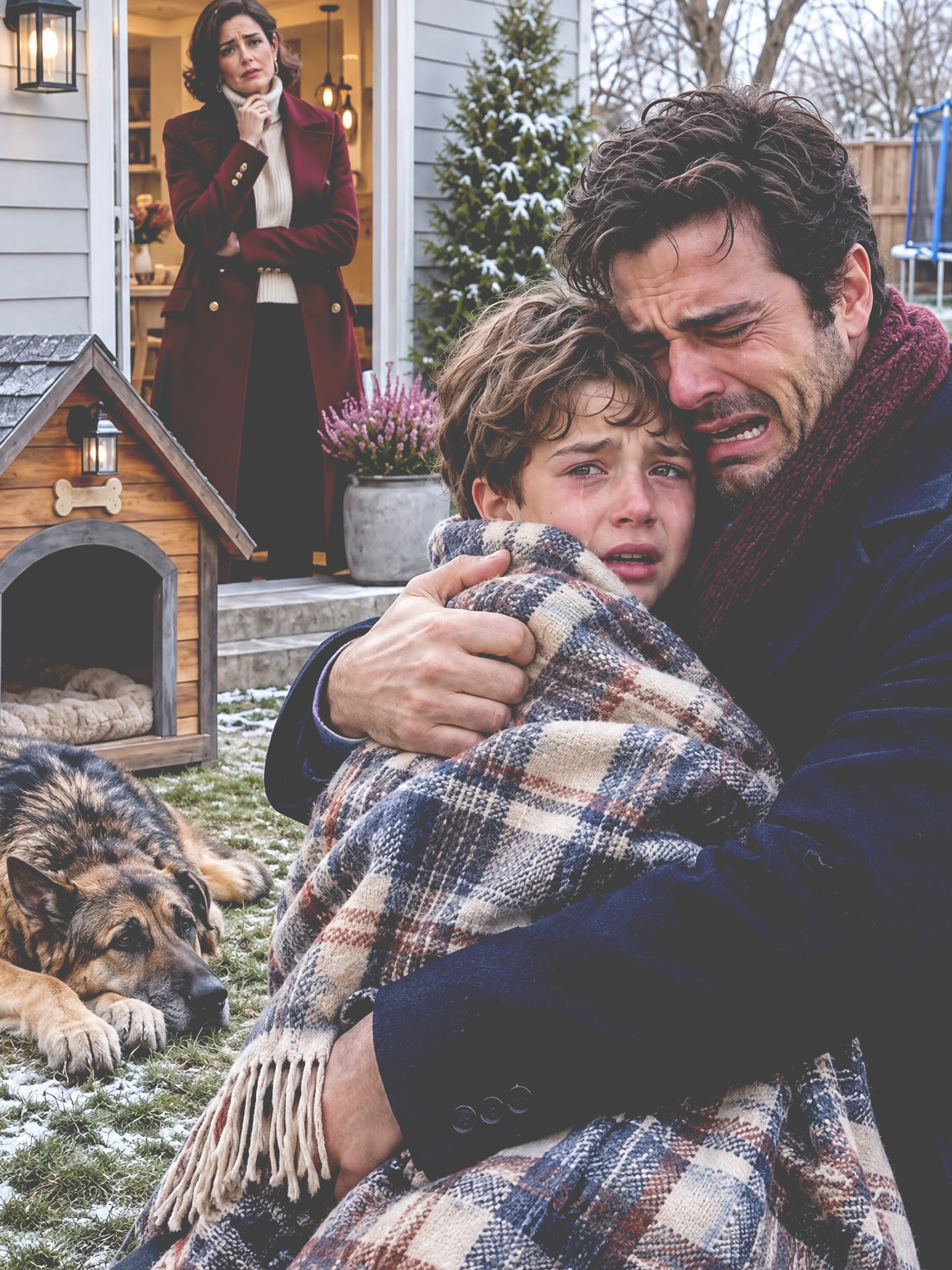
Part 1: I Came Home Six Days Early and Found My 8-Year-Old Son Sleeping in the Doghouse—Then I Checked the Security Camera: I returned from a trucking assignment six days ahead of schedule and found my eight-year-old son curled up inside our dog’s wooden shelter in freezing weather. When I confronted my wife, she barely looked concerned. “He wet the bed again,” she said. “If he can’t behave like a child, he can sleep where the dog sleeps.” My name is Julian Salcedo. I’m forty-two years old, and I drive refrigerated freight trucks across the United States. We live
outside Springfield, Missouri, where winter temperatures can drop well below freezing. For twenty-three days, I’d been hauling shipments across several states, believing the long hours were helping me provide a better life for my family. My son, Matthew, was only four when his mother, Elena, died of cancer. After losing her, he became especially attached to our aging German shepherd, Thunder. The dog had belonged to Elena long before we married and seemed to understand when Matthew needed comfort. Two years ago, I married Lorraine. At first, she treated
Matthew kindly. She bought him coloring books, prepared his favorite meals, and promised she would never try to replace his mother. I believed I’d found someone who would help us become a family again. That belief ended at 5:40 on a freezing morning in December. I parked my truck and entered through the side gate, hoping to surprise Matthew before school. I’d promised to take him fishing when I returned, and I couldn’t wait to tell him we finally had time. Then Thunder began barking from the backyard. His barking sounded desperate. I followed the noise toward the wooden doghouse beside our old oak tree. Thunder was lying across its entrance, his fur damp with frost. When he recognized me, he moved aside, revealing a small figure curled beneath an old blanket.
It was Matthew.
He wore thin pajamas and no socks. His hands were buried in Thunder’s fur, desperately seeking warmth.
“Matthew? Buddy, wake up.”
His eyes opened.
Before he recognized me, he flinched.
“I’m sorry, Daddy,” he whispered. “I tried to get to the bathroom.”
I lifted him into my arms.
His feet were freezing, and he trembled against my chest.
I carried him to the kitchen door and knocked until Lorraine appeared.
“Julian? You’re home early.”
“Why was Matthew sleeping outside?”
She sighed.
“He wet his sheets again. Three times this week. I’m tired of cleaning up after him.”
“He’s eight years old, Lorraine. It’s below freezing!”
“Then maybe he’ll finally learn.”
Matthew buried his face against my shoulder.
I wanted to scream, but my son needed warmth and medical attention more than another frightening argument.
I told Lorraine to move aside.
Inside, I carefully warmed Matthew, changed his clothes, wrapped him in blankets, and prepared oatmeal and hot chocolate.
Once his trembling eased, I arranged for a medical examination that morning.
Lorraine disappeared into our bedroom, slamming the door.
While Matthew rested, I remembered something.
Months earlier, after finding animal tracks near our backyard fence, I’d installed a motion-activated trail camera in the oak tree.
It faced Thunder’s doghouse.
Lorraine had never paid much attention to it.
I went outside, removed the memory card, and opened the files on my laptop.
The first photograph showed Matthew crossing the yard at night, carrying his little pillow.
Another showed him curling up beside Thunder.
In several images, the old dog lay across the entrance, shielding him from the wind.
I checked the timestamps.
The earliest photograph was dated twenty-two days earlier, just after I’d left for work.
There were images from twenty-two separate nights.
My son hadn’t been sent outside once.
He’d been sleeping there almost every night since I left.
Then I found a photograph showing Lorraine standing in the doorway, pointing toward the doghouse while Matthew held his pillow.
I stared at the screen, struggling to breathe.
Behind me, I heard small footsteps.
Matthew was standing in the hallway.
He looked at the photographs, then at me.
“Daddy, are you going to tell Lorraine you know?”
I knelt beside him.
“Why are you afraid of that, sweetheart?”
He gripped my wrist.
“She said if I told you, she’d send me to the same place Mommy went.”
His voice became barely audible.
“And next time, Thunder wouldn’t be allowed to come with me.”
Part 2: My Wife Made My 8-Year-Old Son Sleep Outside for 22 Nights—Then I Discovered Where His Money Had Gone
I was still staring at the security photographs when Matthew told me Lorraine had threatened to send him to the same place his mother had gone.
My eight-year-old son believed that telling me the truth might mean he would never come home again.
I knelt beside him and took his hands.
“Matthew, nobody is sending you away. You haven’t done anything wrong.”
He looked toward the bedroom door.
“Will Lorraine be mad?”
“You’re not going to be alone with her again. I promise.”
I called my mother, Rose, who lived twenty minutes away. When I explained what I’d found, she immediately drove over.
Then I took Matthew to the doctor.
The examination showed irritation on his feet and signs of prolonged exposure to cold, but fortunately, he didn’t require hospitalization.
The doctor asked when his bedwetting had started.
I couldn’t answer.
Matthew quietly explained that Lorraine sometimes locked the back door after sending him outside. Other nights, she made him leave as soon as she discovered his wet sheets.
Thunder always followed him.
The doctor recommended follow-up care and counseling to help Matthew recover from what he’d experienced.
By the time we returned, Mom was waiting.
Matthew ran into her arms.
She didn’t question him. She simply held him close while I collected the evidence.
I photographed the doghouse, preserved the original camera files, and made backup copies showing the dates and times.
Then I contacted Missouri’s child protection authorities and the sheriff’s office.
I explained that my wife had repeatedly forced my son to sleep outdoors in freezing weather and threatened him if he told me.
An investigator advised me to preserve everything and avoid repeatedly questioning Matthew myself.
I wanted answers, but I understood that my son shouldn’t have to relive those nights every time an adult asked what happened.
Lorraine began calling while we were away.
Her first message sounded almost friendly.
“Where are you? Is Matthew okay?”
The next messages were different.
“Don’t turn this into a big scandal.”
“Your son exaggerates everything.”
“You’re going to ruin this family over a little discipline.”
I saved every message.
That afternoon, I contacted Matthew’s teacher.
She told me he’d been falling asleep during lessons and had arrived at school with damp shoes more than once.
She’d sent several concerned messages to Lorraine, who was listed as his emergency contact while I was traveling.
Lorraine had claimed Matthew was dealing with allergies and that I already knew about the situation.
The teacher still had those messages.
I asked her to preserve them.
That evening, I began reviewing our household finances.
After Elena died, Matthew became eligible for survivor benefits based on her work record. Those payments were deposited into a separate account that I managed for his needs.
I’d given Lorraine access to pay for his clothing, school supplies, and medical expenses while I was away.
I trusted her to use that money for Matthew.
But the statements showed something I couldn’t explain.
Over the previous six months, six transfers of $600 each had gone to an account belonging to Lorraine’s sister, Nadia.
The descriptions included words like “therapy” and “school expenses.”
Matthew attended public school, and I hadn’t approved any private therapy sessions matching those payments.
A total of $3,600 had left his account.
I remembered Nadia buying a used ATV several months earlier. Lorraine had told me her sister’s boyfriend paid for it.
The dates didn’t prove the ATV was purchased with Matthew’s money, but they gave me another reason to question the transfers.
I contacted the bank, requested complete transaction records, and revoked Lorraine’s access to the account.
I also arranged to speak with an attorney before taking further action.
When I returned home to collect additional documents, Lorraine was sitting at my laptop.
One of the photographs from the trail camera was still displayed.
“So you’re reporting me for teaching him discipline?” she demanded.
“I’m reporting what happened to Matthew. And I want to know why his money was sent to Nadia.”
Her expression changed.
Then she lifted her phone and showed me a screenshot of an old text message.
It was from me.
“Do whatever you need to do to make him listen.”
I remembered sending it months earlier when Lorraine complained that Matthew wouldn’t finish his homework.
She smiled.
“You told me to handle him, Julian. If you accuse me of anything, I’ll show the police this message.”
I stared at the screen.
Lorraine leaned closer.
“And then we’ll see whether they believe you’re such a wonderful father.”
Part 3: My Wife Threatened to Blame Me for Abusing My Son—But She Had Deleted Part of My Message
Lorraine held up her phone, showing me the text message she’d saved.
“Do whatever you need to do to make him listen.”
I recognized those words immediately. Three months earlier, while unloading freight in Oklahoma, I’d sent them after Lorraine complained that Matthew refused to finish his homework.
But I also remembered what I’d written afterward.
I opened our conversation on my own phone and scrolled back to the same date.
Directly beneath that sentence was another message.
“No yelling or harsh punishments, please. I’ll talk to him when I get home.”
Lorraine had deliberately cropped it out.
“Show the investigators the entire conversation,” I told her. “I’ll give them my phone too.”
She lowered her hand.
“You’re really going to destroy our marriage over a child who doesn’t know how to behave?”
I stared at her.
For two years, I’d believed Lorraine loved Matthew. Now she spoke about my son as though he were an inconvenience she’d been forced to tolerate.
“Matthew isn’t coming back here while you’re staying in this house,” I said.
She laughed bitterly.
“And where will you be, Julian? Driving across the country while your mother raises him?”
I wanted to argue, but her question exposed something I’d been avoiding.
I’d spent twenty-three days on the road, sending money home and trusting a few cheerful photographs as proof that my son was happy.
I hadn’t noticed that his calls were becoming shorter or that Lorraine always had an excuse when he couldn’t speak to me.
“You’re right about one thing,” I said. “I’ve been away too much. That’s going to change.”
I contacted a family attorney that afternoon.
Our house had belonged to me before the marriage, but my attorney advised me not to force Lorraine out or attempt to settle property issues through an argument.
Instead, we began arranging a lawful separation and requesting appropriate protections for Matthew.
That night, my son and I stayed at Mom’s house.
Thunder came with us.
Matthew insisted that the old German shepherd sleep beside his bed. I brought the dog’s cushion into the room and watched my son settle beneath a warm blanket.
Before turning off the light, he looked at me.
“Daddy, if I wet the bed here, do I have to go outside?”
My chest tightened.
“No, buddy. Never. We’ll change the sheets, and you’ll go back to sleep.”
He nodded, but I could tell he wasn’t completely convinced.
The next morning, I reviewed the camera photographs again.
There were images from twenty-two separate nights, beginning shortly after I left for my trucking assignment.
Some showed Matthew entering the doghouse with his pillow. Others showed Thunder lying across the entrance while my son slept inside.
The photographs couldn’t establish exactly how many hours he remained outside each night.
But they documented a repeated pattern that no reasonable person could dismiss as a single punishment.
I provided the original files, medical records, and Lorraine’s messages to the investigators.
Matthew later spoke with a child protection professional trained to interview children without unnecessarily repeating distressing questions.
I waited outside.
When he finished, he asked for apple juice and sat quietly beside my mother.
I didn’t pressure him to tell me what he’d said.
His counselor explained that bedwetting could be associated with stress and recommended continued medical evaluation alongside emotional support.
At school, I met with Matthew’s teacher and reviewed the messages she’d previously sent Lorraine.
She’d repeatedly reported that Matthew appeared exhausted and sometimes arrived with wet shoes.
Lorraine had answered that we were following medical advice.
I asked the school to make me the primary contact and notify me directly about any concerns.
Meanwhile, my attorney helped document the six unexplained $600 transfers from Matthew’s survivor-benefit account.
The payments had gone to Nadia, Lorraine’s sister, under descriptions suggesting educational or therapeutic expenses.
We had no records supporting those descriptions.
Investigators were examining the financial transactions separately from the allegations involving Matthew.
I understood that the process could take months.
I didn’t expect an immediate arrest or a dramatic courtroom confession.
I wanted the evidence preserved and my son protected.
Several days later, Lorraine agreed to meet at my attorney’s office.
She arrived carrying a folder and the same cropped screenshot.
When she accused me of approving her punishments, I placed my phone on the table and displayed the complete conversation.
Then my attorney asked her to provide receipts for the supposed therapy sessions funded by Matthew’s account.
Lorraine looked down at her folder.
For the first time since I’d returned home, she had no prepared explanation.
And I realized that the financial records might reveal another part of what she’d been hiding while I was away.
Part 4: My Wife Used My Son’s Survivor Benefits to Help Her Sister—Then Tried to Blame Me for Everything
Lorraine sat across from me in my attorney’s office, staring at the bank statements spread across the table.
Six transfers. Six hundred dollars each. Every payment had come from the account holding Matthew’s survivor benefits, and every one had gone to her sister, Nadia.
My attorney pointed to the transaction descriptions.
“Can you provide receipts for the therapy and educational expenses listed here?”
Lorraine shifted in her chair.
“Nadia needed some financial help. I was going to put the money back.”
“That money belongs to Matthew,” I said.
“I know that, Julian.”
“Then why didn’t you ask me?”
She looked away.
“Because you would’ve said no.”
For several seconds, nobody spoke.
Lorraine finally admitted that Nadia had been struggling financially. She claimed the transfers were temporary loans and that she intended to repay them after I received my next work bonus.
But there had never been any agreement to lend Matthew’s money to her sister.
My attorney asked that any further explanation and supporting documents be provided in writing.
Then we returned to the photographs.
Lorraine insisted that making Matthew sleep outside was discipline, not mistreatment.
She repeated that I’d told her to do whatever was necessary to make him obey.
I showed the complete text conversation again.
“Yes, I wrote that first sentence,” I said. “I should’ve asked more questions. But I also told you not to use harsh punishments.”
She folded her arms.
“You weren’t here. I cooked for him, washed his clothes, took him to school. You have no idea how exhausting it was.”
I didn’t deny that caring for a child could be difficult.
But Matthew was eight years old, and he’d already lost his mother.
“If you couldn’t manage, you should’ve told me,” I replied. “You could’ve called my mother. You could’ve asked me to come home.”
Lorraine shook her head.
“You always choose him over me.”
I looked at the photographs lying between us.
“He’s my son. He needed someone to protect him.”
The meeting ended without an apology.
My attorney requested that future communication go through our legal representatives. We continued the divorce proceedings and pursued appropriate arrangements to prevent Lorraine from having unsupervised contact with Matthew while the authorities assessed his safety.
The investigation into his treatment remained open.
The financial records were being reviewed separately, and Lorraine eventually agreed through her attorney to begin repaying the $3,600 in installments.
That agreement didn’t erase what had happened.
At home, Matthew was still struggling.
Sometimes he woke when a door slammed. Other mornings, he hid his wet pajamas beneath the bed because he was afraid I’d be angry.
Whenever I found them, I sat beside him.
“Buddy, you don’t have to hide anything.”
“But I made a mess.”
“Then we’ll clean it together. That’s all.”
He would watch my face carefully, as though waiting for the punishment that never came.
His counselor reminded me that rebuilding trust would take time. Matthew needed predictable routines, patience, and repeated reassurance that he was safe.
I followed her advice.
But another problem remained.
My trucking assignments kept me away for weeks.
Even with Mom helping, I couldn’t promise Matthew that I’d be home every night if I continued working the same routes.