“Neglect?” Marcy stood up. “Because we didn’t know the name of a disease?” “Because she has metal and plastic inside her, Mrs. Thornfield. To a judge, that looks like a lack of supervision. You need to prove this is a medical history, not negligence. Do you have any proof? Videos? Photos?” They drove to Dalton’s mother’s house in silence. Beatrice Graves was 67, a retired schoolteacher with a steel spine and a memory like a trap. When they burst in at 4:00 AM, explaining the situation through tears, Beatrice didn’t panic. She walked to her back bedroom and returned with a dusty shoebox. “I told you,” she said softly, placing the box on the kitchen table. “Three years ago. At her birthday.” She pulled out a photo. Emory, aged 3, sitting in the garden. Her mouth was covered in dark soil. “I told you she was eating the dirt,” Beatrice said, looking at her son. “You said she was ‘exploring nature.’” She pulled out another photo. Emory at Christmas, chewing on a piece of shiny wrapping paper. “And here,” Beatrice opened a notebook. “I kept a log. Because I was worried. June 12th: Emory tried to eat the chalk while drawing. July 4th: Found Emory chewing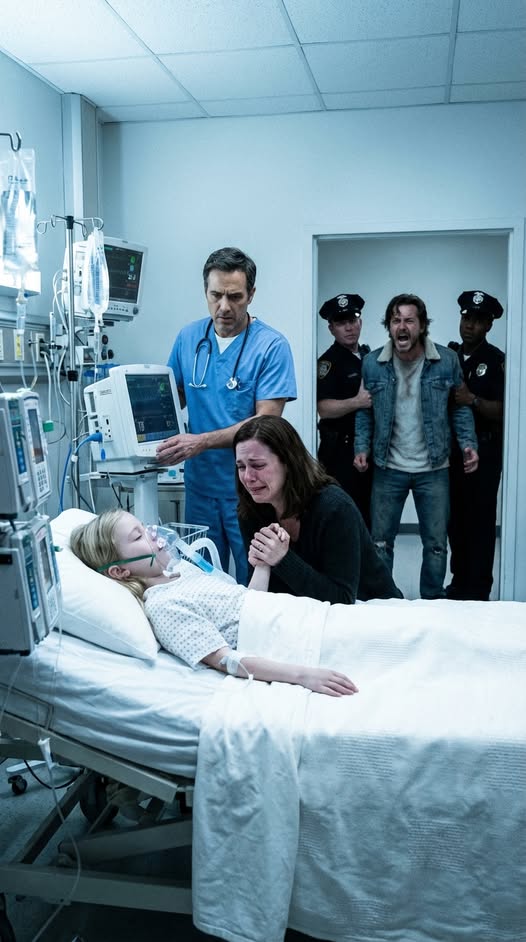
on the foam armrest of the sofa.“ Marcy stared at the notebook, the handwriting neat and precise. “Why didn’t you push us harder?” “I tried,” Beatrice said sadly. “But you two were going through the divorce. You were working two jobs. You were screaming at each other. You told me I was
being a ‘judgmental mother-in-law.’ So I stopped talking. And I just watched her when she was with me.”
Marcy felt like she had been slapped. She remembered that. She remembered telling Beatrice to back off.
“We can fix this,” Dalton said, grabbing the notebook. “This proves it’s a long-term condition. It proves it’s medical.”
“It proves we missed it,” Marcy whispered.
“It proves you are human,” Beatrice said firmly. “Now, drink this coffee. We have a court hearing in four hours.”
The courtroom was sterile and cold. Judge Vernon Hightower sat behind the bench, looking bored. On the other side of the aisle sat Iris Pendleton from Child Protective Services, looking smug.
“Your Honor,” Pendleton began. “The child was found with metal fragments, plastic, and dirt in her digestive tract. The parents admit to leaving her unsupervised for long periods. This is a clear case of negligence.”
Marcy gripped the edge of the table.
“We have a witness, Your Honor,” their public defender announced. “Dr. Helena Marsh, a specialist in pediatric feeding disorders, flying in from Atlanta at Dr. Kilpatrick’s request.”
The doors opened. A tall woman in a sharp suit walked in. Dr. Marsh didn’t look at the parents; she went straight to the stand.
“I have reviewed the medical records and the evidence provided by the grandmother,” Dr. Marsh stated. “Emory Graves is a classic, textbook case of Pica. The ‘marks’ on her fingers that the police identified as defensive wounds? Those are calluses from scratching at walls and furniture to get paint chips and plaster to eat.”
A murmur went through the courtroom.
“This is not abuse,” Dr. Marsh continued, her voice rising. “This is a metabolic and psychological disorder. The child is severely anemic. Her body is craving minerals, and her brain is misinterpreting those signals, telling her to eat dirt and metal to survive. Punishing these parents for missing a rare diagnosis is not justice. It is cruelty.”
Judge Hightower looked over his glasses at Marcy and Dalton. “Is this true? You didn’t know?”
“We didn’t know, Your Honor,” Marcy stood up, her voice trembling but clear. “I worked double shifts to pay for dance lessons. I thought I was doing everything right. I missed the signs because I was too busy trying to keep a roof over her head. I failed her, yes. But I didn’t hurt her.”
Dalton stood up too. “I thought she was just being a kid. We were blind. But we see now. We have the diagnosis. We have the treatment plan. Please, let us bring our daughter home.”
The judge looked at Iris Pendleton. “Does the state have any evidence of physical abuse? Hits? Burns?”
“No, Your Honor,” Pendleton admitted quietly.
“Then I am dismissing the petition for removal,” the gavel banged down, the sound echoing like a gunshot. “Custody remains with the parents, conditioned upon weekly medical supervision and therapy. Case closed.”
Walking out of the courthouse, the sun was blinding. Marcy felt lightheaded.
Detective Brennan was waiting at the bottom of the steps. She looked uncomfortable.
“Mrs. Thornfield. Mr. Graves.” She took a breath. “I… I went in hard. I saw the X-rays and I assumed the worst. I wanted to protect her.”
“You did your job,” Dalton said, extending a hand. “Thank you for caring enough to be angry.”
Brennan took his hand, surprised. “I’m writing a letter for the file. Exonerating both of you completely. Good luck.”
Three days later, Marcy stood on Beatrice’s porch. The door opened, and Emory walked out. She was pale, and she looked tired, but she was smiling.
“Mama!”
Marcy dropped to her knees on the concrete. Emory hit her chest with the force of a cannonball.
“I missed you, baby. I missed you so much.”
“I’m sorry, Mama,” Emory whispered into her hair. “I’m sorry I ate the bad things.”
“No,” Marcy pulled back, framing her daughter’s face with her hands. “You listen to me, Emory. You never apologize for being sick. Ever. We are going to fix your tummy. We are going to get you vitamins. And if you feel like eating something weird, you tell me. You scream it if you have to. Okay?”
“Okay.”
Dalton wrapped his arms around both of them. For the first time in three years, since the day the divorce papers were signed, they felt like a unit. Not broken. Just healing.
That night, back at Marcy’s apartment, things were different. Marcy had quit her second job. It would be tight—ramen noodles and thrift store clothes tight—but she would be home every afternoon. Dalton had moved into a complex three blocks away to co-parent properly.
They sat on the floor of Emory’s room, watching her play.
“We almost lost her,” Dalton said quietly.
“But we didn’t,” Marcy replied, watching Emory draw a picture. “We just had to learn to look closer.”
Emory held up the drawing. It wasn’t a masterpiece. It was a stick figure family holding hands under a giant, yellow sun. But what mattered was what was drawn on the table next to them: a plate of cookies. Real food.
Sometimes, the villains in our stories aren’t monsters or bad people. Sometimes, the villain is just silence. The things we don’t say, the signs we don’t see because we are too tired or too proud. But love? Real love is the willingness to open your eyes, admit you were wrong, and fight like hell to make it right.
If you want more stories like this, or if you’d like to share your thoughts about what you would have done in my situation, I’d love to hear from you. Your perspective helps these stories reach more people, so don’t be shy about commenting or sharing.