Marcy Thornfield’s hands weren’t just shaking; they were vibrating with a frequency that rattled her bones, making the simple act of gripping the steering wheel feel like wrestling a live wire. The high beams of her sedan sliced through the humid Georgia darkness, illuminating the tunnel of pines that lined the empty back roads. Her heart pounded against her ribs, a frantic, erratic drum solo that drowned out the hum of the engine. In the rearview mirror, the silhouette of 6-year-old Emory was a statue of despair. The passing streetlights cut across the back seat in rhythmic intervals, revealing a snapshot of misery every three seconds: pale cheeks, wide, unblinking eyes, and silent tears that flowed like oil. She hadn’t spoken a single word in over three hours. Not a whimper. Not a sigh. Just a terrifying, frozen silence. “Baby, please,” Marcy begged, her eyes darting between the winding road and the mirror. “Please, Emory. Just tell Mama what hurts. Is it your tummy? Your head?” Nothing. Just those quiet tears and that frozen, frightened expression that looked so alien on her usually vibrant face. It had started the moment Emory walked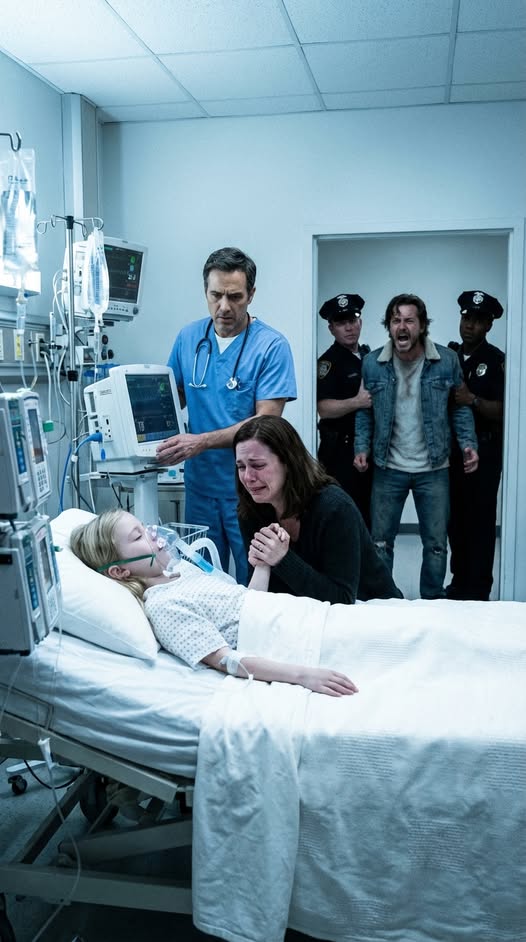
through the door after her weekend visit with her father. Usually, the transition was loud—a tornado of backpacks, half-eaten snacks, and stories about what movies they watched. But today, Emory had walked in moving sideways, like a crab, protecting her midsection. When Marcy knelt to hug her, Emory had flinched.
Actually flinched. Away from her own mother.
At first, Marcy thought it was exhaustion. The weekends with Dalton could be chaotic; he was the “fun dad,” the one who forgot bedtimes and balanced diets. So, Marcy had gone into autopilot: favorite dinner (untouched), warm bath (disaster).
That was the breaking point.
“Come on, sweetie. Bath time,” Marcy had said, reaching out to help lift Emory’s shirt.
The sound that erupted from the little girl wasn’t a scream. It was a guttural, strangled gasp of pure distress, as if her entire body was a raw nerve. Marcy had recoiled, her hands hovering in the air. “What is it? What hurts?”
Emory had just shaken her head, sobbing silently, refusing to sit on the edge of the tub. She stood rigid, her small hands clenched into fists at her sides.
That was when the panic, cold and sharp, pierced through Marcy’s exhaustion. She had been working double shifts at the Meadowbrook Nursing Home all week, functioning on caffeine and willpower. But seeing her daughter in this inexplicable state of agony cut through the fog instantly.
Now, racing toward County General, Marcy’s mind was a kaleidoscope of worst-case scenarios. Did she fall? Did Dalton’s new girlfriend do something? Did she eat something poisonous?
She tried calling Dalton again. The phone rang—once, twice, three times—before clicking to voicemail.
“Come on, Dalton. Pick up, dammit,” she hissed, hitting redial.
In the back seat, Emory made a small, high-pitched whimpering sound. It was the first noise she’d made in hours.
“We’re almost there, baby,” Marcy promised, pressing the accelerator until the speedometer crept past eighty. “Mama’s going to make sure you’re okay. I promise.”
The emergency room lights hit them like a physical blow—harsh, fluorescent, and unforgiving. Marcy screeched to a halt in the ambulance bay, ignoring the “Authorized Vehicles Only” sign. She threw the door open and scrambled to the back seat.
“Okay, sweetie. I need to carry you inside. Can you put your arms around my neck?”
But as Marcy reached in, Emory’s eyes rolled back. Her small body went bonelessly limp, sliding sideways against the car door.
“No. No, no, no! Help! Somebody help me!”
Marcy scooped her daughter up, ignoring the strain in her back, and sprinted toward the automatic doors. She burst into the lobby like a wild animal, her hair wild, her chest heaving.
“My daughter! She won’t wake up! Please!”
The reaction was instant. A nurse behind the triage desk vaulted over the counter. A code alarm began to chime—a rhythmic, terrifying bong, bong, bong. A team of scrubs descended upon them, lifting Emory from Marcy’s trembling arms onto a gurney.
“What happened?” a male doctor barked, shining a penlight into Emory’s unresponsive eyes.
“I don’t know!” Marcy sobbed, stumbling alongside the gurney as they rushed down the hall. “She came home from her dad’s and she couldn’t sit down and she wouldn’t talk. And I tried to call him but he won’t answer. And now she just… she just collapsed!”
“Ma’am, you need to stay here,” a nurse said firmly, planting herself between Marcy and the double doors.
“That’s my baby!”
“And we are going to save her. But you need to let us work. Come with me. We need admission forms.”
Marcy watched the doors swing shut, swallowing her daughter into the belly of the hospital. The silence that followed was louder than the sirens.
The waiting room smelled of stale coffee and industrial disinfectant—the scent of bad news. Marcy sat in a plastic chair, her leg bouncing like a piston.
Ten minutes later, the doctor emerged. He was an older man, Dr. Raymond Fischer, with gray hair and eyes that looked like they had seen too much darkness. He didn’t look comforting. He looked suspicious.
“Mrs. Thornfield?”
“It’s just Marcy. Is she okay? Can I see her?”
“She is stable,” Dr. Fischer said, his voice devoid of warmth. “We have administered a sedative and pain management. She is resting. But before I allow you to see her, I need to ask you some questions.”
He sat down opposite her, opening a notebook. “You said she was with her father this weekend. Did she have any injuries when you dropped her off?”
“No. She was perfect.”
“And when you picked her up?”
“I… I picked her up at 4:00. She was quiet. Withdrawn. She walked funny.”
Dr. Fischer scribbled something down. “Did you notice any bruising? Any marks on her body?”
“She wouldn’t let me touch her. That’s why I brought her here.” Marcy felt a cold dread coiling in her stomach. “Why are you asking me like this? What did you find?”
Dr. Fischer closed the notebook. “We took X-rays, Ms. Thornfield. What we found inside your daughter’s stomach and intestines… it is not consistent with an accident. It is consistent with repeated trauma or ingestion of foreign objects.”
“Foreign objects? Like… she swallowed a toy?”
“We found metal, Ms. Thornfield. Plastic. Dense matter.” He paused, his eyes narrowing. “I have contacted the authorities.”
The world tilted on its axis. “Authorities? You mean the police?”
“Protocol requires it when a child presents with these kinds of internal injuries. Excuse me.”
He stood up and walked away, leaving Marcy gasping for air in the center of the waiting room.
Twenty minutes later, the police arrived.
Detective Sarah Brennan was a woman carved from granite—sharp features, a tight bun, and eyes that scanned Marcy like she was a criminal suspect. She was accompanied by a younger officer, Kelsey Wright, who looked sympathetic but followed Brennan’s lead.
They ushered Marcy into a small, windowless consultation room.
“We need to know about the father,” Brennan started, skipping the pleasantries. “Dalton Graves. Does he have a history of violence?”
“No,” Marcy said, her voice shaking. “He’s irresponsible. He’s messy. But he loves Emory. He would never hurt her.”
“Someone hurt her, Ms. Thornfield,” Brennan said coldly. “We have X-rays showing jagged objects in her digestive tract. We have marks on her fingers. We have a child who was terrified to speak.”
“Marks on her fingers?” Marcy whispered. “What marks?”
“Defensive wounds? Or perhaps self-inflicted from stress? We don’t know yet.” Brennan leaned forward. “We finally got ahold of Mr. Graves. We have units bringing him in for questioning right now.”
“You arrested him?”
“We detained him. There’s a difference.”
Marcy felt sick. “Can I see my daughter? Please. I need to see her.”
Officer Wright glanced at Brennan, who gave a curt nod. “Briefly. Do not touch her. Do not wake her.”
Walking down the hallway felt like walking underwater. When they reached the room, Marcy pressed her hand against the glass. Emory looked so small in the hospital bed, tubes running into her arm, a monitor beeping steadily beside her.
“What are those?” Marcy pointed to Emory’s hand resting on the sheet.
The fingertips were red, raw, and covered in tiny, callus-like abrasions.
“We believe those are from scratching,” Officer Wright said softly. “Or digging.”
“Digging?” Marcy turned to them. “Digging where?”
“We don’t know yet.”
It was 2:00 AM when Dalton was released. Marcy was waiting in the parking lot, sitting on the hood of her car, staring at the hospital lights.
He looked wrecked. His shirt was untucked, his eyes red-rimmed and wild. When he saw her, he didn’t yell. He just collapsed onto the pavement beside her car.
“They think I fed her glass, Marcy,” he choked out. “They asked me if I forced her to eat garbage. They asked if I lock her in closets.”
“Did you?” Marcy asked quietly. She hated herself for asking, but the seed of doubt Dr. Fischer had planted was blooming.
Dalton looked up, tears streaming down his face. “You know me. I’m a screw-up. I forget to sign permission slips. I feed her pizza three nights in a row. But I love that girl more than my own life. I swear to you, Marcy. We watched movies. We played video games. She was happy.”
He pulled out his phone. “Look. Sunday morning.”
He played a video. Emory was sitting at Dalton’s kitchen table, laughing at a joke, eating pancakes. She looked fine. Happy. Normal.
“Then what happened?” Marcy whispered. “Between Sunday noon and when I picked her up?”
“Nothing! She took a nap. I cleaned up the apartment. That’s it.”
Marcy’s phone buzzed. It was a number she didn’t recognize.
“Mrs. Thornfield? This is Dr. Nora Kilpatrick. I’m a pediatric specialist at the hospital. I’ve just come on shift and reviewed Emory’s case.”
“Is she okay?”
“She’s stable. But I need you and Mr. Graves to come back up here. I think the police and Dr. Fischer are looking at this the wrong way.”
Dr. Kilpatrick was younger than Fischer, with a messy ponytail and kind eyes. She met them in the hallway, holding a clear plastic bag.
“I found this under Emory’s bed just now,” she said.
Inside the bag were a paperclip, a plastic button from a hospital gown, and a small piece of dried foam from the pillow.
“She was trying to eat them,” Dr. Kilpatrick said softly. “The night nurse caught her. Emory wasn’t trying to hurt herself, Marcy. She told the nurse they looked ‘tasty.’”
Marcy frowned. “Tasty? A button?”
Dr. Kilpatrick led them into a conference room. “I need you to be honest with me. Does Emory eat things that aren’t food? Dirt? Chalk? Paper?”
Marcy and Dalton looked at each other.
“She… she chews on her pencils,” Dalton said. “I thought it was just a nervous habit.”
“And the eraser,” Marcy whispered, a memory surfacing from months ago. “I found her chewing a pink eraser. She had swallowed half of it. I yelled at her, told her it was gross.”
“And last summer,” Dalton interrupted, his eyes widening. “At the park. I thought she was looking for bugs, but she had a mouthful of pebbles. I had to fish them out with my finger.”
Dr. Kilpatrick nodded grimly. “And did you ever mention this to a pediatrician?”
“No,” Marcy said, shame flooding her face. “We thought it was just… weird kid stuff. We didn’t know.”
“It’s called Pica,” Dr. Kilpatrick said. “It’s a compulsion to eat non-food items. It’s often caused by severe iron or zinc deficiency, or sometimes stress. It’s a medical condition, not abuse. But because she’s been doing it in secret, and because the objects accumulated, it caused a blockage. That’s the pain. That’s the distress.”
“So no one hurt her?” Dalton asked, his voice cracking.
“No one beat her,” Dr. Kilpatrick said. “But Child Protective Services is already involved because of Dr. Fischer’s report. They are filing for emergency custody. They think this is neglect.”