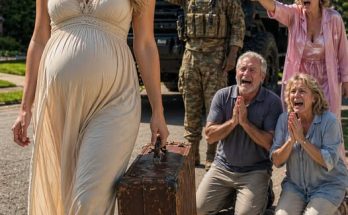
My father snatched the pages from her, his jaw dropping. “This is insane, Claire!” “No,” I corrected. “It is paperwork.” And then, from the hallway behind me, a fragile, small voice broke the silence. “Grandma?” Every muscle in my body seized. I spun around. Emma stood barefoot in the doorway, clutching her quilt, fever-pale but fully awake. My mother’s mask of the doting grandmother instantly slammed back into place. “Oh, sweetheart!” she cooed artificially. “Mommy’s just upset over a silly misunderstanding.” Emma’s wide, exhausted eyes moved from my mother to me, and back again. Then, she asked the question that split the entire scene wide open. “Grandma… why did you tell Grandpa that there was only room in the car for people who actually matter?” Natalie called me screaming so loudly the phone speaker distorted. “Do you have any idea what this legal paper is doing to Mom?!” she shouted. I stood in my office, staring at the city skyline. “Do you have any idea what your mother did to Emma?” “She was trying to make peace! She brought an Easter bunny!” “She lied to school security to gain unauthorized access to my child,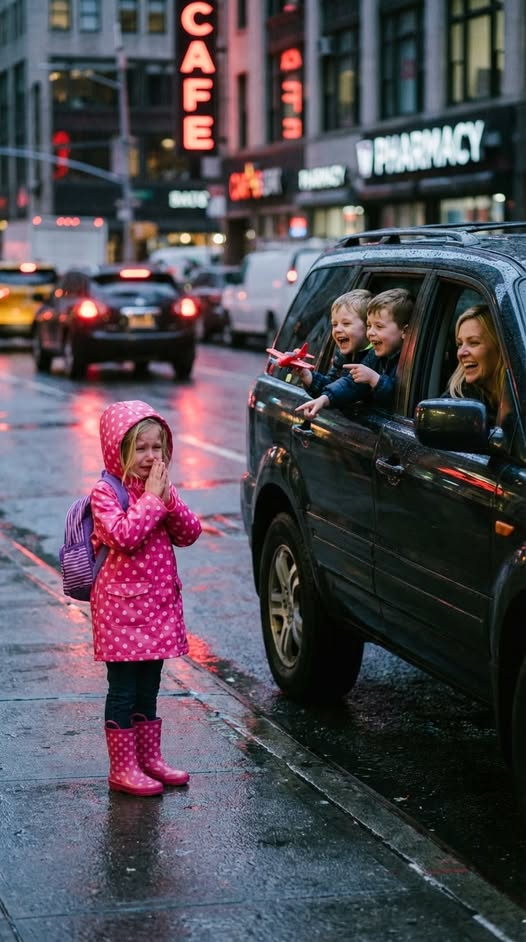
Natalie.” “Oh my God, listen to yourself! You act like they tried to kidnap her!” “No,” I said coldly. “I act like a mother who knows exactly when to stop pretending a situation isn’t dangerous just because the threat shares my DNA.” Natalie’s breath crackled hot over the line. “You always thought you were better than us.”
That almost made me smile. Not because it was true, but because it was the ultimate family anthem. Any boundary I set was called arrogance. Any refusal was called judgment. As long as I kept giving them money, they called me generous. The exact second I asked for basic respect, I became a monster.
“You should worry less about whether I feel better than you,” I said softly, “and worry more about why you were willing to let your mother use a six-year-old child to pressure me into paying your mortgage.”
Silence.
Then Natalie said, smaller, uglier, “I didn’t ask her to do that.”
I believed her. And that was almost the worst part. This hadn’t been a coordinated scheme. My mother had done it entirely on her own, out of the deep, twisted certainty that my resources were family property, and my child was acceptable collateral in her emotional negotiations.
“That doesn’t fix anything,” I said, and ended the call forever.
The restraining order was granted. My parents hired a lawyer for one indignant week, then quickly discovered that legal fees hit very differently when your wealthy daughter is no longer underwriting your bank accounts. My father was forced to find part-time work at a hardware store thirty minutes away. My mother moved with him into a cramped, modest apartment in a neighboring town, after living in Natalie’s chaotic guest room proved intolerable within six days.
The townhouse sold in eleven days.
I expected to feel triumph when the final escrow papers went through. Instead, what I felt was profound grief. Not the kind that begged me to undo my actions. The kind that arrives when an illusion is finally too broken to ever wear again.
Emma started play-therapy in early fall.
At first, she barely spoke in the office. By the fourth week, she told the therapist that sometimes her belly hurt when the school bell rang because she worried the “wrong car” might be waiting. By the sixth week, she asked whether “people can be your grandma and still not be safe.”
The therapist later repeated that line to me with the careful, empathetic face of someone who spends her entire career holding the quietest forms of heartbreak. I answered Emma the only way I could.
“Yes, baby,” I said, holding her hands. “Someone can love you in a way that still isn’t safe enough for you.”
She thought about that for a long time. Then she nodded, looking like a person much, much older than six.
Winter came in hard that year. My routines changed completely. I hired Mrs. Donnelly to pick Emma up on Tuesdays for an after-school art club. On Thursdays, a trusted teacher’s aide watched her. The structure was messier than the old one, and more expensive in some ways. But it was infinitely safer because it rested on chosen reliability instead of inherited entitlement.
In January, my father sent a letter.
Not an email. A real paper letter in his uneven block handwriting. He said he was sorry. Not just for that day, but for “failing to stop what should never have happened.” He admitted he had spent his life confusing peace with passivity. He asked for nothing except the chance, someday, to apologize to Emma if I thought it would help her.
I cried when I read it. Because it was late. Because it was incomplete. But truth, even partial truth, still has a pulse. It didn’t fix the damage, but it acknowledged the grave.
My mother, by contrast, sent a card to Emma with fifty dollars tucked inside and the message: Grandmothers always love you no matter what.
I mailed it back unopened. Return to sender.
By spring, the gossip had quieted. Emma’s therapist suggested letting her choose who counted as “family” for a school project.
When the construction-paper tree came home, it had me at the center, Emma beside me, and then branches full of names written in shaky six-year-old print. Mrs. Donnelly. Mrs. Alvarez. Aunt Tessa from Seattle. Even Mr. Ruiz, the crossing guard. There were no grandparents on the page.
I stared at it at the kitchen table. “Is this okay?” Emma asked nervously.
It was the healthiest family map anyone in my bloodline had made in generations. “It’s more than okay,” I said, kissing her cheek. “It’s true.”
The one-year mark of the storm arrived in silence. It was Easter weekend again.
No dramatic anniversary dinner. Just rain tapping heavily at our windows while I packed Emma’s lunch, and she sat on the floor doing a puzzle. The sound of the weather made my chest tighten for one second. Trauma likes repetition.
Emma looked up. “It’s raining like that day.”
“Yes,” I said softly, pausing my hands.
She considered the puzzle piece in her hand. “I don’t like that day.”
“I know.”
Then she tilted her head in that wise, unnerving way children do when they’ve grown around a wound beautifully. “But I like the after,” she said.
I sat down on the rug beside her. “The after?”
She nodded confidently. “After you came. After Mrs. Donnelly. After the school changed the list. After hot chocolate. After everybody who is safe was still here.”
I looked at my brilliant daughter, at the puzzle half-finished between us, at the rain needling the dark glass outside, and felt something inside me finally settle all the way to the ground.
Not forgiveness. Not triumph. Something infinitely better. The clean, absolute knowledge that protecting her had cost exactly what it should have cost, and not a single dollar less.
So I helped her fit the corner piece into place. And when the storm outside kept going, we just let it.