I have spent thirty-five years sitting on the bench of the family court, presiding over the wreckage of broken homes and the slow, agonizing dissolution of love. I thought I had seen every shade of human cruelty, every selfish rationalization a parent could invent to justify their own failures. But nothing in my decades of jurisprudence prepared me for the moment my phone lit up my nightstand at 2:04 AM. I am sixty-five years old. At my age, sleep is a hard-won negotiation with a body that aches when it rains. I had finally drifted into a heavy, dreamless state when the harsh vibration rattled the wood of my bedside table. I squinted at the glowing screen. Maya. Not my son, Julian. Not his wife, Catherine. My eight-year-old adopted granddaughter. I answered before the second ring, my voice thick with sleep. “Maya? Sweetheart, what’s wrong?” The sound that came through the speaker was not the quiet, hesitant voice I was used to. It was a raspy, labored wheeze, punctuated by the dry, hacking cough of a child whose lungs were fighting for every millimeter of oxygen. “Grandpa…” she whispered. The word sounded like it was being dragged over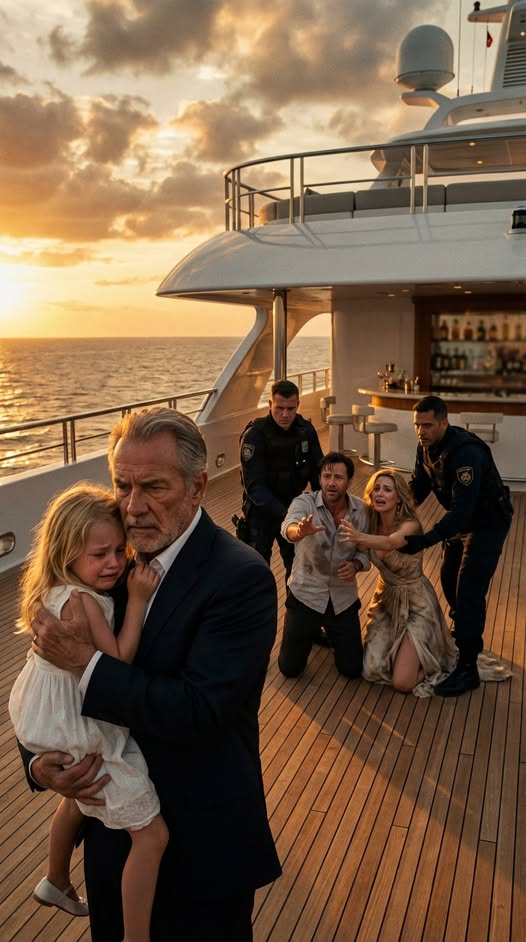
broken glass. “I’m hot. I’m so hot.” A cold dread coiled in my gut, instantly banishing the last remnants of sleep. I sat bolt upright, throwing the heavy duvet aside. “I’m right here, Maya. Did you wake up your parents? Where is Julian?”
A long silence followed, filled only by the terrifying, rhythmic rasp of her breathing.
“They went on the big boat,” she finally croaked, her words slurring together in a way that made the hairs on my arms stand up. “For Leo’s birthday. Mama said… she said I had to stay because I’m ‘too much’ when I’m sick.”
Two words. Big boat.
My mind refused to assemble them into anything sensible. “Are you alone in the house?”
“Mama left a note,” Maya murmured, her voice drifting into a terrifyingly distant daze. “She said don’t be dramatic. Just sleep. But the room is spinning, Grandpa. The walls are melting. I can’t reach the water.”
I didn’t waste breath on outrage. Outrage is a luxury for the helpless, and I was not helpless. I wedged the phone between my shoulder and my ear, pulling on a pair of jeans and a flannel shirt with hands that suddenly felt slick with sweat.
“Maya, listen to me,” I commanded, using the deep, resonant voice I used to quiet panicked courtrooms. “Do not move from your bed. I am coming right now. I am staying on the line with you.”
I grabbed my keys and my wallet. I called my neighbor, Thomas, from the car’s Bluetooth as I tore out of my driveway in Decatur. I told him the spare key was under the mat, to feed my dog, and to pray I didn’t commit a felony before dawn.
The drive to their pristine, upper-middle-class subdivision in Marietta was a seventy-minute journey that I made in forty-five. I pushed my sedan to ninety miles an hour, the dark Georgia pines blurring into a solid wall of black outside my windows. Through the car speakers, I listened to Maya’s breathing grow shallower, her whispers becoming increasingly disjointed.
“I’ll be good,” she hallucinated, crying softly into the receiver. “I’ll be good, Mama. I won’t be sick anymore. Please don’t leave me. I’ll be quiet.”
“I’m coming, sweetheart,” I kept repeating, my knuckles white on the steering wheel. “Grandpa is almost there.”
I swung into the manicured entrance of Highland Estates, my tires screeching in the suffocating summer humidity. I pulled up to their two-story brick colonial. The house was entirely dark, save for the faint glow of a porch light that illuminated the absolute stillness of a home abandoned by its guardians.
I killed the engine and grabbed the spare key Julian had given me years ago. I jammed it into the lock, throwing my weight against the heavy oak door. As I stepped into the foyer, the oppressive, stifling heat of the house hit me like a physical blow, and the silence from my phone told me Maya had stopped answering.
The air inside the house was sweltering, heavy, and dead. They had turned off the central air conditioning to save a few dollars while they vacationed in luxury. I stumbled through the dark, slapping the wall until I found the light switch.
The sudden illumination revealed a living room curated to project the illusion of a perfect family. But my eyes, trained by years of dissecting domestic facades, immediately locked onto the hallway gallery wall. There were fifteen framed photographs perfectly aligned. Thirteen were of Leo, their eleven-year-old biological son—Leo at soccer, Leo at space camp, Leo standing between Julian and Catherine in front of the Cinderella Castle.
Maya appeared in exactly two. In one, she was placed at the far edge of the frame, half a step behind the others. In the second, the lighting obscured her face entirely. She looked like a temporary visitor in her own life.
I rushed toward the kitchen to grab water and stopped dead in my tracks. On the pristine granite island sat a twenty-dollar bill, a bottle of generic children’s fever reducer, and a piece of customized stationery.
I snatched the note.
Maya, stop being dramatic. I put the medicine right here. If you get hot, take it and go to sleep. We are taking Leo on his Dream Cruise because he earned a distraction-free trip. Do not bother Mrs. Gable next door unless the house is literally on fire. Don’t ruin this week for your brother.
On the floor beneath the stool lay a digital thermometer. I picked it up and pressed the recall button. The tiny screen flashed a neon red number: 103.5°F.
They had taken her temperature. They had seen that she was dangerously ill. And then, they had packed their Louis Vuitton luggage, locked the door, and driven to the airport.
“Maya!” I roared, dropping the thermometer and sprinting up the carpeted stairs.
I threw open the door to her bedroom. The heat in this small, upper-floor room was suffocating. Maya was curled into a tight, trembling ball on top of a thin comforter. Her skin was a terrifying, translucent shade of crimson, her curls plastered to her forehead with dried sweat.
“Maya, it’s Grandpa. Look at me,” I pleaded, falling to my knees beside her bed.
I touched her cheek, and my hand recoiled instinctively. She was radiating heat like a furnace. Her eyes fluttered open, but they were milky and unfocused, rolling back slightly. She was trapped deep in the labyrinth of a fever dream.
“I won’t cough,” she mumbled, her small hands clutching the edge of my flannel shirt. “I’m sorry I ruined the trip. I’ll stay in the dark. I promise.”
My chest contracted so violently I thought my ribs would snap. The stories children tell themselves to rationalize their own abuse would break your faith in humanity if you let them. She genuinely believed her illness was a moral failure that justified her abandonment.
I didn’t bother packing a bag. I ran to the adjacent bathroom, soaked a hand towel in cold water, and wrapped it around her burning neck. I scooped her up. She weighed practically nothing, a fragile collection of bones and unimaginable grief.
I carried her down the stairs, kicking the front door shut behind me. The neighbor’s curtain twitched across the street. Someone was watching, a silent suburban spectator who had likely been told not to intervene. I didn’t care. My only objective was keeping the child in my arms tethered to the living.
I laid her gently in the backseat of my sedan, but as I buckled the seatbelt, Maya’s body suddenly went rigid. Her jaw locked, her back arched unnaturally, and her eyes rolled completely white. She was having a febrile seizure, right there in the dark driveway, and the nearest hospital was still twelve agonizing miles away.
I have never driven with such reckless, calculated desperation. The journey to the North Georgia Medical Center was a blur of running red lights and leaning on the horn, my eyes darting between the road and the rearview mirror where Maya was convulsing violently.
I slammed the car into park at the emergency bay, kicking the door open and carrying her into the harsh fluorescent light of the ER. “I need help!” I bellowed, my voice echoing off the linoleum. “She’s seizing! She’s burning up!”
Nurses descended upon us like a synchronized strike team. They took her from my arms, rushing her onto a gurney and disappearing behind a set of double doors.
I collapsed into a hard plastic chair in the waiting room, my hands trembling violently. I looked down at my palms. They were slick with my granddaughter’s sweat. For the first time in thirty years, I closed my eyes and prayed to a God I wasn’t entirely sure I believed in anymore.
An hour passed. Then two. The waiting room smelled of antiseptic and stale coffee, a sterile purgatory. Finally, a doctor in blue scrubs approached me, his face a mask of exhausted, professional fury.
“Mr. Collins?” Dr. Aris asked. “I’m the attending physician.”
“How is she?”
“She’s stabilized,” he said, rubbing the bridge of his nose. “We pushed IV fluids and administered antipyretics to break the fever. When she arrived, her core temperature was 104.2°F. She was severely dehydrated. Another hour or two in that hot house, and we would have been looking at permanent neurological damage, or worse.”
He paused, looking at me with a hard, uncompromising stare. “Where are her parents? The paperwork says you’re her grandfather. I have a legal obligation to report a child brought in under these circumstances with no primary guardian.”
“Report them,” I said, my voice vibrating with a lethal, icy calm. “Report them for felony endangerment. Because her parents are currently on a luxury cruise in the Caribbean.”
Dr. Aris’s jaw tightened. “I’ll have the social worker draft the documentation immediately.”
I walked into Maya’s recovery room. She looked so incredibly small in the hospital bed, connected to a labyrinth of tubes and monitors. When she heard my footsteps, she turned her head. The milky haze was gone from her eyes, replaced by a profound, heartbreaking exhaustion.
She reached out a tiny hand. I took it, sitting on the edge of the mattress.
“Did Mama call?” she whispered, her voice hoarse. “Is she mad that I’m at the doctor? It costs a lot of money.”
I leaned down, pressing my forehead against hers. “She hasn’t called, Maya. And she has no right to be mad. You did nothing wrong. You are safe now.”
While she slept, the grandfather retreated, and the judge took over. I pulled out my phone and called Marcus, a former colleague and the sharpest, most ruthless family lawyer in Atlanta. I sent him photos of the note, the thermometer, and the ER intake forms.
Then, I did a deep dive into Catherine’s public Instagram account. There it was. Posted just twelve hours ago. A photograph of Julian, Catherine, and Leo on the teak deck of the Gilded Seas, holding tropical drinks.
The caption read: “Just the three of us for a distraction-free week. Premium concierge level is worth every penny! Sometimes you just have to prioritize the peace.”
I forwarded the screenshot to Marcus. “File the emergency custody petition by sunrise,” I instructed. “I want full temporary placement. And I don’t want them to know until they step foot on dry land.”
My phone vibrated in my hand. It was a text message from Julian. “Hey Dad, Mrs. Gable texted me that your car was in the driveway. Please don’t overreact. Maya only had a slight fever. Just give her the medicine and let her sleep. We spent $20k on this trip for Leo and I’m not letting her dramatic tendencies ruin it. We’ll be back Sunday afternoon.” I stared at the screen, the absolute audacity of the message turning my blood to ice. I didn’t reply. I just forwarded it to my lawyer. The trap was set.
Sunday arrived with the heavy, humid promise of a summer storm. I did not take Maya back to that suburban prison. I kept her at my house in Decatur, watched over by my neighbor Thomas, who treated her to endless cartoons and homemade soup.
I, however, drove back to Marietta. I parked in Julian’s driveway, unlocked the front door, and sat in the center of their perfectly curated living room. On the coffee table in front of me sat a neat stack of documents: the emergency custody order signed by a superior court judge, the hospital intake records, the pharmacy bills, and a printed copy of the Gilded Seas premium cruise brochure.
At 4:15 PM, a luxury town car pulled up to the curb.
I watched through the sheer curtains as Julian, Catherine, and Leo emerged. They were sun-kissed, laughing, and hauling expensive, duty-free shopping bags. Leo was wearing a plush captain’s hat. They looked like the quintessential American dream—glossy, successful, and entirely morally bankrupt.
The front door opened. Julian walked in, dropping his keys on the console table. “Maya? We brought you a t-shirt!” he called out, the performative cheerfulness grating against my eardrums.
Then, he saw me sitting in the armchair. He froze.
“Dad? What are you doing here in the dark? Where’s Maya?”
Catherine stepped in behind him, her smile instantly evaporating into a scowl of irritation. “Steven. I told you not to make a big deal out of this. She just had a bug. You always coddle her.”
I stood up slowly. I didn’t yell. A man holding all the cards never needs to raise his voice.
“Sit down,” I commanded. It wasn’t a request; it was a directive from the bench.
Julian, sensing the shift in the atmospheric pressure of the room, slowly lowered himself onto the edge of the sofa. Catherine remained standing, crossing her arms defensively.
“I am not playing games, Steven. We’ve been traveling all day,” Catherine snapped. “Where is my daughter?”