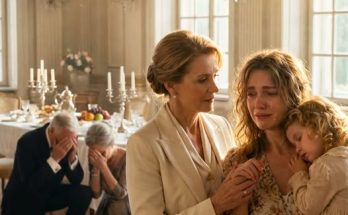
Chapter 7: The Last Gasp of the Performance: They showed up on a Tuesday. No warning, no message, just the sound of a rental car—a far cry from my father’s beloved luxury sedan—crunching up the gravel driveway of Claudia’s estate. I was in the garden with Sylvie, watching her color a very large, very vibrant sun on a piece of sketchpad paper Claudia had given her. I saw them through the iron gates: my mother, looking smaller than I remembered, and my father, his face a mask of stiff, performative humility. Claudia walked out onto the veranda. She didn’t invite them in. She didn’t even step down to the driveway. She stood at the top of the stairs, her arms folded. “We came to talk to Lyanna,” my mother called out, her voice wavering in a way that was perfectly timed for maximum sympathy. “We just want to understand how things went so wrong. We’re family, Claudia. Family doesn’t do this to each other.” I stood up from the grass, my palms slick with sweat. I walked to the edge of the veranda, staying behind Claudia’s shoulder. “You want to understand?” I asked, my voice steady despite the cold dread in my gut. “You want to understand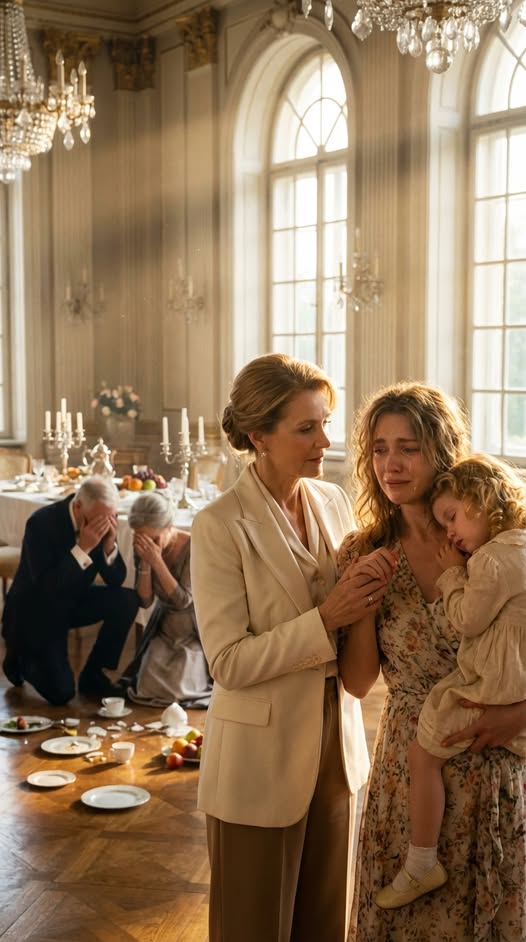
why I won’t let you near my daughter again?” “Lyanna, please,” my father said, his voice cracking on cue. “We were stressed. We didn’t realize it was so serious. We were just trying to maintain some order for your aunt. We did it for her.”
“Don’t use me as a shield for your cowardice, Arthur,” Claudia snapped. “You didn’t do it for me. You did it because you view other people as props in your own movie. And when the props start to bleed or gasp for air, they ruin your shot. That’s not stress. That’s a lack of humanity.”
“We’ll change,” my mother sobbed, reaching through the gate. “We’ll go to counseling. Just… tell the trust officers to stop the sale. We have nowhere to go, Lyanna. Think of your childhood home.”
I looked at the two of them. I remembered the Christmas Eves where I was told to stay in my room because my “energy” was too high. I remembered the time I came home from the hospital after my own surgery and was told to “handle my own recovery” because my mother had a bridge club meeting. I remembered the look on Sylvie’s face when my father put his fingers over those car keys.
The architecture of my life had been built on their convenience.
“No,” I said.
The word was small, but it felt like a fault line had cracked open through the center of the driveway.
“You didn’t lose a house or a car today,” I continued, stepping forward so I could see my mother’s eyes. “You lost a daughter and a granddaughter. And you didn’t lose us because of a house or a trust fund. You lost us because when my child couldn’t breathe, you asked me not to make a scene.”
“You’re being cruel,” my father hissed, the mask of humility finally slipping to reveal the jagged anger underneath. “You’re acting like you’re better than us. You’re just like her now.” He pointed at Claudia.
“If being like her means I value a life over a piece of upholstery,” I said, “then I’ll take that as a compliment.”
I turned to Claudia. “I’m done. I don’t want to hear the rest of the script.”
Claudia nodded. She looked at the security guard standing by the gate. “Show them the way out. And notify the local precinct that any further unannounced visits will be treated as trespassing.”
I walked back into the garden. I sat on the grass beside Sylvie.
“Mama?” she asked, looking up from her drawing. “Is grandma going home?”
“Yes, baby,” I said, kissing the top of her dark curls. “Grandma is going back to her world. And we’re staying here in ours.”
The rental car pulled away, and for the first time in thirty years, the air around me felt completely, perfectly clear.
Epilogue: The New Blueprint
It has been six months since the afternoon the porcelain facade shattered.
My house across town is finally finished. The mold is gone, the pipes are new, and the air is filtered through a state-of-the-art system that Claudia insisted on paying for as a “belated graduation gift.”
But we haven’t moved back. Not entirely.
Sylvie has a room at Claudia’s that is no longer a “bonus room.” It’s a space filled with sunlight and the smell of old books and the chaotic, wonderful evidence of a child who is allowed to sing in the hallways. We split our time between the two homes, creating a new kind of architecture—one built on genuine connection rather than managed distance.
My parents? They live in a small, two-bedroom apartment on the other side of the county. I hear through the family grapevine that my mother still tells people I am “going through a phase,” and that my father still obsessively waxes a ten-year-old sedan he bought with the last of his personal savings. They are still performative, still curated, still trapped in a museum of their own making.
But they are no longer in my ledger.
I’ve learned that the most dangerous lies are the ones that sound like family values. “Don’t make a scene” is often just shorthand for “Don’t let your pain interrupt my comfort.”
Yesterday, Sylvie came running into the kitchen, her curls bouncing, her face flushed from chasing a butterfly in the garden. She stopped, took a deep, clear breath, and yelled at the top of her lungs, “Mama! I found a blue one!”
Claudia, who was reading the morning paper at the island, didn’t wince. She didn’t look for a napkin to smooth over her knee. She looked up, smiled a genuine, unhurried smile, and said, “A blue one? Well, that requires a celebration. Shall we have tea on the patio?”
“With the good plates?” Sylvie asked, her eyes wide.
Claudia stood up and took a porcelain saucer from the top shelf—the one my mother would have guarded with her life.
“There are no other kind of plates,” Claudia said, winking at me. “Only the ones we’re lucky enough to share.”
I watched them walk out toward the garden, and for the first time in my life, I wasn’t waiting for the other shoe to drop. I wasn’t bracing for an impact. I was just… present.
The architecture of my life is no longer a cage. It’s a bridge. And the view from here is breathtaking.
[THE END]