The humidity in Virginia was thick enough to swallow a person whole. It was mid-July, a suffocating ninety-five degrees, and the air hung over the affluent suburb of Oak Ridge like a wet woolen blanket. To the outside world, this town was a manicured paradise of cul-de-sacs, HOA meetings, and Saturday morning farmers’ markets. To me, it had recently become a terrarium, a glass box where the air was slowly being siphoned out. I stood on the back porch, a glass of iced tea sweating onto my palm, watching my ten-year-old son, Leo. He was sitting on the wooden swing set under the old oak tree. He wasn’t swinging. He was just vibrating, a subtle, constant tremor that shook his narrow shoulders. For the past three weeks, my bright, talkative boy had vanished, replaced by a ghost who refused to make eye contact and flinched at sudden noises. “Leo, honey,” I called out, trying to keep the sharp edge of panic out of my voice. “It’s ninety-five degrees. You’re going to get heatstroke in that sweatshirt. Take it off for Mommy.” He didn’t look up. Instead, his small, trembling hands reached up and pulled the drawstrings of his thick, navy-blue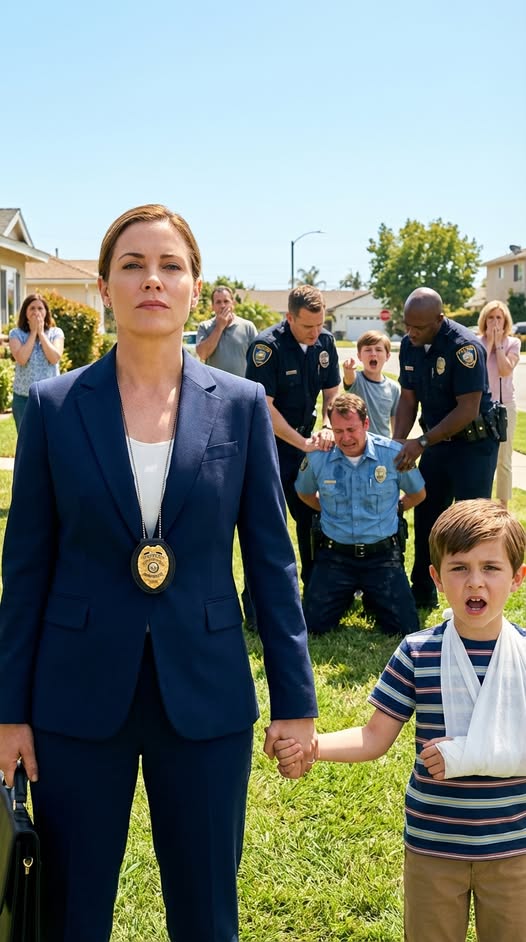
hoodie until his face was reduced to a tiny, shadowed circle. “I’m just cold, Mom,” he whispered, his voice cracking. “Please. Just leave it.” A cold dread coiled in my gut, freezing the sweat on my spine. My “mom instinct” was screaming, thrashing against my ribs like a trapped bird.
But beneath that maternal terror, an older, colder part of my brain was waking up. Before I was the “soft” stay-at-home mom of Oak Ridge, baking cupcakes for the PTA, I was the Chief Prosecutor for the State—a woman who spent fifteen years locking away apex predators. That buried part of me was already cataloging the symptoms. Isolation. Hypervigilance. Inappropriate clothing to conceal trauma. I set my glass down. The ice clinked against the glass, sounding deafening in the heavy silence of the yard. I stepped off the porch and walked toward him, the dry grass crunching beneath my sandals. “Leo,” I murmured softly, reaching out to playfully ruffle his hood, hoping to coax him out of his shell.
But as my fingertips grazed the thick fabric of his left forearm, the silence was violently shattered.
Leo let out a high-pitched, guttural shriek—a sound of pure, unadulterated agony that tore through the muggy air. His knees buckled, and he collapsed onto the parched grass, curling into a tight fetal position, sobbing hysterically. I dropped to my knees beside him, my hands hovering, terrified to touch him again. It was then that I saw it. As he writhed on the ground, a dark, wet stain was beginning to bloom through the thick, dark fabric of his sleeve. It wasn’t sweat. It was the unmistakable, terrifying crimson of fresh blood.
The kitchen island looked like a battlefield. The stark white quartz was marred by sterile saline wrappers, antiseptic wipes, and the heavy, metallic sheen of my poultry shears. I had practically carried Leo inside, his whimpers echoing off the high ceilings. He fought me when I tried to pull the hoodie over his head, so I did what had to be done. I used the heavy shears to systematically cut the sleeve away, starting from the cuff and working my way up to the shoulder.
When the heavy cotton finally peeled back, the breath was knocked out of my lungs.
Leo’s small forearm was grotesquely distorted. The bone was clearly fractured, jutting at a sickening angle beneath the bruised, swollen skin. It was crudely and viciously wrapped in layers of dirty, silver duct tape and stiff, blood-soaked paper towels. My hands, which hadn’t shaken when I faced cartel bosses in a courtroom, trembled violently as I reached for my phone to call an ambulance.
But as I pulled the ruined fabric of the hoodie aside, something fell out of the front pocket and fluttered onto the bloody quartz. A crumpled piece of wide-ruled notebook paper.
I set the phone down. I unfolded the paper, the edges stained with my son’s blood. The letters were printed in blocky, aggressive graphite.
“TELL, AND MOM DIES. WE OWN THIS TOWN.”
The maternal panic that had been suffocating me instantly evaporated. In its place, a cold, prosecutorial rage took root. The thermostat in my soul dropped to absolute zero.
“Who did this, Leo?” I whispered, my voice a jagged blade. I didn’t recognize the sound of it.
He squeezed his eyes shut, fat tears rolling down his pale cheeks. “Jackson,” he sobbed, his voice muffled by the pain. “He… he said his dad is the King of the Police. He said if I cried, if I told you… they’d put you in a cage forever.”
Jackson Miller. A twelve-year-old sociopath in training. And his father was none other than Captain Rick Miller, the charismatic, fiercely protected head of the Oak Ridge Police Department. The man who threw the best block parties, who gave the local kids rides in his cruiser, and who ran this town like a feudal lord.
Before I could even process the magnitude of the threat, a heavy, authoritative knock sounded at the front door. The frosted sidelight window obscured the details, but I could clearly see the broad, unmistakable silhouette of a uniformed officer. The doorknob rattled. He wasn’t waiting for me to answer; he was letting himself in.
Through the foyer, the door swung open. Captain Miller stood there, a predatory, practiced smile plastered across his tanned face. His eyes, however, were dead and black. “Everything alright in there, Elena?” he called out, his voice booming over Leo’s whimpers. “I heard a scream from the street. You know how ‘hysterical’ you moms get in this heat. Thought I’d do a quick welfare check.”
He stepped into the kitchen, the heavy soles of his boots scuffing my hardwood floors. His eyes swept the room, landing methodically on the bloody shears, the grotesque angle of Leo’s taped arm, and finally, the crumpled note resting on the counter. He didn’t look surprised. He didn’t look worried. He looked utterly amused.
“Well now, that’s a nasty accident the boy had,” Miller said smoothly, stepping closer. His large hand dropped casually to his hip, resting heavily on the grip of his holstered service weapon. The leather creaked. He looked from the blood to my face, his smile widening into a smirk. “It would be a real shame if Social Services got it in their heads that his mother was the one who caused it.”
For three agonizing days, I played the part perfectly. I became the ghost Captain Miller expected me to be. I didn’t call the local precinct. I didn’t take Leo to the local hospital; instead, I drove three towns over under the cover of night to a private orthopedic specialist I trusted, registering under my maiden name. I kept Leo home from summer camp. I even stood on my front porch in my floral sundresses and waved submissively when Miller drove his black-and-white cruiser past my house at a crawling pace at two in the morning.
Miller thought he had broken me. He thought I was just another frightened suburban housewife, paralyzed by his badge and his implied violence.
What he didn’t see was the woman in the basement at midnight.
Once Leo was asleep, heavily medicated and secured behind a locked bedroom door, I descended into my husband’s old, windowless study. The air down there was stale, smelling of old paper and ozone. In the center of the room, my laptop screen glowed, illuminating a wall I had transformed into a sprawling, chaotic “murder board.”
I pressed a prepaid burner phone to my ear, listening to the secure line connect.
“It’s Vance,” I said quietly into the receiver, speaking to a former federal contact who owed me his career. “I need the forensic audit on the Oak Ridge Police Pension Fund. I need the hidden ledger, not the public one. And I need the sealed juvenile records for Jackson Miller from the neighboring county.”
A heavy sigh crackled through the speaker. “Elena, you’re on sabbatical. You’re supposed to be finding yourself. If you go poking around local PD finances without jurisdiction…”
“Yes, I know I’m on sabbatical,” I cut him off, my voice turning to ice. “Consider this a private matter that is about to become a state emergency. Get me the files, David.”
I hung up and looked at the corkboard. It wasn’t just about my son’s broken arm anymore. The deeper I dug, the more the polished facade of Oak Ridge crumbled. I had tracked property records, banking anomalies, and police dispatch logs. It was about the three other families who had suddenly sold their homes at a loss and moved away in the middle of the night over the last four years. It was about the “missing” evidence in a dozen local burglary cases. Miller wasn’t just a bully protecting a violent kid; he was running a systematic protection racket, bleeding the town dry while using his badge as a shield.
The contrast of my two lives was jarring. By day, I was murmuring sweet nothings, pressing cool washcloths to Leo’s forehead, telling him the monsters couldn’t get him. By night, I was the monster in the dark, systematically hunting the man who hurt my child, mapping out his financial, professional, and personal obliteration.
The burner phone buzzed, vibrating violently against the wooden desk. A text message with an encrypted file attachment. The password, sent via a separate secure app, unlocked a video file. I clicked play.
It was a grainy, black-and-white feed from a hidden security camera in the middle school locker room—a camera Miller clearly didn’t know existed. My breath caught in my throat. I watched, helpless, as the digital timestamp ticked by. It showed Jackson Miller shoving Leo into a bank of lockers. It showed the violent, sickening twist of my son’s arm. But it was the background that made the blood roar in my ears.
Standing in the doorway of the locker room, leaning casually against the doorframe with his arms crossed, was Captain Miller. He wasn’t stopping it. He was watching his son torture mine, and as Jackson delivered the final, bone-snapping blow, Miller slowly nodded in approval.
The annual Blue Ribbon barbecue was the crown jewel of Oak Ridge’s social calendar. Held in the sprawling municipal park, it was a sea of red, white, and blue bunting, the air thick with the smell of roasting ribs, sweet hickory smoke, and stale beer. It was also Captain Miller’s personal kingdom. He was holding court near the massive stone fire pit, a frosted beer mug in one hand, laughing uproariously with the Mayor and the local judge. He was in his element, practically glowing with the arrogant invincibility of a man who believed he was a god among insects.
I didn’t sneak in. I didn’t hide in the crowd. I walked straight up the center aisle of the picnic tables.
I wasn’t wearing my yoga pants or a floral sundress today. I was encased in a tailored, charcoal-grey Tom Ford power suit that cost more than Miller’s cruiser. My hair was pulled back into a severe, unforgiving knot. The clicking of my stilettos on the paved walkway seemed to cut through the bluegrass music playing over the loudspeakers.
Miller saw me approaching. The laughter died on his lips, replaced by a patronizing sneer. He nudged the Mayor, pointing at me with the rim of his beer mug.
“Well, well. Look who dragged herself out of the house,” Miller mocked, his voice carrying over the crackling fire. He took a step forward, trying to use his sheer physical bulk to intimidate me. “Back for more advice, Elena? I told you the other day, keep the kid quiet, keep ice on that arm, and we won’t have any problems.”
I didn’t stop, didn’t slow my pace until I was inches from his chest. I could smell the cheap pine of his aftershave mixed with the sour tang of alcohol. I looked him dead in the eyes, refusing to yield a single millimeter of space. I reached into my leather briefcase and withdrew a thick, blue legal folder, slapping it flat against the center of his chest. He reflexively grabbed it to keep it from falling.
“What’s this?” Miller hissed, his sneer faltering for a fraction of a second. “A restraining order? I’ll piss on it, Elena. You’re out of your depth.”