“Actually,” I said. I didn’t yell, but I didn’t whisper. I pitched my voice with the precise, practiced projection of a woman who had silenced crowded courtrooms for a decade and a half. The sheer, unadulterated authority in my tone caused the conversations around us to instantly die. “It’s a multi-jurisdictional indictment for racketeering, extortion, witness intimidation, and accessory to felony assault.” Miller blinked, his brain struggling to process the words. “What the hell are you talking about?” “Your badge might grant you authority in this town, Captain,” I said, my words slicing through the humid air like a scalpel, “but my signature determines the color of your prison jumpsuit.” I watched the realization begin to dawn behind his eyes, a slow, horrifying sunrise. “My name is Elena Vance,” I continued, making sure the Mayor and the judge heard every single syllable. “I am the Chief Prosecutor for the State. My sabbatical ended this morning. And as of ten seconds ago, I have authorized the State Police to seize your precinct, freeze your assets, secure your home, and take your son into state custody.” Miller’s face turned a sickly, ashen shade of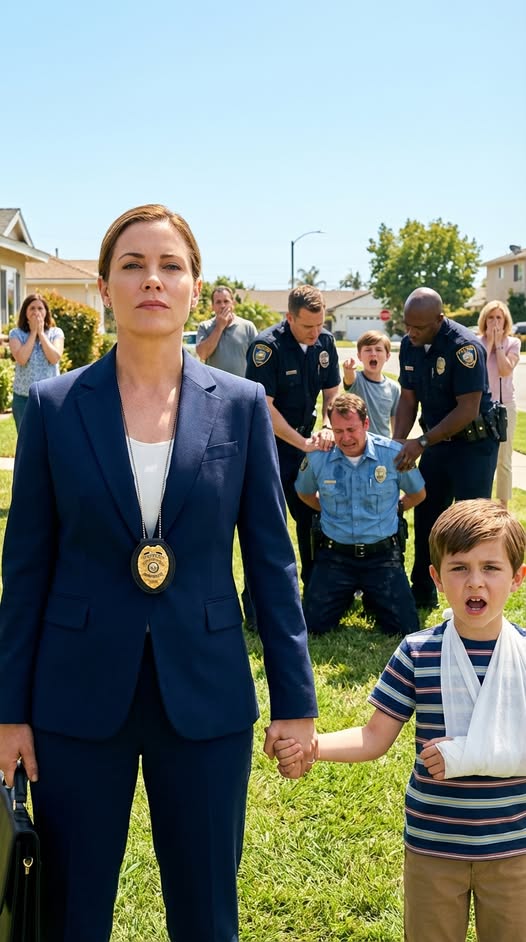
grey. The beer mug slipped from his fingers, shattering on the stone patio. Panic, raw and ugly, finally broke through his facade. He desperately reached for the radio clipped to his shoulder, thumbing the mic to call his loyal deputies.
I leaned in, my voice dropping to a deadly whisper meant only for him. “Don’t bother, Rick. I’ve already had the federal marshals disable your officers’ radios.” I took a half-step back and gestured toward the edge of the park. “Look at the perimeter.”
Miller’s head whipped around. At the edge of the manicured lawn, silently rolling over the grass and blocking every exit, were thirty black SUVs. Their lights were flashing in a silent, synchronized rhythm. None of them carried local plates.
The fall of the “Untouchable” Captain was swift, brutal, and meticulously legal. The man who had terrorized a town from the comfort of a leather chair was now just an inmate in an orange jumpsuit, sitting in a sterile, windowless interrogation room at a state facility. The local judge who had laughed with him at the barbecue had immediately recused himself. The Mayor had spent three hours crying to my investigators, eagerly turning state’s evidence to save his own skin. Miller had tried to bribe the transport guards on the way to holding, only to realize with dawning horror that they had been hand-picked by my office. He was trapped in a cage of my design.
Back in Oak Ridge, the world felt entirely different. The oppressive heatwave hadn’t broken—it was still a sweltering ninety-five degrees in the sun-drenched backyard—but the air finally felt breathable.
I stood by the kitchen window, watching Leo. Today, he wasn’t hiding in the heavy, suffocating navy hoodie. He was wearing a bright red tank top. His heavy fiberglass cast was a kaleidoscope of colors, completely covered in sharpie signatures and doodles from his new friends—kids who had also been silently bullied by Jackson and were finally, wonderfully, allowed to speak. I watched him throw a tennis ball against the fence, his laughter ringing out, bright and clear.
I stepped out onto the porch, the wood warm beneath my feet. I wasn’t just a “stay-at-home mom” anymore, playing a role to fit into a community. Nor was I just the cold, detached prosecutor I used to be. I was something forged in the fire between those two worlds. I was a mother who had systematically burned a corrupt kingdom to the ground to keep her son safe, and I realized I had the power to do it for others.
I picked up my cell phone from the patio table and scrolled to a number I hadn’t dialed in over a year. It rang twice.
“Vance,” the gruff voice of the Governor answered. “Tell me you’re not calling to apologize for the mess you’re making in Oak Ridge. The press is having a field day.”
“No apologies, sir,” I said, watching my son catch the ball. “I’m calling to tell you I’m coming back to work. Officially. But things are going to change. I want a specialized state-level task force dedicated exclusively to municipal police corruption. And I want to lead it.”
The Governor chuckled, a dry, rasping sound. “I’ll have the paperwork drafted by Monday. Welcome back, Elena.”
I hung up, a profound sense of peace settling over my shoulders. I turned to go back inside, pausing to gather the morning mail I had tossed onto the patio table. Bills, a catalog, a few flyers. But beneath them lay a plain white envelope. There was no return address, no stamp. It had been hand-delivered.
Frowning, I tore the flap open. Inside was a single, glossy photograph. It was a picture of me and Leo, taken from a distance, standing on this very porch just that morning. And drawn meticulously in thick, red marker around my son’s smiling face was a perfect, jagged circle.
One year later, the Oak Ridge Police Department was unrecognizable. The old guard was gone, swept away by indictments, early retirements, and federal plea deals. The new Captain was a sharp, fiercely intelligent woman from out of state—someone I had personally vetted and recommended. The town was no longer governed by fear; the shadow of Rick Miller had finally been burned away by the harsh light of accountability.
I walked through the vaulted marble halls of the State Capitol, the clicking of my heels echoing against the stone. It was a rhythm that sounded exactly like a heartbeat—steady, powerful, alive. In the past twelve months, my task force had dismantled three other corrupt precincts across the state. I had been asked by journalists, colleagues, and even the Governor himself why I didn’t just pack up and move away when Miller first threatened my family. Why stay in a house that was watched? Why risk it?
I always gave them the same answer: “Because I wanted my son to see what happens when the law stops being a shield for the bully, and starts being the sword of the victim.” I pushed through the heavy brass doors into the main lobby. The afternoon sun was streaming through the high windows, casting long, golden shadows across the floor. Leo was waiting for me by the security desk. He had grown three inches in a year. His shoulders were pulled back, his posture radiating a quiet, grounded confidence. His eyes were bright and alert. He didn’t wear hoodies anymore, unless it was actually freezing outside.
He looked up from his phone as I approached, flashing me a cheeky, lopsided grin. “Ready to go, Chief?” he asked, tossing his backpack over one shoulder.
“Ready,” I said, reaching out and taking his hand. It was a small gesture, but his grip was firm, strong.
We pushed through the revolving doors and stepped out onto the wide stone steps of the Capitol, the vibrant colors of the sunset bleeding across the sky. The warm breeze felt clean. We were no longer hiding from the world; we were walking boldly into it.
As we reached the bottom step, the heavy, vibrating hum of my secure pager went off at my hip. I unclipped it, reading the encrypted text. A new case. A high-profile state politician. Extortion. Another predator hiding behind a title.
I looked down at the pager, then looked up at Leo. He had seen the message. He didn’t look scared; he gave me a slow, firm nod of understanding. In that brief exchange, I realized I wasn’t just protecting him anymore. I was teaching him. I was showing him how to be the person who stands in the gap, the person who protects everyone else. The cycle of fear in Oak Ridge was permanently broken, but as I clipped the pager back onto my belt and looked out at the city, I knew the guardian was just getting started.
If you want more stories like this, or if you’d like to share your thoughts about what you would have done in my situation, I’d love to hear from you. Your perspective helps these stories reach more people, so don’t be shy about commenting or sharing.