The Architecture of a Phantom: A Chronicle of My Own Coup d’État. Chapter 1: The Anatomy of an Elegant Insult I learned a bitter truth long before I ever put on a black robe: humiliation always cuts the deepest when it is delivered with impeccable manners. My brother, Miles, provided the ultimate proof of this theorem exactly three nights before a lavish family dinner engineered to celebrate his glittering future. The digital message materialized on my phone screen while I was still sitting at my heavy oak desk in my judicial chambers. At a casual glance, it masqueraded as an innocuous logistical update—just another minor adjustment from a bloodline that had spent decades meticulously pruning my existence into a shape that was easier for them to explain at cocktail parties. Then, my eyes tracked over the actual substance of the text. Miles magnanimously informed me that I was permitted to attend the private engagement dinner with his fiancé’s family. However, there was a strict caveat: under no circumstances was I to disclose to anyone that I was his biological sister. Her father, the text noted with an undercurrent of desperate reverence,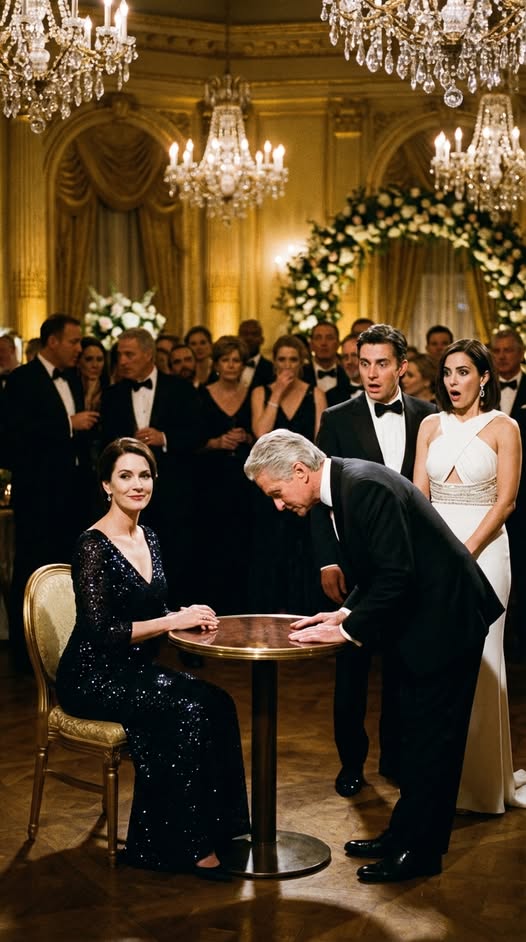
was a prominent federal judge. According to Miles, my presence as his sibling would be “unnecessarily embarrassing.” Before the sheer audacity of the demand could fully settle in my chest, my cell phone vibrated again. It was my mother, Evelyn. She was calling to apply a preemptive emotional tourniquet, utilizing that painfully measured, diplomatic cadence she reserved for moments when she needed me to swallow poison without making a scene. “Audra, darling,” she cooed, her voice tight with artificial warmth. “We think it would be best if you sat at one of the
overflow tables in the back of the private room. Just near the service doors. It’s only for one evening, sweetheart. Just to keep the atmosphere perfectly comfortable.”
Comfortable for whom? The question burned on my tongue, but she did not volunteer an answer. She didn’t need to. That was the defining hallmark of the Cole family pathology: they never had to raise their voices to explicitly declare my worthlessness. Miles was permanently bathed in the spotlight, introduced with glowing pride. I was a logistical problem to be managed, hidden, and ruthlessly reduced.
And still, staring at the polished mahogany of my desk, I told her I would be there. I promised to arrive punctually, sit precisely where I was instructed, and utter absolutely nothing they had not pre-approved.
What my parents and my golden-child brother critically failed to comprehend was the supreme irony of their social maneuvering. The formidable man they were so desperately attempting to impress would know precisely who I was the microscopic second he laid eyes on my face.
Before I tell you what transpired when the patriarch stopped at my shadowy table and sucked the oxygen out of the entire room, ask yourself this: What would you do if your own flesh and blood only welcomed you by demanding you pretend to be a ghost?
I hadn’t replied to Miles immediately. I flipped my phone face down, watching the Boston city lights reflect against the dark glass. The insult didn’t feel shocking; it felt suffocatingly familiar. It was the culmination of thirty-nine years of being treated like a jagged puzzle piece that ruined their pristine picture.
I was an Assistant United States Attorney who had spent a decade prosecuting sprawling public corruption and wire fraud cases that made untouchable men sweat through their bespoke suits. After that crucible, I clerked for Judge Miriam Caldwell, a titan of the First Circuit Court of Appeals. Miriam was a woman whose intellectual standards could surgically strip the ego from a seasoned litigator in under ten minutes. She was also the first human being in my life who looked at me and assessed what I could carry, rather than what I lacked. She had become my truest mentor, my chosen family.
When I calmly relayed the terms of the dinner invitation to her the following morning, I expected righteous indignation. Instead, Miriam offered a terrifyingly still silence.
“What is the name of your brother’s fiancé?” she asked softly.
“Genevieve Ward,” I replied.
Miriam closed her eyes for a fraction of a second. “And her father?”
“Theodore. Judge Theodore Ward.”
A subtle, dangerous shift altered Miriam’s features. She leaned back in her high-backed leather chair, releasing a breath that sounded like a dry chuckle. “Audra… is that truly who your brother is sweating blood to impress?”
I nodded, confused by her reaction. “Do you know him well?”
Miriam peered over the rim of her tortoiseshell reading glasses, her eyes gleaming with the anticipation of a predator catching a scent. “Audra, Theodore Ward has cited your written opinions in his own public remarks on three separate occasions. He doesn’t just know of you. He knows exactly who you are.”
A cold thrill spiked down my spine. The entire architecture of the impending dinner had just fundamentally fractured. I wasn’t walking into a slaughterhouse. I was walking into a courtroom. And Miles had absolutely no idea that the phantom he was trying to hide was about to become the prosecution.
Chapter 2: The Architecture of the Golden Child
By the time Friday evening descended upon the city, I had carved two unalterable resolutions into my mind: I would not grant my family the twisted satisfaction of seeing me emotionally rattled, and I would not lift a single finger to sustain their fragile illusions.
Judge Caldwell picked me up in her town car just after six o’clock. The Boston skyline was a jagged silhouette against an iron-gray sky, making everything look sharper and colder than it actually was. Miriam didn’t waste oxygen on offering maternal comfort. She simply raked her eyes over my tailored black midi dress, my understated pearls, and the impenetrable calm I wore like Kevlar.
“Excellent,” she murmured, turning her gaze back to the passing streetlamps. “Let them underestimate you in absolute peace.”
The Union Club was the precise breed of establishment Miles found intoxicating. It smelled of lemon oil, old money, and exclusivity. The private dining room was perched on an upper floor, wrapped in floor-to-ceiling windows that offered a commanding view of the glittering metropolis. Every fork, every crystal goblet, every linen napkin was aligned with a mathematical precision designed to whisper wealth without ever being so gauche as to shout it.
I spotted my family the moment Miriam and I crossed the threshold.
My parents were mingling, their smiles stretched so tight they looked painful. Miles was holding court near the center of the room, his hand resting possessively on Genevieve’s slender waist. He wore the expression of a man who believed he had finally duped his way into the aristocracy. Genevieve was undeniably elegant, possessing that effortless poise cultivated by generations of wealth.
The exact millisecond Miles’s eyes locked onto mine, the blood drained from his face. He detached himself from Genevieve and intercepted me with a swiftness that bordered on a jog, his face a mask of panicked hostility masked by a frozen grin.
“You’re late,” he hissed under his breath, though I was ten minutes early.
His frantic eyes flicked to Miriam. For a heartbeat, a flicker of genuine confusion passed over his features. He didn’t immediately recognize her out of context, but the predatory, unbothered way she held herself clearly registered as importance.
Before he could demand an explanation for my plus-one, Genevieve glided over. She was gracious and warm, possessing the polished manners of a woman trained to be kind to the help.
Miles stepped between us, his heart visibly pounding against his tailored waistcoat. He introduced me with a level of sociopathic detachment that honestly impressed me.
“Genevieve, darling,” he said, his voice dripping with casual dismissiveness. “This is Audra. She helps out with some administrative work down at the courthouse.”
Administrative work. I stared at my brother. My pulse remained perfectly steady. I let the silence stretch for a beat too long, watching the sweat begin to prickle at his hairline. But I did not correct him. I offered Genevieve a polite nod.
Miles physically deflated with relief. He mistook my silence for submission. He thought the dog had rolled over.
My mother swooped in next, offering a theatrical air-kiss that landed two inches from my cheek. “Audra! So glad you made it. We saved a special little spot for you in the back. Much quieter there, away from the chaos.”
Quieter meant invisible.
I allowed the maitre d’ to escort me to a comically small, two-top table shoved into the shadowy corner directly adjacent to the kitchen’s swinging service doors. The waiters brushed past my chair with practiced efficiency, treating me like part of the architectural fixtures. Miriam secured a seat at a slightly larger table nearby—close enough to monitor the blast radius, far enough to let the detonation occur organically.
From my corner, I had a panoramic view of the head table. Miles sat between Genevieve and her father like a prince in waiting. Judge Theodore Ward was a man who required no introduction. He didn’t dominate the conversation; he simply anchored the room with quiet, terrifying authority. I watched Miles laugh a fraction too loud at a mild joke. I watched my father nod vigorously at everything Ward said. It was a pathetic, sycophantic display.
As the first course of seared scallops was cleared, Judge Ward initiated a tradition I had heard rumors about. He stood up, commandeered a silver tray of champagne flutes from a startled waiter, and began a personal, table-by-table circulation of the room. He liked to greet every guest individually before the main course.
Miles looked positively euphoric, beaming as his future father-in-law worked the room.
I sat back in my chair, folding my hands softly in my lap. I watched the eminent judge slowly weave his way through the tables, moving inexorably toward the shadows of the service entrance.
And as his polished oxfords closed the distance to my hidden corner, I knew the match was about to strike the powder keg.
Chapter 3: The Collision of Worlds
To the oblivious attendees at the main table, I was exactly where I belonged: relegated to the margins, a muted prop in the grand production of Miles’s ascension.
But as Judge Theodore Ward turned the final corner, moving past a towering floral arrangement and stepping into the dim lighting of my section, the entire atmospheric pressure of the dining room radically shifted.
He hadn’t been looking specifically for me; he was merely executing his host duties. But the moment his sharp, assessing eyes locked onto my face, his forward momentum violently halted. It was so abrupt that the crystal flutes on the silver tray in his hands collided with a sharp, resonant clink that echoed over the soft jazz playing through the speakers.
For three agonizing seconds, Theodore Ward simply stared at me. It was not the vague, squinting effort of a man attempting to recall where he had seen a familiar face. It was the stark, visceral shock of undeniable recognition.
Then, instinct eclipsed decorum. He slammed the silver tray down onto the empty corner of my tiny table, completely ignoring the splashing champagne. He straightened his spine, his voice booming out with a rich, carrying baritone that demanded the attention of every soul within a hundred-foot radius.
“My God! Judge Cole! I had absolutely no idea you were in attendance tonight!”
The Union Club went dead.
It was that specific, suffocating brand of silence only wealthy, highly-trained rooms can achieve—a collective holding of breath because everyone simultaneously understands that the tectonic plates of the evening have just ruptured.
At the head table, Miles snapped his neck toward us so violently I thought he might have herniated a disc. My parents froze, their wine glasses suspended mid-air. Genevieve turned in her chair, a polite smile dying a sudden death on her lips.
I rose smoothly from my seat, a reflex ingrained from years in the courtroom. Before I could even extend my hand, Theodore Ward grasped it with both of his, shaking it with the vigorous, profound respect reserved exclusively for esteemed peers, not for administrative assistants hidden by the kitchen doors.
“It is an absolute honor to see you outside of chambers, Audra,” he said, his voice still vibrating with genuine astonishment. “I literally just reread your dissenting opinion on the Holloway privacy injunction last week. I mandated that my entire staff of clerks study it. I told them if they ever wanted to comprehend how to disembowel a flawed argument without wasting a single syllable, they needed to start with you.”
By now, every pair of eyes in the private dining room was laser-focused on our dark corner.