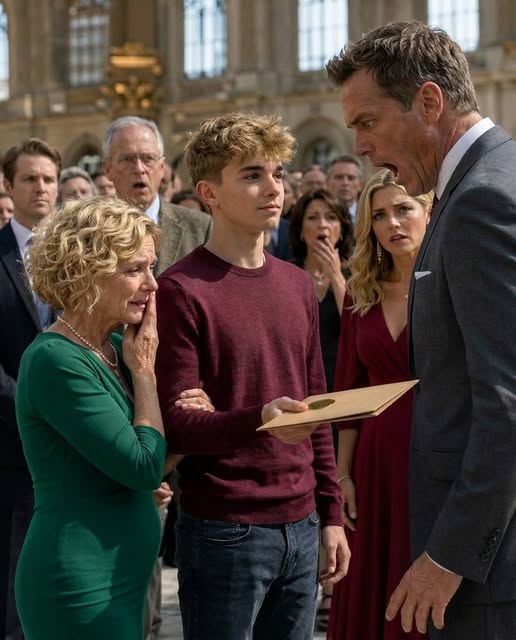
After the ceremony, Andrés tried to speak.
“Mateo, I…”
“Not today,” my son said calmly.
“This moment belongs to my mom.”
And he walked back to me.
He hugged me tightly.
I cried—not from sadness, but from relief.
Later, Andrés approached us again.
“I’d like to talk,” he said.
“There’s nothing left to say,” I replied calmly.
“I made mistakes.”
“Yes,” I nodded.
But I didn’t need anything more.
Because some apologies come too late to matter.
Mateo looked at him.
“Can you forgive me?” Andrés asked.
“Maybe one day,” Mateo said. “But forgiveness doesn’t mean pretending you were there.”
That silence said everything.
For the first time, I didn’t see Andrés as the man who left us.
I saw him as someone who had lost far more than he realized.
That night, Mateo and I had a simple dinner together.
Nothing fancy.
Just laughter, tears, and memories of everything we had survived.
“Was I too harsh?” he asked.
“You were honest,” I told him.
“I didn’t want to humiliate him.”
“I know. You just told the truth.”
And in that moment, I understood something deeply.
My son didn’t destroy his father.
His father destroyed himself years ago—when he chose to walk away.
Mateo simply held up a mirror.
Today, I no longer see my life as a story of abandonment.
I see it as a story of love.
Yes, I became a mother at forty-one.
Yes, my husband left for someone younger.
Yes, I was afraid. I cried. I struggled.
But I also raised a good man.
I built a home with honesty.
I learned that a woman’s worth is not defined by who leaves her.
And I learned that sometimes, the strongest response isn’t anger.
It’s living.
Enduring.
Growing.
And letting life quietly bring everyone face to face with their choices.
That day, my son didn’t need long speeches.
He only said:
“To my mother.”
And that…
was enough.