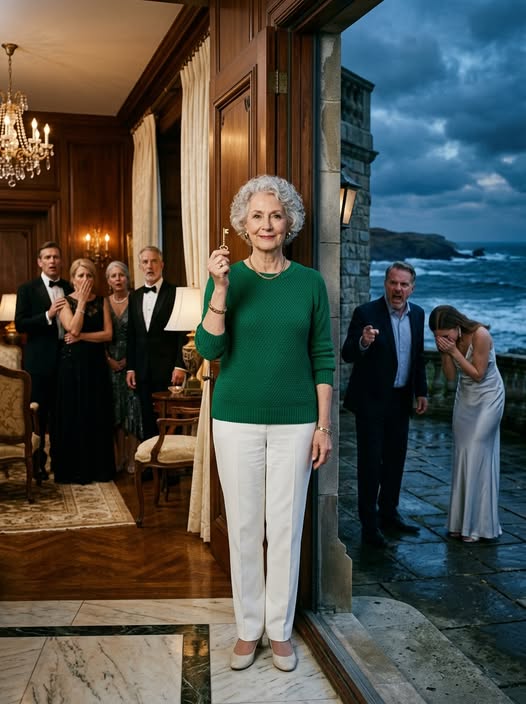
The world looked painfully ordinary.
That is the cruelest thing about heartbreak. Nothing stops for it.
“What exactly are you saying, Adrian?” I asked quietly.
He exhaled. “Vivienne just thinks you might feel uncomfortable. Her family has different traditions. It’s a very refined evening. Imported wine, a private chef, formal table settings. She doesn’t want you to feel out of place.”
Out of place.
I stared at the gold-edged house key resting against my palm.
That key opened the front doors of Seabrook House, an eight-bedroom beachfront estate on a private stretch of Palm Beach coastline. It had vaulted ceilings, limestone terraces, a library lined in mahogany, an infinity pool facing the Atlantic, and enough Italian marble to make Vivienne’s entire social circle faint from envy.
But in that moment, none of it mattered.
Because money can protect your comfort, your privacy, even your reputation. But it cannot fully protect a mother from the sound of her own child treating her like an inconvenience.
“I see,” I said.
Adrian softened his voice, probably thinking kindness could disguise cowardice.
“So you understand?”
That question nearly broke something in me.
He expected me to beg. He expected me to ask whether I could stop by for a few minutes. He expected me to swallow the insult and thank him for explaining it gently. He expected the version of me he had grown used to: quiet, forgiving, modest, invisible.
Instead, I smiled.
It was not a happy smile.
“Of course, darling,” I said. “Enjoy your Christmas.”
There was silence.
“You’re not upset?”
“No,” I replied. “Not at all.”
Then I hung up before he could say another word.
For several minutes, I stood alone in that little kitchen, the mug cooling in my hand.
The pain was there. Sharp. Deep. Familiar.
But underneath it, something older and harder began to rise.
They had mistaken my silence for weakness.
That was their first mistake.
Part 2: The Visit They Did Not Expect
An hour later, I drove to Adrian’s house.
His neighborhood sat behind a black iron gate wrapped in enormous Christmas garlands. The houses were huge, cold, and desperate to look inherited. Stone columns. Circular driveways. Perfectly trimmed hedges. Wreaths big enough to block half the windows.
Vivienne adored that neighborhood. She loved saying “our landscaper” and “the club” as if those phrases proved she had been born into privilege.
She seemed to forget that the down payment for Adrian’s house had secretly come from me.
I parked my old silver sedan in their driveway and sat there for a moment, gripping the steering wheel.
There is a special kind of humiliation in being looked down on by people whose lifestyle you helped fund.
Then I stepped out, walked up the front steps, and rang the bell.
Vivienne opened the door.
She wore a cream cashmere sweater, diamond studs, and the faintly irritated expression of a woman interrupted during something more important than kindness.
“Margaret,” she said.
My name sounded like an obligation in her mouth.
“We weren’t expecting you.”
“No,” I replied. “I gathered that.”
She did not move aside immediately. She held the door half open, just enough to appear polite and just narrow enough to make the message clear.
I looked past her into the house.
“I came to see Noah,” I said. “And to discuss Christmas.”
Her jaw tightened.
“Of course.”
She stepped back.
Inside, the foyer smelled of artificial pine and expensive coffee. A towering flocked Christmas tree stood in the living room, decorated in silver, white, and glass ornaments so perfect they looked unloved. It was beautiful in the way hotel lobbies are beautiful.
No warmth. No memory. No soul.
Adrian came out of his study, guilt flashing across his face.
“Mom.”
Before he could say more, a small figure came racing around the corner.
“Grandma!”
Noah.
My seven-year-old grandson came running toward me, his face bright with joy. For one wonderful second, the ice around my heart cracked.
Then Vivienne’s hand landed on his shoulder.
“Noah,” she said sweetly, though her fingers gripped too tightly. “You need to finish your piano practice.”
“But Grandma just got here.”
“Practice. Now.”
His smile vanished.
The look he gave me was enough to undo every ounce of control I had.
“It’s all right, sweetheart,” I said softly. “I’ll see you soon.”
He walked away slowly, shoulders low.
Vivienne led me to the living room and sat on the ivory sofa I had purchased for them after their basement flooded two years earlier. Adrian stood near the fireplace, staring at the floor like a man hoping cowardice could pass for neutrality.
“I hope you understand this isn’t meant to hurt you,” Vivienne began.
I folded my hands in my lap.
“Then explain what it is meant to do.”
She gave a brittle little smile.
“My parents are very particular. Christmas dinner is a curated event in our family. There will be a seven-course tasting menu, imported caviar, rare wines. It’s simply a different atmosphere.”
“And I would damage that atmosphere?”
Her eyes flicked over my old coat.
“Margaret, let’s be honest. You don’t really enjoy that sort of thing. You’re happier with church bake sales and discount grocery stores. My parents wouldn’t know what to talk about with you. We were trying to spare everyone discomfort.”
There it was.
The truth, finally stripped of perfume.
I looked at Adrian.
“And you agree?”
He shifted. “Mom, Vivienne’s family just has a different style. We want the night to be smooth.”
“Smooth,” I repeated.
A laugh almost escaped me.
“You mean you want to pretend you came from wealth, and I am the inconvenient proof that you did not.”
Vivienne’s face hardened.
“That’s a very defensive interpretation.”
“No,” I said, standing. “It’s an accurate one.”
I adjusted my purse strap.
“Thank you for clarifying your standards. Enjoy your refined Christmas.”
Adrian called after me as I left, but I did not turn around.
By the time I reached my apartment again, my grief had changed shape.
It was no longer sorrow.
It was strategy.
Part 3: The Woman They Never Knew
In my bedroom, I pushed aside a row of faded winter coats and opened the wall safe hidden behind them.
The steel door clicked.
Inside were the documents my family had never cared enough to ask about.
Investment records. Property deeds. Offshore portfolio statements. Trust paperwork. Commercial real estate holdings.
When my husband, Daniel, died fifteen years earlier, he did not leave me struggling. He left behind a fortune built through early technology investments, land acquisitions, and quiet financial brilliance.
At first, I had ignored it because grief swallowed everything.
Then I began studying.
Then I began managing.
Then I multiplied it.
By that Christmas, my assets were worth more than eighty million dollars.
And my son believed I was surviving on coupons.
I took out my phone and called my younger sister, Rosemary.
She answered on the fourth ring.
“Well, this is unexpected. Did Vivienne finally approve family contact?”
I smiled.
“Change of plans. You’re not spending Christmas alone this year. You’re coming to my house in Palm Beach for Christmas Eve dinner. Formal attire.”
There was a pause.
“Margaret, you live in a two-bedroom apartment beside a highway.”
“Not anymore,” I said. “I’ll send the address. Wear something beautiful.”
Before she could interrogate me, I hung up and called my cousin Frank, a retired mechanic Vivienne hated because he laughed too loudly and never pretended to be impressed by her.
“Frank,” I said. “How would you feel about Christmas at a beachfront estate?”
By the end of the evening, I had invited thirty-five people.
The relatives Vivienne had excluded.
The old neighbors Adrian had forgotten.
My financial advisor, Mr. Whitaker.
My closest friend, Lillian, who chaired a philanthropic foundation and was the only person who knew the full extent of my wealth.
Every single person said yes.
Their eagerness told its own sad story.
I had not been the only one starved for a Christmas table where love mattered more than status.
For the next three days, I lived in two worlds.
In the morning, I was the quiet widow in the modest apartment.
In the afternoon, I drove to Seabrook House and became the woman I had hidden for fifteen years.
The estate was magnificent. White stone walls, arched windows, sweeping staircases, a private beach, and a great room facing the Atlantic Ocean.
I hired a young designer named Isabelle to transform it.
“I want beauty,” I told her. “But not cold beauty. I want deep greens, warm golds, candlelight, velvet ribbons, and a tree that reaches the ceiling. Nothing sterile. Nothing that looks like Vivienne touched it.”
Isabelle smiled.
“I understand completely.”
Then I hired Chef Laurent, a former Michelin-starred chef from New York. Together, we planned a menu that made Vivienne’s catered dinner look like reheated leftovers.
Fresh oysters with caviar.
Butter-poached lobster.
Truffle pasta.
Roasted tenderloin.
A croquembouche tower glittering with spun sugar.
On Christmas Eve morning, Vivienne called.
“Margaret,” she said, her voice dripping with false kindness. “I just wanted to make sure there are no hard feelings about tonight. I know being alone on Christmas must be difficult, but this really is best for everyone.”
I stood on the limestone balcony of my bedroom while florists carried hundreds of white orchids through the front doors below.
“No hard feelings at all,” I said. “Actually, you’ve done me a tremendous favor.”
“That’s very mature of you.”
“Yes,” I said. “Merry Christmas, Vivienne. I hope your evening gives you exactly what you deserve.”
Then I ended the call.
Part 4: Christmas Eve at Seabrook House
At five o’clock, I stood before the mirror in a custom emerald gown with diamonds at my throat.
For the first time in years, I looked like myself.
Not Adrian’s aging mother.
Not Vivienne’s embarrassing in-law.
Not the widow everyone assumed had faded quietly into financial irrelevance.
Myself.
When the doorbell rang, I opened the massive oak doors.
Rosemary stood on the portico, clutching an overnight bag. Her mouth fell open as she stared past me at the chandelier, the ocean view, the marble floors, and the enormous Christmas tree glowing behind me.
“Margaret,” she whispered. “Please tell me you have not broken into someone’s mansion.”
I laughed for the first time in days.
“Come in, Rose. Welcome to my home.”
By six o’clock, Seabrook House was alive.
Children ran across the rugs.
Cousins hugged in the foyer.
Frank arrived in a tailored suit and immediately cried when he saw the dining room.
The house smelled of woodsmoke, garlic, pine, perfume, and salt air.
For once, no one was being measured. No one was being corrected. No one was being told they were too loud, too plain, too rustic, or too much.
They were simply loved.
Lillian hugged me near the fireplace.
“You terrifying, magnificent woman,” she whispered. “This is the most elegant revenge I have ever seen.”
“It isn’t revenge,” I said.
Then I looked around the glowing room.
“Not entirely.”
At eight o’clock, I gathered everyone on the back terrace.
The sunset had painted the sky purple and gold. The infinity pool mirrored the first stars. Behind us, Seabrook House glowed like a palace.
Isabelle’s photography team captured everything.
Thirty-five people stood around me.
The people who had loved me when they thought I had nothing.
A few minutes later, I posted three photos online.
The mansion glowing against the ocean.
The long dining table filled with laughter.
And me, standing on the balcony in emerald silk and diamonds.