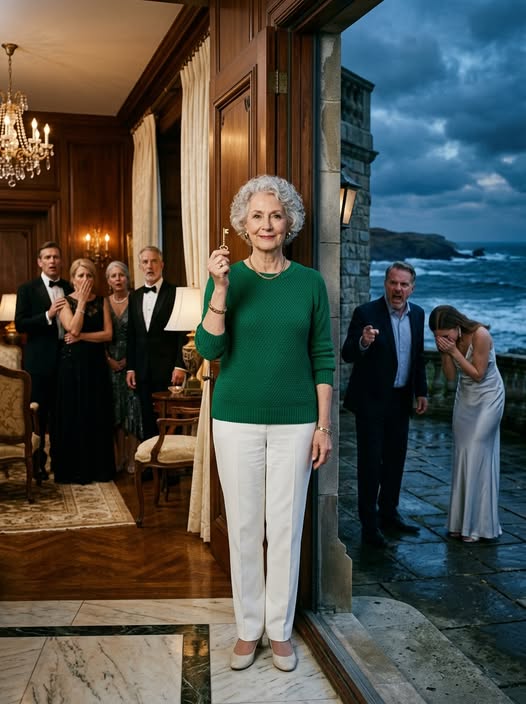
“Grandma?”
My body froze.
“Noah?”
“Why aren’t you here?” he asked, crying. “Did you leave because I didn’t practice piano?”
My anger shattered.
“Oh, sweetheart. No. Never. You did nothing wrong. I love you more than every star in the sky.”
“I miss you.”
“I miss you too,” I whispered. “I’ll see you soon. I promise.”
Then the line went dead.
Vivienne had hung up.
Behind me, fireworks burst over the ocean in gold and silver.
Everyone cheered.
But I stood alone for a moment, my hands trembling.
I had won.
But my grandson had paid for part of the lesson.
And that, I would not forgive.
Part 5: The Morning After
At nine the next morning, the intercom buzzed at the front gate.
I was sitting on the veranda in a silk robe, drinking coffee.
On the security screen, Adrian’s SUV waited outside the wrought-iron barrier.
He looked terrible. Wrinkled shirt. Tired eyes. Unshaven jaw.
Vivienne sat beside him in oversized sunglasses, pale and silent.
I opened the gate.
I wanted them to feel every inch of the long driveway.
When they reached the front doors, I was already dressed in tailored black slacks, a white silk blouse, and Daniel’s antique watch.
I opened the door before they rang.
They stood frozen.
Vivienne’s eyes moved wildly over the fountains, the palm trees, the ocean beyond the house, the scale of everything she had not imagined possible.
“Come in,” I said.
I led them to the mahogany library and sat behind the leather-topped desk.
I did not offer them chairs.
Adrian swallowed.
“Is this real?”
“Yes,” I said. “I bought it last week. Paid in cash.”
Vivienne removed her sunglasses.
“How?” she whispered. “You live on a fixed income.”
“I live on the income I allow you to see.”
Neither of them spoke.
“When Daniel died, he left me a substantial portfolio. Over fifteen years, I grew it into an empire. My assets are now worth over eighty million dollars.”
The number struck them like a physical blow.
Adrian stumbled back slightly.
“Eighty million?” he whispered. “But the apartment… the coupons… why?”
“Because I wanted to know who loved me without money attached,” I said. “I wanted to know whether my son would respect his mother when he believed she had nothing to offer.”
I turned to Vivienne.
“And you answered that question clearly.”
Tears filled her eyes.
“Margaret, I never meant—”
“Do not lie to me in my own house.”
My voice cracked through the library.
“You meant every insult. Every exclusion. Every little look at my clothes. Every time you kept Noah from hugging me. Every time you treated my family like dirt because they did not fit your fantasy of status.”
She began to cry harder.
I looked back at Adrian.
“But you are the greater disappointment. She showed me who she was. You allowed it. You stood there while your wife humiliated your mother because defending me would have inconvenienced you.”
His face collapsed.
“I’m sorry,” he said, voice breaking. “Mom, I am so sorry. I was weak.”
“Yes,” I said. “You were.”
Vivienne clasped her shaking hands.
“How can we fix this?”
“You cannot fix it today,” I replied. “Not with apologies born from embarrassment.”
Adrian looked terrified.
“Are you cutting us off?”
“I am setting boundaries. Noah is my grandson. I will not be pushed out of his life. He will visit me here, without being used as a weapon. As for both of you, you may earn your way back into my life slowly, humbly, and without expecting a single dollar.”
They nodded because they had no other choice.
When they left, I watched their SUV disappear down the palm-lined driveway.
For the first time in years, the air felt clean.
Part 6: The New Rules
The months that followed changed everything.
Vivienne lost the social crown she had worked so hard to polish. The very people she had tried to impress now whispered about how she had excluded an eighty-million-dollar matriarch from Christmas dinner. Some of them tried to get invited to my charity events.
I declined most of them.
Vivienne began therapy. Slowly, awkwardly, she called once a month. Not to ask for money. Not to perform. Just to speak.
I allowed it.
I did not soften the truth for her.
Adrian came on weekends. At first, he arrived stiff and ashamed. Then he began helping Frank restore an old car in the estate garage. He sat with me on the balcony and learned how to speak to me as a person, not a burden.
Progress was slow.
But it was real.
Noah became the light of Seabrook House.
He spent summer days barefoot on the beach, collecting shells, eating pancakes in the kitchen, and learning from Mr. Whitaker how investments worked by using pebbles and seashells.
I taught him the most important lesson first:
Money is not a crown.
It is not a whip.
It is a tool.
Use it to build tables, not walls.
By autumn, Lillian and I launched the Grace and Dignity Fund, investing millions into legal aid and financial education for older adults being isolated, manipulated, or financially abused by their families.
I had been fortunate.
Many people were not.
So I became the shield I once needed.
One evening in late November, I stood alone on the limestone balcony as the Atlantic wind moved through my hair. The sky was purple with twilight. In my hand was a glass of dark red wine.
I thought of that cramped kitchen.
The chipped mug.
The phone call.
The sentence that was meant to reduce me.
Don’t come this year.
If I could speak to the woman I had been in that moment, I would tell her this:
Let it hurt.
Let the pain burn away every illusion.
Let it show you who people are.
Then rise.
We are often taught that age means shrinking. That mothers should accept crumbs of affection. That older women should be grateful for any seat, even at tables where they are barely tolerated.
I reject that completely.
There is terrible power in a woman who stops asking permission to matter.
I did not buy a fifteen-million-dollar mansion simply for revenge.
I bought it because I was done living small for people who were committed to misunderstanding me.
The ocean roared beneath the balcony.
I lifted my glass.
The game was over.
And this time, I had written the rules.