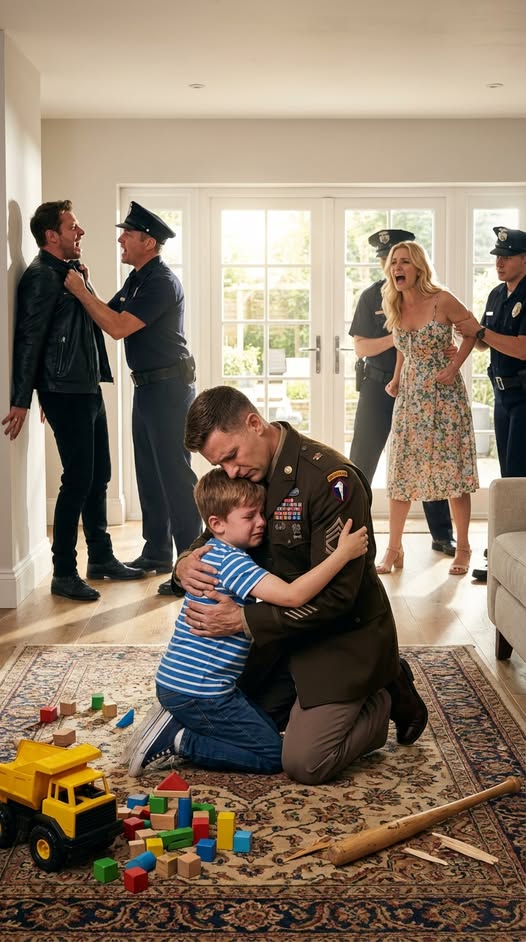
“Chad hit our son with a baseball bat, Marissa,” I said, my voice so low it was almost a whisper, yet it filled the room like a thunderclap. “He hit him so hard the bone snapped. And you? You let him stay in this house. You chose a man who likes to break children because he makes you feel ‘protected.’”
“It wasn’t like that!” she shrieked. “Leo was being difficult! Chad was just—”
“Chad is a coward,” Jackson interrupted, stepping into her line of sight. Marissa flinched.
“I’ve already sent the recording to the authorities,” I said, holding up the emergency phone. “The one Leo used to call me. It recorded everything, Marissa. The thwack. The screams. Your boyfriend’s little speech about ‘teaching him a lesson.’ You aren’t a mother anymore. You’re a witness to a felony.”
The police arrived then, their lights painting the neighborhood in rhythmic flashes of red and blue. One of the officers, a veteran with silver at his temples, walked onto the porch and looked at Chad. He looked at the shattered bat. Then he looked at Jackson.
The officer recognized the “Ghost.” He’d seen that look before—the look of a man who had done what the law was too slow to accomplish.
He turned to me, ignoring Marissa’s hysterics. “Sir, we’ve got the recording. We’ve got the medical team on the way. But we have a problem… Chad here says he was ‘attacked’ by a masked intruder.”
The officer looked at Jackson, then back at me. “I don’t see any masked intruders. Do you?”
“No, officer,” I said, holding Leo tighter. “I just see a man who fell down the stairs. Several times. It’s a tragedy, really.”
The officer nodded slowly, and as the sirens faded into the background, I knew the legal battle was won—but the war for Leo’s soul had only just entered its second phase.
Chapter 5: The Debt of Oak Ridge
The legal fallout was a landslide.
Chad was charged with aggravated assault, child endangerment, and felony battery. Because of the digital recording and the severity of the injuries, he was denied bail. Marissa was placed under immediate investigation by Child Protective Services and lost her custodial rights within forty-eight hours. The “tough guy” was crying in his mugshot, his gym-built muscles useless against the weight of a ten-year mandatory minimum sentence.
In the hospital wing, after Leo’s surgery, the room was quiet. Leo was sleeping, his leg encased in a heavy white cast. I sat by the bed, my hand never leaving his. Jackson stood in the doorway, a silent sentinel in the sterile light.
“You didn’t have to do that, Jackson,” I said. “You could have just called the cops from across the street.”
Jackson looked at his hands—the hands I had saved in the desert. “You carried me three miles through a godforsaken furnace, Dave. You took a bullet in the shoulder to keep the tourniquet on my leg. I only had to walk fifty yards.”
He walked over and handed me a small, heavy object wrapped in a tactical cloth. “The police ‘missed’ this in the evidence pile. I thought you might want to dispose of it.”
I unwrapped it. It was the pieces of the baseball bat. I looked at the wood—the instrument of my son’s pain—and felt a final, cleansing surge of resolution.
“We’re moving, Jackson,” I whispered to my sleeping son. “We’re going to a house with a big yard. Far away from Oak Ridge.”
“I know,” Jackson said, nodding toward the window. “I already put my house on the market. I hear the neighborhood where you’re going needs a good handyman. Someone who knows how to fix… problems.”
The “Ghost” wasn’t going anywhere. The debt wasn’t paid—between brothers like us, the debt is never paid. It’s just a continuous cycle of holding the line.
Marissa tried to call me from her lawyer’s office, begging for a “reasonable” settlement. I didn’t even answer. I blocked her number. There is no “reasonable” when it comes to the safety of a child. There is only the line, and the lions who guard it.
But as I watched the sunrise from the hospital window, I realized that the man I used to be—the suit, the analyst—was gone forever, replaced by something much more dangerous.
Chapter 6: The Lions at the Gate
One Year Later.
The sun was setting over a new house in the suburbs of a different town. This house didn’t have beige walls or corporate art. It had a massive backyard where a golden retriever was currently being chased by a boy with a slight, almost imperceptible limp.
Leo was running, his laughter a bright, defiant sound that had finally erased the memory of that afternoon in Oak Ridge. He was a year older, a year stronger, and a lifetime more secure.
I sat on the porch with Jackson, two men who had seen the worst of humanity in a distant desert and decided to be the best of it in our own backyard. Jackson was cleaning a set of binoculars, still the watchful eye.
“He’s getting fast,” Jackson remarked, nodding toward Leo.
“He had good teachers,” I said.
I looked at my life now. I was still an analyst, but the data I cared about wasn’t in a spreadsheet. It was in the rhythm of my son’s breathing and the peace of our home. I realized that Chad had made the most common mistake of the bully: he thought he was the only one who knew how to be violent.
He didn’t know that for some of us, violence isn’t a hobby or a way to feel big. It’s a tool we keep in a box, reserved for the moment someone tries to hurt what we love.
“You know,” I said, looking at the “Ghost” next door. “I used to think I was a failure for the divorce. I thought I’d lost the chance to protect him.”
“You didn’t lose anything, Dave,” Jackson said, looking at the horizon. “You just had to wait for the storm to show you where the lions were.”
As the stars came out, a black SUV pulled up to the curb. A man in a tailored suit got out, looking lost and frantic. He looked at the house, then at me and Jackson.
“Is this where David Vance lives?” the man asked, his voice shaking. “I… I have a problem. A man is threatening my family, and my lawyer said you were the only one who could help me navigate the… unconventional side of things.”
Jackson looked at me and smiled—a cold, sharp expression that reminded me of the red zone in Fallujah. He stood up and adjusted his shirt.
“Looks like the neighborhood is growing, brother,” Jackson said.
I stood up next to him, the analyst and the ghost, ready to hold the line for anyone who was tired of being afraid.
If you want more stories like this, or if you’d like to share your thoughts about what you would have done in my situation, I’d love to hear from you. Your perspective helps these stories reach more people, so don’t be shy about commenting or sharing.