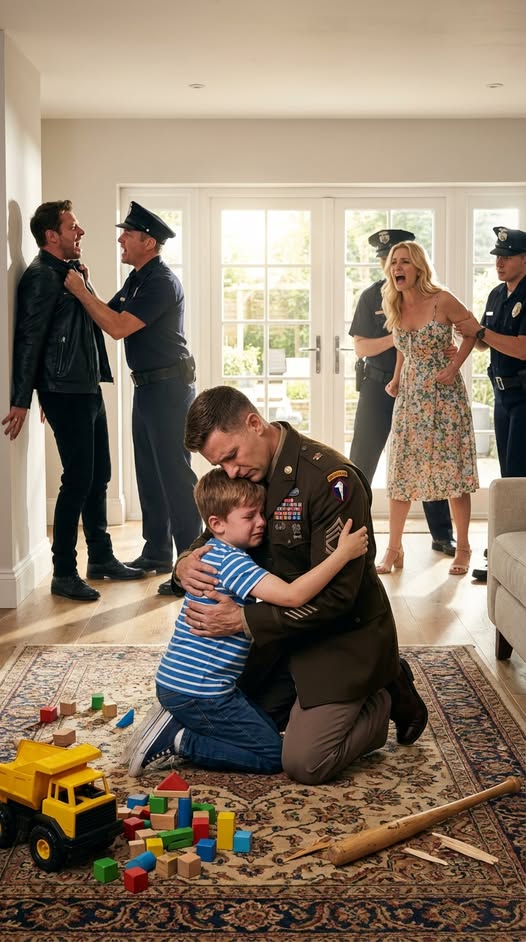
Because I didn’t trust the silence of that house, I had engineered a safeguard. I had hidden a small, encrypted “emergency” cell phone—a burner with a hardened signal—inside the lining of Leo’s favorite backpack. I told him it was our “Special Ops walkie-talkie.”
“Only call it if you’re scared, Leo,” I had whispered during our last weekend together. “No matter what time, no matter who is watching. You press the button, and I will be there.”
At 2:14 PM on a Tuesday, the phone on my desk—a private line kept in a lead-lined drawer—began to vibrate. The sound was a jagged tear in the corporate silence.
I answered it, my heart hammering against my ribs like a trapped bird. “Leo? Hey, buddy. You there?”
I didn’t hear a greeting. I heard a wet, ragged sob. It was a sound of absolute, primal terror that made the blood in my veins turn to liquid nitrogen.
“Dad…” Leo gasped. His voice was faint, muffled, as if he were hiding in the deepest corner of a closet. “Chad has the baseball bat. He hit my leg. He says I’m a crybaby like you. He says I need to learn to be a man.”
In the background, a man’s voice boomed—a jagged, ugly sound that tore through the speaker, distorted by rage. “Leo! Get out from under that bed! You want to call your daddy? Call him! Tell him I’m teaching you the lesson he was too soft to give you!”
Then came the sound. A sickening, hollow thwack—the sound of seasoned ash meeting bone. Leo’s scream was cut short by a gasp of pure, airless agony. Then, the line went dead.
I stood up so violently my ergonomic chair flew backward, shattering the glass partition of my cubicle. The high-pressure corporate world around me vanished. The smell of expensive coffee was replaced by the phantom scent of cordite and burning rubber. I didn’t call 911. I knew the red tape. I knew the “domestic disturbance” protocols that would take forty minutes to navigate.
I scrolled to a contact with no name—just a symbol of a skull. I hit dial as I sprinted toward the elevators, my vision tunneling into a red haze.
“Jackson,” I rasped, my voice vibrating with a lethal frequency. “Level 5. My house. The boyfriend. Don’t let him kill my son before I get there.”
The voice on the other end was like gravel being ground into a fresh wound. “Copy. Fifty yards out. I’m moving.”
As the elevator doors closed, I realized I had just unleashed a ghost, and there was no telling what would be left of the man who had touched my son.
Chapter 2: The Shepherd of Fallujah
Jackson “Ghost” Miller lived in a small, unassuming bungalow directly across the street from Marissa’s house in Oak Ridge. To the neighbors, he was the “quiet veteran”—the man who spent too much time sitting on his porch, staring at the horizon with eyes that seemed to see through walls. They thought he was broken. They didn’t know he was a sentinel.
Jackson had been the lead point-man for a Tier-1 Special Forces unit. He was a master of the “OODA loop”—Observe, Orient, Decide, Act. To him, the world was a series of tactical vectors.
Ten years ago, in the ruins of Fallujah, I had dragged Jackson three miles through a gauntlet of sniper fire. His spine was shattered, his lungs were collapsing, and the desert heat was boiling the blood in his veins. I was the medic who refused to let the “Ghost” vanish. I had stayed in the red zone, stitching him together while mortars turned the earth into a blender. I was the reason he could still walk.
He lived across the street because I had asked him to. He was the shadow I had placed to watch over the only thing that mattered to me.
Jackson was sipping a cup of black coffee when his phone vibrated. He didn’t ask for a description of the threat. He didn’t ask for permission. He put the mug down, walked to his hallway closet, and pulled out a gear bag he hadn’t opened in a year. Inside were zip-ties, a tactical flashlight, and a pair of weighted-knuckle gloves.
Across the street, inside Marissa’s house, Chad was standing over the bed, the heavy ash wood of the baseball bat resting on his shoulder. He was panting, his face flushed with the sick adrenaline of a coward who has finally found someone smaller than him to break.
“Your dad isn’t coming, kid,” Chad sneered, reaching down to grab Leo’s ankle to drag him out. “David is a suit. He’s in a boardroom. He’s probably Power-Pointing his way through his afternoon while you’re here learning what real strength looks like.”
Leo huddled against the wall, his leg twisted at an unnatural angle, his face white with shock.
Chad raised the bat, a terrifying smirk on his face. “One more, Leo. For the road.”
He didn’t get to swing.
The front door of the house didn’t just open; it disintegrated. The deadbolt sheared off the frame as Jackson’s boot met the wood with the force of a battering ram. Jackson didn’t scream. He didn’t issue warnings. He entered the house with the focused, predatory calm of a man returning to a familiar battlefield.
Chad spun around, the bat raised, his “tough guy” bravado flaring up like a cheap lighter. “Who the hell are you? Get the hell out of my—”
Jackson moved with a speed that defied the physics of his age. Before Chad could even register the movement, Jackson’s hand closed around his throat like a hydraulic press. The vanity of the gym-built bully met the reality of the professional warrior.
Chad’s eyes bulged as he was lifted off the floor. The baseball bat fell from his nerveless fingers, clattering onto the hardwood. Jackson didn’t strike him—not yet. He simply pinned him against the wall, his face inches from Chad’s.
“You made a mistake,” Jackson whispered, his voice a low, terrifying hum that seemed to vibrate the very air. “You thought the suit was the only one coming for you. You forgot about the ghosts he keeps in his pockets.”
Jackson’s grip tightened, and Chad began to realize that some doors, once broken, can never be closed again.
Chapter 3: The Breach and the Balm
I was pushing my sedan to 110 miles per hour, weaving through the afternoon traffic on Interstate 95 like a guided missile. My hands were white on the steering wheel, my mind a chaotic loop of Leo’s scream. I was breaking the speed limit of my soul, pushing past the civilized man I had worked so hard to become.
“Please,” I whispered to the empty car, the tears finally breaking through. “Please, Jackson, be there.”
Back at the house, the power dynamic had shifted so violently it had left a vacuum. Jackson had dropped Chad to the floor, but he hadn’t finished. He had grabbed Chad’s wrists and cinched them behind his back with industrial-grade zip-ties, the plastic biting deep into the meat of the man’s arms.
Jackson then turned to the bed. He dropped to one knee, his posture shifting from predator to protector in a heartbeat.
“Hey, little man,” Jackson said, his voice instantly softening into a gravelly warmth. “Uncle Jackson is here. Remember what your dad said? About the lions?”
Leo poked his head out from under the bed, his eyes wide with a mixture of terror and hope. He saw the man from across the street—the one who always waved at him.
“The lions… they guard the gate,” Leo whispered, his voice trembling.
“That’s right,” Jackson said, reaching under to gently pull Leo into his arms. He checked the boy’s leg with the practiced hands of a man who had seen a thousand fractures in the sand. “It’s broken, Leo. But it’s going to be okay. I’m going to sit you right here on the kitchen counter, and I’m going to give you a popsicle. I want you to close your eyes and count to twenty. Can you do that for me?”
“Where’s Chad?” Leo whispered, looking toward the living room where the man was moaning on the floor.
“Chad is just taking a very long nap,” Jackson lied, his eyes never leaving the boy.
He carried Leo to the kitchen, set him down, and handed him a juice box from the fridge. Then, Jackson walked back to the living room. Chad was trying to scramble away on his knees, his face a map of purple and red from where he’d met the wall.
“You… you can’t do this,” Chad gasped, his voice high and thin. “I’ll call the police! I’ll have you arrested for home invasion!”
Jackson picked up the baseball bat. He looked at the blood on the wood—Leo’s blood. A cold, dark light entered his eyes. He didn’t use the bat on Chad. Instead, he placed the wood against the floor and snapped it over his knee as if it were a toothpick.
“The police are coming, Chad,” Jackson said, his voice devoid of any human emotion. “But they’re not coming for me. They’re coming to collect what’s left of the man who thought it was okay to break a child.”
He grabbed Chad by the collar and dragged him toward the front porch. He didn’t care about the neighbors watching. He didn’t care about the optics. He zip-tied Chad to the heavy iron railing of the porch, leaving him on his knees in the flowerbed like a sacrificial animal.
Just then, my car screeched into the driveway, the tires smoking as I jumped the curb. I burst through the door, my hand already reaching for a heavy glass vase on the entryway table to use as a weapon.
I stopped dead in my tracks.
The house was silent, save for the sound of a juice box being squeezed. Jackson was sitting on a kitchen stool, calmly reading a picture book to Leo. On the porch, through the shattered front door, I could see Chad—the “Apex Predator” of Oak Ridge—sobbing and tied like a hog.
I looked at my son, then at Jackson, and the world finally stopped spinning—but the true reckoning was only just beginning.