I looked at Marcus. His eyes were open. He had heard. He reached out and squeezed my hand with a faint, firm pressure.
“Now you know,” he rasped. “Never underestimate… their greed.”
The day of the funeral was gray and misty. I stood at the graveside, the honor guard’s movements crisp and reverent. When they presented me with the folded flag, my composure cracked. I was just Molly, a woman who had lost her world.
But then Raymond gathered the family in a tight circle near the headstone, his back to me.
“To provide stability for the next generation,” he announced loudly, “the house will be transferred to Gerald. His son needs a proper place to grow up.”
I stepped forward. “I am his family. The house is my home.”
Raymond turned, his expression one of cold dismissal. “You are not his blood, Molly. And down here in the South, blood is all that matters.”
It was his final declaration of war. He had no idea that Charles Peton was already in his BMW, driving toward our driveway.
Chapter 5: The Cleaner Arrives
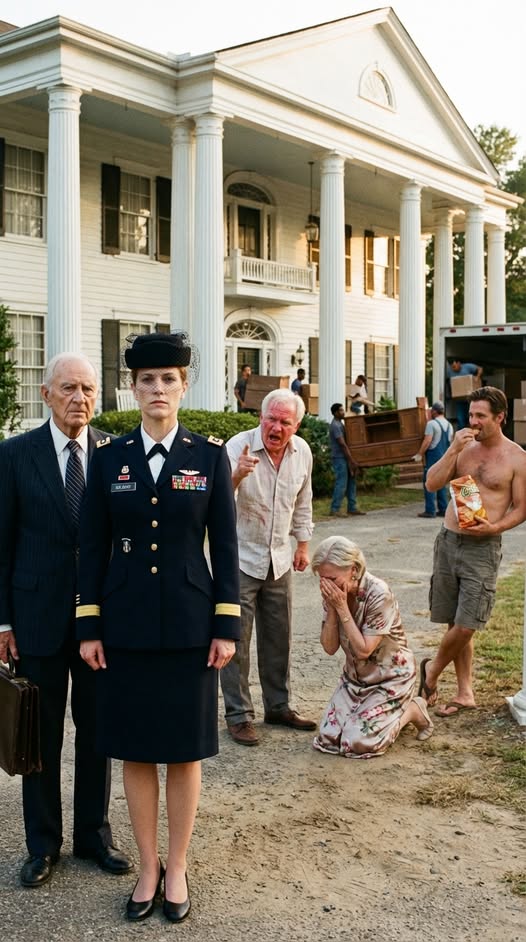
I didn’t drive up to the house the next morning. I parked at the corner and watched. At 8:00 AM, the white moving truck rumbled into my driveway. Gerald emerged, clipboard in hand, directing movers to take my life out to the curb.
I dialed the number. “Charles, the operation is active. The hostiles are on site.”
“Understood, Major. Reinforcements are en route. ETA ten minutes. Hold your position.”
I got out of the car and walked down the sidewalk. I didn’t scream. I didn’t run. I walked to the end of my driveway and planted my feet, crossing my arms in the stance of a soldier on guard duty.
The movers carrying my sofa hesitated. Gerald stormed out. “What the hell are you doing? Get out of the way!”
I said nothing. My silence was a weapon. It was unnerving. Raymond came onto the porch, his face red. “You again? I told you, your time here is done. Leave before I have you removed for trespassing.”
As the word “trespassing” left his mouth, a gleaming black BMW 7-Series glided to a stop, boxing in the moving truck. Charles Peton stepped out. He wore a charcoal suit that cost more than my Jeep and moved with the silent, predatory grace of a shark.
He didn’t look at me. He walked straight to Raymond.
“Raymond Coleman?” it wasn’t a question.
“I am. Who are you?”
“My name is Charles Peton. I am the legal counsel for the estate of the late Marcus Coleman, and I am the personal attorney for my client,” he paused, nodding toward me, “—Major Molly Martin.”
The contrast between his deference and their contempt was a physical shock. Raymond’s bravado began to crack.
“I’m here to inform you,” Charles said, his voice hard as a judge’s gavel, “that you are currently engaged in illegal trespassing and the theft of private property. Every item removed from this house is to be returned to its original position now. If not, my next call is to the Chief of Police—a very dear friend from law school—and you will all spend the night in a downtown holding cell.”
The change was instantaneous. Raymond’s face went from ruddy anger to a pasty, slack-jawed white. They weren’t fighting a widow anymore. They were fighting the Law.
Chapter 6: The Ironclad Reckoning
“I suggest we move this discussion inside,” Charles said.
We walked into the dining room—the very room where I had been dismissed eight years prior. Charles snapped open his briefcase.
“You have no right!” Raymond stammered. “This is a private family matter!”
“Mr. Coleman,” Charles whispered dangerously, “when the assets are valued in the seven-figure range and my client is being illegally evicted, it ceases to be a family matter. It becomes a legal one.”
He slid a blue folder across the table. “These are the deeds to this house, the veterinary clinic on King Street, and the waterfront property. They were refiled years ago under Joint Tenancy. That means one second after Marcus passed, Major Martin became the sole and undisputed owner. The transfer was automatic. Your actions today constitute a felony.”
Gerald made a choking sound. “That’s… that’s not possible.”
“Oh, it’s very possible,” Charles countered. He pulled out the will. “And just in case you felt like arguing, this is the last will and testament. It contains a No-Contest Clause. If any beneficiary attempts to challenge this will, they are treated as if they predeceased the testator. In layman’s terms: you are irrevocably cut off. You forfeit every cent, every heirloom, every photo.”
Patricia began to tremble. “No… Marcus wouldn’t do this to his own family.”
“Madam,” Charles said with brutal lack of pity, “not only would your son do this, he anticipated this exact reaction from you. Your son laid a trap, and you didn’t just walk into it—you sprinted.”
The room went deathly silent. They were defeated. Outmaneuvered by the son they had always underestimated.
“But Marcus knew legal documents might not be enough to penetrate the culture of this family,” Charles continued. “He knew a stronger blow was needed. One aimed at your conscience.”
He pulled out the sealed envelope. “If you still cling to the delusion that this is a misunderstanding, perhaps you should hear it from him.”
Chapter 7: The Nuclear Option
Charles put on his glasses. The room felt heavy, the air thick with dread. He broke the seal and began to read in a voice that carried the weight of a sacred duty.
“To my family,” he began. “If you are hearing these words, it means I am no longer there to stand between my soldier and your cruelty.”
Raymond tried to protest, but Charles pinned him with a stare. “For eight years, you have looked at Molly and seen nothing but a uniform. You saw her sacrifice as a flaw, her courage as an inconvenience. You saw a soldier, but you refused to see the woman—the one who held my hand through every fear.”
The words landed like stones.
“Dad, you demanded a prenup because you don’t trust in love. You only trust in bloodlines. You failed. Mom, you took the scarf she spent weeks knitting and gave it to the help in front of her. It was a gesture of such casual cruelty that it told me everything I needed to know.”
Patricia let out a choked sob—the sound of a woman whose mask had shattered.
“Gerald, Timothy… you treated her like a temporary occupant, already dividing her life before it was even broken. You never understood. I loved her because she is a soldier. She taught me what real honor looks like. She was my moral compass. You do not take a fortress from a soldier.”
I was crying now, but they were tears of fierce pride. He had seen me. He had fought for me from beyond the veil.
“Everything I have belongs to her. By attacking her in her moment of vulnerability, you have proven yourselves unworthy of any part of me. My legacy is the love I have for this woman. Now… get out of her house.”
The silence that followed was the silence of a battlefield after the smoke clears. Raymond collapsed into a chair, a puppet with his strings cut.
“All right,” Charles said, looking at the brothers. “You heard the man. Start bringing it all back in.”
The next two hours were a surreal theater. The arrogant Coleman heirs, sweating in their expensive polos, were forced to haul boxes and furniture back into the house under Charles’s unblinking gaze.
I stood by the door. Patricia approached me, her makeup streaked. “Molly… please… we can talk about this.”
“There is no ‘we,’ Mrs. Coleman,” I said. It was the first time I’d used her formal name. “There never was.”
Before they left, I had one last command. “I want my grandmother’s armchair returned. By you, Gerald. And put it exactly where it was.”
Justice wasn’t a gavel; it was watching them maneuver that floral chair back to its place by the fire.
Chapter 8: The Lighthouse
The fallout in Charleston was swift. News at the country club travels like a summer storm. The Colemans became pariahs. Raymond stopped showing up for golf. Patricia was asked to resign from her charity boards. Gerald’s business deals evaporated. They had lost the only thing they valued more than money: their reputation.
A week later, I received an envelope from Raymond containing a $100,000 check—hush money disguised as an apology.
I took my lighter, watched the flame consume the check, and mailed the ashes back to him in the same envelope. The message was clear: We were done.
I sat in my grandmother’s chair that night, the house finally quiet. I didn’t feel triumphant; I felt a profound, bone-deep peace.
I decided then that I would not sell the clinic. It was Marcus’s heart. With Charles’s help, I restructured it. It is now the Marcus Coleman Memorial Animal Hospital. On weekends, I’m there—answering phones, cleaning kennels, and talking to the military families who now flock there.
We started the Marcus Martin Companion Fund, providing free care for the pets of active-duty soldiers and veterans. I realized that winning the battle wasn’t the end of the mission. It was the beginning of the next one.
I found one last letter tucked in the back of Marcus’s desk.
“My dearest Molly, if you’re reading this, our plan worked. But your new mission, Major, is to live. Live a life that is joyful and loud—just like my mother was always afraid of. Our house was a fortress to protect us. Now, I need you to turn that fortress into a lighthouse. Be a beacon for others. I’m always watching your six. Hold the line, then build something beautiful on it.”
I am standing on my porch now, watching the Charleston sun rise in shades of orange and pink. I’m in my PT gear, ready for my morning run. The air is cool and smells of salt.
Behind me, the house stands strong. It’s no longer just a fortress; it’s a lighthouse. I held the line. I completed the mission. And now, every single day, a new mission begins: to live, to heal, and to pass on a legacy not of bloodlines, but of honor.
My war is over. I am home.