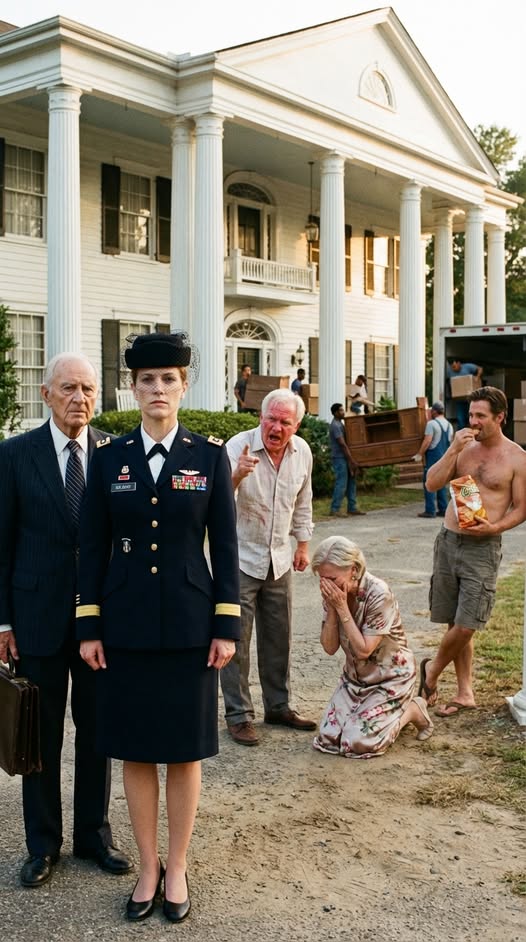
The chimes echoed inside—a cheerful, melodic sound that felt like a mockery. When the door finally creaked open, it wasn’t my husband’s smile that greeted me. It was my brother-in-law, Timothy, shirtless and clutching a half-eaten bag of potato chips. He looked at me with the mild annoyance one might show a persistent telemarketer.
“Oh, it’s you,” he mumbled, his mouth full of salt and grease. He didn’t step aside. I had to shoulder past him to enter my own sanctuary.
Inside, the living room had been transformed from a home into a staging area for an evacuation. My father-in-law, Raymond Coleman, stood in the center of the room like a four-star general surveying conquered territory. He held a clipboard, a pen tucked behind his ear, directing two movers I didn’t recognize. The air was thick with the cloying humidity of the Lowcountry and the sharp, cheap scent of Raymond’s cigar smoke.
“You’re back sooner than we expected,” Raymond said, his voice as flat as a gravestone. There was no “I’m sorry for your loss.” No “How are you holding up, Molly?”
“We’re proceeding with the transfer,” he added, tapping his clipboard.
Transfer. He used the word as if he were decommissioning a military base, not ripping apart the home where Marcus and I had hosted Christmases and held each other on the terrifying nights before my deployments.
Just then, a voice dripped down from the top of the stairs, sweet as honey laced with arsenic. Patricia, my mother-in-law, descended the steps holding my jewelry box—the simple wooden one Marcus had bought me at a craft fair in Ohio.
“My, these things look awfully… simple,” she cooed, her Southern drawl thickening with every step. “Are these standard issue, Molly dear? You can take them, of course. We have no need for them.”
Her eyes shifted to the wall above the fireplace—my wall of honor. My Bronze Star, my Purple Heart, the framed commendations from tours in places she couldn’t pronounce. They were symbols of the blood and sweat I’d given for this country.
“Gerald,” she called to her other son, who was taping up a box of books. “Take those things down. They simply don’t match the aesthetic of the house anymore.”
The words hit harder than any physical blow. It wasn’t about the house. It was about erasure. They were systematically removing any trace that Major Molly Martin had ever existed within these walls. They treated me like a sentry whose watch had ended, a transient soldier whose temporary assignment was over.
But they made a fatal mistake. They thought they were fighting a lone, broken widow. They had no idea they were marching onto a battlefield my husband had already prepared.
Chapter 2: The Cold War Table
To understand the fury in my heart, you have to understand the eight years of “Cold War” that preceded this day. The Colemans never saw me; they saw an intruder.
It started at the very first dinner, years ago. I had spent a week preparing, buying a conservative navy blue dress, practicing anecdotes about my childhood in Ohio, trying to bridge the gap between my world of steel mills and their world of polished mahogany.
When Marcus ushered me into their colonial mansion, the first thing I noticed was the silence—the heavy, oppressive quiet of old money. Everything was polished to a mirror shine. It felt less like a home and more like a museum exhibit on Southern aristocracy.
We sat down to a formal dinner of shrimp and grits. Patricia started the interrogation disguised as polite conversation.
“Marcus tells us you’re a Captain in the Army, dear. You… command men?” she asked, sipping her iced tea.
“Yes, ma’am. A logistics company,” I replied.
“Hm,” she murmured. “It must be very… loud.”
She said the word “loud” like it was a contagious disease I had brought into her pristine dining room. The implication was clear: I was unrefined. I was “new.” I didn’t belong in their world of hushed whispers and inherited silver.
Raymond cleared his throat, fixing me with a gaze that felt like a performance evaluation. “And your family? They’re back in Ohio? Your father worked in the steel mills, I understand.”
It wasn’t a question; it was a statement of fact. I realized then he’d probably run a background check on me before the appetizers were served. “Honest work,” he declared, his tone dripping with a condescension that made my skin crawl. He spoke of my father—a man who worked double shifts for thirty years—as if he were a sturdy, simple-minded workhorse in a history book.
They never asked about my dreams. They performed a clinical dissection of my resume and my roots, finding every piece flawed.
A week before our wedding, Raymond requested a meeting at the Charleston Country Club. Overlooking the manicured greens, surrounded by men in pastel polos, he pushed a document across the table.
“I need you to sign a prenuptial agreement,” he said, stirring his drink. “It’s a simple matter of protecting the family assets. Your career… it’s a high-risk variable. Deployments, war zones—a soldier’s life is inherently unstable. We can’t have our legacy tied to such an uncertain future.”
He wasn’t worried about my safety. He was risk-assessing my life. Our marriage wasn’t a union of love to him; it was a volatile stock he needed to hedge against.
Through it all, Marcus was my saving grace. That night, he held me in our small apartment and whispered, “I’m so sorry, Molly. They don’t see you. All they see is the uniform.”
He was right. To them, the uniform was a costume of the help. To Marcus, it was a part of the woman he loved—the woman who was tough as nails but cried during sappy commercials.
I kept trying, though. For him. One Christmas, I spent months knitting an emerald cashmere scarf for Patricia. I poured hours into it, each stitch a silent plea for acceptance. On Christmas morning, she opened it, smiled that placid, plastic smile, and immediately turned to her housekeeper.
“Eleanor, this would look wonderful on you. A little Christmas bonus.”
Then, without missing a beat, she handed Marcus a Rolex.
In that moment, watching the hurt flash in Marcus’s eyes before he masked it, I finally understood. I would never be enough. I would always be the outsider. But as I stood in my looted living room years later, watching them take my grandmother’s chair, I realized the Cold War was over. The shooting had started.
Chapter 3: The Secret War Room
The true “Endgame” was revealed three months before Marcus passed. We were at a cousin’s wedding at a historic plantation. The air smelled of magnolia and old secrets.
I had slipped away from the reception to find a moment of peace in the gardens. As I rounded the corner of the darkened veranda, I heard voices—Raymond, Gerald, and Timothy.
“When Marcus is gone,” Raymond said, his voice stripped of its public charm, “we have to move fast. The lawyer says a wife has residency rights, but we can apply pressure. She’s a soldier; she’s used to moving. We make it clear she isn’t welcome, and she’ll pack her bags.”
“The vet clinic is the real prize,” Gerald added greedily. “I’ve already spoken to Dr. Henderson. He’s ready to make an offer the moment it’s available.”
My heart hammered against my ribs. They were carving up Marcus’s life’s work while he was still standing in the other room.
“What if she puts up a fight?” Timothy asked.
Patricia’s voice joined them, a venomous whisper. “What is she going to demand? She came into this family with nothing but a duffel bag. She’ll leave the same way. Leave her to me. Woman to woman. I know exactly what to say to make her understand her place.”
I don’t know how I made it back to the table. The drive home was a blur of neon lights and static. When we got inside, I didn’t cry. The soldier took over. I sat Marcus down and gave him an after-action report.
“Objective: Full seizure of assets,” I stated, my voice steady. “Method: Psychological pressure. Timeline: Immediately following your death.”
Marcus gripped the steering wheel of his chair so hard his knuckles turned white. He didn’t doubt me. He knew.
“All right,” he said, his voice low and dangerous. “They’ve declared war. It’s time we draw up a battle plan.”
He went to the hall closet and pulled out a worn leather briefcase I’d never seen. Our kitchen became a secret war room.
“They’ve always thought I was soft,” Marcus began, his voice cold and precise. “They mistook kindness for weakness. They were wrong. I don’t fight like they do. I fight like a strategist.”
He explained that the day his father demanded the prenup was the day he knew this battle was inevitable. He hadn’t gone to the family lawyer. He had sought out a man named Charles Peton—a legal pitbull known in Charleston as “The Cleaner.”
“I’ve met with Charles twice a year for seven years,” Marcus confessed.
For seven years, my gentle husband had been building a fortress around me. He laid out the documents. Defensive Line One: Joint Tenancy with Right of Survivorship.
“The moment I’m gone, ownership of the house, the clinic, and the investments automatically transfers to you,” he said with a grim smile. “It bypasses the will. It bypasses probate. They can’t touch it.”
Defensive Line Two: The Iron Will. It was drafted with the precision of a military order, witnessed by a judge, and notarized.
Then, he pulled out a single sealed envelope. “Defensive Line Three: The Nuclear Option. That isn’t a love letter, Molly. It’s an indictment. If they make a single hostile move, Charles is to deploy everything. He is to read this letter aloud to them in person.”
He took my hand. “I’m sorry I’m leaving you with this fight, Major. But I know you. You won’t back down. Promise me you’ll hold the line.”
“Yes, sir,” I whispered. “I’ll hold the line.”
Six weeks later, the word “cancer” entered our lives. The hypothetical war became a brutally real countdown.