A ripple of applause went around the table. Aunt Celeste dabbed at her eyes. The book club lady cheered. I looked at my mother. I thought about the scholarship to Appalachian State I had turned down at sixteen because she told me, “It’s just the two of us, Simone. You know what this house is without you here.” I had sacrificed my future to stay near a woman who was actively defrauding me. Gloria’s eyes finally landed on me. Her smile thinned. “Simone,” she said, her voice carrying a sharp edge. “You’ve never really been a contributing member of this household. Once Randall is here, things are going to change. You won’t just be showing up on Sundays. You’ll need to call first. You’ll be a visitor.” She laughed, a light, dismissive sound. “I suppose this is your last meal here, the way things have been. But that’s okay. You’re always welcome to visit.” The word “visit” landed like a slap. I felt the last cord of my loyalty snap. I reached into my bag and pulled out the manila envelope. I set it in the center of the table, right between the water pitcher and the basket of rolls. “That’s from my attorney,” I said. The room went so quiet I could hear the clock in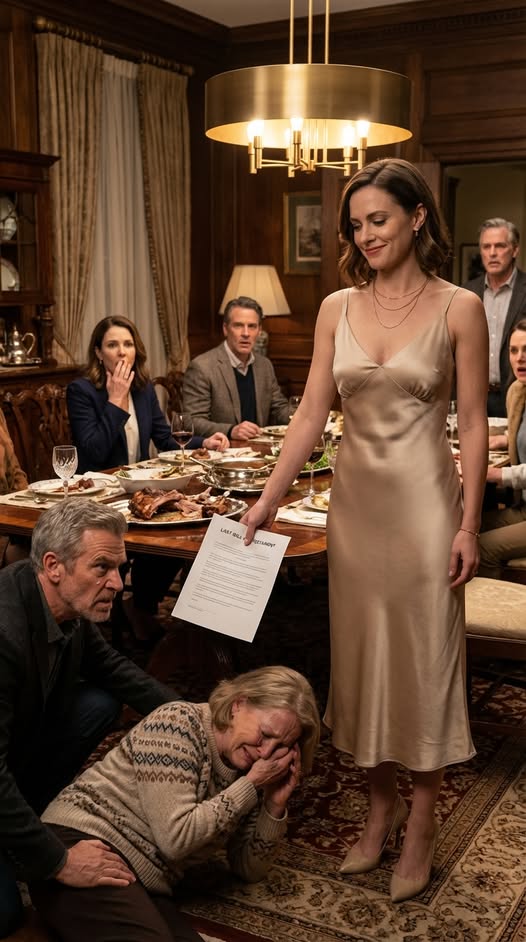
the kitchen ticking toward the explosion. Chapter 4: The Eviction of a Lie: My mother picked up the envelope as if it were a poisonous snake. She pulled out the documents—the cease and desist, the copy of the 2004 deed, and the probate records. She read the first page. Her face didn’t turn red; it turned a sickly, translucent grey. She read the second page, where Earl’s signature sat in bold, black ink.
“What is this?” she hissed.
“It’s a legal notification,” I said, my voice as steady as my grandfather’s hands. “The house has been in my name since 2004. You haven’t had the legal authority to act on behalf of this property since 2009. That document informs you that any attempt to modify the title will result in a fraud suit.”
Aunt Celeste grabbed the paper from Gloria’s hand. She gasped. “Simone? You own this? Since you were seventeen?”
“The records are public, Celeste,” I said. “Anyone with a phone can verify it right now.”
I looked at Randall. He was holding out his hand. I passed him the copy of the deed. He read it with the slow, methodical focus of a contractor checking a blueprint. He looked at the date. He looked at Earl’s signature. Then he looked at Gloria.
“You told me this was your house,” Randall said. He wasn’t yelling. He sounded like a man who had just found a crack in a load-bearing wall.
“Randall, honey, I can explain—” Gloria started.
“The paper doesn’t need an explanation,” Randall said. He stood up, grabbed his jacket, and looked at me. “I’m sorry, Simone. I didn’t know.”
He walked out the front door, and the sound of it closing was the most honest thing I’d heard in that house in years.
The room erupted. My mother turned her fury on me. “Earl would never want this! You’re using a piece of paper to destroy this family!”
“Earl wrote the paper, Mom,” I said. “He wrote it because he knew exactly who you were. You were about to put a stranger’s name on his property. You were about to give away what he built for me.”
“Thirty years I’ve kept this house clean!” she screamed. “Thirty years I’ve paid the bills! A piece of paper doesn’t erase thirty years!”
“It doesn’t have to,” I said, standing up. “The deed doesn’t care about the cleaning. It cares about the ownership. And you’re right, Mom. This is my last meal here. But it’s yours, too.”
I walked out of the house, ignoring the shocked stares of my relatives. I sat in my Subaru and watched the lights of the house. I expected to feel triumphant. Instead, I felt like a room that had been emptied of all its furniture. I was standing in a hollow space, looking at the outlines on the floor where my life used to be.
My phone lit up with a text from a number I didn’t recognize—a Memphis area code. It was my father, Ray. “Heard about the house. Earl always said you’d figure it out.”
Chapter 5: The Weight of the Key
The legal battle lasted six months. My mother filed a deed contest, claiming an “oral agreement” with Earl. She tried to make me the villain in the church pews and the book club meetings.
But as Peg said, “Oral agreements aren’t worth the air they’re printed on.”
In April, the court dismissed her claim and ordered her to pay nearly ten thousand dollars in legal fees. I didn’t ask for back rent. I didn’t pursue the fraud charges. I simply gave her six months to pack her things.
On moving day, the house was a skeleton of itself. The furniture was gone, leaving pale rectangles on the carpet. Gloria sat on the front porch steps, looking at the oak tree Earl had planted in 1975.
“Earl always liked you better,” she said, her voice small.
“He trusted me,” I corrected. “There’s a difference.”
I watched the moving truck disappear around the corner of Birchwood Drive. For the first time in my life, I walked through the front door and didn’t feel like a guest. I walked into the kitchen and touched the counters. They were mine. I walked into the dining room. It was mine.
I went down to the basement. The workbench was still there. I picked up the hand plane and felt the smooth, worn wood of the handle. It fit my hand perfectly.
I took a photograph out of my pocket—a picture of me at sixteen, holding my acceptance letter to Appalachian State. I had looked so happy. I had looked like a girl who was about to go somewhere.
I sat on the basement floor and pulled out my phone. I dialed the number for the graduate admissions office at Appalachian State.
“Hello,” I said when a woman answered. “I’m calling to inquire about the pre-law graduate track. My name is Simone Archer. I think I’m finally ready to start.”
I hung up and looked at the wall of tools. Earl hadn’t given me a house; he had given me a fortress. He had given me the one thing my mother could never provide: permission to exist without her consent.
I went back upstairs, locked the front door, and put the key in my pocket. It was heavy, solid, and real.
Documentation, I realized, isn’t just the difference between a story and a case. It’s the difference between being a shadow and being a person.
I walked out onto my porch and looked at the neighborhood, finally understanding that the only person who can truly hand you the key to your life is yourself.
The End