As the door clicked shut behind them, the fog that had obscured my life for twenty-six years finally lifted. I saw them with a terrifying, crystalline clarity. They weren’t my protectors. They weren’t my foundation. They were just people who happened to share my DNA—people who viewed my existence as a series of obligations that occasionally interfered with their social calendar. I lay there, staring at the flowers Gerald had left, and I felt a new kind of strength beginning to knit itself together in my chest. It was a silent steel, a quiet resolution. I was done. Chapter 5: The Fog Lifts: Gerald visited me twice more before I was discharged. On the third day, he brought his wife, Patricia. She was a woman who radiated a quiet, earth-mother warmth. She didn’t say much at first; she simply took my hand in hers—her palm warm and calloused—and looked at me with a gaze that said, I see you. “You have people, Holly,” she said softly, echoing a thought I hadn’t yet dared to form. “You just haven’t met all of them yet. Some family is born in a delivery room, but the best kind is found in the trenches.” I found out later, through a whisper from Clara the nurse,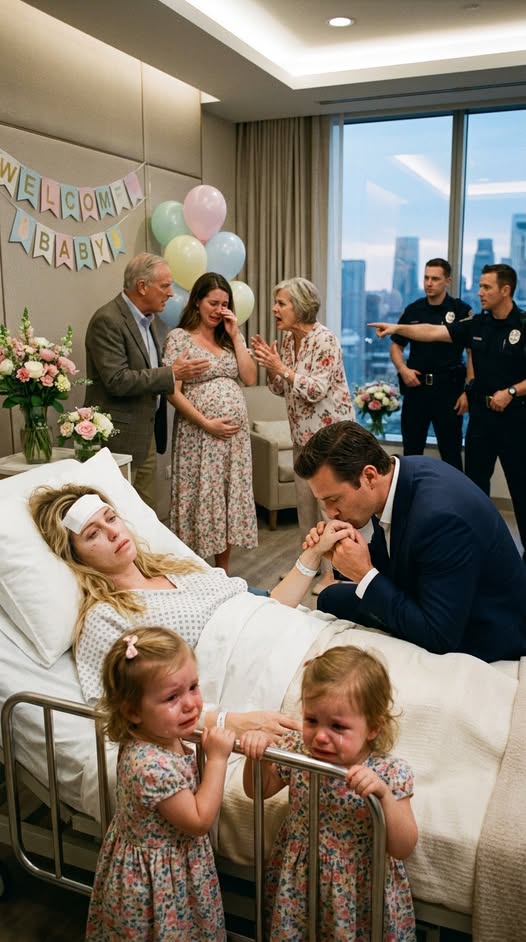
that Gerald hadn’t just paid the bill. He had gone to the Patient Advocacy Office. He had filed a formal report regarding my mother’s attempt to override medical advice for a non-medical reason. He had ensured that there was a legal paper trail of her negligence, a shield in case she ever tried to exert that kind of control over me again.
He never mentioned it to me. He wasn’t a man who traded in gratitude.
When the day of my discharge finally came, my parents didn’t come to pick me up. My father sent a text saying he was “held up at the club” and that I should call an Uber. “You’re a big girl, Holly. You can handle it.”
I didn’t call an Uber.
I walked out of the sliding glass doors of the hospital to find Gerald’s gray sedan idling at the curb. He got out, took my small bag from my hand, and opened the passenger door.
“Ready to go home?” he asked.
“I don’t think I know where home is anymore,” I admitted, my voice trembling.
He looked at me, his kind eyes steady. “Home isn’t a place you go back to, Holly. It’s the place you build with the people who would never leave you on a kitchen floor.”
As we drove away from the hospital, I looked at my phone. I had three new messages from my mother asking if I could “stop by the dry cleaners” on my way home because she was too tired from the shower weekend.
I didn’t reply. I didn’t get angry. I simply swiped the notification away and blocked the number.
The fog hadn’t just lifted; it had been burned away by the sun. I realized that for twenty-six years, I had been rearranging my worth to fit into the tiny, cramped spaces my parents provided. I had been shrinking myself so they wouldn’t feel the burden of my needs.
But I had flatlined. I had seen the absolute silence. And I was no longer interested in being small.
Chapter 6: The Found Lineage
Recovery was a slow process, but it wasn’t lonely.
Gerald and Patricia became the pillars of my new life. They didn’t replace my parents in a legal sense, but they filled the hollow spaces in my soul with the kind of love that is defined by presence. When I had a fever a week after surgery, it was Patricia who brought over homemade soup and sat with me until my breathing leveled out. When my car broke down, it was Gerald who showed up with a toolbox and a thermos of coffee, no questions asked.
My biological parents were outraged at first. They couldn’t understand why I had stopped answering their calls. They couldn’t understand why I didn’t show up for Sunday dinner to hear more stories about my sister’s “angelic” pregnancy.
“You’re being ungrateful, Holly!” my mother screamed during the one and only time I allowed her to corner me in person. “After everything we’ve done for you! We gave you life!”
“You gave me a birth certificate,” I replied, my voice as calm as the surface of a mountain lake. “But on a Thursday morning at 2:00 a.m., a stranger gave me my life. You tried to take it back for a baby shower. There is no coming back from that, Mom.”
I haven’t spoken to them in fourteen months.
People ask me if I regret it. They say, “But they’re your parents.” They use the word like it’s a magic spell that should negate a lifetime of neglect. I just smile and tell them that I’m busy. I’m busy building a life with the people who show up.
I am fully recovered now. The scar on my side is a faded silver line, a map of the night I almost disappeared. I look at it sometimes in the mirror and I don’t feel pain. I feel triumph.
If this story reached you today, I want you to look at the people in your life. Don’t look at the titles they hold—Mother, Father, Sister, Brother. Look at their hands. Are they holding you up, or are they waiting for you to fall so they don’t have to carry you?
Love isn’t a feeling. It’s not a blood type. It’s a choice made in the dark, in the silence, and in the hospital corridors at 4:00 a.m.
Sometimes, nearly losing your life is the only thing that finally shows you whose hands were never truly holding you to begin with. And sometimes, the most beautiful things in your life are the ones that arrive in a simple gray jacket, bearing a bouquet of lilies and a promise to never let go.
My name is Holly Crawford. I am twenty-seven years old. I have flatlined once, but I have never been more alive.
Like and share this story if it moved you. Subscribe to our community for more true stories of survival, betrayal, and the unexpected kindness that changes everything. Your presence here matters—just as much as the people who show up for you.