The Invisible Empire. Chapter 1: The Veil of Privacy. On the day I pledged my life to Nolan Pierce, I carried a secret heavier than the cathedral-length lace trailing behind me. It wasn’t a scandalous past or a hidden debt; it was the sheer, staggering weight of a legacy that defined the skyline of half the Tri-State area. My father, Theodore Hart, had spent forty grueling years transforming a single rented warehouse in Erie into Hart Industrial Systems, one of the most formidable industrial supply empires in Western Pennsylvania. But as the women in the bridal suite at St. Matthew’s in Pittsburgh fussed over my hair, pinning a veil that cost more than their cars, they saw only Evelyn Hart: a quiet project coordinator with a sensible sedan and a penchant for “plain” cashmere coats. I preferred it that way. In a world where every movement is tracked and every asset is appraised, there is a profound, almost primal power in being underestimated. “You look so… grounding, Evelyn,” my soon-to-be mother-in-law, Claudia Pierce, said as she swept into the room. She was draped in silk the color of a bruised plum, her smile as sharp and polished as a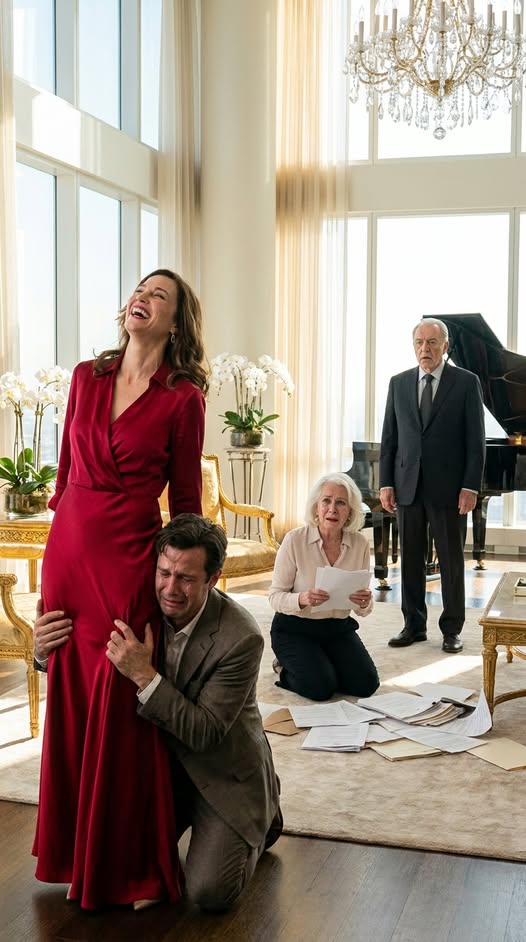
surgical blade. “Nolan has always been such a dreamer. He needs someone like you—someone simple—to keep his feet on the dirt.” Simple. The word hung in the air like a faint scent of ozone before a storm.
I merely smiled. My father hadn’t raised me to worship gold; he had raised me to observe what the prospect of gold did to others. “Never hide your character, Evie,” he would tell me over breakfast when I was a child, “but never advertise your leverage. Let them think they’ve won the map before they’ve even found the territory.”
So, when I met Nolan—a brilliant architect with tired green eyes and a laugh that felt like a sanctuary—I stayed silent. I told him my father ran a “regional supply company.” It was a half-truth, the most dangerous kind. I didn’t mention that the company supplied the steel for the bridges he designed, the HVAC systems for the hospitals he drafted, and the municipal infrastructure for five different states. I didn’t tell him that within two years, my father intended to step down, leaving me as the majority owner of assets that would make Claudia’s head spin.
The wedding was beautiful, understated, and to Claudia, a sign of my “modest” origins. I watched her count the guests, her eyes darting toward my father’s quiet colleagues, dismissing them as middle-management types. She didn’t realize that the man she had sat at the “extended family” table was the CEO of a global logistics firm.
As we danced our first dance, Nolan whispered, “Are you happy?”
“I’m exactly where I want to be,” I replied, tucking my head into his shoulder.
And for six weeks, it was true. We settled into his brownstone in Sewickley, a charming, leafy suburb of Pittsburgh. We navigated the domestic mundanities of marriage—leaving cabinet doors open, arguing over who forgot to call the plumber, and planning a future built on his steady income and my supposed “savings.”
But the peace of Sewickley was a fragile thing. I should have known that the silence I had cultivated wouldn’t just protect my privacy—it would act as a vacuum, inviting someone like Claudia to fill it with her own ambitions.
The storm broke on a Tuesday morning, heralded by the sound of a heavy brass knocker against our front door. When I opened it, I didn’t find a delivery or a neighbor. I found Claudia, standing there with the posture of a queen regent, and a man in a charcoal suit holding a leather portfolio.
“Evelyn, dear,” Claudia said, stepping past me without an invitation. “We need to have a very serious conversation about the future.”
I looked at the man in the suit. His eyes were cold, professional, and entirely devoid of empathy. In that moment, I realized that the “simple” girl was about to be served.
Chapter 2: The Paper Trap
Nolan came downstairs, his shirt half-buttoned, looking between his mother and the stranger with a mounting sense of dread. “Mother? What’s going on? Who is this?”
“This,” Claudia said, smoothing her gloves as she sat on our velvet sofa, “is Gregory Sloat. He’s the family’s primary counsel. And he’s here because I’ve decided that we cannot leave your future to chance any longer.”
Gregory Sloat didn’t waste time. He opened the leather portfolio and slid a thick packet of documents across the coffee table. The header was printed in a stark, authoritative font: POSTNUPTIAL AGREEMENT AND ASSET SEQUESTRATION.
My blood ran cold, not with fear, but with a sudden, searing clarity.
“I’ve seen it happen too many times,” Claudia continued, her voice dripping with artificial sympathy. “Women from… let’s say, lesser circumstances… who find themselves adjacent to a family with potential. They stay for a few years, wait for the career to peak, and then walk away with half of a legacy they didn’t help build. I’m protecting you, Nolan. And Evelyn, if you truly love him for who he is, as you say you do, then your signature on these papers shouldn’t cost you a wink of sleep.”
I looked down at the documents. The terms were draconian. It wasn’t just a waiver of alimony; it was a total surrender of any claim to the Pierce family’s minor investments, the Sewickley house, and even future earnings Nolan might accrue from his architectural practice.
Nolan stared at the papers as if they were a venomous snake. “You brought a lawyer into my home? To interrogate my wife’s intentions? Mother, this is insane. We’ve been married for six weeks!”
“Six weeks is precisely when the rose-colored glasses start to slip,” Claudia snapped. “Gregory, explain the necessity.”
Sloat cleared his throat. “Mr. Pierce, this is a standard framework designed to protect pre-marital and future family interests. It ensures that the Pierce name—and the assets associated with it—remains within the bloodline. It’s a matter of prudence.”
I felt a strange, bubbling sensation in my chest. It was laughter, suppressed and sharp. To them, I was a fortune hunter in a Target sweater. To them, I was a threat because I had “nothing.”
“Prudence,” I repeated, the word tasting like ash. “Is that what you call this, Mr. Sloat? Arriving unannounced to coerce a signature through emotional ambush?”
Claudia’s eyes narrowed. “Don’t use that tone with me, Evelyn. You should be grateful we’re being this transparent.”
“I’m very grateful,” I said, picking up the document. I flipped through the pages, my eyes scanning the clauses with the speed of someone who had been reading labor contracts since she was twenty. “However, I have a few questions. Are you licensed to practice in this commonwealth, Mr. Sloat?”
The lawyer blinked, surprised by the shift in my demeanor. “I am.”
“Then you’re aware that for a postnuptial agreement to be enforceable in Pennsylvania, there must be full and fair financial disclosure from both parties. Otherwise, the document is essentially expensive confetti. Did you include a schedule of my assets in this draft?”
Claudia let out a dry, rattling laugh. “Your assets? Your used sedan? Your checking account with three months of rent in it? Don’t be tedious, Evelyn.”
I looked at Nolan. He was pale, his hands shaking with fury. I could see him realizing that the woman he called mother saw his wife as a parasite.
“Nolan,” I said softly. “You don’t need to sign this. And neither do I.”
“I know that!” Nolan shouted, finally turning on his mother. “Get out. Take your lawyer and your insults and get out of my house!”
Claudia stood, her face a mask of aristocratic outrage. “You’re making a mistake, Nolan! You don’t know who she is! You’re blinded by a pretty face and a quiet mouth!”
“No,” I said, my voice cutting through her tirade like a diamond through glass. “The mistake was thinking that silence is the same thing as emptiness.”
I walked to the door and held it open. Sloat gathered his papers, looking embarrassed, but Claudia lingered. She leaned in close to me, the scent of her expensive perfume cloying and suffocating.
“You think you’ve won?” she whispered. “I will make sure you never see a dime of the Pierce legacy.”
I smiled—a real, genuine smile that didn’t reach my eyes. “Claudia, you should be much more worried about your own.”
As the door clicked shut, the silence in the foyer was deafening. Nolan turned to me, his eyes filled with questions he didn’t know how to ask.
“Evelyn,” he started, his voice cracking. “I am so sorry. I had no idea she would…”
“I know,” I said. I led him to the kitchen, poured two glasses of water, and sat him down. “But before we go any further, I need to tell you exactly who you married.”
The look on his face when I began to describe the 1986 founding of Hart Industrial Systems was something I will never forget.
Chapter 3: The Duquesne Gambit
I told him everything. I told him about the six hundred employees whose livelihoods depended on my family’s decisions. I told him about the trust structures, the boards of directors, and the ironclad pre-marital asset protection I had already signed months before our wedding—not because I didn’t trust him, but because a multi-million dollar corporation is a machine that requires its own insurance.
Nolan sat in silence for a long time. He wasn’t angry; he was processing the sheer scale of the omission.
“So,” he said finally, a ghost of a smile playing on his lips. “When we argued about the $200 plumber’s bill last week…”
“I still think he overcharged us,” I said, and we both laughed—a cathartic, breaking-the-tension sound.
But while Nolan and I were finding our footing, Claudia was busy reorganizing her troops. She was a woman who viewed a “No” as a temporary setback rather than a final answer. Exactly eight days later, I received a text. It was an invitation—or rather, a summons—to lunch at the Duquesne Club.
The Duquesne Club was the old-money heart of Pittsburgh. Wood-paneled walls, oil paintings of stern men, and the muffled clink of silver against china. It was Claudia’s home turf.
“Don’t go,” Nolan urged me that morning. “She’s just going to try another angle.”
“I have to go,” I said, checking my reflection. I had traded the “plain” cashmere for a tailored charcoal suit that screamed authority. “She needs to understand the new rules of the game.”
I didn’t go alone. I asked Miriam Kessler, my father’s general counsel and a woman who had negotiated deals with the toughest labor unions in the country, to wait in the lounge. I wanted Claudia to see that I had a shadow of my own.
Claudia was already seated when I arrived, looking immaculate in ivory silk. She looked like a woman ready to grant a pardon.
“Evelyn,” she said, gesturing to the chair opposite her. “I’m glad you came. That business at the house… it was all a misunderstanding. I was simply overwhelmed with maternal concern.”
“Maternal concern usually doesn’t involve a process server, Claudia,” I said, sitting down. I didn’t order a drink. I didn’t unfold my napkin.
She sighed, a practiced sound of disappointment. “I’ve done some digging, Evelyn. I heard about your father. Theodore Hart. It seems I was… under-informed about the extent of your family’s ‘supply company.’”
There it is, I thought. The pivot.
“Comfortable,” she said, using the word like a bridge. “Your family is quite comfortable. Which changes the nature of our partnership. Nolan’s architecture firm—it’s struggling, isn’t it? The overhead is high, the clients are fickle. With the right injection of capital—Hart capital—he could be the premier architect in the state. And of course, your father’s infrastructure projects would need… design services.”