Chapter 1: The Departure: My name is Joanna Frell, and at thirty-one years old, I learned that silence possesses a terrifying, deafening volume. I was standing at Gate B17 inside the sterile, echoing expanse of McGee Tyson Airport in Knoxville, Tennessee. The clock on the departure screen glared a digital 5:14 AM. The December morning was a raw, biting cold that seemed to seep straight through the concrete of the parking garage and into our bones. Beside me stood my grandmother, Hazel Frell. Her thin, papery hands were curled tightly around the handle of a battered leather suitcase—a relic that had once belonged to my grandfather, Earl, cracked along its seams and stubbornly patched with silver duct tape from a mountain getaway three decades prior. Scattered around us like restless birds were eleven members of my family. They were a flurry of manic energy: checking digital boarding passes, adjusting designer carry-ons, and mindlessly scrolling through their smartphones. The air crackled with the anticipation of an international holiday. My father, Richard Frell, turned to face my grandmother. He didn’t bother to soften his tone.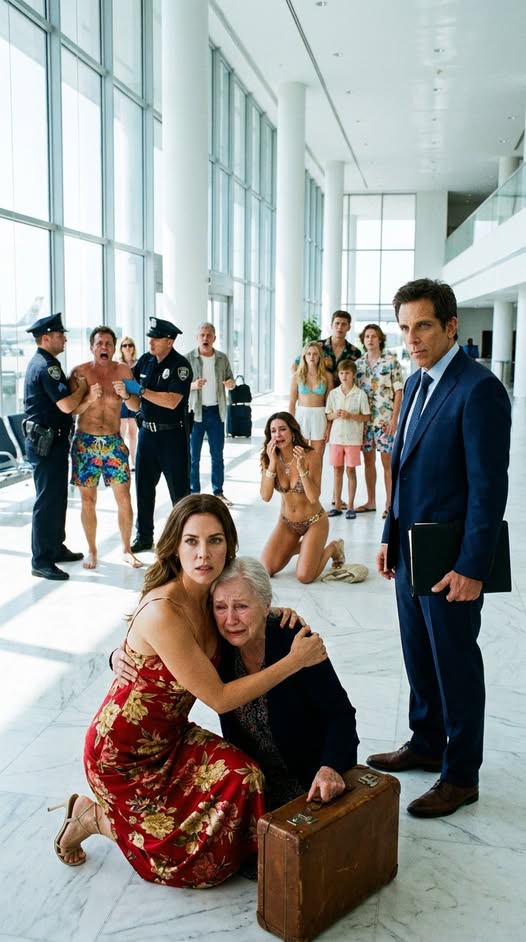
He didn’t lean in to preserve her dignity. “Mom, I must have forgotten to book your ticket,” he stated, his voice carrying over the hum of the terminal. “Just go home.” Eleven people heard him. The uniformed gate agent behind the podium paused, her fingers hovering over her keyboard. An elderly couple waiting in the adjacent boarding lane snapped their heads around to stare. Hazel didn’t gasp. She didn’t argue. With methodical slowness, she unclasped her plastic boarding pass holder. Inside rested a neatly printed itinerary—flight times, hotel reservations, scheduled tours
—but no booking reference. No thirteen-digit ticket number. Nothing but a useless piece of paper. She clicked the holder shut. She didn’t shed a single tear.
What my father couldn’t possibly fathom—what none of them understood in that frigid terminal—was that his three-week European vacation would ultimately cost him everything he had meticulously stolen. Not because I am a master of vengeance, but because a truth buried in silence will eventually tear its way to the surface with ferocious noise.
To understand the gravity of that moment, you have to understand the woman holding the duct-taped suitcase. Hazel spent thirty-four years teaching third grade at Maryville Elementary, shaping minds with a blend of strict discipline and profound kindness until she retired at sixty-five. She had raised two children—Richard and my aunt, Diane Mitchell—entirely on her own after Earl succumbed to lung cancer eighteen years ago. She never entertained the idea of remarrying. She often joked, with a wistful smile, that Earl was the only man stubborn enough to love her correctly.
She resided in the identical three-bedroom ranch house Earl had purchased in 1981, tucked away on a leafy, quiet street in Maryville, forty-minute drive south of Knoxville. Hazel was the sort of matriarch who starched her everyday napkins, manicured her lawn with military precision, and penned letters of gratitude before the ink on a gift tag had fully dried. She swathed birthday presents in the Sunday comics because she deemed shiny wrapping paper a frivolous indulgence. Over two decades, she had squirreled away every spare dollar, fueled by an unwavering conviction that leaving a financial legacy for her bloodline was her ultimate earthly duty.
But lately, the facade of her pristine life had begun to fray. The wooden railing on her front porch wobbled precariously. Her gutters sagged, choking on autumn leaves. A persistent drip from the kitchen faucet was managed only by a plastic mixing bowl she left in the sink overnight. In the dead of winter, her home was uncomfortably brisk; she wore the same three threadbare cardigans in heavy rotation, insisting she simply found them “cozy.”
When I had cautiously broached the subject with my father months prior, he had waved me off with an easy, practiced smile. “Mom’s doing great, Jo. You know how she is—she just hates spending a dime.” I swallowed his reassurance whole. After all, Richard managed her estate. He boasted about checking on her every other week. He claimed everything was seamlessly handled.
I had yet to comprehend the sinister architecture behind that specific word.
The grand European excursion had been unveiled during Thanksgiving dinner. Twelve of us sat shoulder-to-shoulder around Hazel’s dining table, breathing in the scent of roasted turkey and sage dressing. Richard had risen, tapping a spoon against his wine glass.
“I’ve been orchestrating a little surprise for the family,” he announced, beaming. “Three weeks in Europe. Rome, Florence, Paris, London. All of us, making memories.”
The dining room erupted. Diane’s teenagers immediately pulled out their iPhones to Google the Colosseum. Brenda, my stepmother, gasped and launched into a monologue about the boutiques in the Marais district. Greg, Diane’s perpetually stressed husband, peppered Richard with logistical questions.
Hazel sat quietly at the head of the table. Her eyes, usually pools of calm, sparkled with an uncharacteristic, vivid light. She laid her silver fork down and smoothed her palms flat against the linen tablecloth. “I have never crossed the ocean,” she murmured. “Your grandpa always promised we’d see the Eiffel Tower one day.”
Richard cleared his throat, launching into the financial breakdown. “It’s a shared expense, naturally. Flights, accommodations, trains—roughly sixty-five thousand total for the twelve of us.” He shifted his gaze to Hazel. “Mom, your portion would be around thirty thousand, drawn from your retirement account. Only if you want to join, of course.”
She didn’t blink. “I am seventy-four years old, Richard. If not now, when?”
She drafted the check that very weekend. Thirty thousand dollars, extracted from the nest egg she had starved herself of luxuries to build. That same afternoon, she wrestled Earl’s battered suitcase from the depths of the hall closet. She spent weeks meticulously packing, folding her sensible trousers and laying her navy-blue passport atop the garments like a holy relic. When she handed Richard the check, his smile hadn’t reached his eyes. It was a cold, calculated smirk that had lingered in my periphery, gnawing at my instincts.
And now, here we were. 5:14 AM.
“I must have forgotten to book yours. Just go home. We’ll FaceTime you from the Trevi Fountain.” He delivered the dismissal with the casual indifference of a man canceling a dentist appointment.
Diane looked at the floor. Brenda nervously adjusted her silk scarf. Greg suddenly found the digital departure board fascinating. Not a single voice rose in her defense. No one suggested calling the airline. No one mentioned the thirty thousand dollars she had eagerly handed over.
Hazel slipped the empty itinerary back into her worn leather purse. Her hands shook, a faint, rhythmic tremor, but her expression remained an impenetrable mask of dignity. I glanced down at my father’s luggage. Fastened to the handle was a priority tag. Business Class.
Without a backward glance, the eleven of them turned and began the march toward the security checkpoint. They didn’t look back.
Hazel stood stranded beneath the buzzing fluorescent lights, Earl’s suitcase anchoring her to the linoleum. Somewhere in the terminal, a toddler threw a tantrum. The intercom chirped, announcing the boarding of the flight to Rome in forty minutes.
I looked at the crisp boarding pass in my right hand. I looked at the woman who had taught me how to tie my shoes and bake cornbread.
Slowly, deliberately, I ripped the boarding pass straight down the middle.
Richard paused, turning back with a scowl. “Jo, what the hell are you doing?”
“I’m going home with Grandma,” I said, my voice echoing like a gunshot.
Diane halted her march. “Oh, stop being so dramatic,” Brenda sighed, not even bothering to turn around. “Your grandmother wouldn’t enjoy all those cobblestones anyway. Her knees are shot.”
Richard’s cruelty had been chillingly calculated. Brenda’s was thoughtlessly casual. In that moment, I couldn’t decide which flavor of malice disgusted me more.
I stepped forward and seized the handle of Hazel’s suitcase. It weighed a ton. She had packed for three weeks of adventure: her Sunday finest, her reading glasses, a worn Bible, and a stash of butterscotch candies she saved for turbulent flights.
We turned our backs on the security line and walked toward the sliding glass exit doors. I waited for a voice to call out, a footstep to chase us down. There was only the hum of the airport. The automatic doors parted, and the chill of the Tennessee morning hit my face—sharper, more brutal than it had felt an hour ago. It felt like waking up from a long, suffocating sleep.
Hazel reached out, her icy, fragile fingers finding my free hand. “You didn’t have to throw your trip away, sweet girl,” she whispered.
“Yes, Grandma,” I replied, squeezing her hand. “I absolutely did.”
But as I loaded her luggage into the trunk of my car, a terrifying realization washed over me. Richard hadn’t just forgotten a ticket. The priority tags, the casual dismissal, the missing money. As I slammed the trunk shut, my mind began to race, sensing a labyrinth of deceit that I was entirely unprepared to navigate.
Chapter 2: The Silent House
The drive back to Maryville was consumed by an oppressive silence. The heater in my sedan blasted, but Hazel kept her coat buttoned to her chin, staring out the passenger window at the rolling silhouettes of the Appalachian foothills.
I hauled her heavy suitcase over the threshold. She immediately sank into Earl’s old recliner in the living room, her eyes fixed on a blank patch of floral wallpaper. I brewed a pot of chamomile tea, but the mug sat untouched on the side table, growing tepid.
That night, I took refuge in her spare bedroom. The mattress felt paper-thin beneath me. Every twenty minutes, the ancient furnace in the basement rattled violently, fighting a losing battle against the winter draft. I lay awake in the pitch black, my mind a churning mechanism. I was tallying the offenses my father had committed, and meticulously outlining the war I was about to wage.
Dawn broke in a wash of dreary, slate-gray light. I dragged myself out of bed at six-thirty, alerted by the sharp sizzle of grease on a hot stove. Hazel was already in the kitchen. She had brushed her silver hair, pinned it back neatly, and donned her quilted house slippers. She stood over a heavy, black cast-iron skillet, scrambling eggs.
“Your grandfather haggled for this pan at a flea market back in ’73,” she stated, her voice devoid of its usual warmth. “Fifty years, and it still sears a steak better than anything they sell today.”
I pulled out a wooden chair and took a long, hard look at my surroundings. At first glance, the kitchen was a time capsule of my childhood. But the trained eye sees what nostalgia obscures. I opened the refrigerator. It was a cavern of empty space—a half-empty carton of generic milk, a sliver of butter, a lone jar of dill pickles, and the eggs she was currently cooking.
My gaze shifted to the countertop. A row of amber prescription bottles stood at attention. I picked one up. Generic. I picked up another. Generic. Having spent seven years working in geriatric care at Knoxville General, I knew the pharmaceutical landscape intimately. One was for hypertension, the other for severe rheumatoid arthritis. Both were the cheapest, least effective alternatives to the premium brands she had taken for a decade.
I glanced at the digital thermostat mounted on the hallway wall. It read sixty-two degrees.
“Grandma,” I began, keeping my tone deceptively light. “When was the last time Dad actually came by the house?”
She tapped the wooden spatula against the rim of the skillet. “Oh, Richard checks in. He’s a good boy. He makes sure to pick up my mail.”
“He takes your mail?”
“He says it’s much safer,” she replied, plating the eggs. “He warned me about those identity thieves targeting seniors. Says it’s easier if he just handles the paperwork.”
I forced myself to eat the breakfast, masking my growing nausea. After washing the plates and hanging the historic skillet back on its iron hook, I wandered to the front entryway. I knelt by the brass mail slot in the door. The wicker basket beneath it was overflowing, but only with glossy catalogs, grocery circulars, and a faded landscaping flyer from the previous summer.
There were no bank statements. No Medicare summaries. No envelopes from the Social Security Administration. Nothing bearing the seal of a financial institution. Not a single one.
In my profession, you learn to spot the absence of a thing before you notice its brokenness.
Later that afternoon, while Hazel retreated to her room for a nap that looked more like an exhaustion-induced coma, a shadow fell across the porch. It was Loretta Sims, the next-door neighbor. Loretta was sixty-eight, a fiercely observant widow who had retired from the county clerk’s office. She was the sort of woman who noticed the exact hour your porch light burned out but kept her mouth firmly shut unless explicitly invited to speak.
I invited her.
She arrived bearing a foil-wrapped casserole, her eyes darting nervously toward the front door. We sat in the damp cold on the porch rocking chairs. Down the street, cheerful, blinking Christmas lights mocked the gloom of our afternoon.
“I’ve been sick with worry over Hazel,” Loretta murmured, clutching her cardigan tight. “She used to join the church ladies at the diner every single Friday for pie. Cut it out completely about two years back. Whispered to me she couldn’t stretch her pension that far.”
“Couldn’t afford a slice of pie?” I echoed, my chest tightening.
Loretta shook her head grimly. “And your father. He rolls up here every other Tuesday, right around dawn. I watch him from my kitchen window while my coffee brews. He opens the mailbox, scoops everything out, gets right back in his truck, and drives off. Never rings the bell. Never steps foot inside to check if she’s breathing.”
A cold sweat broke out across my back. “Never goes inside?”
“I hate to stir up family drama, Joanna. But a blind man could see the rot. I’ve known your grandmother for nineteen years. She used to bring a massive peach cobbler to the block party every July. The last two summers? She brings a bag of store-bought chips and apologizes that she’s ‘downsizing’.”
I thanked Loretta, took the casserole inside, and stood at the kitchen sink for an hour, staring relentlessly at the empty mailbox through the glass.
When the sun finally dipped below the treeline, I pulled out my cell phone and dialed the toll-free number on the back of Hazel’s debit card. After navigating a maze of automated prompts, a cheerful representative answered.
“I’m calling on behalf of my grandmother, Hazel Frell,” I explained, adopting my most professional, clinical voice. “I need to review her recent account activity.”
“I can certainly try to help with that,” the representative chimed. “Let me just check the authorizations on the profile.” Keys clattered over the line. “Ah. I’m terribly sorry, ma’am, but you are not listed as an authorized party. The sole authorized signer and account manager is Richard Frell. I cannot disclose any information without his verbal consent.”
The tightness in my chest metamorphosed. It was no longer anxiety. It was a pure, unadulterated fury. The trap had been meticulously set, and my father held the only key.
Chapter 3: The Paper Trail
The beige filing cabinet sat in the corner of the spare bedroom, its metal sides dented and labeled with yellowing masking tape. Bills. Medical. Taxes. Personal.
I waited until I heard the steady, rhythmic breathing of Hazel sleeping down the hall before I crept into the room. I slid open the drawer marked Personal. Past a thick folder of ancient Christmas cards and a stack of Earl’s laminated obituaries, my fingers brushed against a thick, heavy-stock envelope.
I pulled it out. It was a six-page legal document, stamped with a crimson notary seal, dated exactly five years ago.
Durable Power of Attorney.
It granted Richard Alan Frell sweeping, unmitigated financial authority over the accounts, real estate assets, and legal affairs of Hazel May Frell.
“He told me it was just a precaution,” a voice whispered from the doorway.
I jumped. Hazel was leaning against the doorframe, her arms crossed tight against her chest, her face pale in the dim light of the bedside lamp. “He said it was just in case I ended up in the hospital, so he could pay the water bill. So the lights wouldn’t get shut off.”
I swallowed hard, my eyes scanning the dense legalese. The powers granted weren’t limited to paying a water bill. The language was ruthlessly broad. Unrestricted access to all banking institutions. Authority to redirect mail. Power to alter beneficiaries on life insurance policies. Discretionary authority to execute withdrawals for the ‘benefit of the principal’.
“Grandma,” I asked, my voice barely a rasp. “Do you have any idea what your current bank balances are?”
She slowly shook her head. “Richard handles the spreadsheets. He always tells me I have a healthy cushion.”
I pulled out my phone and photographed every single page, front and back, capturing the notary’s signature and my father’s scrawl. I slid the document back into its exact resting place and pushed the drawer shut.
“You think he’s done something terrible, don’t you?” she asked, walking over to sit on the edge of the mattress. She stared down at her hands, the skin translucent over blue veins. “He’s my boy, Joanna.”
“I know he is,” I said, sitting beside her. “But if you don’t know your own balance, we have a problem. We need to go to the bank tomorrow. Just to look.”
If you ever find yourself navigating the murky waters of an aging parent’s life, let me offer you a piece of unsolicited, desperate advice: Ask them who holds their Power of Attorney. Ask them if they can log into their online banking. Do not wait for a crisis. Because by the time you notice the cheap medication and the missing mail, the wolves have already eaten their fill.
I barely slept. The next morning, day four of my self-imposed exile from my hospital job, I called my nursing supervisor and requested a week of emergency paid leave. She didn’t press for details; she heard the steel in my voice and approved it instantly.
I started with the bureaucratic monolith of Social Security. After forty-one excruciating minutes on hold, a regional clerk confirmed that Hazel’s direct deposits were indeed active. However, the receiving routing number had been altered twice in the past three years. First, it was moved from her primary checking to a joint savings account. Then, it was diverted entirely to an external account at a different banking institution—one Hazel didn’t even know existed. But the clerk hit the same wall: without Richard’s authorization, they couldn’t give me the destination account number.
At noon, I made a can of tomato soup and two grilled cheese sandwiches in the legendary cast-iron skillet. We ate in a suffocating silence, punctuated only by the hum of the dying refrigerator.
Finally, Hazel pushed her half-eaten sandwich away and stood up. “Get your coat,” she ordered, her voice suddenly commanding. “You’re driving.”
Maryville Community Bank was a modest brick building situated next to an old hardware store. Hazel had maintained her accounts there for over three decades; she knew the tellers by their first names. But what we unearthed inside that quiet lobby made my hands tremble violently—and I am a trauma nurse. My hands do not shake.
The branch manager, a woman named Tina, wore a sharp blazer and an expression of mounting horror as she navigated through Hazel’s financial history on her monitor.
“Mrs. Frell,” Tina began, her voice tight, avoiding Hazel’s gaze. “Your primary retirement savings account… well, five years ago, it held a balance of two hundred and twelve thousand dollars.” She hesitated, swallowing hard. She swiveled the flat-screen monitor so we could see the glaring numbers. “As of this morning, your current available balance is forty-one thousand, six hundred dollars.”
Hazel leaned forward, her brow furrowing. “Tina, honey, your machine is broken. That simply cannot be right.”
Tina silently hit print. The laser printer behind her hummed, spitting out page after page of transaction history. Five years of systematic bloodletting. I laid the sheets flat on the laminate desk and read them, pressing my palms against the paper to hide my tremors.
Three thousand withdrawn here. Five thousand transferred there.
Twelve thousand dollars for ‘Home Repairs’ in March of 2022—the exact month I remembered Hazel complaining about the sagging gutters that were never fixed.
Eight thousand for ‘Medical Out-of-Pocket’ in August of 2023—a month I knew her Medicare and supplemental insurance had covered her minor cataract surgery in full.
And then, the killing blow. The most recent line item, executed eight weeks prior.
Withdrawal: $30,000. Memo: Travel Fund.
Over one hundred and forty thousand dollars had been siphoned away. Evaporated. And every single transfer, every wire, every check was authorized by a solitary digital signature: Richard Frell.
Hazel sat frozen in the stiff vinyl chair. She picked up the thick stack of printouts. She read the top page, her eyes tracking the columns of missing wealth. Then, with agonizing slowness, she folded the papers in half, then into quarters. She unsnapped her purse and tucked the evidence right next to the plastic holder that contained her fake airline itinerary.
She did not scream. She didn’t weep. She sat with the absolute, terrifying stillness of a survivor who has just watched the horizon collapse and is waiting for the shockwave to hit.
“Would you… would you like me to flag the account for fraud, Mrs. Frell?” Tina whispered, looking like she might be sick.
“Not yet,” I interjected, my voice sharp. “We need to understand the full scope of the battlefield first.”
The drive home was a blur. Hazel stared out the window, refusing to turn on the radio. When I killed the engine in the driveway, she didn’t immediately open her door. She placed her hand over mine on the center console.
“How long, Joanna?”
“Five years,” I said, my throat thick. “At least.”
She unbuckled her belt, walked up the steps, and entered the house. She marched straight to the kitchen, opened the empty refrigerator, stared at the jar of pickles, and slammed it shut. She wasn’t hungry. She was visually quantifying everything she had been denied.
“I saved that money for twenty-two years,” she said to the blank wall. “Started the month after Earl was buried. Every teacher’s paycheck. Every meager tax refund. Every summer when my friends went to Florida, and I stayed here to weed the garden.” She turned around, her eyes blazing with a dry, hollow fire. “Every New Year’s Eve, I sat at this very table with a pocket calculator. Two hundred and twelve thousand. I was so damn proud of that number.”
“Grandma, I am so sorry—”
She held up a hand to silence me. “I trusted him because I birthed him. I didn’t verify the statements because a mother shouldn’t have to audit her own son.” She grabbed the back of the dining chair, her knuckles turning white. “That is the part that is going to kill me.”
She retreated to her bedroom and gently closed the door. She didn’t emerge for dinner.
At eleven o’clock that night, as I sat at the table reviewing the bank statements under the harsh overhead light, Hazel walked out. She was wearing her thick robe, her reading glasses perched on the bridge of her nose. She sat opposite me, folded her hands over the tragic ledger, and looked me dead in the eye.
“Help me fix this, baby.”
Not destroy him. Not make him bleed. Fix. Restore. Reclaim. Those three words told me everything I needed to know about the steel spine of Hazel Frell.
“We need a lawyer, Grandma,” I said. “A predator. Someone who specializes in elder abuse.”
She nodded solemnly. “I don’t want my boy in a penitentiary. This isn’t about putting him behind bars. It’s about taking my dignity back, and making damn sure he can’t touch another cent.” She tapped a manicured finger against the bank printout. “Your grandpa would have burned Richard’s house to the foundation.”
“We aren’t committing arson,” I promised. “We’re going to be much more surgical than that.”
Before I went to sleep, I sent a secure text to Dr. Patel, the chief of geriatrics at my hospital. Need the most vicious elder law attorney in East Tennessee. Urgent.
Three minutes later, my phone buzzed in the dark.
Marcus Webb. He doesn’t take prisoners. He doesn’t lose.
I saved the number. I finally had a target, and a plan. And a plan is the only thing that separates paralyzing grief from lethal action. But to win, I needed an undeniable weapon. I needed a confession.
Chapter 4: The Digital Smoking Gun
Day six arrived with a cruel digital taunt. My phone vibrated with a notification from the “Frell Family Vacay” WhatsApp group. It was a sun-drenched selfie of Richard, his arm draped casually over Brenda’s shoulder, the ancient columns of the Colosseum looming behind them. They were both sporting expensive, oversized sunglasses.
Caption: Day Three in Rome! Living the absolute dream. Missing you all!
I scrolled further. There was Diane, wrapped in a designer silk scarf, posing dramatically on the Spanish Steps. There was Greg, treating the kids to towering cones of artisanal gelato. There was Brenda at a vineyard in Tuscany, hoisting a crystal glass of wine toward the camera, the golden hills rolling endlessly in the background.
A moment later, Richard sent a private text to Hazel’s phone. A solo selfie in front of the Trevi Fountain.
Miss you so much, Mom. Wish you were here to see this. Love you!
Hazel was seated in Earl’s recliner, working on a crossword puzzle, when the screen lit up. She picked up the phone, adjusted her glasses, and read the message. Her expression didn’t shift. She simply turned the phone face down on the armrest and penciled in a six-letter word for ‘betrayal’. She did not reply.
Once she was asleep, I took her phone into the kitchen. I opened the group chat and scrolled relentlessly backward, past the Italian landscapes, past the airport check-in complaints, back to the weeks leading up to the trip. I found a thread where Richard had shared a screenshot of the master flight confirmation.
Twelve names. Twelve tickets.
I pinched the screen to zoom in. I scoured the pixelated text. Hazel’s name wasn’t on the manifest. It had never been on the manifest.
I kept digging, diving into the forwarded booking details Richard had emailed to the group. I found the seating chart. Three passengers had been flagged for an upgrade to international Business Class: Richard Frell, Brenda Frell, and Diane Mitchell.
Cost per upgrade: $4,200.
Payment method: Visa ending in 7841.
I looked at the bank printout on the table. Account 7841. Hazel’s primary savings.
They were drinking Tuscan wine she had been too frugal to purchase for herself. They were sleeping in lie-flat leather seats at thirty thousand feet, financed by the money she thought was safely generating interest for her medical care.
I set the phone down. The circumstantial evidence was damning, but a savvy lawyer could argue miscommunication. I needed undeniable intent. I needed a smoking gun.
Hazel’s desktop computer was an archaic Dell tower banished to the corner of the guest room, humming like a jet engine when it powered up. Richard had set it up for her years ago, creating a shared “Family Hub” email address where he purportedly managed household bills and digital correspondence. Hazel, terrified of breaking the machine, rarely touched it. She didn’t even know the password.
But Richard, arrogant in his absolute control, had left the browser perpetually logged in.
I opened the email client. My eyes scanned the inbox—mostly spam and automated bank alerts. I switched to the Sent folder and began sorting by date, walking backward through the digital footprint of my father’s deceit.
Three months prior to the Thanksgiving announcement. An email from Richard to Diane.
Subject: Trip Logistics / Mom.
My pulse hammered against my ribs. I double-clicked the thread.
It was a short message, but the second paragraph hit me with the force of a physical blow.
Don’t worry about booking Mom’s ticket with the group block. Tell her we’ll handle the paperwork on our end. She’s completely clueless about the accounts now anyway. She won’t even notice the money’s gone.
I read it twice. A third time. The words burned themselves onto my retinas. She won’t even notice. It wasn’t an oversight. It wasn’t a moment of financial panic. It was a cold-blooded, premeditated execution of her trust.
I scrolled down to the forwarded chain below it. It was correspondence between Richard and a luxury travel concierge.
Please upgrade the Frell party (3 seats) to business class for the transatlantic legs. Charge the balance to the account ending in 7841. Keep this off the master itinerary sent to the group.
I walked out to the living room and retrieved Hazel’s purse. I pulled out the plastic boarding pass holder and extracted the printed itinerary Richard had handed her. I laid it on the desk next to the computer screen.
It was a masterpiece of forgery. He had taken the real master itinerary, meticulously photoshopped Hazel’s name onto a copy, aligned the fonts, and deleted the booking reference codes. He had crafted a phantom ticket to pacify a seventy-four-year-old woman so she would pack her bags, say her goodbyes, and march into an airport terminal believing she had a seat on a plane.
I must have forgotten your ticket.
He hadn’t forgotten a damn thing. The plan, from the very beginning, was to abandon her at the gate.
I found a blank USB drive in my laptop bag. With mechanical precision, I downloaded every single email. I exported the forged itinerary. I saved the receipts for the business-class upgrades. I created a master folder on the drive, labeled it ‘Evidence,’ and safely ejected it.
I closed the humming Dell laptop. The silence in the house was no longer heavy; it was charged, lethal, and ready to detonate. I picked up my phone and dialed the number for Marcus Webb.
Chapter 5: The Architect of Ruin
Day eight. Knoxville.
The law offices of Marcus Webb occupied the second floor of a restored brick building near the historic Market Square. It wasn’t a sprawling corporate firm; it was a boutique operation—four attorneys dedicated exclusively to elder law and estate litigation. The waiting room was unpretentious, adorned with worn vinyl chairs and a faded print of the Smoky Mountains.
Marcus Webb was forty-eight, tall, with sharp features and a dusting of gunmetal gray at his temples. He wore a crisp navy suit and wire-rimmed reading glasses that he habitually pushed up the bridge of his nose. His desk was a monument to order: a single yellow legal pad perfectly centered, two Montblanc pens resting parallel to each other.
Hazel sat opposite him, swathed in her protective navy coat, her spine rigid. I sat to her left. I didn’t speak. I simply slid the USB drive, the photographs of the Power of Attorney, the bank’s transaction history, and Loretta’s handwritten witness statement across the polished mahogany.
Marcus picked up the documents. For twenty-two agonizing minutes, the only sound in the office was the turning of pages and the soft click of his mouse as he navigated the contents of the flash drive. He didn’t sigh. He didn’t react. He merely consumed the data.
Finally, he pushed his glasses up, leaned back in his leather chair, and fixed his gaze on my grandmother.
“Mrs. Frell,” Marcus began, his voice a smooth, resonant baritone. “What we have here is textbook, actionable financial exploitation of a vulnerable adult under Tennessee Code section 71-6-117. It is egregious, it is documented, and it is highly illegal.”
He leaned forward, tapping a finger against his legal pad. “We have four immediate avenues of attack. One: I file an emergency ex parte petition to revoke the Power of Attorney and freeze all assets. Two: We initiate a civil suit for the total recovery of all misappropriated funds, plus punitive damages. Three: We file a formal referral to Adult Protective Services, triggering a state investigation. Four: We hand this binder to the District Attorney for criminal grand larceny charges.”
Hazel didn’t flinch. “I just want my money returned, Mr. Webb. And I want my name restored as the sole owner of my accounts. No prison.”
Marcus nodded slowly. “I can facilitate the restitution. But you must understand, Mrs. Frell, when I strike, this does not go away quietly. Your son will feel the impact.” He paused, his eyes narrowing slightly. “Before we proceed… do you happen to know who the current beneficiary is on your life insurance policy?”
Hazel frowned. “Why, it’s split evenly between Joanna and the elementary school. It has been for ten years.”
Marcus turned his monitor toward us. “According to the portal access I just ran… the beneficiary designation was altered eighteen months ago. The new, sole beneficiary upon your passing is Richard Alan Frell.”
The air left the room. Hazel stared at the glowing screen. She didn’t blink. The betrayal had metastasized from theft of her life to a wager on her death.
Marcus closed the digital file with a sharp click. “I will draft the petitions tonight. We go to war tomorrow.”
Days nine through twelve were a masterclass in legal surgery. Marcus moved with terrifying precision. The emergency petition to revoke the POA hit the judge’s desk on Tuesday morning. The motion for a temporary restraining order on every account bearing Hazel’s name followed by noon. Hazel signed a mountain of affidavits at her kitchen table, her reading glasses slipping down her nose, her coffee growing cold.
The bank, terrified of complicity the moment they saw the court seal, complied instantly. Hazel’s accounts were locked in a vault of judicial ice. No withdrawals. No electronic transfers. No credit card authorizations. For the first time in half a decade, Richard was completely locked out.
On day eleven, the trap snapped shut halfway across the globe.
Richard’s premium credit card, tethered directly to Hazel’s drained savings, was declined at a luxury boutique in Venice.
He texted Hazel frantically. Mom, something crazy is happening with the bank. Card declined twice. Fraud alert maybe? Can you call the 1-800 number?
Hazel read the text. She handed the phone to me. “What do I say?”