Chapter 1: The Anatomy of a Fracture: The late afternoon sun filtered through the Venetian blinds of my downtown office, slicing the room into long, gold ribbons across the mahogany desk. It was a space I had designed to be a fortress—a sanctuary of blueprints, steel, and glass where I’d spent more nights than I cared to admit. I was currently laboring over the structural schematics for the Morrison Center, my pen hovering over a load-bearing anomaly near the east foyer, when my phone vibrated against the polished wood. The display read: Isabella Griffin. My daughter. A reflexive smile tugged at my mouth. It was graduation day, and I expected to hear a frantic question about the tassel’s orientation or a joke about the impending three-hour ceremony. I expected excitement. I expected the sound of a seventeen-year-old standing on the precipice of her future. “Hey, buddy,” I answered, leaning back in my leather chair. What filtered through the speaker was not excitement. It was a sound that made the blood in my veins turn to slush. Sobbing. It wasn’t the sobbing of a child who’d scraped a knee, nor the frustration of a teenager who’d failed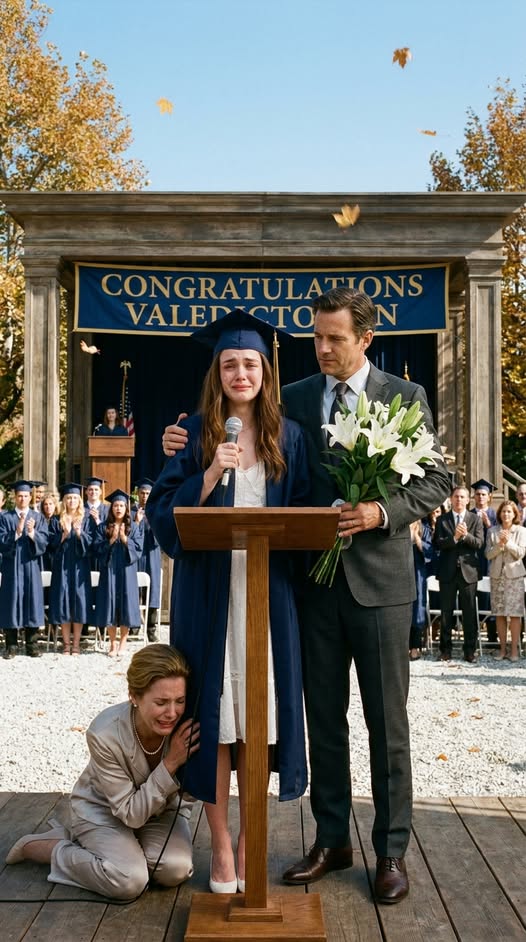
a test. It was a raw, visceral, and utterly broken sound—the kind of noise no young woman should ever have to produce, least of all on the day meant to be her crowning achievement. “Dad,” Isabella gasped, her voice fracturing so violently I barely recognized it. “She… she’s annihilated them.” I sat bolt upright, the blueprints forgotten. “Isabella, take a breath. Talk to me. What’s happened?” “Mom shredded my cap and gown.” Her breathing was jagged, punctuated by the frantic rhythm of a panic attack. “There are just… strips of blue fabric everywhere. She left a note on my
pillow.” My fingers clamped around the phone until my knuckles turned a ghostly white. “What did the note say, Isabella?” A heavy silence followed, save for her hitching breath. Then, she whispered the words that would haunt me for years: “It says I’m not her daughter anymore. It calls me a… a failure.”
For a heartbeat, the office ceased to exist. The framed awards, the city skyline through the window, the career I had built from the dirt up—all of it felt like cardboard compared to the sound of my daughter disintegrating on the other end of a cellular signal.
Twenty years of marriage to Candace Mann, and I had foolishly believed I had mapped the deepest trenches of her cruelty. I had spent two decades navigating the minefield of her ego, surviving the frigid silences and the razor-sharp criticisms that she wielded like a scalpel. I had endured her family’s elitism and her obsession with “The Mann Standard.”
But this? This was a demolition of the soul.
“I can’t show up, Dad,” Isabella said, her voice small. “I can’t walk across that stage. I can’t face them. I just want to disappear.”
“Listen to me,” I said, already surging out of my chair and sweeping my keys from the desk. “Do not move. Stay in your room. I am coming to get you, and we are going to that ceremony. Do you understand?”
“But I have nothing to wear—”
“Trust me, kiddo. I have a plan.”
The drive from downtown to the mansion we had once shared took fifteen minutes, but in my mind, it was a journey through twenty years of structural decay. I had met Candace at a charity gala hosted by her father’s real estate empire, back when I was a hungry young architect with a construction foreman’s grit and a head full of dreams. She was stunning, possessing a sharp-witted elegance that seemed tailored into her very marrow.
At the time, she told me she wanted authenticity. She claimed to loathe the stiff, inherited wealth of the men her parents, Roger and Lynn Mann, tried to force upon her. I was the “son of the soil,” the man who understood how to read a joist and a budget, and for a while, I believed I was her rebellion.
But as my own firm flourished, as I began to win commissions based on my talent rather than her family’s connections, the dynamic shifted. Candace didn’t want a partner who could build his own world; she wanted a trophy she could polish and place on a shelf.
The poison eventually trickled down to Isabella. She didn’t see a daughter; she saw a project. An extension of the Mann brand that was currently failing to meet its quarterly quotas.
I pulled into the gravel driveway, my heart hammering against my ribs. Technically, the house was still a joint asset, though I’d been living in a stark apartment downtown for four months. The separation was a cold war, one Candace was intent on winning by controlling the narrative and, by extension, our daughter.
Isabella met me at the door. At seventeen, she had my dark hair and athletic build, but the sharpness of her features was all Candace. Right now, however, she looked hollow.
“Show me,” I commanded.
She led me upstairs to a room that smelled of old books and discarded childhood. The navy-blue graduation gown lay in ribbons across her bed. It hadn’t been torn in a fit of rage; it had been methodically, surgically shredded with scissors. It looked like a pile of blue confetti. The gold tassel had been snipped into tiny threads, scattered like dust across her pillow.
The note sat in the center of the wreckage, written in Candace’s perfect, rhythmic cursive.
You are no longer my daughter. You are a failure. You have proven yourself to be mediocre, embarrassing, and utterly beneath the Mann standard—just like your father. Do not look to me for university tuition. You are on your own.
I read it twice, the words searing into my retinas.
“Dad,” Isabella said, her voice barely audible. “I maintained a 3.7 GPA. I made varsity cross-country. I got accepted to three major universities. Why does she hate me so much?”
I turned and gripped her shoulders. “Because you are not a puppet, Isabella. You are a human being, and you had the audacity to become someone she couldn’t script. To a woman like your mother, that isn’t a choice—it’s a betrayal.”
I looked at the walls of her room—posters of the Pacific Crest Trail, ecology textbooks, and photos of her mud-streaked and grinning at finish lines. This was the person Candace refused to acknowledge.
“Get dressed,” I said. “Put on that charcoal suit we bought for your interviews. I’ll be back in ninety minutes.”
“Where are you going? Graduation starts at seven.”
I gave her a look that usually preceded a hostile boardroom takeover. “I’m going to go collect a debt. Stay ready.”
As I walked out, I knew the foundation was cracked beyond repair. But even a ruined building can have a spectacular demolition.
Chapter 2: The Hidden Rank
My first stop was the school district’s administrative office. I had made several calls on the drive over, and Principal Vera Rice had agreed to meet me despite the late hour. Vera was a woman of formidable structure—stocky, with steel-gray hair and eyes that had seen every trick in the book.
“Steven, I saw the photos you messaged me,” she said, ushering me into her office. Her voice was taut with a quiet, seething anger. “That is more than a mother’s disappointment. That is domestic sabotage.”
“It’s a declaration of war,” I corrected, leaning over her desk. “Principal Rice, I need two things. I need a replacement cap and gown, and I need to know the truth about Isabella’s final class ranking.”
Vera looked at her computer screen, her brow furrowing. She typed for a moment, then rotated the monitor toward me. Her finger traced a line beneath Isabella’s name.
“This was meant to be confidential until the ceremony,” she murmured. “But given the circumstances, I think the hierarchy needs to be established. Isabella isn’t just graduating with honors, Steven. She is graduating as the Valedictorian.”
The word hit me like a physical blow. A weighted GPA of 4.2. She had surpassed the runner-up, Meredith Bird, by a mere point zero three.
“She didn’t tell me,” I whispered, my chest tightening with a complex cocktail of pride and incandescent rage.
“She was informed yesterday,” Vera said. “She told me she wanted to surprise her father at the dinner afterward. She wanted to give you one untainted moment of joy.”
The pieces of the puzzle suddenly clicked together with a sickening metallic snap. Candace hadn’t shredded that gown because Isabella was a “failure.” She had shredded it because she had found out she was the best.
Vera Rice leaned back, her eyes narrowing. “You should know that Meredith Bird’s mother, Erin Bird, sits on the school board with Candace. They’ve been locked in a social arms race for fifteen years. Candace must have found out through a leak on the board.”
I understood the pathology instantly. In Candace’s warped reality, Isabella’s success was an insult because it happened in a field she found “impractical”—environmental science. She had won, but she had won on her own terms, which meant she couldn’t claim credit for the victory. If she couldn’t own the Valedictorian, she would simply ensure the Valedictorian didn’t exist.
“I have a request, Vera,” I said, my voice dropping to a low, dangerous frequency. “I want to change the order of the ceremony. And I need a specific list of the guest speakers.”
Vera Rice studied me for a long time. Then, a sharp, wolfish smile touched her lips. “Candace Mann has spent the last three years trying to cut our ecology funding and calling Isabella’s independent study ‘tree-hugger nonsense.’ I think it’s time the school board saw what success actually looks like.”
“What about the gown?”
“I’ll have a fresh one in my office,” she promised. “And Steven? Make it count.”
I left the office and dialed a number I hadn’t called in years. Arnold Costa. Arnold was an old-school tailor downtown who owed me a favor from when I designed his flagship store.
“Arnold, it’s Steven Griffin. I need a miracle. A full navy cap and gown, adult medium. I need it in an hour.”
“Graduation season, Steven? You’re asking for a miracle,” Arnold’s raspy voice crackled.
“Candace shredded my daughter’s gown three hours before the walk.”
The line went silent for a beat. “I’ll be at the shop in ten minutes. I’ll pull one from the back stock if I have to steal it from the manufacturer myself.”
By the time I returned to get Isabella, the “Plan” was no longer a hope. It was a blueprint.
Isabella was waiting by the door, dressed in her charcoal suit, looking like a woman awaiting a sentencing. I handed her a small, sealed envelope I’d picked up from the printer.
“What’s this?” she asked.
“That,” I said, “is the script for the rest of your life. Get in the car, Valedictorian.”
Isabella’s eyes went wide. She stood frozen on the porch. “You found out?”
“I found out,” I said, grabbing her arm and pulling her toward the SUV. “And by the time tonight is over, the entire city is going to know too.”
Chapter 3: The Gathering of the Phalanx
We didn’t go straight to the high school. I made a detour to the State University campus, pulling up in front of the Ecology Department building. Waiting by the curb was Professor Timothy Stevens, a man with a weathered face and the calloused hands of someone who spent more time in wetlands than in lecture halls.
“Professor,” I said, stepping out of the car. “Thank you for coming.”
Stevens looked at Isabella, then back to me. He held a thick, embossed folder. “Isabella is one of the most brilliant students I’ve mentored in twenty years, Mr. Griffin. When you told me what happened… well, academic sabotage is a crime I don’t take lightly.”
He leaned into the car window. “Isabella, the research assistant offer I mentioned? The one we were going to discuss next week? Consider it officially signed. Full funding for your freshman and sophomore years, working on the Great Wetlands Restoration Project. You’ll be co-authoring your first paper by Christmas.”
Isabella’s jaw dropped. For the first time all day, the haunted look in her eyes was replaced by a spark of genuine, incandescent hope. “Full funding? But Mom said—”
“Your mother doesn’t decide your worth,” Stevens said firmly. “I’ll see you at the ceremony. I wouldn’t miss this speech for the world.”
We pulled away, and the silence in the car was finally comfortable. Isabella held the folder from Stevens like it was made of glass.
“He really thinks I’m that good?” Isabella whispered.
“He knows you are,” I replied. “Now, listen carefully. When we get to the school, you’re going to stay in the back with Principal Rice. I’m going to go to the main seating area. I want you to avoid your mother until you are standing at that podium.”
“Dad, she’s going to be in the front row. She’ll try to stop me.”
“She won’t,” I said. “Because I’ll be sitting right next to her.”
We arrived at the high school at 6:30 PM. The parking lot was a chaotic sea of minivans, SUVs, and students in fluttering navy gowns. I saw the Mann family’s black Mercedes parked in the VIP section. Candace was already there, no doubt holding court with her parents, maintaining the fiction that her daughter was “unwell” and would be missing the ceremony.
Principal Rice met us at the side entrance. She ushered Isabella into a back room, zipping her into the fresh gown Arnold Costa had provided. It was a perfect fit. She then handed her the gold honor cords—thick, braided symbols of her academic dominance.
“You look like a leader, Isabella,” Vera said, her voice softening. “Now, go show them why.”
I made my way into the auditorium. It was a cavernous space, smelling of floor wax and nervous energy. I scanned the front row and saw her. Candace looked impeccable. She wore a cream-colored designer dress and pearls, her hair styled in perfect, cold waves. To her left sat Roger and Lynn Mann, both looking as if they were attending a funeral rather than a graduation.
I walked down the center aisle, feeling the eyes of the local socialites on me. I took the empty seat directly to Candace’s right.
She stiffened as if I were a contagion. “Steven? What are you doing here? I told you, Isabella is having a nervous breakdown. She’s back at the house.”
“Is she?” I asked, my voice conversational. “That’s strange. I could have sworn I just saw her.”
Candace’s eyes flashed with a frigid anger. “Don’t start your games, Steven. She isn’t coming. She’s a failure who couldn’t handle the pressure of graduation. I’ve already informed the school board that she’s withdrawing.”
“Well,” I said, leaning back and crossing my legs. “I suppose we’ll just have to wait and see what the Principal has to say about that.”
The lights dimmed. The processional began.
Candace didn’t even look up as the first students began to file in. She was busy on her phone, likely texting Erin Bird to gloat about Meredith’s impending victory. But as the students in the ‘G’ section began to walk, I felt her entire body go rigid.
Isabella walked in at the end of the line, separate from the others. She moved with a quiet, devastating confidence. The gold cords gleamed under the stage lights. Her head was held high, and for the first time in her life, she didn’t look toward the front row for approval.
Candace’s head snapped up. Her face went from a pale ivory to a splotchy, panicked red. Her breath caught in a sharp, audible hiss.
“How… how is she here?” she whispered, her hands shaking as she clutched her designer purse.
“She’s here to graduate, Candace,” I said. “And it turns out, she’s going to do it in style.”
Chapter 4: The Sound of a Falling House
The ceremony proceeded with the agonizing slow-motion of a car crash.
Awards were presented. The choir sang a soaring, hopeful anthem. Through it all, Candace sat beside me like a statue carved from salt. I could feel the frantic energy radiating off her—the sound of her brain desperately trying to find a way to spin this. She whispered fiercely to her mother, Lynn, whose face had twisted into a mask of pure aristocratic disdain.
“You told everyone she was sick,” Lynn hissed at her daughter. “You look like a fool, Candace.”
“I’ll handle it,” Candace whispered back, though her voice lacked its usual iron.
Finally, Principal Rice returned to the podium. The room went silent.
“Every year,” Vera began, her voice echoing through the rafters, “we honor the student who has demonstrated the highest level of academic rigor and intellectual curiosity. This year, the race was exceptionally close—separated by a fraction of a point.”
I saw Erin Bird lean forward, her camera ready, a look of smug certainty on her face. Candace’s knuckles were white.
“Graduating with a weighted GPA of 4.2,” Vera continued, “having completed an independent university research study and served as a state-ranked athlete… please welcome your Valedictorian, Isabella Griffin.”
The auditorium erupted.
The sound wasn’t just polite applause; it was a roar. Isabella’s cross-country teammates were on their feet, whooping and hollering. The students—the ones who knew how hard she’d worked while her mother mocked her interests—gave her a standing ovation that lasted nearly a full minute.
I watched Candace. It was a fascinating study in structural failure. Her mouth opened and closed, but no sound emerged. She looked at the gold cords around Isabella’s neck—the cords she had tried to prevent her from wearing by shredding her gown—and she seemed to physically shrink in her seat.
Isabella stepped up to the podium. She adjusted the microphone. She looked out over the crowd, her gaze lingering on her mother for exactly one second. It wasn’t a look of anger. It was a look of total, unburdened indifference.
“Thank you,” Isabella began. Her voice was steady, resonant, carrying the weight of a woman who had finally found her own foundation. “When I was writing this speech, I spent a long time thinking about what it means to be a ‘success.’ In the world I grew up in, success was defined by prestige, by family name, and by meeting expectations that weren’t mine.”