A low murmur rippled through the audience. “But yesterday,” Isabella continued, her voice growing stronger, “someone told me I was a failure. They told me that because I chose my own path—environmental science, athletics, a state university—I was beneath the standard. They even tried to make sure I couldn’t stand here today.” Candace gasped, her hand flying to her throat. The people in the rows behind us began to whisper, their eyes darting toward her. “But standing here,” Isabella said, “I realize that being a failure in the eyes of someone who only values image is the greatest success I’ve ever achieved. I’ve realized that the only person I need to be ‘good enough’ for is myself. And I am enough.” She then looked toward the back of the room. “I want to thank my father. Not for his money, and not for his connections, but for being the only person who saw the woman I was trying to become and having a plan to help me get there.” The applause was thunderous. Isabella sat back down, and for the rest of the ceremony, the Mann family sat in a bubble of absolute, humiliating silence. As the graduates filed out, the traditional cap toss filled the air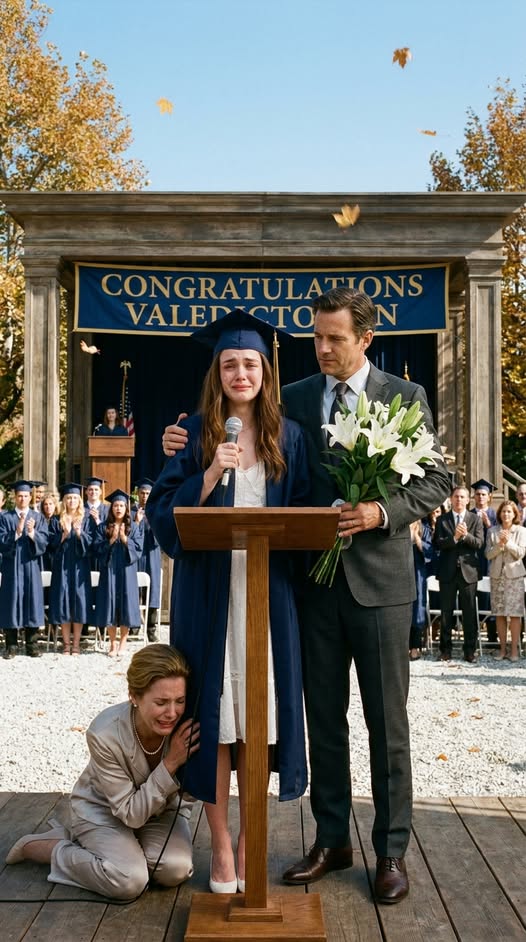
with navy-blue mortarboards. Isabella caught hers and walked straight toward me, ignoring the frantic, reaching hand of her mother. “I did it, Dad,” she said, pulling me into a hug. “You did more than that, kiddo,” I said. “You built something that can’t be torn down.” But the night wasn’t over. As we moved toward the exit, Roger Mann stepped into our path. He looked older than he had two hours ago. His face was a map of regret. “Steven,” he said, his voice gravelly. “Isabella.”
He looked at his granddaughter, then at the gold cords. “I’ve been blind. I’ve let Candace run her mother’s vanity for too long. I saw that speech. I saw the professor from the university.”
He reached into his jacket and pulled out a small, leather-bound book. “This was my father’s ledger. He started with a single truck and a dream, long before we became ‘The Manns.’ I think it belongs with someone who actually knows how to build something from the ground up.”
He handed it to Isabella. Then he looked at me. “Steven, I suspect our lawyers will be in touch. I won’t be funding Candace’s legal defense for the divorce. She’s on her own.”
Candace, standing five feet away, looked as if she had been struck. “Father? You can’t be serious!”
Roger didn’t even turn around. “Go home, Candace. You’ve done enough damage for one lifetime.”
We walked out into the cool night air. The stars were out, and for the first time in twenty years, I felt like I could finally breathe.
“Pizza?” Isabella asked.
“Pizza,” I agreed. “And tomorrow, we start the real work.”
Chapter 5: The Ledger of Lies
The victory at graduation was a spectacular crescendo, but in the world of high-stakes architecture and real estate, the real work happens in the silent demolition of the basement.
The morning after the ceremony, while Isabella was sleeping off the adrenaline of the night before, my phone rang. It was Roger Mann. His voice was tight, stripped of the bravado he’d carried for decades.
“Steven, we need to talk. I’m at the office. My private office. Come alone.”
When I arrived at the Mann Development headquarters—a glass monolith I had always despised—Roger was sitting behind a desk covered in bank statements and internal ledgers. He looked like a man who had just seen a ghost.
“I couldn’t sleep after last night,” Roger said, gesturing for me to sit. “Isabella’s speech… the way she talked about expectations and failure. It made me wonder why Candace was so desperate to stop her. Why she was so panicked about her being independent.”
He slid a folder across the mahogany desk. “I started digging into the trust accounts. Specifically, the ones Candace has been managing for the last six years.”
I opened the folder. My eyes scanned the columns of numbers, my architect’s brain immediately spotting the structural inconsistencies. There were disbursements for “Consulting Fees” to companies that didn’t exist. There were transfers to offshore accounts labeled as “Isabella’s Education Fund” that had been emptied as soon as they were filled.
“She’s been embezzling,” I whispered.
“Nearly two million dollars,” Roger said, his voice trembling with a mix of fury and shame. “She wasn’t just trying to control Isabella’s future. She was stealing it. She needed her to stay under her thumb, to go to the schools she chose and take the jobs she dictated, so she would never look at the books. She needed her to remain a ‘puppet’ so she could keep the fraud alive.”
The irony was a jagged blade. She had called Isabella a failure to hide the fact that she was a criminal. She had shredded her gown because the Valedictorian would eventually grow up to be a woman who understood how to read a ledger.
“What are you going to do?” I asked.
“I’ve already called the authorities,” Roger said. “And Steven? I’ve reviewed the prenuptial agreement. Because she committed fraud against the family estate, the ‘infidelity and conduct’ clauses are triggered. She’s losing everything. The house, the cars, the Mann name. It’s over.”
The news broke forty-eight hours later.
“Local Socialite Candace Mann Arrested for Multi-Million Dollar Fraud.” The headline was splashed across every local paper. The photo wasn’t of her in a designer dress at a gala; it was a grainy mugshot of a woman whose mask had finally, irrevocably cracked.
Isabella and I watched the report from my small apartment. She sat in silence for a long time, watching the woman who had tried to destroy her being led into a courthouse in handcuffs.
“Dad,” she said quietly. “Does this mean she really never loved me? Was it all just about the money?”
I sat down next to her and gripped her hand. “I think she loved the idea of you, Isabella. She loved the image of a perfect daughter. But real love… real love requires seeing the truth. And she was too busy hiding her own lies to ever see yours.”
Isabella nodded, a single tear tracking through the dust on her cheek. “I’m glad it’s over.”
“It’s not just over, Isabella,” I said. “It’s a clean site. Now, we get to build.”
The next few months were a whirlwind of legal filings and new beginnings. I won full custody of Isabella, though as she turned eighteen, it became a symbolic victory. I kept my firm, my reputation, and my dignity. Candace was sentenced to four years in a minimum-security facility, with her parents refusing to pay for anything more than a public defender.
Roger Mann, in a surprising turn of events, became a frequent visitor at our apartment. He and Isabella spent hours over the old ledger, Roger telling stories about the early days of construction, teaching Isabella that true legacy isn’t about the name on the building—it’s about the integrity of the beams inside.
Chapter 6: The Architecture of a Life
Five Years Later.
The air in the university’s grand auditorium was thick with the scent of lilies and the hum of a thousand hushed conversations. I sat in the front row, my heart hammering with a familiar, rhythmic pride. Next to me sat Roger Mann, eighty now but looking sharper than he had in years, clutching a program with a hand that still bore the scars of a lifetime in development.
“She’s next,” Roger whispered, his voice thick with emotion.
I looked at the stage. Dr. Isabella Griffin was standing at the podium. At twenty-six, she had completed her PhD in Environmental Resilience and Climate Architecture. She had spent the last five years becoming one of the leading voices in sustainable development, proving that you could build a future that respected the earth as much as the humans living on it.
She looked out over the crowd—the same way she had five years ago at her high school graduation—and her eyes found mine. She gave a small, barely perceptible nod.
“Success,” Isabella began, her voice resonant and sure, “is often measured in the height of the structures we build. But over the last few years, I’ve learned that a building is only as strong as the truth of its foundation. I’ve learned that you cannot build a life on lies, or expectations that aren’t your own.”
She spoke of her research, of the wetlands she’d helped restore, and of the new urban designs she was pioneering. But at the end, she paused.
“Ten years ago,” Isabella said, “my world was shredded into navy-blue ribbons. I was told I was a failure. But I had a father who looked at a ruined gown and saw a blueprint. I had a father who taught me that when the walls come down, you don’t stop building—you just build better.”
The standing ovation was immediate.
After the ceremony, we stood on the campus green, the evening sun casting long, gold shadows across the grass. Isabella was surrounded by colleagues, fellow researchers, and students who looked at her with the same reverence I once had for the steel-and-glass giants of my youth.
“So,” I said, pulling her into a hug. “What’s the next plan, Doctor?”
Isabella grinned, a real, unburdened expression that lit up her entire face. “Actually, Dad, I’ve been talking to Roger. We’re thinking about a joint venture. Griffin & Mann: Sustainable Foundations. I handle the ecology; he handles the old-school grit. And you?”
“And me?”
“You’re the Principal Architect,” Isabella said. “We need someone who knows how to make sure the structure holds.”
As we walked toward the car, a shadow detached itself from the trees near the parking lot. A woman stood there, dressed in a simple, worn coat. Her hair was gray, her face lined with a bitterness that no amount of time could soften.
Candace.
She had been out of prison for a year. She had tried to contact Isabella several times, always with a narrative that she was the “true victim” of Roger’s greed and my “manipulation.” Isabella had never replied.
She looked at her—her daughter, the doctor, the success—and for a moment, I saw a flicker of something in her eyes. It wasn’t love. It was the frantic, starving look of a woman who finally realized that the world she had tried to control had moved on without her.
Isabella stopped. She looked at her for three seconds. She didn’t shout. She didn’t offer an olive branch. She simply turned back to us, tucked her degree under her arm, and kept walking.
“You okay, kiddo?” I asked.
“I’m better than okay, Dad,” Isabella said, her voice firm. “I’m free.”
That night, we sat in a quiet restaurant overlooking the city—the three generations of us. We toasted to the past, to the lessons learned in the rubble, and to the future we were going to build together.
I looked at my daughter and realized that my “Plan” all those years ago hadn’t just been about a graduation ceremony. It had been about teaching her the most important rule of architecture:
The most beautiful buildings aren’t the ones that are perfect from the start. They’re the ones that have been rebuilt, stronger and truer, after the storm.
And as I watched Isabella laugh with her grandfather, I knew that the blueprint was finally complete.