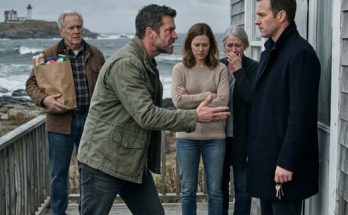
“Get out,” my brother in law said with a sharpness that seemed to vibrate against the humid morning air. My father, Franklin Pritchard, stood paralyzed in the doorway of the weathered cedar house I had purchased for my parents’ fortieth anniversary while his fingers remained clamped onto the brass handle as if the metal could explain the sudden hostility. In his other hand, he clutched a simple paper grocery bag where the crust of a baguette poked out of the top alongside a bundle of fresh parsley with stems that had been crushed by his tight grip. Behind him, the rugged coastline of Rockport was being itself, which meant the cold Atlantic was churning up gray swells and tossing white spray against the boulders with a rhythmic indifference that ignored the human tragedy unfolding on the porch. It was supposed to be a perfectly ordinary morning of the kind my mother had spent decades imagining during her long shifts at the accounting firm. She had envisioned sipping dark coffee on the wrap around porch and feeling the salt air soften the curtains while my father pretended to solve a crossword puzzle but really spent his time studying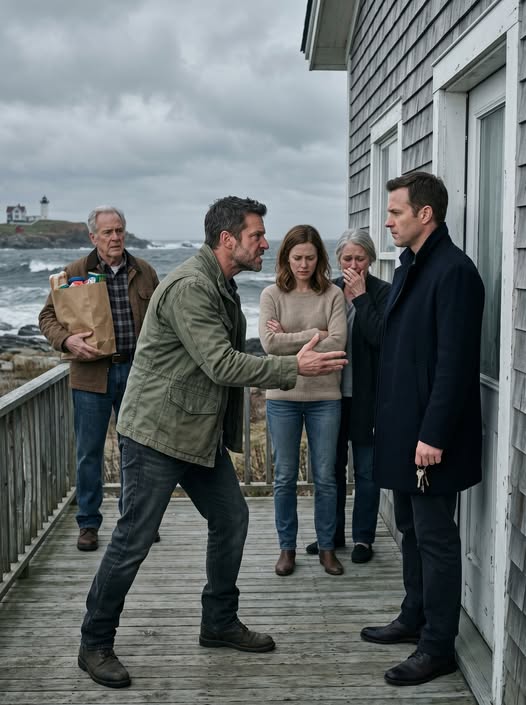
the horizon. Instead, my mother was standing in the middle of the gravel driveway wearing her house slippers and a light teal cardigan as mascara tracked two dark paths down her cheeks. She was weeping with such intensity that she kept pressing her palm against her lips as if she could physically trap the sobbing sounds inside her own throat. “This is no longer your residence,” Chadwick Vance said again with a louder tone as if my father were suffering from a loss of hearing rather than a loss of dignity. “You cannot simply wander into this property whenever the mood
strikes you,” he added while looking down from the top step. When my mother had called me only an hour earlier, her voice was trembling so violently that I honestly believed a member of our family had passed away in the night. “Gavin,” she had whispered through the phone, “you need to
drive here right this second.” I had been sitting in a boardroom in downtown Boston, only half listening to a junior partner explain a logistics error that felt incredibly trivial compared to the terror in my mother’s breath.
I was already grabbing my keys and heading for the elevator before she had even managed to finish the next sentence.
“What has happened to you?” I asked as I stepped out into the bright city light.
“He changed the deadbolts,” she replied, and for a moment I genuinely could not process the meaning of those simple words.
My brain kept attempting to find a more logical explanation such as a broken lock or a misunderstanding with a local handyman or perhaps a security system malfunction.
“Who exactly changed the locks on your home?” I demanded as I reached my car and threw my briefcase into the passenger seat.
There was a long silence on the other end of the line before a shaky breath escaped her lungs.
“It was Chadwick,” she finally admitted, and the name alone caused a cold sensation to settle deep in my chest.
Forty five minutes later, I accelerated into the driveway far too quickly and sent gravel flying toward the stone wall where a group of gulls took flight in a frantic cloud of white wings.
Chadwick was leaning against the porch railing with his arms folded across his chest and a silver ring of keys dangling from one finger.
He gave the keys a small and lazy jingle that made the edges of my vision sharpen with a dangerous level of focus.
My sister, Megan, stood a few feet behind him with a pale and rigid expression while her arms were wrapped tightly around her own waist.
She refused to meet my eyes and instead focused her gaze on the toes of her expensive leather boots as the wind whipped her hair across her face.
My parents’ two weathered suitcases were sitting on the porch planks as if they had been unceremoniously dragged out and abandoned without any regard for the belongings inside.
My mother’s wide brimmed sun hat had fallen upside down on top of one of the bags where it fluttered pathetically in the coastal breeze.
My father still stood by the threshold looking smaller and more fragile than I had ever seen him in my entire life.
He had always been a man of six feet of solid reliability who carried himself like someone who believed in the structural integrity of door hinges and the sanctity of keeping one’s word.
Seeing him diminished by a man like Chadwick was the kind of sight that permanently alters the internal geography of a son’s heart.
“What is going on here?” I asked, and my voice sounded unnervingly calm, which was usually a sign that my fury had reached a boiling point.
Chadwick actually had the nerve to smirk at me as if we were merely two colleagues discussing a minor clerical error in a shared spreadsheet.
“It is a good thing you arrived, Gavin, because we really need to get this situation clarified for everyone involved,” he said.
My father looked at me once with eyes full of confusion before looking down at the humble bag of groceries in his hand.
“He claims he has a legal right to occupy this house,” my father muttered with a voice that lacked its usual resonance.
“A legal right?” I repeated while taking several slow steps toward the stairs. “On what possible basis would you make such a claim?”
Chadwick reached down to pick up a leather bound portfolio from a nearby wicker chair and tapped it against his palm with an air of unearned authority.
“Megan and I have been overseeing the logistics of this property, and it has become clear that your parents are becoming far too elderly for the upkeep,” he explained.
“Between the rising property taxes and the general liability of a coastal home, we have decided that it is much more practical to convert this into a short term rental,” he continued.
He pronounced the word practical with the specific inflection of men who believe that efficiency should always trump things like loyalty or history or basic human decency.
“You decided this?” I asked as I turned my gaze toward my sister who was still trying to disappear into the shadows of the porch.
Megan finally spoke up, but her voice had that thin and defensive quality that I remembered from our childhood whenever she knew she was defending the wrong side.
“Gavin, you need to remain calm because you are clearly overreacting to a simple management decision,” she said with a forced sense of indignation.
I simply stared at her while the sound of the waves crashing against the rocks filled the silence that stretched between us.
The entire coastline continued to exist in its cold and expensive beauty, which only served to make me angrier because this place was supposed to be a sanctuary.
“Overreacting?” I asked while gesturing toward our mother who was still shaking in the driveway. “Our mother is in tears and our father has been locked out of his own house, yet you think this is nothing?”
Chadwick let the keys jingle one more time as a smug expression crossed his face.
“I am simply protecting the asset from further depreciation,” he stated with a coldness that made the air feel like it had dropped twenty degrees.
That specific word was the breaking point for me because he did not see a home or a gift or a place of rest.
He did not see the cottage where my mother had once whispered to me that she could hear the music of the tide from her pillow and didn’t know how to thank me enough.
The entire situation became crystal clear in that moment as I realized that Chadwick looked at love and only saw a way to calculate a potential yield.
“Give me the keys to the house,” I said with a tone that left no room for negotiation.
Chadwick let out a short and performative laugh as if I had just made a very amusing but ultimately irrelevant suggestion.
He honestly believed that he held the power in this scenario because he had Megan standing behind him and because my parents were too shocked to fight back.
He did not seem to understand that I had paid for every single nail and shingle of this house with cash that I had earned through years of relentless work.
He did not realize that I knew every single signature on every legal document because I had designed the entire ownership structure to prevent exactly this kind of predatory behavior.
“I said give me the keys,” I repeated as I reached the bottom step of the porch.
“The answer is no,” Chadwick replied while trying to look imposing. “And you should remember that Megan is your sister and we are family.”
My father flinched at the mention of family while my mother made a small and broken sound that tore through the sound of the wind.
I wish I could say that the events of that morning were a complete surprise to me, but a dark part of my mind had been expecting a conflict for several months.
I had noticed the subtle shift in Chadwick’s behavior during his recent visits to the coast.
He had started asking questions that were far too specific to be considered casual interest such as the cost of the flood insurance and the local zoning laws for vacation rentals.
Megan had also started adopting a strangely patronizing tone when speaking about our parents as if she were trying to rebrand them as fragile before they actually were.
To truly understand how we ended up on that porch, you have to understand the night I gave them the navy blue envelope at the anniversary dinner.
My parents had been married for four decades, and their life together had been a masterclass in quiet sacrifice and uncomplaining labor.
My father had spent his best years managing a dusty warehouse in the valley while my mother balanced the books for three different local businesses that never paid her what she was worth.
They had raised us in a house where the checking account was always one broken appliance away from a total disaster, yet they never made us feel the weight of their stress.
My father was not a man who expressed his feelings through poetry, but he showed his love by making sure the car tires were safe and the heater worked through the winter.
He gave love a physical shape through his actions while my mother provided enough warm words to fill the gaps in the conversation.
Every summer for as long as I could remember, they would drive to the coast and park their old sedan near a public beach just to sit and look at the water.
They would eat simple sandwiches and talk about a someday that always felt like it was floating just out of reach.
Someday was a word that they used to convince themselves that all the years of working overtime would eventually lead to a moment of peace.
By the time I reached my late thirties, I had found enough professional success in the tech sector to finally change the math of their lives.
I was the child who lived in spreadsheets and spent my weekends learning how to build systems that could scale into something profitable.
After years of living in cramped apartments and pouring my soul into a startup that eventually took off, I found myself in a position to buy them the one thing they would never buy for themselves.
Megan and I had grown up under the same roof, yet we had emerged with completely different understandings of the relationship between effort and reward.
She was three years younger and had always possessed a charm that allowed her to glide over the consequences of her impulsive decisions.
She was not a malicious person by nature, but she had a gift for standing just close enough to a crisis that our parents felt compelled to rush in and rescue her.
Then she met Chadwick, a man who possessed a high level of confidence that many people often mistook for actual competence.
He spoke in polished sentences about high level opportunities and private equity but never seemed to stay with one venture for more than a few months.
The first time I met him, he spent thirty minutes explaining why middle class people failed to understand the concept of leveraging their equity.
I remember watching him and realizing that he was the kind of man who viewed every room as a stage for his next potential pitch.
When I began looking for the coastal property, I kept the process entirely secret because I wanted it to be a pure gift rather than a subject for a family debate.
The house I eventually found was a modest but beautiful structure on a quiet bluff that overlooked a secluded stretch of the Atlantic.
It was exactly the kind of place that my parents would have deemed too indulgent for people of their humble background.
I also knew that if I were to give them this home, I would need to build a fortress of legal protections around it to ensure their safety.