Chapter 1: The Anatomy of a Silence: It happened across a rented folding table littered with half-eaten deviled eggs, crumpled pastel napkins, and the glittering foil of discarded chocolate wrappers. The crisp April breeze was rustling through the blooming dogwood trees, carrying the scent of damp spring earth and honey-glazed ham. “Next time, just don’t bring the kid.” The sentence slipped from my mother’s mouth with casual, terrifying precision. She didn’t raise her voice. She didn’t sneer. She simply delivered the poison with the placid, unsettling smile of a woman commenting on the lovely Easter Sunday weather. But she was staring right at me, and she was talking about her own flesh and blood. My son, Theo—a six-year-old boy missing his two front teeth, fiercely obsessed with prehistoric reptiles, who was currently sitting three feet away with a smudge of milk chocolate on his chin from the morning’s egg hunt. She spoke of him as if he were a neighborhood stray that had wandered into the pavilion and ruined the holiday aesthetic. I looked around the sprawling backyard. There were twenty-three adults present for the annual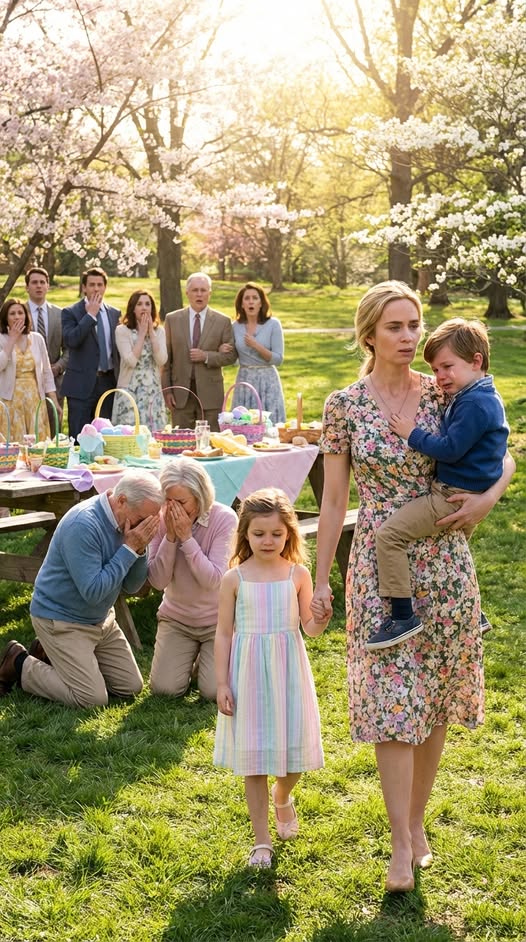
family Easter gathering. Twenty-three people who shared my DNA, dressed in their Sunday best. Not a single one of them uttered a word. My father, Gil, suddenly found the intricate weave of his wicker chair fascinating. My aunt and uncle stared blankly down at their paper plates. The silence was so dense, so suffocating, I felt it pressing against my windpipe like a physical weight. Before I explain the explosion that followed, you need to understand the architecture of my family. My name is Karen. I am thirty-four, living in Dayton, Ohio. I spend three grueling days a week
scraping plaque as a dental hygienist, and I plug the leaking holes in my budget by picking up administrative shifts at a local urgent care clinic on the weekends. I occupy that precarious middle-class purgatory where the electricity stays on, but a blown radiator can send me spiraling into
insomnia for an entire month. My mother, Patrice, is the sun around which our family’s dysfunctional solar system revolves. She isn’t a plate-thrower. She is a covert, psychological operator. She is the kind of woman who will compliment your Easter dress while simultaneously making you
wish you could evaporate into thin air. For my entire adult life, I had been the designated shock absorber for her emotional turbulence. More importantly, I was the family’s ATM. When their furnace completely died two winters ago, I drained my meager savings to wire them twelve hundred
dollars. When my dad’s truck needed tires to pass inspection, my credit card took the hit. I never complained, because I had swallowed the toxic, generational lie that this is simply what you do for blood.
Except, the ledger only ever flowed in one direction. The one time I begged my mother to watch Theo so I could take my thirteen-year-old daughter, Marlo, to a weekend volleyball tournament, Patrice claimed she was “simply too exhausted.” Yet, that same Saturday, she posted forty photos on Facebook of a lavish card night she hosted, complete with three homemade dips. I swallowed the hurt, just as I always did.
But sitting at that picnic table, watching my mother systematically reject my sweet, gentle boy because he had accidentally tipped over a plastic cup of lemonade on the grass ten minutes earlier, something inside my chest finally fractured. I opened my mouth to offer my usual, pathetic apology to keep the peace.
But before the first syllable could leave my lips, the screech of metal chair legs dragging across the concrete patio shattered the silence. My thirteen-year-old daughter was pushing her chair back, and the look in her eyes sent a cold shiver straight down my spine.
Chapter 2: The Eruption
Marlo didn’t slam her hands on the table. She didn’t scream. She methodically wiped her fingers on a paper napkin, dropped it onto her half-eaten ham sandwich, and stood up. She had refused to wear a dress that morning, opting instead for a faded volleyball t-shirt and jeans, and right now, she looked like a soldier stepping onto a battlefield. She locked eyes with the woman who had terrorized me for three decades.
“Say that again.”
The words were dangerously calm, carrying the steady, terrifying weight of a judge delivering a life sentence. She stood there, her messy ponytail blowing in the spring breeze, daring her grandmother to repeat the poison.
My aunt’s fork froze halfway to her mouth. My uncle actually choked on a bite of potato salad, coughing violently into his fist. Patrice stared at her granddaughter, her placid smile faltering into a mask of genuine shock. She let out a high, dismissive little laugh, adjusting her pearl necklace.
“Marlo, sit down right now,” my mother scolded, adopting her favorite patronizing tone. “This is an adult conversation.”
Marlo didn’t flinch. “Then stop acting like a child.”
The shockwave that hit the patio was palpable. But Patrice does not lose. She refuses to be outmaneuvered, especially by an adolescent. Instead of addressing the teenager who had just publicly humiliated her, she pivoted the artillery directly at me. “This,” she declared loudly, her eyes burning into mine, “is exactly what happens when you refuse to teach your children basic respect.”
I felt the old, familiar gravity pulling at me. The conditioned reflex to grab Marlo’s wrist, to whisper apologies, to absorb the blame so the rest of the family could go back to hunting pastel plastic eggs in peace. Protect the peace at the cost of yourself, my inner voice whispered.
But then I looked at Theo. His big brown eyes were wide with confusion, and he leaned into my arm, his small voice trembling. “Mama, does Grandma not want me here?” The fault line in my chest cracked wide open. The peacemaker inside me died, right there on the grass.
I looked across the table, meeting my mother’s furious gaze. “Patrice,” I said, my voice eerily hollow. “Theo is your blood. And if you cannot treat a six-year-old boy like family on Easter Sunday, I have absolutely no reason to continue treating you like mine.”
I stood up, grabbed my purse, took Theo’s small hand in mine, and gestured for Marlo to follow. We walked away from the buffet, away from the pastel decorations, and away from twenty-three statues who lacked the spine to defend a child.
The car ride home was a tomb. Marlo stared out the passenger window, her jaw set like granite. Theo had fallen asleep in his car seat, his woven Easter basket sitting empty at his feet, his mouth slightly open. My hands gripped the steering wheel so tightly my knuckles ached, my mother’s voice playing on an agonizing, infinite loop in my head.
When I finally pulled into our driveway, I killed the engine and just sat there. I realized with a sickening jolt that I had spent my entire adult life driving away from family holidays with this exact knot of nausea twisting in my gut.
That night, standing in my quiet kitchen, I called my cousin, Deanna. She is the only person in our bloodline who had ever seen through my mother’s polished veneer. I poured out every agonizing detail.
When I finished, Deanna’s voice came through the speaker, hard and uncompromising. “Karen, you have spent years writing checks for people who wouldn’t spit on you if you were on fire. When does it end?”
I looked at the dark window over my sink, staring at my own exhausted reflection. “It ends tonight.”
But making a vow in the dark is easy. I had no idea that cutting off the supply would unleash a war that was about to arrive right at my front door.
Chapter 3: The ATM Closes
I didn’t make a grand proclamation. I didn’t send a dramatic email detailing my grievances. I simply turned off the tap, quietly and absolutely.
The first test of my new reality arrived exactly nine days later. My phone buzzed on the kitchen counter, flashing my mother’s name. I let it ring three times before sliding my thumb across the screen. She didn’t call to apologize; admitting fault was biologically impossible for Patrice. Instead, she launched into her practiced, helpless routine.
“The water heater in the basement is making a horrific screeching noise,” she sighed heavily into the receiver. “Your father thinks the whole tank needs to be replaced. I just don’t know what we’re going to do, Karen. He’s only getting part-time hours at the shop, and my arthritis is flaring up terribly. I just… I don’t know.”
Then came the silence.
It was a heavy, loaded, weaponized pause. A vacuum designed specifically for me to rush in and fill with, Don’t panic, Mom, I’ll put it on my Visa. I gripped the edge of the kitchen counter. My heart hammered against my ribs.
“That sounds incredibly stressful,” I said evenly. “I really hope you guys can figure it out.”
The silence on the other end stretched so long I pulled the phone away from my ear to check if the call had dropped. It hadn’t. Patrice simply had no programming for a version of her daughter that didn’t immediately reach for a checkbook. She sputtered a clipped goodbye and hung up.
Two days later, she tried again. This time it was a sob story about a devastating electric bill. I gave her the exact same response: That’s tough. Call the utility company and ask for a payment plan. I would be lying if I said it felt entirely triumphant. I felt physically ill. When your entire identity in a family is built on being the designated fixer, stepping out of that role feels dangerously like abandoning your post. But Deanna kept me anchored. Every single morning, my phone would light up with a text from Springfield: Day 12. You are not an ATM. Keep going. Since the money had stopped flowing, Patrice realized she was losing her grip. So, she deployed her flying monkeys.
First came the voicemail from my Aunt Gail. She rambled for four agonizing minutes about how “family helps family,” and accused me of being a selfish, ungrateful daughter. This was rich coming from a woman who had never attended a single one of my school plays. Then came a call from Barbara, my mother’s church friend—a woman I had once watched steal a floral centerpiece from a charity luncheon—calling to lecture me on the “Christian example” I was setting for my children.
I ignored them all. I was holding the line.
Until a rainy Tuesday afternoon, when the collateral damage finally hit the one person I had been trying to protect.
I was standing at the stove browning ground beef when Theo shuffled into the kitchen. He climbed up onto a barstool, swinging his legs, opening and closing his mouth like a guppy trying to find oxygen.
“Mama?” he whispered, staring at his sneakers. “Am I bad?”
I froze. I slowly set the wooden spoon down on the counter and turned off the burner. “Why on earth would you ask me that, baby?”
He looked up at me, his eyes brimming with heavy, wet tears. “Because Grandma doesn’t like me. She didn’t want me at Easter. So I think I’m bad.”
The air was sucked out of the room. My beautiful, gentle boy, who shared his snacks with strangers and apologized to inanimate objects when he bumped into them, was sitting at my counter actively trying to calculate what fundamental flaw in his soul made his grandmother hate him.
I pulled him off the stool, burying my face in his neck, holding him so tightly I feared I might bruise him. I poured every ounce of love I had into him, promising him that grown-ups were complicated, and that he was the greatest thing the universe had ever created.
When he finally went back to his room to play, I walked into my bathroom, locked the door, sank to the cold tile floor, and wept until I couldn’t breathe.
When I stood up, I washed my face, picked up my phone, and dialed my mother.
“I love you,” I told her, my voice stripped of all emotion. “But until you look my son in the eye and apologize to him for what you said at that party, I am not attending another family dinner. I am not coming for Thanksgiving. And I am never sending you another dime.”
“You are going to punish your parents over a joke?” she scoffed, her tone dripping with disbelief. “I was joking, Karen. You have always been far too sensitive.”
A joke. My son believed his soul was defective, and she called it a punchline.
“If it was just a joke,” I replied coldly, “then apologizing for it should be effortless.”
She slammed the phone down. And that was the moment Patrice decided to burn my world to the ground.
Chapter 4: The Poison in the Sweet Tea
The smear campaign was a masterclass in psychological warfare.
Patrice spun a narrative so violently distorted it was almost impressive. To the aunts, the uncles, and the second cousins, I was painted as the unstable, vindictive daughter who had abandoned her aging, financially struggling parents over a harmless misunderstanding at an Easter egg hunt. She conveniently omitted her comment about Theo. She erased the thousands of dollars I had poured into their household over the years.
Deanna tried to run interference, defending my name to anyone who would listen, but the family had already digested the lie. It was easier to believe I was crazy than to confront the ugly reality of my mother’s cruelty.
The deepest cut came from Gil. My father called me on a Thursday evening, his voice weary and soft.
“Karen, sweetheart,” he sighed. “Can’t you just let this go? Your mother didn’t mean anything by it. She’s been so upset these last few weeks. The house is miserable.”
I closed my eyes, pressing the bridge of my nose. “She’s upset, Dad? Your grandson asked me if he was a bad person. And you sat at that picnic table, you heard exactly what she said, and you didn’t even put your fork down. I love you, Dad, but I cannot pretend you didn’t abandon us too.”
He went entirely quiet. For a long, painful minute, the only sound was the static on the line. Finally, he whispered, “I know. I know I should have spoken up.”