It was the most honest sentence he had uttered in a decade. I waited, holding my breath, hoping this was the moment he would finally become the father I needed. But he merely sighed again, murmured a weak apology, and hung up. Agreeing with Patrice was still the path of least resistance. Meanwhile, Marlo was watching everything. My daughter is dangerously perceptive. She saw me taking deep, trembling breaths before checking my text messages. She watched the light die in my eyes every time the phone rang. Then came the second week of May. I was cleaning up after dinner when Marlo walked into the kitchen. She had been acting strangely since she got off the school bus—checking her phone incessantly, then slamming it face down on the table as if it were radioactive. She stood in the doorway, her arms crossed tightly over her chest. “Mom,” she said, her voice unusually tight. “I need to show you something. And I need you to promise you won’t freak out.” She walked over and handed me her phone. I looked down at the glowing screen. It was a long thread of text messages. From Patrice. My mother had bypassed me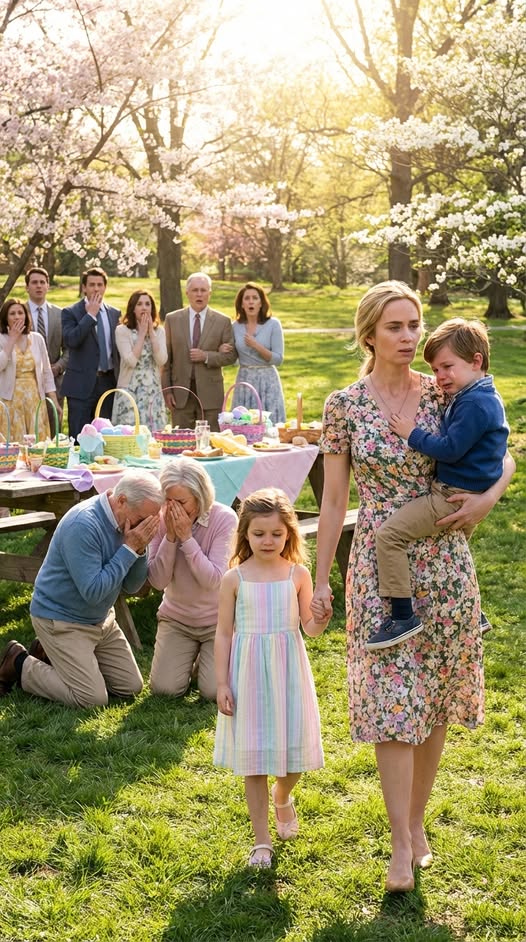
entirely, likely coercing my boundary-less Aunt Gail for Marlo’s cell number, and had been secretly texting my thirteen-year-old daughter for three days. The messages started like poison disguised as sweet tea. Hi, sweetheart. Grandma misses you so much. But as I scrolled, the venom became clear. Patrice was carefully, methodically trying to recruit my child as a spy and an ally against me. I wish your mother would let me see you guys. Your mom has always been very emotional, even when she was your age. She tends to overreact and blow things out of proportion.
Maybe you could talk some sense into her for me? My blood turned to ice. She was attempting to alienate my daughter from me. And worse, in the dozens of messages displayed on the screen, she never once asked about Theo. Her other grandchild didn’t even exist in her twisted narrative.
But it was the blue bubbles—Marlo’s replies—that made my breath catch in my throat. Marlo hadn’t just been passively reading the manipulation. To the message about me being “emotional,” my thirteen-year-old had typed: My mom isn’t emotional. She’s just done pretending everything is
fine when it’s actually toxic. There’s a big difference. And to the request that Marlo “talk some sense” into me, she had written: I’m not going to ask my mom to forgive someone who hasn’t even apologized for what they did. That wouldn’t make any sense, Grandma. I stared at the phone for
what felt like an eternity. I slowly handed the device back to my daughter, who was aggressively chewing on her thumbnail, looking terrified that she had stepped over a line.
“You,” I whispered, my voice thick with emotion, “are the most incredible human being I have ever known.”
Marlo blinked, dropping her hand. “So… I’m not grounded for talking back to an adult?”
I let out a sound that was half-laugh, half-sob. “Honey, the only person in this family who is about to be in trouble is your grandmother.”
I walked over to the counter, picked up my own phone, and prepared to drop a nuclear bomb on the entire family tree.
Chapter 5: The Cinnamon Rolls and the Reckoning
They say you shouldn’t act in anger. But I wasn’t angry. I was operating with the cold, lethal clarity of a mother protecting her young.
I asked Marlo to send me screenshots of the entire text thread. I didn’t crop them. I didn’t edit out Marlo’s brilliant, defiant responses. I attached those four images to a mass text message addressed to everyone who had dared to call me selfish over the past month: Aunt Gail, Uncle Vernon, Barbara, and half a dozen other flying monkeys.
I didn’t write a manifesto. I added exactly one sentence to the images: This is what she is doing behind my back now.
I hit send, tossed the phone onto the couch, and braced for the explosion.
The fallout was immediate, but not in the way I expected. Aunt Gail called me ten minutes later. For the very first time in my life, she didn’t open the conversation by defending her sister. “Karen,” she stammered, sounding genuinely rattled. “I… I had no idea she was texting the girls. She told me you were holding them hostage.”
“There is a vast ocean of things you don’t know, Gail,” I replied sharply, “because you only ever listen to the person crying the loudest.”
Uncle Vernon offered total radio silence, which was a blessing. Deanna, however, called me laughing so hysterically she could barely string a sentence together. “Marlo is my absolute hero,” she gasped through the phone. “I am driving down there right now to buy that girl a massive pizza.”
And she did. Deanna drove forty minutes with a large pepperoni pizza and a stuffed plush triceratops for Theo, declaring that he deserved a random Tuesday present just for existing.
From Patrice? Absolute, terrifying silence. For two solid weeks, there was no smear campaign, no passive-aggressive Facebook posts. My mother had encountered the one thing a manipulator cannot spin: her own words, captured in black and white, exposing her attempt to weaponize a child.
Then, on a gloomy Saturday morning, a heavy knock echoed through my front door.
I looked through the peephole and my stomach dropped. It was Gil. He was standing on my porch wearing his battered canvas fishing hat, clutching a greasy white paper bag from a local bakery. I unlocked the door and let him in. He looked as though he had aged ten years; the bags under his eyes were bruised and heavy.
He shuffled into the kitchen, sat heavily at my table, and placed the paper bag between us. “I bought those cinnamon rolls you used to love when you were in middle school,” he mumbled.
I sat across from him, cautious. “Dad, what are you doing here?”
Suddenly, this stoic, quiet man—a man I had never seen shed a tear in my thirty-four years on earth—buried his weathered face in his rough hands and began to sob. His shoulders heaved with decades of suppressed guilt.
“I failed you, Karen,” he choked out, the words muffled by his palms. “I sat at that table on Easter, I heard the venom in her voice, and I did nothing. I’ve been terrified of your mother’s wrath for thirty-seven years, and my cowardice finally cost me my daughter and my grandchildren.”
I reached across the table and placed my hand gently over his wrists. “Dad,” I whispered, my own tears spilling over. “I never needed you to be a superhero. I just needed you to be honest.”
And for the next two hours, he was. He confessed everything. He told me how sick to his stomach he felt every time I wired them money to fix their messes. He admitted that he had tried to intervene once, years ago, and Patrice had subjected him to a punishing, eleven-day silent treatment that broke his spirit.
“But she’s terrified right now, Karen,” he said, wiping his eyes with a napkin. “She won’t ever say it out loud, but she knows she went too far with Marlo. She is terrified she has lost you permanently, and because everyone has always bent to her will, she has no idea how to exist in a world where you don’t.”
“I know,” I said softly. “I bent until my spine broke. But I am done.”
Gil looked at me, his eyes red but suddenly possessing a spark of resolve I had never seen before. “What if,” he said slowly, “I finally stopped bending, too?”
Two days later, my father called to tell me he had delivered his own ultimatum. He told his wife that her behavior at Easter was an atrocity, the text messages were unforgivable, and her financial parasitism was over. He told her that if she did not repair the damage she had caused, she was going to lose him, too.
And then, exactly nine weeks after the holiday that fractured our family, my cell phone rang.
“I need to speak to Theo,” my mother’s voice rasped through the speaker. She sounded small. Deflated. “I owe that little boy an apology. And I owe you one, too.”
I stared out my kitchen window at the empty driveway. “I’ll think about it,” I said, and hung up.
I needed to ensure this wasn’t an ambush.
Chapter 6: Grace in the Wreckage
I consulted Deanna. “Let her come to your house,” my cousin advised. “Make her enter your territory, on your terms. If she tries to spin it or play the victim, you show her the door. It’s that simple.”
I invited my mother to dinner the following Sunday. Just the four of us. I was painfully clear: Bring a genuine apology, or do not bother getting out of your car. Patrice arrived precisely at five o’clock. When I opened the door, I barely recognized her. She was wearing a formal navy dress—something she reserved for church or weddings—and in her trembling hands, she held a bouquet of yellow tulips. My favorite flowers. I hadn’t realized she even knew that.
Theo was lying on his stomach on the living room rug, deeply engrossed in a cartoon. When he heard the door close, he looked over his shoulder. He didn’t jump up. He didn’t run to her legs the way he used to. He just lay there, watching her with a cautious, guarded expression.
I saw the physical impact of his hesitation strike my mother like a physical blow. The reality of what she had destroyed finally penetrated her armor.
She walked over to the edge of the rug. With agonizing slowness, ignoring the severe arthritis in her knees, she lowered herself down until she was sitting on the floor at his eye level.
“Theo,” she said, her voice cracking instantly. “Grandma needs to tell you something very important.”
Theo sat up, crossing his legs, clutching a plastic dinosaur to his chest.
“What I said about you at the Easter picnic was wrong,” Patrice told him, tears immediately spilling over her mascara. “It was mean, and it was entirely my fault. You didn’t do a single thing wrong. You are my beautiful grandson, and I love you so much. I am so, so sorry.”
I held my breath, my fingernails digging into my palms.
Theo studied her face for five long seconds. He processed her tears, her words, the absolute vulnerability of an elder begging for forgiveness. And then, he smiled.
“It’s okay, Grandma,” my six-year-old son said, his voice light and bright. He held out his plastic toy. “Do you want to see my new Stegosaurus?”
It was a display of pure, unadulterated grace. The kind of effortless, unconditional forgiveness that adults spend their entire lives forgetting how to give.
Patrice let out a shattered sob, pulled him into her arms, and wept into his shoulder. They were real tears this time. Not the theatrical, performative tears she used to win arguments, but the heavy, violent weeping of a woman mourning her own cruelty.
Over the roasted chicken I made for dinner, she apologized to me. She admitted she had used me as a crutch and a punching bag for years. She told me, to my absolute shock, that Gil had forced her to make an appointment with a family counselor.
Then, she turned to Marlo. “I owe you the biggest apology of all,” she said softly. “I never should have put you in the middle of adult problems. I shouldn’t have sent those texts. You were incredibly brave to stand up for your brother.”
Marlo paused with her fork halfway to her mouth. She looked at her grandmother with the calm, calculating gaze of a seasoned veteran. “Thank you, Grandma,” she said evenly. “But just so we are clear… I will do it again if I ever have to.”
For a second, the table held its breath. Then, my mother let out a genuine, self-deprecating laugh. “I know you will,” she smiled. “I believe you.”
I am not going to tie this story up with a perfect, cinematic bow. Trust is a building demolished by dynamite and rebuilt with tweezers. It takes time.
The financial well remains permanently dry. I have never sent another dollar. Surprisingly, Gil took a full-time position at a local hardware store, and when he calls me now, he excitedly talks about power tools and cedar planks, sounding lighter and happier than he has in a decade. Aunt Gail drops by occasionally with a casserole, avoiding eye contact but trying her best. Uncle Vernon remains mute, but at Thanksgiving, he sat on the floor with Theo and asked him the complicated scientific names of every dinosaur in his toy box. For Vernon, that is the equivalent of a Shakespearean sonnet.
And Deanna? She still comes over every other weekend, armed with pizza and unrelenting support. Just yesterday, my phone buzzed with a text from her: Day 147 of choosing yourself. Look at the empire you saved. I wept when I read it. The good kind of tears. The kind that wash away the soot of a long, brutal war.
If you are reading this, and you are the designated shock absorber in your family—the one who bites their tongue, opens their wallet, and sacrifices their own dignity to keep a toxic peace—I need you to hear me.
You are allowed to stop. You are allowed to let the plates crash to the floor.
It will be terrifying. The silence will be deafening. The backlash will be brutal. But when the smoke finally clears, you might be shocked to discover who is standing behind you in the wreckage, holding the line.
For me, it wasn’t an army. It was a thirteen-year-old girl in a messy ponytail, who looked the monster dead in the eye, pushed her chair back, and said: Say that again.