Chapter 1 — 2:34 in the Morning: Two thirty-four in the morning. I had just come off a twenty-four-hour shift, and I was standing in the parking lot at Fort Belvoir in the thick wet heat of a Virginia summer night, holding a cup of coffee that had gone cold hours ago, thinking about nothing more complicated than getting home to my own bed and the sleeping shape of my husband beside it. Then my phone lit up in the dark. Mom. My mother, Harriet Ashcroft, was seventy-one years old and the most deliberate human being I have ever known. She did not call in the middle of
the night. She did not call in the middle of the day without checking first whether it was a good time. In fifteen years I could not remember a single after-midnight call from her, and so the phone ringing at 2:34 landed in my chest like a dropped stone before I had even answered it. “Mom. What’s wrong?” For a few seconds there was only breathing — jagged, uneven, wrong. Then a voice came through that I almost didn’t recognize as hers, thin and shaking and small. “Valerie. Your husband. He came to my house tonight.” My boots stopped on the concrete. “Ronan hurt me,”
she said, and the word hurt came apart in her mouth. “And then he called the police. He told them I was the one who threatened him.” My keys slipped out of my fingers and hit the pavement, and the sound of them was very far away. I remember thinking, in the first blank second, that there had to be a mistake — that she’d fallen, gotten confused, dialed the wrong daughter’s worst nightmare into the phone.
Because the sentence she’d just said did not fit into the world I lived in.
In my world, Ronan was the man who had held me through my father’s funeral, who drove four hours to bring me soup the one time I got the flu badly enough to scare myself, who was, by the unanimous verdict of everyone who knew us, the good one, the catch, the husband other women mentioned to their own husbands as a standard.
You do not, in the space of a single phone call, dismantle fifteen years of a person and rebuild them as someone who beats old women in the dark.
The mind won’t do it that fast.
Mine spent those first seconds frantically trying to keep the old Ronan alive, reaching for any explanation that would let the man I knew stay the man I knew.
It was my mother’s voice that stopped it — that thin, wrong, frightened voice, a voice I had never once heard her use in seventy-one years — because whatever else I could talk myself out of, I could not talk myself out of that sound.
Chapter 2 — Two Impossible People
I want you to understand the two people my mother had just placed at the center of a violent crime, because for a moment my mind refused to hold them in the same sentence.
On one side: Harriet Ashcroft.
A widow who spent her mornings pruning the rosebushes my late father had planted, who volunteered three afternoons a week at the county library, who ironed her napkins and wrote thank-you notes by hand and had never, in my entire life, raised a hand or her voice to anyone.
On the other: Ronan.
My husband of fifteen years.
The man who carried the elderly neighbors’ groceries up their steps, who charmed every room he entered, who had not once in a decade and a half so much as shouted at me.
The man everyone called lucky Valerie’s husband, as if I were the one who’d landed above my station.
These were the two people my mother’s broken voice was telling me had been in a room together, and that one of them had left the other bruised.
I have thought a great deal since about how completely I believed in Ronan, because it embarrasses me, and because I think the embarrassment is worth sitting with rather than hiding.
I am not a naive woman.
I have spent a career assessing threats, reading rooms, deciding in seconds whether a person is telling the truth.
It is my job.
And I missed him entirely.
For fifteen years I lived beside a man who was, I would learn, capable of driving to an old woman’s house in the dark to terrorize her, and I did not see it, because he never once let me.
The good ones — the truly dangerous good ones — do not slip.
They are patient.
They build a version of themselves so consistent and so warm that questioning it would feel like an insult to your own judgment.
Ronan had spent a decade and a half being exactly the husband I would have designed, and the reward for that patience was that on the night the mask finally came off, his own wife’s first instinct was to disbelieve the victim.
That is what a good disguise buys a man.
It buys him the benefit of the doubt at the exact moment he least deserves it.
Fifteen years of training took over before the grief could.
My voice went flat and level and cold, the tone I used on the worst nights of my career, the one that keeps a scared room from noticing the person in charge is also afraid.
“Where are you right now, Mom?”
“The county precinct.
Ronan told them he was only defending himself.
He swore to the officers that I came at him with the iron tool from my fireplace.”
“Are they giving you medical care?”
“Not yet.
They just keep asking me questions.
Valerie, I’m so frightened.”
“Listen to me carefully.
Do not sign anything.
Not one document.
Ask for a doctor, out loud, in front of a witness, right now.
And say nothing else until I get there.
I’m leaving this second.”
Chapter 3 — Why Two in the Morning
I stood alone in that empty lot for one more second after I hung up, and I made myself think instead of feel, because thinking was the only thing that was going to help her.
The first question was the loudest one.
Why had Ronan been at my mother’s house at two thirty in the morning at all?
He had told me he was working late.
My mother lived forty minutes away.
There was no innocent version of my husband driving across the county in the dark to arrive on a seventy-one-year-old woman’s doorstep in the middle of the night.
Whatever this was, it had not been an accident, and it had not been spontaneous.
He had gone there on purpose, at an hour chosen so that no one would see.
The second thing I understood, standing there, was the shape of what he’d built.
Ronan had not simply lost his temper and then panicked.
He had called the police himself.
He had gotten there first, told his story first, and cast himself as the victim first — a calm, reasonable, uninjured man reporting that his elderly mother-in-law had attacked him.
He was betting, correctly, that a station full of tired officers at three in the morning would find it far easier to believe a polished son-in-law than a hysterical old woman with no witnesses.
It was, I had to admit even then, a good plan.
It had exactly one flaw.
And I was already holding it, turning it over in my mind like a smooth cold stone, as I picked my keys up off the pavement and got into my car.
I did not scream.
I did not cry.
I drove.
I want to be honest that the calm was not strength, or not only strength.
It was a tool, and I reached for it the way you reach for a tourniquet — not because you feel nothing, but because feeling everything, right then, would cost you the person you’re trying to save.
Underneath the flat voice and the steady hands, I was a daughter whose mother had just told her, weeping, that she’d been beaten in her own home.
Every animal thing in me wanted to drive that car through the wall of the police station and put my body between my mother and the world.
The training didn’t erase any of that.
It just built a room around it, and shut the door, and let me function in the hallway outside while the storm stayed sealed in the room.
I would open that door later, alone, more than once, in the months to come.
But not on the drive.
On the drive I needed the daughter locked away and the officer at the wheel, because my mother did not need my grief.
She needed someone who could think.
Chapter 4 — The One Fact
The drive to the Fairfax County precinct was forty minutes of streetlights and calculation.
Here is the fact I was holding, the one Ronan did not know I had, the one he could not have known would matter, because it was the kind of small domestic detail a busy son-in-law never troubles to learn about the woman he’s decided to destroy.
My mother did not own a fireplace poker.
She did not own an iron poker, or a brass stand, or a set of andirons, or a single one of the heavy black tools that Ronan had described to the police in such confident detail.
She could not have swung an iron fireplace tool at his head, because there was no iron fireplace tool in her house to swing.
Eight years earlier, the year after my father died, my mother had grown tired of the mess and the draft of the old wood-burning hearth, and she had it sealed and replaced with a wall-mounted electric fireplace — a flat glass panel set flush into the living room wall, clean and modern, no chimney, no ash, no grate, and no tools.
I had helped her choose it.
I had been there the afternoon it was installed.
I had watched the old iron set go out to the curb.
I remembered the day clearly, driving through the dark toward her.
My father had been gone about a year, and my mother had spent that year slowly, deliberately reclaiming the house from grief — repainting, giving away his suits, learning to sleep in the middle of the bed.
The fireplace was part of that.
She’d told me the old hearth reminded her of winter evenings with him, and that she loved those memories but could not keep lighting a fire into them every night, and so she was going to put in something new that was only hers.
I had thought it was a small, sad, sensible thing at the time, one more quiet adjustment in a widow’s long adjustment to being alone.
I had not thought about it in years.
I certainly had never imagined that a grieving woman’s decision to stop sweeping ash would, eight years later, be the precise and unshakable fact standing between my mother and a prison cell.
Ronan had built his entire alibi on a weapon that had not existed in that house for the better part of a decade.
And he had no idea.
He had walked into my mother’s living room in the dark and invented, on the spot, a poker to blame her with, never imagining there was no poker to be found — and that the one person who knew that beyond any doubt was the wife he assumed would take his word for everything, as she had for fifteen years.
Chapter 5 — The Picture-Perfect Husband
When I pulled into the precinct lot, the first thing I saw stopped the breath in my throat.
Ronan was standing near the front doors, a foam coffee cup in his hand, talking easily with a young patrol officer.
He was immaculate.
Not a hair wrong, not a mark on him, not a button out of place — a man without a scratch, wearing an expression of grave, weary concern, the very picture of a decent husband dragged out of bed by a family tragedy.
Somewhere behind me a siren started up, and an ambulance swung around the corner, its red lights sweeping across the wet asphalt.
I got out of my car.
I crossed the lot with my boots hitting the pavement in the even, unhurried rhythm they teach you, the one that says the person walking is not going to be rushed by anything.
Ronan turned, and his face rearranged itself into relief, and he came toward me with his arms half-open.
I noticed, in the flat clinical way my training had switched on, that there was not a mark on him.
He was claiming that a seventy-one-year-old woman had swung a heavy iron poker at his head with enough force that he’d feared for his life.
A man who has genuinely fended off a blow like that shows it — a raised arm, a scrape, a torn cuff, the small disarray of someone who has actually been in a fight.
Ronan had none of it.
His shirt was tucked.
His hair was combed.
His coffee had not spilled.
He stood in that parking lot the picture of a man who had spent the evening doing paperwork, not disarming a lunatic, and he had not even thought to rough himself up a little to sell the story, because it had not occurred to him that anyone would look closely enough to need convincing.
That was the whole architecture of his plan, laid bare in a single glance: he was not counting on evidence.
He was counting on being believed.
“Valerie.
Thank God.
She just — she lost her mind tonight, I don’t even know how to — ”
I walked past him without slowing down.
Chapter 6 — She Snapped
“Valerie, will you listen?” He came after me, following me through the glass doors into the bright fluorescent hum of the station.
“Your mother has lost her grip on reality.
She called me over there, started accusing me of these insane financial things, and then she came at me — she swung a cast-iron poker at my head.
I had to pin her wrists just to keep her from splitting my skull open.”
The young patrol officer stepped up on my other side with a notepad.
“Lieutenant Colonel, I understand this is upsetting.
But your husband has filed a formal complaint.
He’s alleging your mother assaulted him with a deadly weapon.”
I stopped in the middle of the processing room and turned to face them both.
I was still in uniform.
I let them both take a good look at it, and at my face, before I spoke.
“Where is my mother?”
“Holding room, ma’am,” the officer said.
“The paramedics are with her now.”
“Take me to her.”
I noticed, walking, the shape of the accusation Ronan had chosen, and it told me a great deal about him. She’s lost her grip on reality.
She’s senile.
She snapped. Every word of his story required my mother to be diminished — not a competent adult who might be telling the truth, but a confused old woman whose account could be dismissed on its face.
That is the oldest move there is against the elderly, and it works because the world is half-prepared to believe it before anyone says a word: that past a certain age a person becomes unreliable, dramatic, not quite a full witness to their own life.
Ronan was counting on that reflex.
He needed everyone in the building to file my mother under poor confused thing so that nothing she said would have to be weighed.
What he could not have known was that he’d picked the one accusation guaranteed to steady me instead of shake me, because I knew my mother, and whatever else was true in that station, Harriet Ashcroft’s grip on reality was better than his, better than the young officer’s, better, that night, than my own.
Chapter 7 — Let’s Look at the Crime Scene
Ronan caught my elbow.
His fingers closed on my sleeve, and the touch of them — this hand I had held for fifteen years — sent something through me I can only describe as revulsion.
“Valerie, please.” His voice dropped, warm and reasonable, the voice that had talked me down from a hundred smaller worries.
“Don’t let her drama pull you in.
Look at me.
I’m your husband.
Why on earth would I lie to you about something like this?”
I looked down at his hand on my arm.
I said nothing.
I just looked at it, steadily, until he understood, and slowly took it back.
“All right, Ronan,” I said, and my own calm frightened me a little, it was so complete.
“Let’s go and see her.
Let’s all go and look at the crime scene together.”
Something flickered behind his eyes at that — the first small crack, the first hint that the script he’d written might have a line in it he hadn’t checked.
He covered it fast.
But I had seen it, and he had seen me see it, and we walked down that hallway together knowing the ground had shifted, even if only one of us yet knew how far.
I think, if I’m honest, that our marriage ended in that hallway, in the space of that flicker — earlier than the handcuffs, earlier than the divorce papers, before I had a single piece of proof.
Not because of anything I could have argued in a court.
Because I had just watched my husband’s face do something I had never seen it do in fifteen years: perform.
I had always believed his warmth was real.
Standing in that fluorescent corridor, I watched him choose an expression, deploy it, and adjust it when it didn’t land, the way an actor does, and I understood in my body before my mind caught up that if he could do that here, on this night, over my mother’s bruises, then he had almost certainly been doing it the whole time, in a thousand smaller ways I’d taken for love.
You cannot un-see a thing like that.
The proof came later and it mattered, for the law.
But I stopped being married to Ronan the moment I saw him act, and knew it for acting, in the worst hour of my mother’s life.
Chapter 8 — The Holding Room
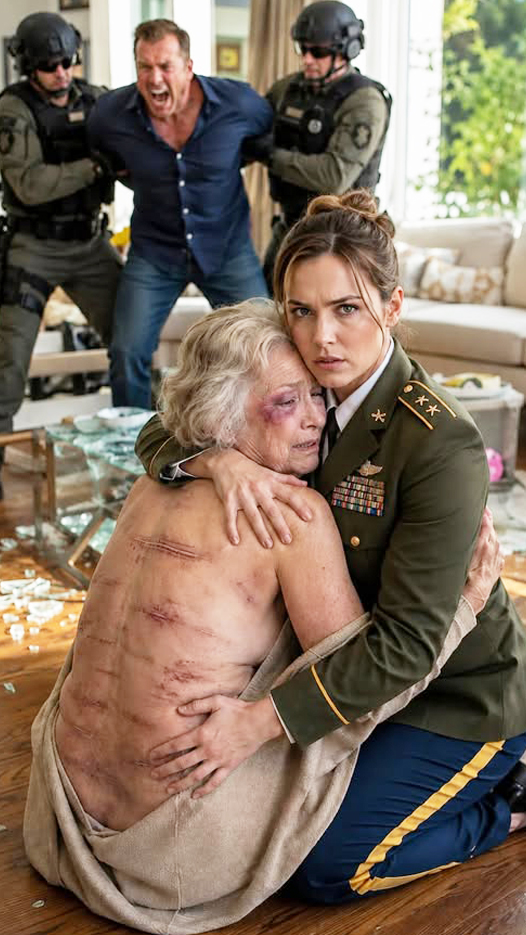
The officer opened the door, and I will not spend long on what I saw, because my mother lived it and does not need it described for anyone.
She was on a hard bench under a thin thermal blanket.
She had been hurt.
The evidence of it was plain on her face and on her thin wrists, and it was, to anyone with working eyes, the evidence of someone who had been held down and struck, not of someone who had launched an attack.
A paramedic was crouched in front of her, gentle, murmuring.
When she saw me, her composure broke all over again.
“Valerie.”
I crossed the room in two steps and went down on one knee in front of her and took both her cold hands in both of mine.
“I’m here, Mom.
I’m right here.
I’m not going anywhere.”
From the doorway, Ronan produced a long, sorrowful sigh, playing the scene to the detective now entering behind him.
“I know how this looks, Valerie.
But she was swinging that poker like a woman possessed.
Holding her wrists was the only way I could keep either of us from getting killed.”
I did not turn around.
I kept my eyes on my mother’s face, and I felt the last of my fear for her burn off and turn into something colder and far more useful.
Because here is what Ronan, standing in that doorway performing his sorrow, did not understand about the room he was in: every injury he was pointing to as proof of her violence was, to anyone who actually looked, proof of his.
A woman who swings a weapon at a man’s head does not end up with bruises ringing her wrists like bracelets.
She does not end up cornered on a bench.
The marks on my mother were not the marks of an aggressor; they were the marks of someone who had been held and had struggled to get free.
The very evidence he was using to accuse her was, read right, the evidence that would convict him.
He had brought his own proof to the station and set it on a bench and called it hers.
He was too pleased with his story to see that the story was already lying on the table in front of everyone, in the shape of an old woman who had been made to hurt.
Chapter 9 — Captain Doyle
The detective was a lean, unhurried man in his fifties named Captain Doyle, and he came into the room holding a tablet and wearing the carefully neutral expression of someone who has learned not to decide anything before the facts are in.
“Lieutenant Colonel.” He nodded to me.
“I’m sorry you’re here under these circumstances.
I’ll be straight with you.
Mr.
Dawson alleges your mother initiated a physical altercation using a heavy iron fireplace tool.
That’s a serious allegation, and given the severity, I’m obligated to process the domestic assault charge against her — unless the evidence tells a different story.”
“It wasn’t like that,” my mother said, her voice trembling but clear.
“He came to my house.
He demanded I sign over the estate trust from Valerie’s father.
And when I told him no — when I kept telling him no — ” She stopped, and her hands tightened on mine.
“He lost control.”
I watched Captain Doyle as she spoke, because in that moment he was the one person in the room whose mind was still open, and everything depended on it staying that way.
He was in a hard position, and to his credit he seemed to know it.
A formal complaint had been filed by a calm, credible-seeming man.
The accused was an elderly woman with visible injuries she couldn’t prove the source of and no witnesses.
The path of least resistance for a tired detective at three in the morning is to process the charge as filed and let it sort itself out later.
I could see him weighing it.
And I understood that my job, the only job that mattered in that room, was not to plead or to rage or to demand he believe my mother over my husband — that would only have marked me as the hysterical relative, easy to set aside.
My job was to hand him one fact so hard and so checkable that his own caution would do the rest.
Doyle didn’t need to be persuaded.
He needed to be given something he could verify with a radio.
“She’s confused,” Ronan cut in, loud and smooth, turning to Doyle.
“She’s seventy-one, Captain, she’s frightened, she’s not thinking clearly.
She attacked me with the cast-iron poker from her fireplace.
I was defending myself.”
I stood up from beside my mother, slowly, and turned to face my husband across that small bright room.
And I asked him a question I already knew the answer to.
Chapter 10 — What Specific Tool
“Ronan.
Tell the Captain again.
Be specific.
What exactly did she attack you with?”
He didn’t hesitate; that was his mistake.
A careful liar hedges.
Ronan was so sure of his story that he doubled down on the detail.
I had asked the question on purpose, and I had asked for the detail on purpose, because in my line of work you learn that the way a lie dies is almost never a dramatic contradiction.
It’s specificity.
A vague liar can wriggle — it happened so fast, I’m not sure exactly what she grabbed. You cannot corner a man who refuses to commit.
But Ronan had no reason yet to be vague; in his mind he was winning, and a winning man embellishes, because the details make the story vivid and the vividness makes it believed.
So I invited him to be vivid.
I asked him to be exact, and I kept my face empty while I did it, giving him nothing to read, and he walked straight into it, painting his imaginary poker in loving detail — the length, the point, the black handle — nailing his own story to a specific object in a specific room, an object I already knew did not exist.
Every word he added was another nail.
By the time he finished describing a weapon that had gone to the curb eight years ago, he had made his lie far too specific to survive contact with a single radio call.
“The iron poker,” he said, with a flash of impatience, as if I were being slow.
“The long one, with the pointed end and the black handle.
From the stand by her fireplace.
She swung it right at my head — I’m lucky to be standing here.”
“Captain Doyle,” I said, without taking my eyes off Ronan.
“Do you have officers at my mother’s residence right now?”
“A unit’s been at the scene about twenty minutes,” Doyle said.
“Securing the house, looking for the weapon.”
“Good,” I said.
“Then I’d like you to have them do one specific thing for me.
I’d like them to go and look at the fireplace in the living room.”
Ronan laughed — an ugly, arrogant bark of a laugh, the sound of a man who thinks the trap he’s standing in was set for someone else.
“Yes!
Please!
Send them to the fireplace, Captain.
They’ll find the whole set, and they’ll find the one poker missing from it — the one she came at me with.”
I let his laugh finish.
Then I said the sentence I had been carrying since a parking lot forty minutes away.
Chapter 11 — Look at the Fireplace
“No, Ronan.
They won’t find a missing poker.”
He blinked.
“They won’t find a missing poker,” I said, “because there is no poker.
My mother converted that living room to a ventless electric fireplace eight years ago, the year after my father died.
There is no wood-burning hearth.
There is no grate.
There is no iron stand and there are no iron tools, because there is nothing in that room to use them on.”
The room had gone completely silent.
Captain Doyle’s head had come up from his tablet.
“There is no long iron poker with a pointed end and a black handle,” I went on, taking one step toward my husband.
“There is no brass stand beside the hearth.
There is only a flat panel of glass, set flush into the wall, with an electric coil behind it.
I helped her pick it out.
I was there the day it was installed.
I watched the old iron set go out to the curb with the trash eight years ago.”
I watched the color leave Ronan’s face — not gradually, but all at once, the way water leaves a sink when you pull the plug.
His mouth opened.
Nothing came out of it.
I have replayed that moment more times than I can count, and what strikes me is not his fear but his confusion — the visible, scrambling effort of a man trying to find the exit from a room he was certain had only the one door, the one he’d built.
He had prepared for so much.
He had prepared to be doubted, and had his wounded dignity ready.
He had prepared for my mother’s tears, and had “she’s confused, she’s senile” loaded and waiting.
He had even prepared for the police to search the house, and welcomed it, because he believed the search would prove him right.
What he had not prepared for — what he could not have prepared for, because it required knowing a small true thing about a woman he’d never bothered to actually know — was that there was no weapon to find.
His whole plan had one silent assumption underneath it, load-bearing and never once examined: that a house with a fireplace has fireplace tools.
It was such a small assumption.
It was the kind of thing no one checks.
And it was wrong, and everything he had built stood on top of it, and I watched it all come down behind his eyes in the two seconds it took him to understand that the fireplace was going to speak, and it was not going to speak for him.
Chapter 12 — The Radio
Captain Doyle looked at Ronan for a long, level moment, and then he looked at me, and something in his face had changed — the neutrality gone, replaced by the flat attention of a man who has just realized which way a thing is actually pointing.
He lifted the radio at his shoulder.
“Unit Four, this is Doyle.
I need you to go to the living room of the Ashcroft residence and describe the fireplace to me.
Specifically: is it a wood-burning hearth, and are there any iron fireplace tools present — a poker, a stand, anything of that description.
Over.”
There was a burst of static, and then a few seconds of nothing, and those few seconds were some of the longest of my life.
Ronan stood frozen in the middle of the room.
My mother had gone still, watching.
Doyle waited, his eyes on my husband.
Then the radio came back.
“Captain, negative on a wood-burning hearth.
Living room fireplace is a wall-mounted electric unit, glass front, built into the wall.
No poker, no stand, no iron tools of any kind present.
We’ve been through the whole residence — there are no fireplace tools anywhere in this house.
Over.”
The words came out of the little speaker into that silent room and simply hung there.
Ronan made a small sound, not quite a word.
Chapter 13 — The Handcuffs
After that, it happened quickly, and it happened the way it should.
Captain Doyle did not raise his voice.
He didn’t need to.
He turned to the patrol officer and said, evenly, that Mr.
Dawson was to be placed under arrest — and then he read out the charges, and there were more of them than Ronan had counted on when he drove across the county in the dark: filing a false police report, aggravated assault, elder abuse, and attempted extortion.
When the handcuffs closed around his wrists, the fifteen-year performance came apart all at once.
The charm, the ease, the picture-perfect concern — all of it fell off him like a coat, and underneath was a frightened man who had gambled everything on the assumption that no one would ever check the fireplace.
He turned to me as they walked him toward the door.
“Valerie.
Val, please.
Please, you have to help me, tell them, we can fix this, I made a mistake — ”
I said nothing.
I had spent fifteen years listening to that voice, trusting that voice, being soothed and reassured and steered by that voice.
I had nothing left to say to it.
I stood beside my mother with my hand on her shoulder and I watched them take my husband away, and I did not give him one single word to carry with him.
I have been asked, since, whether I wanted to say something — whether some part of me wanted to scream at him, to make him understand, to land even one blow of my own after everything he’d done.
And the honest answer is no, and it surprised me too.
There was a version of me that might have wanted that, a younger version, before the career, before I’d learned what actually costs a guilty man the most.
It is not your fury.
Your fury he can use; it casts him as the wronged party, the victim of a cold and vengeful wife, and men like Ronan are never more comfortable than when they can find a way to be the one who was hurt.
What costs them is your silence.
Your complete, unbothered, final absence of anything to give them.
I looked at him being led toward that door, and I felt the pull of the last word, and I let it go, because withholding it was the truest thing I could do — the plain statement that he had already stopped being a person I spoke to.
The door closed behind him, and the room was quiet, and my mother reached up and put her cold hand over mine.
Chapter 14 — Four Hundred Thousand
The why of it came out over the following days, once my own lawyers ordered a forensic audit of the finances I had shared, apparently in name only, with my husband.
Ronan was drowning.
Behind the immaculate surface — the good job, the easy manner, the groceries carried up the neighbors’ steps — he had run up something over four hundred thousand dollars in gambling losses and a tangle of bad offshore investments, and the people he owed were not the patient kind.
He had been circling the drain for the better part of a year, and I had not seen a single sign of it, because he was very, very good at surfaces.
That was the word my lawyer used, going through the statements — surfaces — and it has stayed with me.
Ronan lived entirely on them.
The confident handshake, the remembered birthday, the grocery bags carried up the neighbor’s steps where the neighbor could see: these were not kindnesses, I understood now, so much as maintenance, the constant upkeep of a facade with nothing behind it.
For a year he had been quietly insolvent, lying to me across the dinner table every single night, and the performance had not so much as flickered.
I keep thinking about what it must take to do that — to come home to a person who loves you and trusts you and hold, unbroken, a lie that size, for months, over a thousand ordinary evenings.
It is not the behavior of a man who lost his temper once.
It is the behavior of a man for whom the whole marriage had always been a surface, and I simply had not been standing at the right angle to see the nothing underneath.
And he knew, as I knew, that my mother held a substantial life-insurance trust left by my father — money that had kept her comfortable and independent in her widowhood, and that Ronan had come to think of, somewhere in his desperation, as the thing that could save him.
So he had driven to her house in the dead of night to frighten and pressure a seventy-one-year-old woman into signing a power of attorney that would have handed him control of it.
When she refused — when my careful, stubborn, unshakable mother simply kept saying no — his desperation turned into the thing that put her on that bench.
And then, uninjured and thinking fast, he had reached for the first weapon his panic could invent, and invented a poker, and called the police to report the victim as the attacker.
He had miscalculated one thing, and then everything.
He assumed the officers would take the successful son-in-law’s word over the frightened old woman’s.
He forgot that the old woman’s daughter had spent a career in military intelligence learning that a lie is only ever as strong as its smallest unchecked detail — and that this particular lie had been built, from the ground up, on a fireplace that did not exist.
Chapter 15 — What the Law Did
I want to be clear that I did none of what came next out of revenge, because I have watched revenge hollow out better people than me, and my mother had already lost enough of her peace to this man without my handing him any more of it.
Continue Reading →
I simply let the law do its ordinary, unglamorous work, and I made sure it had every fact it needed.
Six months later, our divorce was final.
Faced with the physical evidence, the financial trail, and a fireplace that could not lie for him, Ronan took a felony plea rather than put my mother through a jury trial — seven years in a state penitentiary, a permanent protective order barring him from ever contacting either of us again, and the total collapse of the reputation and the career and the borrowed lifestyle he had spent fifteen years polishing.
The offshore creditors got what the courts left, which was very little.
The picture-perfect husband was gone as completely as if he had never existed, which, in every way that mattered, he never had.
My mother healed slowly.
The bruises faded in a couple of weeks; the flinch when a man moved too fast near her took longer, and some small part of it, I think, will always be there.
But she is not a woman who lets a thing like this take the light out of her.
She went back to her roses.
She went back to the library.
She wrote her thank-you notes.
And a little at a time, the peace came back into her quiet house, room by room, until it was hers again.
I stayed with her for the first month, sleeping in my old childhood bedroom, and I learned some things about my mother in that month that I had somehow missed in a lifetime of loving her.
I learned how truly tough she was under all the softness — how a woman can iron her napkins and prune her roses and also refuse, through the worst night of her life, to sign a single piece of paper a frightening man was demanding, over and over, that she sign.
That refusal was the whole reason any of the rest was possible.
If she had signed — if she had been the kind of frightened that gives in rather than the kind that digs in — Ronan would have gotten what he came for and there might never have been a crime to expose at all.
My training got the credit for saving us, in the story people tell.
But my mother saved us first, on her own, hours before I ever arrived, simply by being a seventy-one-year-old woman who knew the difference between yes and no and would not be moved off it, no matter what it cost her.
I come from her.
On the nights I’m proud of how I handled that station, I try to remember where the steel actually came from.
Chapter 16 — The Fireplace She Didn’t Have
A year after that night, I stood in my mother’s sunlit living room on a warm afternoon, the windows open, the whole room smelling of the roses she’d cut and put in a jar on the sill.
She came in from the kitchen and handed me a cup of tea, and the two of us stood together for a moment, looking at the wall.
At the fireplace.
The flat glass panel, gleaming and clean, set flush into the plaster.
The ordinary, modern, toolless little fireplace that a desperate man had never bothered to look at closely, and that had, in the end, told the truth when no one in that station was inclined to believe a frightened old woman.
People assume, when I tell this story, that the thing that saved us was my training — the cold voice, the intelligence career, the habit of checking details.
And that helped, I won’t pretend it didn’t.
But it wasn’t really the training.
The training only taught me to reach for a fact.
The fact itself was a gift from my mother’s ordinary life — from a quiet afternoon eight years earlier when a practical widow decided she was tired of sweeping ash and had the old hearth sealed up.
She could not have known, choosing a fireplace, that she was choosing the one detail that would one day undo the man who came to hurt her.
Our lives are full of those small, unremarked decisions, and most of them never matter, and once in a great while one of them saves you.
I think that’s the part of this I most want people to take from it — not the drama of the station, not the handcuffs, but that.
Ronan built a lie the way clever, cornered people always build lies: big and bold and confident, aimed at the big obvious things, the reputations and the assumptions and the general willingness of a tired world to believe a well-dressed man.
And it was undone not by anything grand, but by the smallest, most ordinary truth in the house — a fireplace, a widow’s practical choice, a piece of glass on a wall.
Grand lies are strong against grand challenges and helpless against small facts, because the liar never thinks to defend the small facts; he doesn’t even see them.
My mother’s electric fireplace was not evidence anyone gathered or a trap anyone laid.
It was just true, sitting quietly on the wall being true, for eight years, waiting without knowing it was waiting.
And when the moment came, the truth did not need a clever daughter to make it powerful.
It needed one person in the room who knew it was there.
We don’t talk about that night much anymore, she and I.
Once in a while it surfaces — a police drama on the television, a stranger’s careless joke about a fireplace poker in some mystery novel — and we catch each other’s eye, and something passes between us that is half a grimace and half, God help us, a kind of grim amusement, because there is something almost absurd in it too: a four-hundred-thousand-dollar scheme and a fifteen-year marriage brought down by a wall of glass and an electric coil.
Mostly, though, we let it be the past.
My mother has never wanted to be a woman defined by the worst thing a man did to her, and I have followed her lead in that, the way I have followed her lead in most things worth doing.
I took a sip of the tea.
I put my arm around my mother’s shoulders, and she leaned into me, small and warm and unbroken.
Ronan had driven to this house in the dark believing he could take everything my family had and call it self-defense.
He failed at that.
What he actually accomplished, in the end, was to strip away fifteen years of a very good disguise, and to hand my mother and me, at some real cost, a plain and permanent freedom from him.
We were safe.
The truth had held.
And standing in that bright room with a cup of tea and the smell of roses and my mother under my arm, I understood that we had come out the other side of it not diminished, but free.