The final cardboard box from the moving truck had a split bottom that let three yellow plastic bowls slip onto the gravel. Olivia reached for them first, her mismatched red and green socks slipping inside her oversized canvas sneakers. She stood up and adjusted the left sock, pulling the red cotton fabric up to her shin before stacking the bowls. I stood by the tailgate of the blue Chevrolet, feeling the heavy metal of my father’s silver key ring cold against my palm. I twirled the ring around my index finger, a habit that usually started when the bank’s underwriting guidelines did
not quite match the applicant’s real life. The blue Chevrolet was an eighty-two Caprice Classic, valued at exactly eighteen hundred dollars according to the local county assessor’s manual. It was the last physical asset my father owned before the hospital bills took the rest of his savings. “We need to get the heavy blankets inside before the air turns damp,” I said, looking toward the gray sky over the water. Olivia did not answer, her eyes already scanning the thick green lawn that sloped down to the marshy edge of the lake. She carried the taped box toward the porch steps,
which sagged three inches on the left side where the cedar post met the dirt. I followed her, the silver key ring clicking against my knuckle with every step. Inside the cottage, the air smelled of old newspapers and dry pine needles. The kitchen counter was covered in a thin layer of gray dust that must have settled over the three months the house stood empty after my father passed.
“Mom, can I go look at the dock?” Olivia asked, setting the box of plastic bowls on the linoleum floor.
“Only from the grass line,” I said, keeping my voice low and professional. “The wood on those planks is split.”
She was already out the back door before the rusty screen could fully close.
I watched her through the small kitchen window, her bright yellow shirt a tiny speck against the dark green of the backyard.
I took a deep breath, trying to push down the familiar weight of my father’s outstanding debts that still lingered in my desk drawer.
The local utility company had already sent a notice about the connection fee, and my bank account was down to three figures.
I walked out to the backyard, the tall grass wet against my leather flats.
The backyard lawn was wider than I remembered from my childhood visits, ending in a thick line of damp lake reeds.
Olivia was already on her knees near the old stone well cover, her hands cupped like a small bowl.
“I found him,” she said, her voice dropping to a busy whisper. “His name is Kevin and he is very green.”
A small leopard frog sat between her thumbs, its throat pulsing in the cold afternoon air.
“Kevin belongs in the marsh, Olivia,” I said, kneeling beside her on the damp clover.
“He says he wants to live under our porch because it looks like a cave,” she said, her fingers closing gently over the creature.
The porch really did look like a cave, the lower timbers rotting where the lake moisture pooled during the spring floods.
I stood up, my knees cracking in the quiet afternoon air.
“We have to paint that porch soon,” I said, mostly to myself, thinking of the cost of lumber.
A shadow fell across the rusted wire fence that separated our yard from the wooded lot next door.
A man in a faded gray work shirt stood there, holding a long spirit level and a small wooden toolbox.
He was seventy-one, with broad shoulders that curved slightly forward from years of lifting heavy timber.
“That cedar joist under the front step is completely shot,” he said, his gravelly voice low and slow.
I took a step toward the fence line, my hand returning to the silver key ring in my coat pocket. “We just moved in today.”
“I knew your father,” the man said, looking down at his worn leather boots. “I am Harold.”
“Samantha,” I said. “And this is Olivia.”
Harold looked at the sagging porch, then back to his toolbox. “I have some red oak scraps in my garage that would shore that up until the frost hits.”
“We cannot afford to hire anyone right now,” I said, my voice automatically sliding into the firm tone I used for high-risk loan rejections.
“I do not want your money,” Harold said, his eyes resting on the calm lake for a moment. “I made a promise to keep an eye on this place.”
I looked at the silver level in his hand, wondering what kind of promise would bring a retired neighbor over on our very first afternoon.
“The house is solid,” Harold continued, pointing his level toward the roofline. “Your father built the frame to last, but the damp gets into everything eventually.”
“He always said the lake air was good for his lungs,” I said.
“He said a lot of things,” Harold replied softly, his voice trailing off as he looked at the old blue car in the driveway.
He tapped his faded baseball cap against his knee, the fabric making a dull thud against his canvas trousers.
“He took care of that car,” I said, defending the old Chevrolet. “It still runs.”
“I know he did,” Harold said. “But you might want to park it a little closer to the porch.”
Before I could ask him why, a car door slammed in the driveway next door, the sharp sound echoing off the flat water.
Harold looked toward the sound, his face tightening slightly under his gray stubble.
“I should get back to my workshop,” Harold said, turning toward his own property line.
I walked around the side of the house to check the car, my heels sinking into the wet gravel of our driveway.
A tall woman stood on the second-story balcony of the white house next door, wearing a heavy cream silk robe.
She held a small ceramic cup in her right hand, her fingers smoothing the lapel of her robe with the other.
This was Valerie, the neighbor whose three-story home towered over our small wooden cottage like a monument.
“You cannot leave that vehicle there,” Valerie called down, her tone cold and perfectly flat.
I stopped at the edge of the gravel, my fingers tightening around the silver key ring until the metal edges bit into my skin.
“The vehicle is fully within my property line,” I said, looking up at the high balcony.
“That piece of junk is ruining my view of the lake,” she said, resting her ceramic cup on the painted wooden railing.
“The car is registered and runs perfectly,” I said, citing the basic municipal guidelines for residential parking.
“It is an eyesore,” Valerie said, her eyes narrowing as she looked past me toward the yard. “We have standards on this lane.”
“We just arrived today,” I said, trying to keep my voice even so Olivia wouldn’t hear the tension. “The moving truck just left.”
“It needs to be gone by tomorrow,” Valerie said.
She stepped back into her bedroom, her hand reaching for the heavy glass handle of the door.
Valerie closed her balcony door with a soft, deliberate click.
I stood on the gravel for a long moment, the silver key ring still tight in my hand.
The sky was turning a darker shade of gray, the wind from the water picking up the scent of cold pine.
The blue Chevrolet sat perfectly quiet under the shadow of her balcony.
The brass latches at the local hardware store cost twelve dollars a pack, and I needed three of them to secure the kitchen screen doors.
The old clerk behind the counter was counting brass washers into a cardboard box, his glasses sliding down his nose.
The store smelled of linseed oil and dry cedar, a familiar scent that reminded me of my father’s workbench after he came home from the township office.
I stood in aisle four, comparing the brass screws to the zinc ones, when a shadow fell across the wooden bin of galvanized nails.
Valerie was standing two feet away, her fingers tracing the rough grain of a stack of heavy wooden stakes.
They were the thick, square kind used by surveyors, each one pointed at the bottom for driving deep into the Wisconsin dirt.
She didn’t look at me, but she picked up four of them, her nails painted a sharp, pearlescent white that looked too clean for a dusty aisle.
I set my latches down on the shelf.
“Good morning, Valerie,” I said.
She loaded the stakes into her metal cart with a dry, wooden clatter that echoed in the quiet store.
“You should consider a different color for your porch railings,” she said, her voice dropping into that cool, flat register. “The peeling look doesn’t suit the lane.”
“Harold is helping me fix the railings this weekend,” I said.
Valerie paused, her hand hovering over a bundle of yellow nylon twine on the shelf below.
“Harold is a retired old man with too much time on his hands,” she said.
“He knows how to build things,” I said, keeping my voice steady. “He built half the lake cottages thirty years ago.”
“Times change,” she said. “The standards of this community have moved past amateur carpentry.”
She pushed her cart toward the checkout, her silk scarf trailing behind her shoulder like a small green flag.
I watched her pay the cashier with a crisp fifty-dollar bill, leaving the three dollars of change on the wooden counter.
There were six stakes in her cart when she wheeled it out to her black Mercedes.
I took my paper bag of brass latches and walked out to the parking lot, where the sun was starting to burn through the lake fog.
My blue Chevrolet sat in the gravel lot, its chrome bumper reflecting the glare of the morning.
As I drove back toward the house, I noticed three orange plastic flags tied to the bushes near the edge of Valerie’s manicured lawn.
They hadn’t been there when I left at nine.
I parked the car under the old oak tree and walked around the front fender, checking the tire pressure with my small silver gauge.
The reading was twenty-eight pounds, slightly low but enough to get me to the bank on Monday.
The chrome on the grille was starting to pit, but my father had polished it every autumn until his joints became too stiff to hold the cloth.
I went inside and set the hardware bag on the kitchen table next to Olivia’s school drawings.
I worked for an hour, pre-drilling the holes with an old hand drill before turning the brass screws into place.
The new latches clicked shut with a solid, reassuring sound that made the house feel a little more secure against the outside.
Olivia was still at her elementary school until three, leaving the house completely silent except for the hum of the old refrigerator.
I spent the next three hours at the kitchen table, reviewing bank loan applications on my laptop while the light shifted across the linoleum floor.
There were forty-five accounts that needed verification by the end of the month, a stack of work that kept my mind off the cold draft coming from the window.
At three-thirty, the school bus braked at the corner, its yellow lights flashing through the living room window.
Olivia ran up the gravel driveway, her backpack bouncing against her shoulders as she making her way to the front door.
“I found a red leaf on the walk,” she said, holding it up like a trophy. “It looks like a hand.”
“Go wash your hands for dinner, sweetie,” I said, taking her jacket.
She ran down the hallway, her sneakers squeaking on the old pine floorboards.
By four in the afternoon, the mail carrier had left a utility bill and a flyers envelope in our metal box at the end of the driveway.
The gravel was dry, and the lake breeze carried the scent of damp reeds from the shore, smelling of autumn and cold mud.
I was sorting through the envelopes when Valerie’s Mercedes quieted to a stop right behind my rear bumper.
The engine idled with a soft, expensive purr that made the old Chevrolet look even older in the gray afternoon light.
She rolled down her tinted window, resting her elbow on the leather ledge, looking down at me from her high seat.
“That vehicle is still sitting in my direct line of sight,” she said.
“It’s parked on my property, Valerie,” I said, holding the mail against my ribs.
She smoothed the lapels of her silk jacket, her rings catching the gray autumn light that filtered through the oaks.
“Normal, wealthy people live here, not single moms in rusted out cars,” she said.
The words hung in the air, cold and heavy, making the space between us feel very narrow.
“My father kept this car running for twenty years,” I said, my thumb tracing the silver key ring in my pocket. “It stays where it is.”
“We will see what the county zoning board has to say about unlicensed storage on residential parcels,” she said.
She rolled the window up with a smooth, silent glide and drove the remaining thirty feet to her own brick driveway.
I stood by the mailbox, my fingers tightening on the utility bill until the paper crinkled.
The blue Chevrolet sat under the maple tree, its chrome bumper reflecting the dull Wisconsin sky.
A small white card was tucked under the windshield wiper of my car.
I walked over and pulled it out, finding a printed towing policy from a company twelve miles away.
There was no name signed to the card, just a red circle drawn around the section about abandoned property.
I slid the card into my pocket and went inside, where the kitchen was still dark and cold.
The kitchen smelled of boiled potatoes and vinegar when the clock in the hall struck six.
I set out two blue plates on the oak table, placing a small pat of butter on Olivia’s potatoes to make them taste like the ones her grandfather used to mash.
Olivia sat at the oak dining table, using her fork to line up her peas in a neat, straight row along the rim of her plate.
She adjusted her mismatched socks, one bright green and the other a faded purple stripe that had slid down her ankle.
“Mom,” she said, without looking up from her plate. “Why does the lady next door hate us?”
“She doesn’t hate us, sweetie,” I said, pouring apple juice into her plastic cup. “She just likes things to look a certain way.”
“She looked at me when I was walking by the fence,” Olivia said, pushing a single pea out of the line with her thumb. “She had a giant yellow tape measure.”
“What was she measuring?” I asked, sitting down across from her.
“The grass,” Olivia said. “She wrote numbers in a little black book and then she stared at our kitchen window.”
I set the juice carton down on the wooden table, my hand pausing on the cardboard corner.
“Did she say anything to you?” I asked.
“No,” Olivia said. “But she made a face like she smelled sour milk, and then she pointed at the blue car.”
“We have a right to be here, Olivia,” I said. “This was your grandfather’s house, and he wanted us to have it.”
Olivia nodded, but her fork kept moving the peas back and forth on the blue ceramic plate.
“Can we go back to our old apartment?” she asked.
The question was small, but it made the quiet room feel much larger and colder.
“This is our home now,” I said. “We just have to get used to the lake.”
She didn’t answer, she just reached down to pull her purple sock back up to her knee.
After she went to bed, I sat in the living room and watched the headlight beams of a passing truck sweep across the ceiling.
The air had turned cold enough to show my breath when I stepped onto the porch steps at seven.
I sat on the top step, pulling my wool cardigan tight around my shoulders to keep out the damp wind from the water.
In my lap was my father’s old municipal code book, a heavy, blue-bound volume with yellowed edges.
He had kept it in the bottom drawer of his desk, wrapped in an old flannel shirt to protect the spine.
The pages were yellowed, smelling of cedar shavings and old paper.
I flipped to the section marked Oak Haven Township, searching for the rules on residential parking.
The text was dry, listing setback requirements and vehicle weight limits in tiny, faded print.
Near the back of the book, tucked between the pages of the township zoning map, was a folded sheet of onionskin paper.
It was a copy of our original parcel survey, dated July eleventh, nineteen seventy-four.
A heavy pencil line had been drawn right through the center of our gravel driveway.
The line didn’t follow the black ink of the official boundary that had been printed by the county surveyor.
It curved outward, cutting three feet into our gravel path before bending back toward Valerie’s stone wall.
Written in my father’s neat, draftsman handwriting in the margin were the words: “disputed, see section four.”
I rubbed my thumb over the pencil mark, the graphite smudging slightly on my skin.
The official boundary line showed our driveway was ten feet wide, plenty of room for the Chevrolet.
But this pencil line cut it down to seven, barely wide enough for a motorcycle.
I looked up at Valerie’s dark windows, then down at the stakes she had bought this morning.
A single red flag was stuck in the dirt at the very edge of our gravel, right where the pencil line showed the curve.
I turned back to the page, staring at the hand-drawn pencil line under the porch light.
The hand-drawn line in my father’s old municipal code book kept me awake until the lake mist cleared. By eleven the next morning, I was sitting on Harold’s front porch, watching him arrange a plate of homemade oatmeal cookies on a small folding table.
“Your father knew about that boundary line,” Harold said, his gravelly voice low and slow. “He just didn’t want to start a war he couldn’t afford to finish.”
He handed me a warm cookie, the scent of cinnamon mixing with the damp smell of lake reeds. I took a bite, but my throat felt too tight to swallow easily.
“Valerie says my Chevrolet is ruining her view,” I said, twirling my silver key ring around my index finger. “But is it really just about a parked car?”
Harold looked out toward the water, his eyes narrowing as he looked at the grand, multi-tiered house next door. “She has a way of making people feel like renters in their own homes. She has done it to three families before you.”
“What happened to them?” I asked.
He picked up his faded baseball cap from the porch floor and set it on his knee, his fingers tracing the worn fabric of the brim. He did not tap it. He just held it still.
“They sold cheap,” Harold said. “And they left before the first heavy frost.”
“I can’t afford to sell cheap, Harold. This house is all we have left from my father.”
“I know,” Harold said. “That is why we have to be smart about how we handle her.”
I finished my cookie and wiped the crumbs from my lap, looking at the quiet street. “She told me yesterday that normal people don’t keep rusted-out cars in their driveways.”
“She wants you to feel small,” Harold said, taking a slow sip from his mug. “When people feel small, they make mistakes.”
I went back to my driveway at two in the afternoon with my phone in my hand, determined to document the layout of our property. The blue Chevrolet sat under the gray autumn sky, its vintage chrome catches catching the pale light.
I took three photos of the front bumper, then walked along the wooden fence line that separated our yard from Valerie’s manicured grass. Near the corner where our properties met, something bright caught my eye.
A fresh metal stake, topped with a strip of orange surveyor’s tape, was driven deep into the gravel right behind my rear tire.
It was a foot inside my driveway, forcing me to step onto Valerie’s perfectly edged lawn just to look at it.
The metal was cold and brand new, without a speck of rust on the top. I took a photo of the stake, making sure to include the rear tire of the Chevrolet in the frame for scale.
“She wants you to feel small,” Harold said, taking a slow sip from his mug. “When people feel small, they make mistakes.”
I went back to my driveway at two in the afternoon with my phone in my hand, determined to document the layout of our property. The blue Chevrolet sat under the gray autumn sky, its vintage chrome catches catching the pale light.
I took three photos of the front bumper, then walked along the wooden fence line that separated our yard from Valerie’s manicured grass. Near the corner where our properties met, something bright caught my eye.
A fresh metal stake, topped with a strip of orange surveyor’s tape, was driven deep into the gravel right behind my rear tire.
It was a foot inside my driveway, forcing me to step onto Valerie’s perfectly edged lawn just to look at it.
The metal was cold and brand new, without a speck of rust on the top. I took a photo of the stake, making sure to include the rear tire of the Chevrolet in the frame for scale.
Martha looked down at her logbook, her finger tracing a fresh signature. “Valerie Vance. She has a thirty-day hold on the original plats.”
“Can I pay for a copy of the boundary lines anyway?” I asked, pulling out my wallet. “I have the one hundred fifty dollar municipal fee right here.”
“Not without the master file,” Martha said, shaking her head. “Until she returns the original surveyor sheets, we cannot certify any new prints.”
I walked out of the building with my receipt, the wind off the lake catching the paper as I reached my car.
By half past five, the dusk was turning the lake into a sheet of slate. I sat at my kitchen table, my phone showing no new messages and no answers from the county assessor.
A knock on the back door made me jump, the silver keys on my ring clinking against the wood.
Harold stood on the small porch, holding a thick, weathered manila folder under his arm.
“Olivia is next door helping me sort brass screws,” he said, stepping into the kitchen and setting the folder on the table. “I thought you and I should have a look at this before she comes home.”
The paper of the folder was yellowed at the edges, secured with a thick red rubber band that looked ready to snap.
“What is this, Harold?” I asked, reaching for the rubber band.
“It is everything your father couldn’t use because he ran out of time,” Harold said.
He slid the folder toward me, his rough fingers leaving a faint mark on the cardboard. Inside were dozens of pages of hand-drawn surveys, old tax assessments, and photographs of Valerie’s stone wall being built.
I picked up a document dated five years ago, noticing a red circle drawn around the second-story balcony of Valerie’s house.
“She does not want you parking that Chevrolet there because of the view,” Harold said. “But there is a bigger reason she wants that driveway.”
I looked at the map, then at the hand-drawn pencil line that matched the one in my father’s code book.
“What is she planning to do?” I asked.
“She has been trying to claim those three feet of gravel for ten years,” Harold said. “If she gets them, your driveway is gone, and her easement violation disappears.”
I stared at the photos of her stone wall, realizing how close the stones were to our boundary. “We need to show this to the county.”
“Not yet,” Harold said. “The reassessment inspector is coming on November twelve, and we need every detail in order.”
“I can’t just sit here and wait,” I said, my finger tracing the edge of the manila folder.
“You won’t be sitting,” Harold said. “From now on, you write down every single thing she does. Every time she speaks to you, every time a truck pulls up.”
I took a deep breath, looking at the neat rows of photos my father had taken. “I will start tonight.”
I looked at the map, then at the hand-drawn pencil line that matched the one in my father’s code book.
“What is she planning to do?” I asked.
“She has been trying to claim those three feet of gravel for ten years,” Harold said. “If she gets them, your driveway is gone, and her easement violation disappears.”
I stared at the photos of her stone wall, realizing how close the stones were to our boundary. “We need to show this to the county.”
“Not yet,” Harold said. “The reassessment inspector is coming on November twelve, and we need every detail in order.”
“I can’t just sit here and wait,” I said, my finger tracing the edge of the manila folder.
“You won’t be sitting,” Harold said. “From now on, you write down every single thing she does. Every time she speaks to you, every time a truck pulls up.”
I took a deep breath, looking at the neat rows of photos my father had taken. “I will start tonight.”
“Sometimes the canning process leaves a metallic taste,” she added, looking at Toby rather than me. “Of course, if budget is the only consideration, one must do what one must do.”
My face warmed, the heat rising from my collar.
“Oats are classified as a single-ingredient commodity under federal food standards, Valerie,” I said, keeping my voice level as I handed Toby a twenty-dollar bill. “There is no variance in the chemical makeup.”
“I am sure they do, dear,” she said, her tone smooth and patronizing. “I simply worry about the nutritional density for little Olivia. Growing children need quality, not just fillers.”
Toby stared at his register screen, his fingers hovering over the keys as if he wanted to disappear into the counter.
“Normal, wealthy people live here, not single moms in rusted-out cars,” Valerie murmured, her voice dropping just enough to escape Toby’s hearing but landing squarely on me.
I took my change, three dollar bills and some loose coins, and dropped them into my purse without counting them.
“We do just fine,” I said.
“Of course you do,” Valerie said, sliding her designer card into the reader. “Though I suppose every dollar saved goes toward keeping that old blue Chevrolet running.”
I did not answer her.
I grabbed my paper bags and walked out into the bright autumn light, the cool air doing little to soothe the heat in my cheeks.
At four o’clock, I stood near the property line where the wild blackberry bushes met Valerie’s manicured sod. The smell of damp lake reeds drifted up from the shore, thick and heavy with the coming autumn. The vintage blue Chevrolet, valued at eighteen hundred dollars, sat quietly in the gravel driveway, its polished chrome catching the pale afternoon sun.
A man in dusty canvas work pants was digging a trench along the border, his shovel cutting clean slices into the dark Wisconsin dirt.
Valerie stood three feet behind him, smoothing the lapels of her silk robe as she pointed a manicured finger toward the gravel edge of my driveway.
“Excuse me, Valerie,” I called out, stepping closer to the sagging wire fence that separated our yards.
She did not turn her head, her gaze remaining fixed on the trench.
“We need to go at least four inches deeper here, Marcus,” Valerie said to the worker, her voice carrying clearly over the sound of his shovel. “The drainage must flow away from my stone wall, not toward it.”
“Valerie, I wanted to talk to you about what happened at the grocery store,” I said, raising my voice slightly.
Marcus looked up at me, his brow furrowed, but Valerie immediately tapped his shoulder with the tip of her leather shoe.
“Don’t stop, Marcus,” she said. “We are paying by the hour, and the weather will turn by November.”
I took a step closer, my hand gripping the cold metal of the fence post.
“The boundary lines in the town records are very clear,” I said, trying to keep the tremor out of my voice. “The driveway belongs to this property, and any excavation within three feet of the easement requires a municipal permit.”
Valerie took a slow sip from a white porcelain mug she held in both hands, her eyes tracing the line of her upper balcony.
“Ensure the gravel is cleared back completely,” she told Marcus, pointing again. “We cannot have debris ruining the clean line of the new barrier.”
Marcus nodded quickly, refusing to meet my eyes as he shoved his spade into the earth again.
“I am speaking to you, Valerie,” I said.
She turned her back to the fence, her silk scarf fluttering in the autumn breeze as she walked toward her stone steps without a single backward glance.
I stood alone by the blackberry bushes, my hand still gripping the cold wire.
At five o’clock, the low rumble of a white sedan idling in my driveway drew me to the front window.
A man wearing a tan uniform with a county seal on the sleeve stepped out, carrying a silver clipboard and a digital camera.
I met him on the gravel path before he could reach the steps.
“Can I help you with something?” I asked, my fingers instantly finding the silver key ring in my coat pocket and spinning it twice around my index finger.
“Samantha Miller?” he asked, looking down at his paper. “I am Craig Vance, county code enforcement.”
He pointed the tip of his pen toward the wooden railing of my front porch, where the paint had peeled away to reveal grey, soft pine.
“We received an anonymous complaint regarding structural hazards on this parcel,” he said.
“Hazards?” I asked, looking at the porch where my father had sat every evening for thirty years. “It is just old paint.”
Craig stepped up onto the bottom step, using his thumb to press against the vertical spindle of the railing.
The wood gave way with a soft, wet crunch, leaving a hollow indentation where his hand had been.
“This is dry rot, ma’am,” Craig said, taking a photograph of the damaged wood with his camera. “The county code requires all exterior railings over thirty inches high to be structurally sound and capable of resisting a minimum force.”
“I just moved in six weeks ago,” I said, my voice rising. “I am planning to repair it as soon as I can clear some savings.”
“The complaint specifically noted that a minor child resides here,” he said, writing something on a carbon-copy pad. “A failing guardrail on a five-step elevated porch is a Class B municipal safety violation.”
I looked up at Valerie’s second-story balcony, but the glass doors were closed, the heavy drapes drawn tight against the afternoon sun.
“Who called this in?” I asked, though the answer was already burning in my throat.
“We don’t disclose the source of municipal complaints,” Craig said, tearing a bright orange sheet of paper from his pad.
He held it out to me, the paper stiff and smelling of fresh ink.
“You have thirty days to bring the railing up to code, or the county will issue a fine of five hundred dollars,” he said.
Inside the living room, the orange paper sat on the floor between Olivia and me.
Olivia sat with her legs crossed, adjusting her mismatched socks, one bright green and the other striped with blue.
“Is the porch going to fall down, Mom?” she asked, her words tumbling out quickly. “Because if the steps break then Captain Greenback won’t be able to hop up to say hello and he will be very lonely outside in the cold.”
“No, sweetie,” I said, sitting down beside her on the bare hardwood floor. “The wood is just old. It needs some new boards.”
“The lady next door was watching the man with the clipboard,” Olivia said, her fingers twisting the top of her left sock. “She was smiling from her window.”
I pulled my knees to my chest, realizing for the first time that this was not a simple misunderstanding about a parked car.
Valerie knew exactly how thin my savings were, and she was going to use every municipal rule in the county book to make staying here impossible.
The cost of a professional contractor to rebuild the entire front porch would run into thousands of dollars, a sum I did not have.
“Some people think a nice view is more important than being nice,” I said, my hand touching the rough edge of the orange notice.
Olivia nodded slowly, leaning her head against my shoulder.
We sat in the quiet room as the shadows lengthened across the floor, the damp lake air creeping through the gaps in the window frame.
Outside, the engine of the county sedan started up with a low grunt, its headlights sweeping across our living room wall.
I stood by the glass, holding the warning notice as the inspector’s car drove away.
The orange paper felt stiff in my hand, the official county seal still damp from the morning mist. I folded the warning notice into a tight square and slipped it into my back pocket just as Harold’s faded red truck rounded the corner.
He parked near the curb, the engine sputtering twice before falling silent. The passenger side door creaked open, and he climbed down slowly, carrying a heavy metal toolbox in his right hand.
“Heard a car leave,” Harold said, his voice gravelly and low in the quiet autumn air. “Looked like the county inspector’s vehicle.”
“It was,” I said, pulling the paper out to show him. “We have thirty days to replace the entire railing on the front porch, or they start fining us daily.”
He set the toolbox on the gravel, his eyes scanning the rotting wooden balusters. The damp scent of lake reeds drifted up from the shore, thick and cold.
“The wood is soft as cake,” Harold said, tapping the bottom rail with the toe of his work boot. “I can rebuild the whole thing for you. Won’t charge you a dime for the labor, but you will need to buy the lumber.”
“I cannot ask you to do that, Harold,” I said. “You have your own projects to finish.”
He shook his head, looking toward the gray water of the lake.
“If I don’t fix things, I go stir crazy,” he said.
He picked up a rusty tape measure from his belt and stretched it across the bottom step. I watched the silver metal slide back into its housing with a sharp snap.
“We need eight-foot two-by-fours and some cedar balusters,” he said. “Get to the lumber yard before the morning rush ends.”
I looked at my silver key ring, spinning it twice around my index finger.
“How much will the lumber cost?” I asked.
“About two hundred dollars,” Harold said. “Maybe a little less if they have a sale on the pressure-treated pine.”
I checked my phone to look at my balance. The screen showed exactly three hundred and forty-two dollars in my savings account.
“I will be back in an hour,” I said.
The drive to the lumber yard took fifteen minutes, the blue Chevrolet humming quietly along the county road. The autumn leaves were starting to pile up in the dry ditches, bright red and yellow against the gravel.
The smell of fresh pine and damp sawdust filled the warehouse when I walked through the sliding doors. A forklift rumbled in the back, shifting large pallets of cedar shingles with a steady, hydraulic whine.
I pushed a heavy orange cart down the center aisle, searching for the pressure-treated pine Harold had specified. A young man with a pencil tucked behind his ear pointed me toward the back wall.
“The construction lumber is in aisle four,” he said, wiping his hands on a greasy rag. “Pine is on the left.”
The price tags on the wood were higher than I expected. Each eight-foot board was twelve dollars, and the balusters were four dollars apiece.
I counted them out carefully, loading nineteen boards onto the cart. My arms ached by the time the last piece of pine settled onto the metal frame.
Near the checkout counter, a shelf of clearance items caught my eye. A single, dusty container of yellow exterior paint sat near the end of the bottom shelf, marked down to forty-five dollars.
I picked it up, feeling the weight of the metal can. It was a bright, warm shade, like dry corn husks in the late October sun.
“Are you planning to paint the porch yellow?” the cashier asked as she scanned the wood.
“Eventually,” I said, sliding my debit card into the reader.
The machine beeped, and the total flashed on the screen. It was two hundred dollars for the lumber, and forty-five dollars for the paint.
I watched the receipt print out, knowing my emergency fund was now down to less than one hundred dollars. The paper felt cold between my fingers as I tucked it into my purse.
I loaded the heavy boards into the trunk of the blue Chevrolet, letting the long ends hang out over the bumper. A red warning flag fluttered from the tailgate as I backed out of the parking space.
Harold was waiting by the front steps when I pulled back into the driveway. He helped me carry the long boards to the grass, his large hands lifting three pieces of pine at a time without straining.
Olivia ran out of the front door, holding a small plastic broom she had found in the kitchen closet.
“I am the assistant builder,” she said, adjusting her mismatched socks as she ran toward the saw horses. “Harold said I get to clear the workspace.”
“Keep your safety glasses on,” Harold said, pointing to a pair of small plastic goggles sitting on his toolbox.
Olivia put them on immediately, her eyes wide behind the scratched plastic. She began sweeping the dry gravel off the bottom step.
Harold set up two wooden saw horses near the side fence, laying the first long pine board across them. He marked the wood with a thick carpenter’s pencil, his movements slow and deliberate.
“Your father used to help me build the docks down at the marina,” Harold said. “He had a good eye for a straight line.”
“He never mentioned building docks,” I said.
“He was a quiet man,” Harold said, tapping his pencil against his thumb. “But he kept good records.”
I sat on the top step, watching Olivia sweep a small pile of sawdust into the grass. The sun was high now, casting long, sharp shadows across the driveway.
“Do you think the inspector will come back?” I asked.
“He will come back on the twelfth,” Harold said. “That is the county deadline.”
He plugged his circular saw into an extension cord that ran from my kitchen window. The yellow cord lay coiled across the grass like a sleeping snake.
“Valerie is watching us,” Olivia whispered, pointing toward the high balcony next door.
I looked up, but the glass door of the upper balcony was empty, the white silk curtains drawn tight against the afternoon light.
A loud diesel engine rumbled at the end of the street, followed by the heavy hiss of air brakes. A flatbed truck loaded with large gray stone blocks backed slowly into Valerie’s driveway.
A man in a dusty grey t-shirt jumped down from the cab and began unfastening the heavy yellow straps holding the stones in place.
Valerie stood near her side garden, pointing toward the property line. She was wearing a cream-colored silk robe, her hand resting on the wooden stake she had driven into the dirt the day before.
“Are they starting the stone wall today?” I asked, walking over to the fence line.
Harold stopped his work and leaned against his saw horse, watching the flatbed truck.
“That is a lot of stone for a simple garden path,” Harold said.
The contractor began unloading the first stack of heavy blocks, letting them drop onto the grass with a dull, heavy thud.
“She didn’t get a permit for that wall,” Harold whispered, his voice barely audible over the sound of the idling truck.
“How do you know?” I asked.
“Because the city clerk doesn’t issue permits for work on a public easement,” Harold said. “The city will shut this down before they lay the second row.”
“Did you call them, Harold?” I asked.
He did not answer me, his eyes fixed on the flatbed truck as the driver unloaded another heavy pallet of stone.
“The work will halt soon enough,” Harold said quietly. “Just watch.”
He turned back to his saw horses, lifting the circular saw with both hands.
I watched the contractor lift a heavy gray stone, his face red from the effort.
Harold pulled the trigger on the saw, and the loud, high-pitched whine of the blade cut through the quiet afternoon air.
The sound of Harold’s circular saw slicing through the new pine boards filled the yard.
The blade whined to a stop, leaving a fresh scent of sawdust hanging in the damp autumn air. We packed up the tools as the afternoon light began to fade over the lake reeds, leaving the new step supports standing solid against the dirt.
At eleven o’clock the next morning, the shadow of Valerie’s house crept toward our porch, but Valerie herself was already crossing her manicured lawn.
He did not answer me, his eyes fixed on the flatbed truck as the driver unloaded another heavy pallet of stone.
“The work will halt soon enough,” Harold said quietly. “Just watch.”
He turned back to his saw horses, lifting the circular saw with both hands.
I watched the contractor lift a heavy gray stone, his face red from the effort.
Harold pulled the trigger on the saw, and the loud, high-pitched whine of the blade cut through the quiet afternoon air.
The sound of Harold’s circular saw slicing through the new pine boards filled the yard.
The blade whined to a stop, leaving a fresh scent of sawdust hanging in the damp autumn air. We packed up the tools as the afternoon light began to fade over the lake reeds, leaving the new step supports standing solid against the dirt.
At eleven o’clock the next morning, the shadow of Valerie’s house crept toward our porch, but Valerie herself was already crossing her manicured lawn.
She smiled, but her eyes remained perfectly still, reflecting the grey lake behind me.
“How is your little girl adjusting?” Valerie asked, her gaze drifting toward the side yard. “Olivia, is it?”
“She likes the lake,” I said. “She has already found a frog.”
“Charming,” Valerie said, though her tone suggested something far less pleasant. “I just want us to be good neighbors, sweetheart.”
I felt a sudden, small weight lift from my shoulders, thinking perhaps the tension of the last few weeks was finally breaking.
“I appreciate you saying that,” I said. “We really want to make this work.”
“Of course you do,” Valerie said, her tone softening even further as she took a half-step closer. “We all want Oak Haven to be a peaceful place.”
She looked up at the porch railing Harold had begun to rebuild.
“Your friend is doing a wonderful job with the pine,” she said, pointing a manicured finger at the structural posts. “But a full historic porch repair can be terribly expensive.”
“We are taking it one step at a time,” I said, keeping my hand flat on the top of the paper plate.
“That is exactly why I wanted to talk to you,” Valerie said. “My contractor mentioned that the town code for these lakeside porches is incredibly strict.”
She reached into her designer leather handbag and pulled out a folded white document.
“Actually, I had an idea that could solve both of our problems at once,” she said, unfolding the paper. “A simple co-signed boundary adjustment.”
I looked down at the document, which had a small, printed diagram of our shared driveway at the bottom.
“I do not understand,” I said.
“It is just a minor tweak on the town map,” Valerie said, her finger tracing a line on the paper. “It shifts the driveway boundary slightly to the west.”
She looked up, her expression warm and helpful.
“In exchange for your signature, I will personally pay for the entire cost of your porch restoration,” she said.
I stared at the diagram, trying to trace the black lines representing our properties.
“The entire cost?” I asked.
“Every penny,” Valerie said. “We can hire a licensed crew to finish it by the end of the week, and you won’t have to worry about the county inspectors at all.”
As a junior underwriter, I was used to analyzing risk, but the thought of saving our remaining cash was incredibly tempting. The two hundred dollars I had spent yesterday at the lumber yard had already put a noticeable dent in my monthly budget.
“I should probably read through the details first,” I said.
Valerie’s smile remained, but her hand stayed on the edge of the paper for a second before she let me take it.
“Naturally,” Valerie said. “But the contractor needs to order the materials by three o’clock if we want them delivered tomorrow.”
She took a step back toward her lawn, smoothing her sweater.
“Just let me know after lunch,” she said. “It would be such a relief to have this settled for you.”
I watched her walk back to her house, her leather shoes silent against the grass.
At one o’clock, I walked down the gravel road to Harold’s front yard.
The double doors of his workshop were wide open, and the scent of motor oil and old pine greeted me before I even reached the threshold.
Harold was sitting at his workbench, cleaning a small hand plane with a dry rag.
“Harold,” I said, stepping inside. “Do you have a minute?”
He set the tool down and turned his head, his gravelly voice quiet in the wooden room.
“Always room for a neighbor,” Harold said.
I handed him the folded document Valerie had given me.
“Valerie came over this morning,” I said. “She offered to pay for the entire porch repair if I sign this boundary adjustment.”
Harold adjusted his glasses, sliding the metal frames up his nose as he opened the paper.
He stared at the map for a long time, his thick fingers tracing the black lines Valerie had pointed out earlier.
“She brought you cookies too?” Harold asked, not looking up.
“Yes,” I said. “Sugar cookies.”
Harold grunted, setting the paper flat on the wooden workbench.
“This is not an adjustment, Samantha,” Harold said.
“What do you mean?” I asked, leaning closer to the bench.
“Look at this line,” Harold said, pointing his pencil at the gravel driveway area. “She is trying to buy your driveway for the price of a few pine boards.”
My throat felt dry as I looked at the pencil tip.
“If you sign this, you give up the physical easement,” Harold said. “The new boundary line would run right through the middle of your parking space.”
“But she said it was just a minor tweak,” I said.
“It is a trap,” Harold said. “If you sign, you will never be able to park your Chevrolet there again, and she will have legal right to fence it off.”
I leaned against the workbench, the paper looking much colder now than it had on my porch.
“She was so nice about it,” I said, my voice barely above a whisper.
“Valerie is never nicer than when she wants something on paper,” Harold said.
He stood up, walking over to a shelf lined with old coffee cans filled with assorted nails. He selected a small brass screw and held it up to the light.
“Your father spent thirty years keeping this property clear of her additions,” Harold said, his voice dropping to a lower register. “He knew exactly what she was trying to do, even back then.”
“I just wanted to fix the porch without spending everything we have left,” I said.
“We will fix the porch,” Harold said, turning back to me. “But we will do it the right way, under the rules, and on your own terms.”
He folded the document back up and handed it to me, his hand steady.
“Keep this safe,” Harold said. “But do not put your name on it.”
By eight o’clock that evening, the autumn wind was rattling the kitchen window panes.
I sat at the table with the unsigned document sitting under the yellow light of the hanging lamp.
Olivia was sitting on the floor nearby, sorting her mismatched socks into neat pairs of blue and orange. She constantly adjusted her left sock, which had bright green stripes that did not match her right one.
The silver key ring felt heavy in my pocket, and I pulled it out, twirling it slowly around my index finger to quiet my thoughts.
“Mom,” Olivia said, dropping a green sock onto the pile.
“Yes, sweetie?” I asked.
“The lady next door is talking really loud outside,” Olivia said, pointing toward the side window that faced Valerie’s yard.
I stood up and walked to the window, pulling the curtain back an inch.
The sky was dark, but the floodlights on Valerie’s second-story balcony were turned on, casting a bright white glare across the lawn.
Valerie was pacing back and forth on her deck, holding her phone to her ear. She was smoothing the lapels of her silk robe as she walked.
I opened the window just a crack, letting in the cold air and the smell of damp lake reeds.
Her voice carried clearly across the narrow space between our houses.
“I do not care about the permit,” Valerie said into the phone. “The truck needs to be here on Friday afternoon.”
There was a brief pause, and Valerie smoothed the front of her silk robe with her free hand.
“Yes, Friday at four o’clock,” Valerie said, her voice sharp and commanding. “Pour the concrete exactly along the marked stakes.”
She paused again, listening to the person on the other end.
“Just get it done,” Valerie said. “We will handle the city inspector later.”
She turned and walked back inside, the sliding glass door shutting with a heavy click.
I closed the window and turned back to the kitchen, my hand tightening around my key ring.
Olivia looked up from her socks, her eyes wide.
“What is a concrete truck, Mom?” Olivia asked.
I did not answer her right away, looking down at the unsigned boundary contract on the table.
I walked over, picked up the paper, and slid it deep into the kitchen drawer.
The drawer clicked shut, and I did not look at the contract again until the county courthouse doors opened at nine o’clock the following morning.
The records room in the basement of the municipal building smelled of dry paper, old leather binders, and the faint, chemically tang of floor wax. I waited by the high oak counter for ten minutes while the clerk, a tall man named Arthur with thick reading glasses, searched the metal filing drawers in the back.
Arthur returned carrying a large, flat ledger with blue canvas binding, its corners worn down to the gray cardboard underneath. He laid it flat on the counter between us, the heavy pages releasing a small puff of dust that caught the yellow light of the desk lamp.
“Oak Haven, section twelve, lakefront parcels,” Arthur said, his gravelly voice barely above a whisper. “Your late father’s property is registered under parcel forty-two, and the adjoining lot is forty-three.”
I leaned over the map, my fingers tracing the black ink lines that had been drawn by a county surveyor in nineteen sixty-eight. The public easement was clearly marked in faded red ink, stretching fifteen feet from the center of the asphalt road.
“This red line indicates the county’s right-of-way,” I said, pointing to the margin. “Nothing permanent can be built within this zone without a special municipal variance, correct?”
Arthur adjusted his glasses and peered through the lower half of his bifocals. He reached for a plastic ruler and aligned it with the scale at the bottom of the page.
“That is correct,” Arthur said. “Any structure within those fifteen feet is technically on public land and subject to immediate removal at the owner’s expense.”
I pulled the land survey documents from my manila folder and laid them next to the ledger. The stone wall Valerie had constructed three weeks ago was clearly marked on my survey, and it sat exactly twelve feet from the road centerline.
“She is three feet inside the easement,” I said, my voice tight. “Did she ever file for a variance before she built that wall?”
Arthur turned back to his computer screen, his fingers clicking slowly on the keyboard for nearly two minutes while I watched the cursor blink. He shook his head without looking up.
“There are no active or historical variances on file for parcel forty-three,” Arthur said, printing out a certified copy of the plat map and stamping it with a heavy blue seal. “That wall is entirely unpermitted.”
I paid thirty-five dollars for the certified documents, my hand twirling my silver key ring around my index finger as I waited for the receipt. The paper was still warm from the copier when I walked out into the chilly autumn air.
The drive back to Oak Haven took forty minutes, the old heater in the Chevrolet buzzing loudly behind the dashboard. I parked in my gravel driveway, got out of the car, and stood near the driver’s side door with the certified deed map open in my hands.
The wooden stakes Valerie had driven into the gravel were still connected by their thin red string, cutting a straight line right through my parking space. I took a metal measuring tape from the glove box and walked to the edge of the asphalt.
I measured fifteen feet from the road centerline, which placed the public easement boundary well past the start of the stone wall. Then I measured the distance from the stakes to the side of my house.
If I had signed the boundary adjustment contract Valerie offered yesterday, our shared line would have moved four feet closer to my kitchen window. The new line would have run directly through the middle of my front left tire, leaving only three feet of clearance.
There would be no physical way to park the Chevrolet in the driveway without scraping the side of the house. I folded the measuring tape, the sharp snap of the metal echoing in the quiet morning.
The side gate of Valerie’s property clicked open, and the sound of shears cutting through stems broke the silence.
I walked across the damp autumn grass toward the property line, the certified papers held firmly at my side. Valerie was standing near her hydrangeas, wearing a long cream-colored silk robe that trailed slightly in the grass.
“Valerie, we need to talk about these property lines,” I said, stopping five feet from her stone wall.
She did not look up immediately, carefully snipping a dried brown flower head and placing it into a wicker basket at her feet. She smoothed the lapels of her silk robe with her free hand.
“I believe I told you before, Samantha, my legal counsel handles my property matters,” Valerie said, her voice patronizing and thin. “I have no interest in debating these details with you.”
“Your stone wall is built three feet inside the public easement,” I said, holding the stamped county deed toward her. “And the contract you asked me to sign would have eliminated my parking space entirely.”
Valerie finally turned her head, her cold eyes scanning the blue seal on the document in my hand before looking back at her shears.
“You are being incredibly dramatic about a few inches of gravel,” she said, scoffing softly. “The county has more important things to worry about than a minor aesthetic improvement on a quiet road.”
“It is not a minor improvement, and it is three feet, not a few inches,” I said, keeping my voice level. “You tried to trick me into signing away my driveway so you wouldn’t have to tear down your wall.”
Valerie let out a quiet, sharp laugh and turned her back to me, walking slowly toward her back steps.
“Good luck finding anyone at city hall who cares, sweetheart,” she called over her shoulder as she opened her screen door. “We have lived here for twelve years, and you have been here for six weeks.”
The door clicked shut behind her, leaving me alone in the yard with the certified papers.
I walked back to my porch and sat on the lower step, laying the maps out on the weathered wood. Within ten minutes, Harold’s white pickup truck pulled up to the curb, and he walked up the path carrying his wooden tool box.
“I saw you talking to her,” Harold said, his gravelly voice low as he sat down beside me. “She didn’t look very happy.”
“She laughed at me,” I said, tracing the blue seal on the deed with my thumb. “She knows the wall is on public land, but she thinks the city will ignore it because she has been here longer.”
Harold stared at the map, then pointed to the section marking the driveway.
“She isn’t worried about the city because she has already hired a new crew,” Harold said. “My old contact at the building office told me why her first contractor walked off the job last week.”
I looked at him, waiting.
“The original contractor realized she didn’t have municipal permits for the stone wall or the balcony,” Harold said. “He refused to do any more work because he didn’t want his license suspended by the county.”
“So who is coming tomorrow?” I asked.
“She hired a concrete supply yard from two counties over,” Harold said, his voice dropping. “They don’t know the local easement rules, and she gave them your street address, pretending it was her own secondary entrance.”
I felt a cold weight settle in my chest as I looked at the wooden stakes.
“Why would she give them my address?” I asked.
“She is trying to build a wall right through your parking space,” Harold said, his eyes fixed on the red string. “She ordered a six-inch concrete curb to be poured directly along those stakes tomorrow afternoon.”
I stood up, my boots sinking into the soft earth at the edge of the gravel.
“She can’t just pour concrete on my driveway,” I said, looking at the stakes.
“She knows that once the concrete is poured and dry, it will take you months of expensive court dates to force her to remove it,” Harold said. “She thinks you will run out of money and sell the house before the lawyers ever finish.”
The red strings on the stakes fluttered in the autumn breeze, marking a path straight through the middle of the gravel. Tomorrow was Friday, and the concrete truck was scheduled to arrive.
I stared at the stakes marking the planned concrete pour.
The wooden stakes remained driven into the gravel of my driveway all through the night, and by ten o’clock the next morning I was leaning against the laminate counter of the municipal planning office.
The clerk behind the desk did not look up from her monitor. She had a nameplate that read Clara, and she wore a pair of reading glasses on a beaded chain around her neck.
I slid the land survey document toward her. I had spent the morning trying to map out the exact legal terms of the easement, but the lines on the old blue paper seemed to blur together under the fluorescent lights.
“I need to file an emergency injunction to stop a construction crew,” I said.
Clara finally looked up, her glasses sliding down her nose. She tapped a yellow pencil against her palm.
“Emergency injunctions require a formal review by the zoning board,” she said.
“The concrete truck is scheduled for Friday afternoon,” I said, my voice rising slightly. “That is only three days from now.”
Clara pulled a blue form from a wire basket on her left. She slid it across the counter toward me, her face completely expressionless.
“The processing time for a temporary halt is ten business days,” she said.
I took my silver key ring from my pocket and began to twirl it around my index finger. The metal keys clicked against each other in the quiet room.
“Is there any way to expedite it?” I asked. “The neighbor is trying to pour a three-foot barrier directly through my parking space.”
“Ten business days is the absolute minimum,” Clara said, returning her gaze to her monitor.
The computer fan hummed in the silence between us. I stood there holding the blue paper, realizing that the system my father had trusted for forty years was not going to move fast enough to save his driveway.
I walked out of the brick building into the cool autumn air. The town square was quiet, but my mind was spinning with the dates on the calendar.
By the time I pulled my car back onto our street at one o’clock, a white pickup truck with a yellow warning light on the roof was idling near my mailbox.
A man in a neon vest was standing next to my old blue Chevrolet. He held a clipboard in one hand and a roll of adhesive plastic notices in the other.
I parked on the grass and stepped out of my car, my boots sinking into the damp earth.
“Can I help you?” I asked.
The man did not look at me as he peeled the backing off an orange warning sheet. He pressed it flat against the driver-side window of the Chevrolet.
“Private parking violation,” he said, checking a box on his clipboard. “An authorized representative of the lane association reported an abandoned, non-operational vehicle on a shared easement.”
“This is my driveway,” I said, pointing to the gravel beneath the tires. “And the car runs perfectly.”
“The report says it has been stationary for over thirty days without a valid municipal parking decal,” he said.
I looked up at Valerie’s upper balcony. The glass doors were shut, but the sheer white curtains moved slightly, as if someone had just stepped back from the pane.
“Who filed the report?” I asked.
“The complaint is anonymous,” the man said, turning back toward his truck. “You have twenty-four hours to remove the vehicle or it will be towed at the owner’s expense.”
“I live here,” I said, my voice shaking as I stepped closer to him. “My father owned this house for thirty years.”
“The fee to dispute the action is one hundred fifty dollars,” he said, climbing into the cab of his truck. “You can pay it online, or you can let the truck hook it tomorrow morning.”
He slammed the door and drove away, leaving a faint smell of diesel exhaust in the autumn air.
I walked over to the Chevrolet and tried to peel the orange sticker off the glass. The adhesive was thick and left a sticky gray residue across the window.
The total in my checking account was down to four hundred and twelve dollars after buying the wood for the porch repairs. Another hundred and fifty would take almost half of what I had left for groceries and heating oil.
I pulled out my phone and dialed the number printed at the bottom of the orange notice. The automated voice asked for my credit card number before it would even connect me to a representative.
I typed the numbers in, watching the wind shake the dry maple leaves above my head. The transaction went through with a dull beep, leaving me with a receipt number and a cold knot in my stomach.
At three-thirty, I stood at the corner of the gravel road waiting for the yellow school bus to arrive.
The bus brakes squealed as it came to a stop, and Olivia stepped down the ribbed metal stairs. Her backpack looked too large for her small shoulders, and she was busy pulling up her left sock, which was bright green while her right one was blue.
“Hi, Mom,” she said, looking down at her shoes as we began the short walk back to our cabin.
“How was your day, sweetie?” I asked, reaching out to take her hand.
She did not take my hand, choosing instead to kick a loose stone along the edge of the road.
“A girl at recess said we might have to move,” Olivia said.
I stopped walking and looked down at her. “Why would she say that?”
“She said her mom told her that the lady next door is going to take our driveway,” Olivia said.
She stopped kicking the stone and looked up at me, her blue eyes wide and searching.
“Maybe we don’t belong here, Mom,” she said.
The words felt like a physical blow. I looked past her toward our small home, where the unfinished porch steps stood open to the weather.
“We belong here, Olivia,” I said, though my own voice lacked the certainty she needed to hear. “This was your grandfather’s house.”
“But the lady next door has a giant house,” she said, her voice dropping to a whisper. “And she looks at us like we are dirty.”
I put my arm around her shoulder and pulled her close, but her body was tense and she did not lean into me.
We walked the rest of the way in silence, the dry grass swishing against our boots.
By seven o’clock that evening, the cabin was dark except for the single yellow bulb hanging over the kitchen table. Olivia was in her bedroom, the quiet sound of her colored pencils scratching against paper carrying through the thin drywall.
I sat with my legal pad, listing the numbers over and over again.
A local attorney specializing in property disputes wanted a fifteen-hundred-dollar retainer just to look at the easement maps. The county court clerk had told me that a private lawsuit would take months to reach a judge.
Every legal avenue I explored was blocked by a wall of money I did not have.
The concrete truck was scheduled to arrive on Friday, and there was nothing in my bank account that could stop it. I was a junior underwriter who spent her days calculating risk for other people, yet I could not find a way to mitigate the risk to my own daughter’s home.
I looked at the silver key ring sitting on the table next to my father’s old municipal code book.
The pencil line he had drawn across the boundary map seemed to mock my inability to protect what he had left us.
I reached out and picked up the key ring, feeling the cold metal of the key that unlocked the front door of the only place we had left to go.
I put my head in my hands at the kitchen table.
I lifted my face from my hands, took a deep breath of the cold kitchen air, and checked the wall clock. It was ten minutes to eight. I had to drop Olivia at Harold’s place before my shift at the bank started at eight-thirty.
We walked across the damp grass to Harold’s detached garage, where the side door stood half-open. Inside, a single yellow bulb hung from the rafters, casting long shadows over shelves of old paint cans and jars of mismatched screws.
Harold had a large, blue-lined paper map spread flat across his workbench, held down at the corners by two heavy iron wrenches. Olivia was already standing on an upturned milk crate, her fingers tracing a thick black line near the lakefront boundary.
“This blue section here is the county easement,” Harold said, his gravelly voice sounding deeper in the small space. “The public has twelve feet from the high-water mark, which means her stone wall is sitting right where the county road crew is supposed to have access.”
Olivia adjusted her pink and green striped socks, pulling the left one up to her knee. “And she wants to put the gray stuff right here on our gravel?”
“She wants to block the Chevrolet,” Harold said, nodding slowly. “But the town map doesn’t lie, even if Valerie thinks she owns the dirt under our shoes.”
I reached into my pocket and touched my silver key ring, twirling it around my index finger. “Harold, the clerk at city hall said an injunction takes ten business days. The concrete truck is coming tomorrow.”
Harold did not look up from the map. He picked up a red carpenter’s pencil and drew a small circle near the edge of my driveway. “Sometimes the official way is the slow way, Samantha. We just need to make sure the right people are looking at the right spot when the driver puts his truck in reverse.”
“What does that mean?” I asked.
Olivia looked up at me with a wide, bright grin that she tried to hide behind her collar. “We are making a map of the secret lines, Mom.”
“You two need to stay away from her fence,” I said, looking at the pencil marks. “I cannot afford any more fines, and I definitely cannot afford a lawyer if she sues us.”
Harold set the pencil down next to a jar of rusted bolts. “She won’t be suing anyone by tomorrow evening, Samantha. You just get to the bank.”
I watched him tap the paper map with his thick pointer finger, pointing directly at the boundary line that separated my driveway from Valerie’s manicured lawn. The paper was worn at the edges, yellowed from years of storage in some forgotten county file.
“Did my father know about this map?” I asked, my voice quiet in the cool garage.
“Your father is the one who helped me copy it from the county archives back in ninety-four,” Harold said. “He knew exactly what she was trying to do even back then.”
“But he never used it against her,” I said.
“He was a quiet man, Samantha,” Harold said, looking out the small garage window toward the lake. “He preferred to let people make their own mistakes before he stepped in.”
I looked at the clock on the garage wall and realized I had exactly twelve minutes to get to the main street branch. I kissed Olivia on the forehead, her hair smelling of Harold’s wood shavings and the sweet oatmeal cookies he always left on the counter.
The bank felt like a different world, silent and smelling of carpet cleaner and old paper, but my mind stayed on the gravel driveway. Every hour I spent verifying loan applications felt like a delay, a ticking clock counting down to Friday afternoon.
By the time I unlocked our front door at half-past five, the shadows of the pine trees stretched all the way to the porch steps. I set my purse on the counter and took out my phone, opening a blank document in my notes app.
If the city council could not help me in twenty-four hours, I would have to build my own record of what was happening. I stood by the kitchen window, hidden behind the thin lace curtain, and looked out at Valerie’s upper balcony.
Valerie was standing near her railing, smoothing the lapels of her blue silk robe while she talked into a small silver cell phone. She was pointing toward my driveway, gesturing with her free hand as if she were directing traffic.
I typed the exact time into my phone: 5:34 PM. Neighbor on balcony, gesturing toward our parking space.
A light breeze carried the scent of damp lake reeds through the window screen, along with the distant sound of Valerie’s voice. She was speaking in her cold, patronizing tone, her words clipped and sharp.
“No, the physical address is forty-two Lakeview,” Valerie said, her voice rising slightly. “But you will see the blue car. Just park right against the gravel edge and start the pour there.”
Forty-two Lakeview was my address. Valerie lived at forty-four.
I wrote the numbers down on my phone, my fingers cold against the screen. She was giving the concrete company my address, pretending my driveway belonged to her property.
“Olivia,” I called out, my voice tight. “Come inside for dinner, please.”
Olivia ran through the screen door, her shoes covered in gray dust from the driveway. “Harold showed me how to measure the fence with a tape made of yellow metal, Mom.”
“We are staying inside tonight,” I said, closing the window and locking it. “I want you to wash your hands.”
I spent the next hour typing every date I could remember, from the day we moved in to the moment the code inspector handed me the warning notice. It felt small, like trying to stop a flood with a handful of sand, but it was the only power I had left.
If Valerie wanted a paper war, I would give her one, even if I had to write down every single step she took on her manicured grass. I saved the file, backed it up to my email, and took a picture of the metal stake near our gravel.
At half-past six, the air turned cool enough for sweaters, and the lake water looked like gray slate under the fading sky. I walked with Olivia down the narrow gravel sidewalk toward the public pier, hoping the fresh air would calm my chest.
Harold was sitting on his front porch steps, holding a small wooden block and a piece of sandpaper. He stood up when he saw us, brushing sawdust from his jeans.
“She was talking on her phone again,” Olivia said, running ahead to meet him. “She said the big truck is coming at four o’clock tomorrow.”
Harold stopped sanding the wood and looked at me. “Did she say where they were dumping?”
“She gave them my address,” I said, my voice barely louder than a whisper. “She told them to park against my gravel and start pouring.”
“That means she is bypassing the town permit office entirely,” Harold said, his gravelly voice dropping an octave. “If they pour on your land, she will claim it was a delivery error after the cement is already dry.”
“How do we stop a truck?” I asked. “I cannot park the Chevrolet in the road, or the county will tow it.”
Olivia looked up at Harold, her eyes bright under her messy bangs. “We have the yellow tape, Harold. We can show the driver the map.”
“Drivers don’t look at maps when they have a hot load of cement, Olivia,” Harold said, tapping his thumb against his palm. “But they do look at orange signs.”
“I don’t have an orange sign, Harold,” I said. “And the city office is closed until Monday.”
“I still have a few phone numbers from my contracting days,” Harold said, looking down the road toward Valerie’s empty driveway. “Some of the old inspectors still remember when Valerie’s husband tried to build his boat slip over the public beach.”
“Will they come out here on a Friday evening?” I asked.
“If they think a commercial truck is dumping without a county permit, they will,” Harold said.
“I don’t want you getting in trouble for this, Harold,” I said, looking at his tired eyes. “You have already spent too much time fixing my porch.”
“Your father spent three days helping me rebuild my garage roof after the big storm in eighty-eight,” Harold said, his voice softening. “I don’t forget things like that, Samantha.”
We stood on the sidewalk as the first streetlights flickered on, their pale orange glow reflecting on the surface of the lake. The neighborhood was quiet, but it felt like the silence before a storm.
By eight o’clock, Olivia was sitting on our porch swing with a small bowl of sliced apples, her legs swinging back and forth. I sat next to her, holding my phone and cleaning the camera lens with the edge of my sweater.
“Tomorrow is going to be a busy day, Olivia,” I said, looking out at the dark shape of the Chevrolet parked in the driveway. “I need you to stay on the porch, no matter what.”
“I know,” Olivia said, taking a bite of an apple. “But Harold said we don’t have to worry about the big truck.”
“Harold is trying to help, but he is seventy-one years old,” I said. “He cannot stand in front of a concrete mixer.”
Olivia looked at me and winked, a slow, clumsy movement of her left eye that made her whole cheek bunch up. “We have a secret plan, Mom. Harold said the lady is going to get a big surprise.”
“Olivia, this isn’t a game,” I said, my voice sharper than I intended. “If that concrete ruins the driveway, we won’t have a place to park, and we might have to leave.”
Olivia’s smile faded, and she set her bowl down on the wooden swing between us. “I don’t want to leave Grandfather’s house.”
“We aren’t leaving yet,” I said, softening my voice and pulling her close against my side. “I just need to take clear pictures of everything tomorrow. The bank has lawyers who look at land documents, and maybe one of them can help us next week.”
“I have an idea about the lady, Mom,” Olivia whispered, her voice warm against my shoulder.
“What idea?” I asked.
“Harold says some people are like hollow trees,” she said. “They look big and strong, but if you tap them with a hammer, they just make a loud noise.”
I did not answer, but I held her tighter as the cool night air began to creep under the porch roof. I carried her inside to her small bedroom, where the old wooden floorboards creaked under our feet.
She climbed into bed, her mismatched socks left in a small pile near the closet door. Olivia smiled sleepily as she pulls the quilt over her shoulder.
The clock on my phone showed five minutes to four. The heavy heat of the Wisconsin autumn sat thick in the air, smelling of damp lake reeds and dry pine needles. I stood on our front porch, twirling my silver key ring around my index finger.
Olivia sat on the bottom step, adjusting her mismatched socks. One was bright blue with yellow stars, the other a faded purple. She was watching the road, her eyes wide and quiet.
“He will be here, Mom,” Olivia said. “Harold promised.”
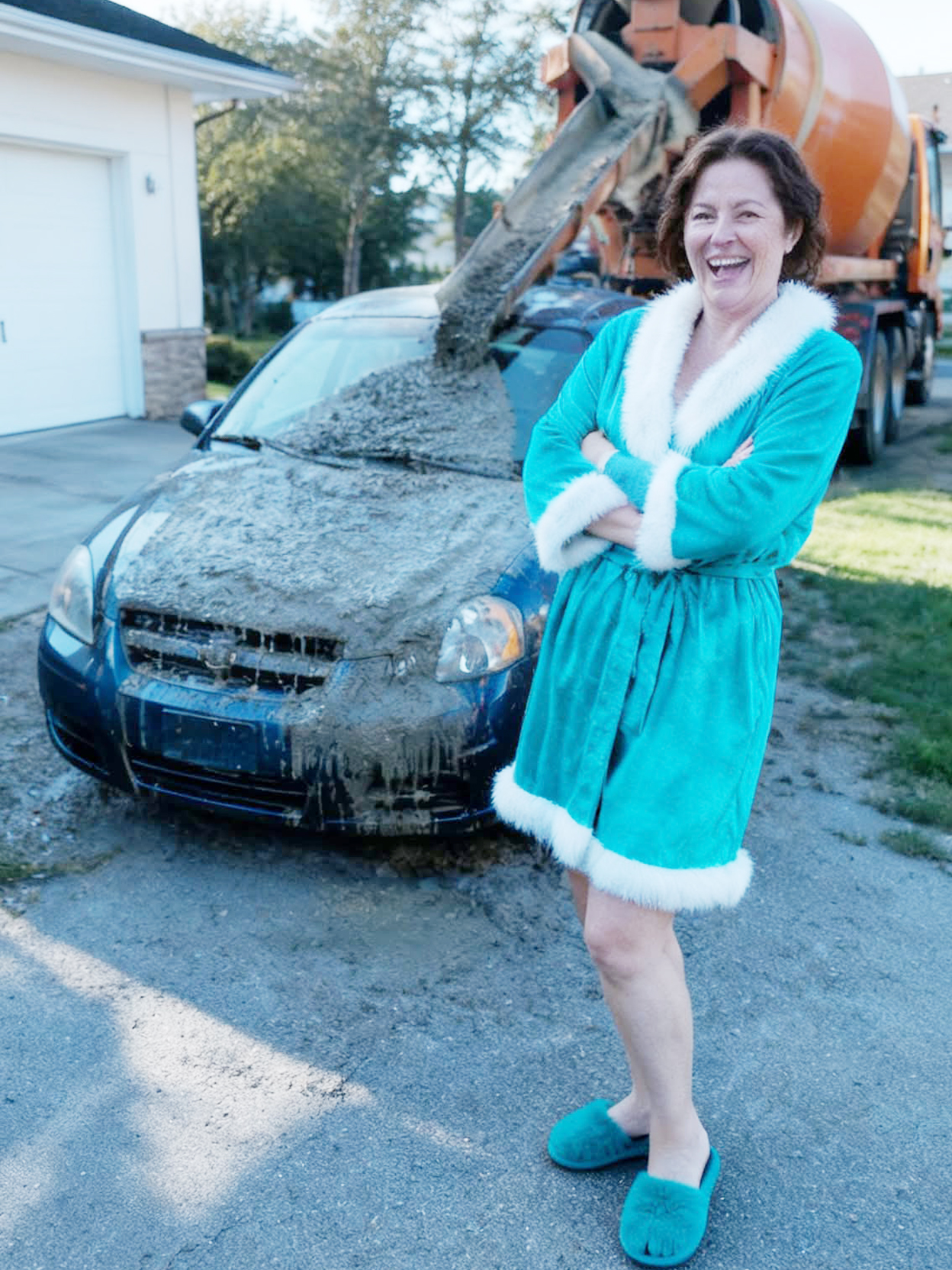
Before I could ask her what she meant, a deep rumble vibrated through the soles of my shoes. A yellow concrete mixer turned the corner, its massive drum rotating slowly. It was a twelve-ton machine, coughing black exhaust into the clear afternoon air.
The truck slowed as it reached our property line. I walked down the steps, my heart heavy with a sudden, cold weight. The driver, a broad-shouldered man with a red bandana tied around his neck, leaned out of the cab window.
“Twelve-forty?” he shouted over the roar of the engine.
“No,” I said, pointing toward Valerie’s large house. “This is twelve-thirty-eight. Her house is next door.”
The driver checked a clipboard on his dashboard. “The order says to pour the border along the gravel strip. Right where that blue Chevy is parked.”
“That is my car,” I said, stepping between the truck and my driveway. “And this is my land. You cannot pour concrete here.”
The driver, whose name tag read Daniel, sighed and wiped sweat from his neck with his red bandana. He looked back at the narrow gravel lane, then at his clipboard again.
“Look, lady, I just deliver the mud,” Daniel said. “The ticket says twelve-forty, but the customer specifically described this gravel pad. She said the blue car was abandoned and would be moved by four.”
“It is not abandoned,” I said. “And it is not her land.”
Valerie appeared on her second-story balcony. She was wearing her cream-colored silk robe, her hands resting lightly on the wooden railing.
“Driver!” Valerie called down, her patronizing tone cutting through the engine noise. “Do not listen to her. The easement belongs to my parcel. Begin the pour before the batch spoils.”
Daniel looked between us, his mouth set in a tight line. He was clearly thinking about his company’s liability, his fingers tapping against the steering wheel.
“I need to call dispatch,” Daniel muttered.
But before he could reach for his radio, a sharp hiss of air brakes echoed through the yard. He had already engaged the reverse gear. The truck crept backward, its massive rear tires sinking slightly into our gravel.
The long metal delivery chute swung outward, pivoting with a screech of ungreased iron. It hovered directly over the hood of my late father’s blue Chevrolet.
“Stop!” I screamed, running toward the driver’s side. “Stop the truck!”
A wet, heavy gray mass began to slide down the metal chute. It was thick and smelled of wet stone and lime. Before anyone could move, a large scoop of wet cement spilled over the side, landing with a loud splat on the polished blue hood of the car.
“Shut it down!” a gravelly voice roared.
Harold stepped out from behind his garage, carrying a thick manila folder under his arm. He walked with a steady, angry stride, his face dark under his faded baseball cap.
Daniel slammed his hand onto the control panel on the side of the truck. The rotating drum stopped with a heavy clunk, and the flow of wet concrete halted, leaving a gray heap sitting on my car’s hood.
Valerie watched from her balcony, her expression triumphant. She smoothed the lapels of her robe, looking down at us like a queen inspecting her courtyard.
“It is already done, Samantha,” Valerie said. “You should have signed the paper when you had the chance.”
Olivia walked over to the side of the driveway, completely calm. She did not look at the ruined paint on the Chevrolet. She pointed toward the road.
“The white car is parking, Mom,” Olivia said.
A white Ford Explorer with the words County Code Enforcement painted on the side pulled up behind Valerie’s stone wall.
A man in a tan uniform got out, holding a digital level and a black clipboard. Harold walked directly to him, opening his manila folder.
“Inspector Vance,” Harold said, his gravelly voice dropping to a professional murmur. “I have the plat maps from nineteen seventy-four, plus the current easement filings. Every single unpermitted addition is documented right here.”
The inspector took the folder and began flipping through the pages, his eyes scanning Harold’s neat handwriting and the old municipal survey maps.
Valerie’s triumphant look faded. She began descending her outdoor staircase, her silk robe rustling against the steps.
“What is going on here?” Valerie asked, her voice losing its cold edge. “This is a private residential project.”
“Not according to these records,” Inspector Vance said. He walked over to Valerie’s stone wall, placing his level against the masonry. “This wall is three feet inside the county easement. And your entire upper balcony violates the setback requirements.”
“That is impossible,” Valerie said, her hands smoothing her lapels over and over. “My contractor assured me everything was legal.”
“Your contractor was unlicensed, ma’am,” Harold said, tapping his cap against his knee. “And you never filed for a municipal permit.”
Inspector Vance pulled a bright orange sheet of plastic from his clipboard. He walked up to Valerie’s front door and pressed the orange stop work notice against the glass, securing it with tape.
“All construction on this property is halted immediately,” the inspector said. “You will receive a formal citation in the mail.”
A second truck, a gray pickup with the concrete company’s logo, pulled up to the curb. A supervisor in a hard hat got out, looking at the wet cement on my car.
“What is going on here?” the supervisor asked.
“Your customer lied about the property lines,” Harold said, pointing to the manila folder. “She ordered this pour on my neighbor’s driveway.”
The supervisor looked at the orange notice, then at Valerie. He pulled out a small black recorder.
“We record all dispatch calls for quality insurance,” the supervisor said. “Let us hear what you told our office on Wednesday.”
He pressed play. Valerie’s voice came through the speaker, clear and sharp.
“Yes, the address is twelve-forty,” Valerie’s recorded voice said. “The gravel spot next to the old blue Chevrolet is my secondary driveway. Just pour the barrier right there. The car belongs to a tenant who is moving.”
The supervisor turned off the recorder and looked at Valerie, his face red with anger.
“Shut it down right now, we were lied to!” the supervisor yelled to Daniel.
Valerie stood on her bottom step, frozen. She stared at the orange stop work order fluttering in the breeze on her front door.
The concrete truck’s heavy diesel engine coughed and began to roar in reverse. Daniel, the driver, hauled himself into the high cab, his red bandana tucked into his collar, leaving our driveway suddenly wide and silent.
I sat on the bottom step of the porch and pulled Olivia into my lap. She adjusted her mismatched socks, one blue and one yellow, then wrapped her thin arms around my neck.
“The big truck is going away,” Olivia said.
“Yes, it is,” I said.
The gray sludge of wet cement sat heavy on the blue hood of the Chevrolet. It looked like a wet wool blanket thrown over the metal, slowly losing its sheen under the autumn sun.
“Can we wash it off before it dries?” Olivia asked.
“Harold is getting the hose,” I said.
Harold walked around from the side yard carrying a green garden hose with a brass nozzle. He did not say anything, but he gave me a slow nod as he turned the brass fixture.
The water sprayed against the blue paint, sending gray ribbons of liquid sand down into the gravel.
“It will take more than water to get the film off,” Harold said, his gravelly voice low. “But we can stop it from setting.”
“Where is Valerie?” I asked.
Harold pointed with his chin toward the driveway next door.
“She is inside with the door locked,” Harold said.
“Is the city inspector still there?” I asked.
“He is waiting by the stone wall,” Harold said.
The water pressure sputtered, then came back in a steady, hard stream. Harold kept the nozzle aimed at the headlights, washing away the grit that had collected near the chrome trim.
“The chrome will rust if we leave any behind,” Harold said.
“I can scrub the bumper,” Olivia said, reaching for a rag on the porch step.
“Just the plastic parts, Olivia,” I said.
We worked in silence for ten minutes until the worst of the gray slime was pooling in the dirt. The blue paint looked dull under the wet film, but the shape of the hood was still straight.
Harold turned off the spigot, and the sudden quiet of the lakeside road returned.
“Let us go see what the inspector has to say,” Harold said.
We walked across the grass toward the property line. The ground was soft beneath our sneakers, holding the scent of damp lake reeds.
The city inspector, a man in a tan jacket named Mr. Henderson, stood near Valerie’s stone wall. He held a clipboard and pointed a yellow pen at the second-story balcony.
Valerie stood in the middle of her manicured lawn, her hands pressed flat against the lapels of her silk robe. She was weeping, the tears leaving dark tracks through her makeup.
“The entire structure extends three feet past your legal boundary,” Mr. Henderson said.
“It was built five years ago,” Valerie said. Her voice lacked its usual cold authority.
“Without a permit, and on a public easement,” Mr. Henderson said. “The city requires total demolition of the balcony and the stone wall.”
“Demolition?” Valerie asked.
“Within thirty days,” the inspector said. He clipped his pen to his board. “Or the city will perform the work and place a tax lien on the property.”
“Can I appeal the decision?” Valerie asked.
“The appeal window closed three years ago when the initial notice was sent to your contractor,” Mr. Henderson said.
He climbed into his white sedan and drove away, leaving Valerie standing alone on the grass.
Harold walked back to his porch workshop, leaving his hose near our driveway entrance.
“She looks very small now,” Olivia whispered, watching Valerie from the shadow of our porch.
“She has a lot of things to figure out,” I said.
“Are we going to help her?” Olivia asked.
“We have our own house to fix, sweetheart,” I said.
We watched Valerie walk back toward her front steps. She walked slowly, her silk robe dragging slightly in the grass.
“I want to go inside,” Olivia said.
“Go ahead,” I said. “I will be there in a minute.”
I stood by the fence line for a moment, looking at the marks where the concrete truck had backed up. The ground was torn, but the gravel could be raked back into place.
The sun was beginning to drop behind the tall pines near the water. The smell of damp lake reeds drifted up from the shore.
Valerie walked slowly toward the property line fence, her steps uneven on the grass. She did not look up at her balcony.
“Samantha,” Valerie called out.
I stood up from the porch steps and walked to the fence line. I kept my hands in my pockets.
“Yes, Valerie,” I said.
“The concrete supervisor said you have a right to file a police report for property damage,” she said.
She reached into her pocket and pulled out a small leather checkbook. Her fingers were pale.
“I will pay for the repairs,” Valerie said. “The full cost to restore the Chevrolet. I have the funds.”
“The supervisor is already writing up an incident report,” I said.
“Please,” Valerie said. Her voice was barely a whisper. “If you file formal charges, the county will accelerate the inspection on my main house.”
“The inspection is already scheduled for November twelve,” I said.
“I know,” Valerie said. “But a pending criminal complaint means they won’t grant me an extension to fix the easement.”
She looked down at her polished shoes.
“I will write the check now,” she said. “Eighteen hundred dollars. That is what the car is worth, isn’t it?”
“We need an estimate from the shop first,” I said.
“I will pay whatever they ask,” Valerie said. “Directly to the mechanic.”
“I am not trying to make this harder for you, Valerie,” I said.
“I know,” she said, her voice dropping. “I just want this to be over.”
“We will take the car to the shop tomorrow,” I said.
She nodded slowly, then turned back toward her house without another word.
Inside the kitchen, the air was warm and smelled of Harold’s oatmeal cookies. Olivia sat at the table drawing a picture of a frog on a paper napkin.
I stood by the window, twirling my silver key ring around my index finger. The metal clicked against my fingernails in a steady rhythm.
Valerie was still sitting on her lower step outside, her head resting in her hands.
“Are we going to call the police, Mom?” Olivia asked.
“No,” I said. “We are not.”
“Because she was mean?” Olivia asked.
“She made a mistake, and she is going to fix it,” I said. “We don’t need to make her feel worse.”
The anger that had kept my shoulders tight for six weeks seemed to slip away, leaving only a quiet tiredness. My father’s debts were still waiting, but the house was safe.
“My mom says a cold drink helps on a hard day,” Olivia said, standing up from her chair.
She walked over to the refrigerator and pulled out a small foil-topped juice box.
“What are you doing, Olivia?” I asked.
“I am going to give this to her,” Olivia said.
I did not stop her. I opened the back door and followed her out into the cool evening air.
Valerie looked up as Olivia stopped at the edge of the grass. Olivia held out the cherry juice box, the straw still attached to the side.
“Here,” Olivia said.
Valerie stared at the small red box in the child’s hand, her face completely still.
Valerie looked down at the small cardboard carton, her fingers remaining perfectly still against her silk lapel. She did not reach out to take the straw, but her chin trembled slightly before she turned back toward her front steps and closed the heavy oak door.
The next morning, the orange municipal stop work notice remained taped to her glass panel, fluttering in the early breeze that swept off the water.
By Monday, the private towing company had canceled their citation, and a representative from the insurer called my office at the bank. His tone was remarkably polite as he confirmed the wire transfer had been completed.
“The sum of eighteen hundred dollars has been cleared for the body shop,” the man said, his voice crackling over the line. “We have received the signed release from your neighbor.”
On Friday morning at ten o’clock, I walked into the lobby of Miller Auto Body, where the scent of fresh paint and motor oil hung heavy in the warm air. The manager, a quiet man named Carl, did not even ask for my identification.
“She paid the full estimate,” Carl said, sliding a metal clipboard across the high counter. “No questions asked.”
I signed my name at the bottom of the work order and walked out to the gravel lot where the blue Chevrolet sat under the high autumn sky. The gray concrete crust that had coated the hood was entirely gone.
The paint was smooth and deep, catching the cold morning light like polished stone. I ran my fingers along the driver-side fender, finding no grit or rough edges left from the spill.
“We had to buff the chrome twice to get the residue off the grille,” Carl said, coming out to stand by the rear bumper. “But she is exactly as she was.”
I turned the key in the ignition, and the engine started with its familiar, low rumble. The drive back to Oak Haven felt different, the steering wheel light in my hands as I passed the county line where the maples were dropping their last dry leaves.
When I pulled into our driveway at one o’clock, the smell of fresh cedar and wet paint hung in the cool air. Harold stood on the bottom step of our porch, holding a wooden stir stick over a gallon can of pale yellow paint.
“The city inspector came by while you were in town,” Harold said, nodding toward the new railing. “He signed off on the structural post and cleared the file.”
Olivia was already dipping a roller into the plastic tray, her mismatched red and green socks pulled up to her shins. She carefully dragged the roller up the first vertical spindle, leaving a bright, even coat of yellow behind.
“Look, Mom,” Olivia said, pointing with her elbow so she would not get paint on her fingers. “Harold says this color makes the porch look like a stick of butter.”
“It is a good shade,” Harold said, tapping his faded baseball cap against his knee. “Your father always wanted to do this side of the house in yellow. He said the grey pine looked too much like a rainy day.”
I reached into my pocket and felt the silver key ring, twirling it around my index finger out of habit, though the tight knot in my chest had finally loosened. “Did he really say that, Harold?”
“He talked about you all the time, Samantha,” Harold said, his voice dropping into its quietest gravel tone. “Every time we sat on this porch, he would mention how much you loved the lake when you were little.”
He handed me a clean brush so I could help with the trim. We worked in silence for an hour, the steady stroke of the bristles the only sound between our yard and the large, quiet house next door.
By late afternoon, the shadows of the oaks stretched long across the lawn, and the yellow paint on the porch steps was dry to the touch. Olivia had wandered down to the narrow strip of shore where the damp lake reeds grew thick and tall.
I walked down to join her, the ground soft under my sneakers. She was sitting on a flat stone, her knees pulled up to her chest, watching a small green shape rest on a floating log.
“Is that Kevin?” I asked, sitting beside her on the dry grass.
“He grew bigger,” Olivia whispered, not moving a muscle. “I think he likes the cold water better than the grass.”
The frog gave a sudden, powerful kick and vanished into the dark green depth of the lake, leaving a circle of ripples that spread toward the center. Olivia watched the water go still again, her hand reaching down to adjust the heel of her left sock.
“Do you think Grandpa can see the blue car from where he is?” she asked.
“I think he would be glad we kept it,” I said, putting my arm around her shoulder. “He loved that old thing.”
We walked back up the slope as the sky turned a pale violet. The workers Valerie hired had finished their afternoon shift, leaving the side of her house completely altered.
The massive stone wall had been dismantled, the heavy blocks stacked neatly on pallets to be hauled away, and the upper balcony was entirely gone, leaving only a clean, flat wall of siding where the unpermitted timber had once hung over our property.
Valerie’s house was completely dark, the drapes drawn shut against the autumn evening. There were no projection lights, no loud phone calls, and no trucks blocking the gravel path.
I guided the Chevrolet into its regular spot right beside the new yellow porch. The concrete company paid eighteen hundred dollars to restore the Chevrolet to its original condition. Samantha chose not to file private trespassing charges, allowing Valerie to quietly dismantle her unpermitted balcony. Valerie spent the next month supervising contractors who removed the stone wall from the public easement. Harold and Olivia finished painting the front porch a bright, welcoming shade of yellow. The car sat safely in the driveway as the sun set over the quiet water.
“We finally made it home, Olivia,” Samantha said.
The reflection of the autumn sunset rested on the polished blue hood of the Chevrolet.