The kitchen clock did not tick, but the refrigerator hummed in a low, uneven rhythm that usually meant a compressor was failing. I held the handle of my ceramic mug, realizing the coffee inside had gone entirely cold while I stared at the rain on the window. Five years had passed since my daughter Jennifer walked out of this house after our final, silent argument. Every morning since then had begun exactly like this, in a quiet that felt more like a physical weight than a comfort. I slowly twisted the plain gold ring on my left ring finger. It was a habit that had worn the metal thin
over forty years, and now it was the only thing that kept my hands still when the house grew too quiet. The rain was steady now, blurring the yellow leaves on the maple tree near the driveway. I wondered, as I did every single morning, if she was sleeping under a dry roof, or if she had forgotten the sound of the rain in Oakhaven. Before she left, Jennifer had told me that she could no longer breathe in this town. I had told her she was being foolish, and those were the last words we ever exchanged. The silence of the house was absolute, the kind of quiet that makes your
ears ring after a while. I took a small sip of the cold coffee and immediately regretted it, setting the mug down on the Formica counter. A sudden, soft thump sounded from the front porch. It was not the wind, and it was too heavy to be a stray cat against the siding. I stood frozen by the sink, listening for a second sound. The kitchen clock remained silent, but the hum of the refrigerator seemed to grow louder in the sudden tension. I wiped my palms on my apron, my heart giving a single, hard thud against my ribs.
I walked toward the hallway, my slippers making no sound on the linoleum. The air in the corridor was always colder than the rest of the house, drawing a draft from under the front door.
I unlocked the deadbolt, the brass mechanism turning with a sharp click that sounded incredibly loud.
When I pulled the heavy oak door open, the damp autumn air hit my face, carrying the smell of wet earth and decaying oak leaves.
On the gray-painted floorboards of the porch, pushed against the cedar siding to stay out of the rain, sat a shallow wicker basket.
I stepped forward, my slippers soaking up the dampness from the floorboards instantly.
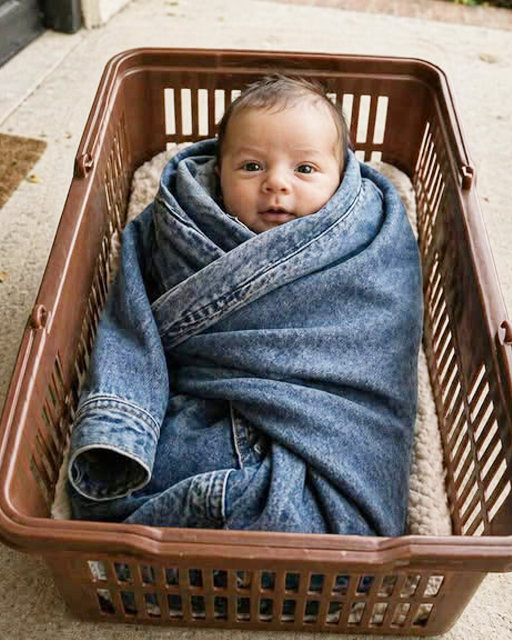
Inside the basket, wrapped tightly in a thick bundle of faded blue fabric, was a baby.
The fabric was a denim jacket, worn soft at the cuffs, with a distinct tear near the left pocket that I had mended myself with heavy navy thread twenty years ago. It was Jennifer’s jacket, the one she wore the day she left Oakhaven.
I looked down the long, gravel driveway, but the autumn mist had swallowed the road. There were no headlights, no taillights, and no sound of an engine in the wet morning air.
Only the steady dripping of water from the clogged gutters broke the quiet.
My hand shook slightly as I reached down toward the basket, my fingers brushing the damp denim.
The baby did not stir, her tiny face pale and perfect in the gray morning light.
I lifted the entire basket into my arms, surprised by how light it felt, and carried it quickly inside.
I shut the heavy oak door with my foot, turning the deadbolt once more to lock out the cold rain.
I set the basket in the middle of the living room rug, right where the morning light was beginning to filter through the sheer curtains.
Kneeling on the worn carpet, I began to unwrap the stiff denim with slow, deliberate movements. My fingers brushed the copper buttons, cold from the porch air.
The baby stirred, her tiny chest rising and falling in a rhythmic, peaceful cycle.
She did not wake, only turned her head slightly to the side, exposing a tiny, perfect ear.
I have you now, I whispered.
My voice sounded strange and hollow in the empty room, a sound I had not used in hours.
Who could have left her on my porch in the middle of a cold October rain?
I stood up and walked to the phone on the wall, my mind racing through the names of anyone Jennifer might have known, but the list was short and years out of date.
I dialed my sister Clara’s number, my fingers slipping twice on the plastic rotary dial.
Clara arrived ten minutes later, her old sedan idling loudly in my driveway before she shut it off.
She did not knock, but pushed the front door open, her yellow raincoat dripping water onto the linoleum.
Where is she, Clara asked, her voice sharp but her eyes wide with a quiet worry.
I pointed toward the living room, where the basket sat on the rug.
Clara walked over, her boots clicking on the wood floor, and stood over the baby for a long moment. She reached into her pocket, pulled out her spectacles, and tapped them gently against her notepad as she looked down.
There was a canvas bag on the porch chair, Clara said, turning back to me. I brought it inside.
She set a heavy green canvas diaper bag on the kitchen chair near the table.
Inside were six neat rows of disposable diapers, two plastic bottles of formula, and a small pink plastic rattle.
No note, Clara asked, her eyes searching my face.
I shook my head, my fingers tracing the gold ring on my hand.
Nothing, I said, though my eyes remained fixed on the blue denim jacket draped over the back of the kitchen chair.
The blue denim jacket lay open on the table, its collar still holding the scent of cedar and old rain.
My fingers brushed against something stiff inside the deep left pocket of the denim.
Clara reached across the table and took my cold mug, setting it near the sink before she sat back down on the vinyl chair.
“What did you find, Martha?” she asked.
I pulled out a small piece of lined yellow paper, folded three times into a tight square.
My thumb rubbed the crease, where a smudge of blue ink had bled slightly into the paper fibers.
“This writing is her hand, Clara, I would know it anywhere.”
Clara tapped her spectacles on her notepad, her eyes fixed on my fingers. “Open it.”
The paper felt thin, almost brittle, as if it had been carried in a coat pocket for days before landing on my porch.
I unfolded the first crease, revealing the neat, slanted script Jennifer had practiced so diligently back in middle school.
Clara leaned closer, her shoulder pressing against mine as we looked at the words together in the gray morning light.
*Please take care of Hope,* the note began, the name written in a larger, bolder hand than the rest of the text.
*She is my daughter, and she belongs with you now.*
There was no return address at the top, no city postmark, and no explanation of why she had left her child on the damp boards of my porch.
“Hope,” Clara whispered, her voice carrying a thin, raspy quality that made me look up from the yellow paper. “She named her after Grandma.”
I twisted the plain gold ring on my left ring finger, my eyes searching the bottom of the page for some sign of where my daughter had gone.
The message ended with a single, hasty sentence: *Do not try to find me, but know she is safe with you.*
Clara rubbed her temple with two fingers, her hand trembling slightly before she caught herself and dropped it to her lap.
“We need to know where she is, Clara.”
“She does not want to be found, sister,” Clara said, her voice dropping an octave as she adjusted her notepad.
“That does not mean we stop looking.”
We moved into the living room, where the baby lay asleep in the middle of the sofa, wrapped in a pink receiving blanket we had found in the bag of diapers.
I sat on the edge of the cushion, my hand resting near the baby’s tiny, rising chest while Clara stood by the window.
“If Jennifer is in trouble, she would have left more than a scrap of yellow paper,” Clara said.
“Maybe she could not write more,” I said.
Clara stopped looking out at the rain, her breath coming a bit faster as she leaned against the armchair for support
I noticed her face looked paler than usual under the morning light, but when I began to ask her about it, she waved her hand impatiently.
“We have to consider the practicalities, Martha,” she said, her voice regaining its usual sharp edge. “A baby requires more than a name and a denim jacket.”
“I have her formula from the bag, and four packs of diapers,” I said, counting the items in my head.
“That will last four days, maybe five.”
Clara tapped her spectacles against her notepad again, the plastic clicking in the quiet room. “And then what?”
“I still have her old number,” I said, rising from the sofa. “The one from her apartment in Toledo.”
Clara did not follow me back to the kitchen, remaining by the sofa with her hand pressed against her side.
The kitchen wall phone hung beside the pantry, its long black cord tangled from years of quick, impatient pulls.
My fingers felt heavy as I lifted the receiver and pressed the worn rubber buttons one by one.
Six numbers went through, then the seventh, each tone sounding too loud in the empty house.
Clara stood in the doorway now, watching me with her arms folded tightly across her chest.
“Is it ringing?” she asked.
A click sounded on the other end, followed by three rising, metallic tones that made my chest tighten.
“The number you have dialed is no longer in service,” a recorded voice said, flat and mechanical.
I held the plastic receiver to my ear anyway, waiting through the silence that followed the recording.
“Nothing?” Clara asked.
“It is disconnected,” I said, my voice barely reaching her across the small space of the kitchen.
“We should check her old friends,” Clara said, though she looked toward the hallway rather than at me.
“None of them have called me in three years, Clara.”
I hung the receiver back on its cradle, the plastic clicking into place with a definitive, heavy thud.
The silence of the kitchen returned, heavier now that the mechanical voice had faded.
I walked into the hallway, my slippers quiet on the worn linoleum that led to the back bedrooms.
On the doorframe just outside the pantry, a series of faint pencil marks showed where Jennifer had stood each year on her birthday.
The highest mark was sixty-four inches, made five years ago, just three weeks before she left.
“She was so small when we started this,” I whispered, my finger tracing the faded lead lines.
Clara joined me, her shoulder brushing mine as she looked at the markings on the wood.
“Martha, you do not have a single legal document for that child,” she said, her voice dropping its warmth.
“She is my granddaughter, Clara.”
“The state of Ohio does not care about bloodlines when a baby is left on a porch,” she said.
She tapped her notepad with her pen, her knuckles pale. “If a doctor asks for her immunization records tomorrow, what will you show them?”
I looked down at my hands, realizing the yellow note was still clutched in my palm, small and insufficient.
“I do not even have her birth certificate,” I said.
“We have nothing but a jacket and a scrap of paper,” Clara said.
The reality of the quiet house settled around us, the absence of any official record making the baby’s presence feel temporary, almost illegal.
I walked back to the kitchen wall, my hand shaking as I lifted the receiver to try the number one last time.
I stared at the disconnected phone in my hand, the dial tone buzzing like an angry insect in the quiet room.
It was already half past ten. I set the receiver back on its cradle and took my car keys off the hook by the pantry.
Clara stood by the stove, her fingers brushing the edge of her notepad. “Where are you going in this damp weather?”
“To the corner of Maple and Third,” I said.
“The baby is sleeping,” Clara said, nodding toward the living room where the small basket sat on the rug. “I will stay until noon, but no later.”
“I will be back before then,” I said, pulling my wool coat from the peg.
Paul’s insurance agency was a small brick building sandwiched between a hardware store and a closed bakery. The faded blue awning had shivered in the Oakhaven wind since nineteen eighty-four, its edges frayed and gray from decades of road salt. I parked my Buick near the curb, the wipers leaving two thick arcs on the glass before I switched off the ignition.
The brass bell above the door gave its familiar double chime as I stepped inside.
Paul sat behind his oak desk, surrounded by stacks of manila folders and a box of calendar refills for the coming year. He was sixty-four, with hair the color of wet gravel, and he had carried my family’s policies since my late husband bought his first pickup truck.
“Martha,” Paul said, rising from his leather swivel chair with a slow, deliberate movement. “I did not expect you in town today. Please, take a seat.”
“Thank you, Paul,” I said, sitting in the green vinyl chair across from him.
He cleared his throat before speaking. “I trust everything is satisfactory at the house after the storm last week.”
“The house is fine,” I said, twisting the gold band on my finger. “I need you to look at your database for me.”
“Our database is quite specific to active accounts,” Paul said, his voice carrying that formal, cautious rhythm he used for annual renewals. “Is there a particular policy you wish to review?”
“I want you to search for Jennifer,” I said.
Paul did not look at his computer screen. He looked at the brass letter opener on his blotter, his thumb tracing the dull edge of the metal.
“Jennifer left Oakhaven five years ago, Martha,” he said. “We closed her auto file when she sold the sedan, as you recall.”
“Check for any recent inquiries,” I said. “Maybe an address change. Or a request for a policy transfer from another county.”
“The state requires us to purge inactive files after three years,” Paul said, his eyes remaining on the letter opener. “It is standard procedure to protect client privacy.”
“Try anyway,” I said, my voice flat. “Please.”
Paul reached for his mouse, his index finger clicking twice to wake the monitor.
The screen threw a pale blue light across his face, highlighting the deep lines around his mouth. A small bead of sweat formed near his temple, just below the gray line of his sideburn, though the office radiator was barely clicking in the corner.
“There is nothing here under her social security number,” Paul said, his finger scrolling slowly through a blank spreadsheet. “Nothing active, at least.”
“What about inactive?” I asked.
“The screen is empty, Martha,” he said, turning the monitor slightly so I could see the blue search fields. “No inquiries. No correspondence.”
He wiped his forehead with the back of his hand, his eyes darting toward the window that looked out on the gray street.
He cleared his throat before speaking again. “We have to be very careful about the paperwork when a child is involved, Martha.”
I stood up, my purse strap heavy on my shoulder. “I did not mention a child, Paul.”
He froze for a second, his hand hovering over the keyboard. “You mentioned her. I assumed. It is a small town, and people talk.”
“Nobody knows she is back,” I said.
“Of course,” Paul said, his voice dropping to a murmur. “Of course.”
I walked out to the parking lot where Clara was waiting in the passenger seat of her own sedan, having driven over to meet me after her grocery run.
I opened her passenger door and leaned in, the scent of damp wool rising from her collar. “He knew something before I even opened my mouth.”
Clara tapped her spectacles against her notepad, her brow furrowing. “Paul has always been clumsy with his words, Martha.”
“He was sweating, Clara,” I said. “In a drafty office.”
“He has high blood pressure,” she said, looking toward the agency window where the blinds were tightly drawn. “Go home and check the old records.”
“Why would he assume there was a child?” I asked.
“Perhaps someone saw the diaper bag,” Clara said, though her voice lacked conviction.
I drove back to my house, the tires humming on the wet asphalt of Elm Street.
In the living room, the baby was sleeping in the portable crib, her small hand curled near her chin.
I walked to the rolltop desk in the corner, the one my father built from cherry wood.
In the bottom drawer, behind the old utility receipts and the manuals for appliances we no longer owned, sat a thick, brown envelope.
The metal clasp was rusted, leaving a dull orange smudge on my thumb as I pried it open.
Inside were the tax records from ten years ago, folded into neat thirds.
I unfolded the homeowners policy schedule from nineteen ninety-six.
The coverage limit was forty-five thousand dollars.
The rebuilding cost of a two-story frame house in Oakhaven was now three times that amount.
I looked at the beneficiary line, which was still blank.
The dusty brown envelope felt heavy in my lap, a reminder of how much I had let slide over the years.
The rain finally stopped just before ten o’clock the next morning, leaving the streets of Oakhaven slick and gray. I needed to buy milk and some bread, but the walls of my house had started to feel too close.
Inside the local grocery store, the fluorescent lights hummed a steady, flat tone that made my head ache. I stood near the bakery counter, staring at a tray of powdered donuts without really seeing them.
A small loaf of artisan bread on the shelf was marked at six dollars. I remembered when the same loaf was three, back before Jennifer left.
My fingers found the plain gold ring on my left hand, twisting it slowly around the knuckle.
“Martha?”
Paul was standing three feet away, holding a plastic container of glazed donuts. He wore his usual tan trench coat, though he had left it unbuttoned, revealing a dark green wool tie.
“Good morning, Paul,” I said, speaking slowly, letting a long pause settle between my words. “I did not expect to run into you here.”
“Just picking up a few items for the office staff,” he said, his voice carrying that formal, cautious rhythm he used when he was on the clock. He cleared his throat. “How are things at the house?”
“The house is quiet,” I said. “Too quiet, sometimes.”
He nodded once, his eyes drifting toward the bakery display case behind me.
“Paul,” I said, my voice dropping lower. “I have been thinking about our conversation yesterday. About the records.”
“Martha, we looked,” he said, his tone shifting into something a bit more guarded. “There was nothing new in the database. I told you that.”
“I am not asking about the computer,” I said, watching his face closely. “I am asking if Jennifer ever reached out to you directly. A letter, maybe. Or a personal phone call to your private line.”
Paul did not answer right away. He shifted the plastic container of donuts to his left hand, his grip tightening until the plastic gave a sharp crinkle.
“Why would she do that, Martha?” he asked.
“Because you were her godfather, Paul,” I said. “And because she trusted you.”
Before he could reply, the squeak of a grocery cart wheel sounded behind us.
Clara stepped out from the baking aisle, her shopping list held firmly in her hand. She stopped beside me, tapping her spectacles against her small yellow notepad.
“Morning, Paul,” Clara said, her voice sharp but not unkind. “You look like you just lost a client.”
Paul did not smile. He pulled his shoulders back, his posture stiffening under his coat.
“We were just discussing some old business, Clara,” Paul said, his voice suddenly much louder than it had been a moment before. “Martha seems to think I am keeping secrets from her.”
A woman putting a loaf of rye bread into her cart paused, her hand hovering over the shelf.
“I only asked if she wrote to you,” I said, keeping my voice soft, hoping he would match my volume.
“And I have told you three times now that she did not,” Paul said, his voice rising another notch. He stepped closer, his face turning a dark, mottled red. “You are letting old grief make you see things that are not there, Martha.”
The bread delivery boy stopped stacking loaves two aisles over, turning his head to watch us.
“Paul, quiet down,” Clara said, her warmth completely gone now, replaced by a hard, protective edge. “There is no need to make a scene in the middle of the store.”
“I am not making a scene, Clara, your sister is,” Paul said, his words echoing off the linoleum floor. He pointed a finger toward me, his hand steady but his face tight with anger. “She has been coming into my office, questioning my staff, and now she is cornering me in public. It is enough.”
My cheeks began to warm, the heat spreading rapidly from my neck to my ears.
“I was only asking,” I whispered.
“You are letting your imagination run wild because you cannot accept the choices your daughter made,” Paul said, his voice carrying clearly all the way to the pharmacy counter. “She left. She did not want to be found. It has been five years, Martha, and no amount of digging through old papers is going to change that.”
A young mother holding a toddler by the hand took a step backward, guiding her child away from our aisle.
“That is quite enough, Paul,” Clara said, her voice dropping into a low, dangerous register.
Paul looked around, finally noticing the five or six shoppers who had stopped to stare at us. He cleared his throat again, the sound dry and raspy.
“I have a business to run,” he said, his voice returning to a tight, formal clip. “I cannot spend my mornings defending my integrity in the grocery store. Good day, ladies.”
He turned and walked quickly toward the checkout lanes, his tan coat billowing slightly behind him.
I stood frozen by the bakery display, the hum of the fluorescent lights suddenly sounding incredibly loud.
“Let’s go, Martha,” Clara said gently, taking my elbow.
We left our half-empty basket on the end-cap of the pasta aisle and walked out into the cool, gray air of the parking lot.
By one o’clock, I was sitting alone at my kitchen table. The house was completely silent, save for the occasional click of the refrigerator turning on.
I had the folded yellow note sitting on the clean wood before me.
I traced the handwriting with my index finger, following the loops of the letters Jennifer had written. The ink was still dark, but the paper felt thin, almost fragile under my touch.
*You are letting old grief make you see things that are not there, Martha.*
Paul’s words seemed to hang in the corners of the kitchen, louder than the silence.
I looked toward the hallway, where the empty bedroom sat behind a closed door. For five years, I had believed she was out there, living a life she chose, angry with me for the things I had said during our last argument.
Now, a baby was sleeping in a crib down the hall, and my neighbor of thirty years was shouting at me in the grocery store.
I picked up the note, folding it back along its original creases until it was a small, perfect square.
Was I losing my mind?
I had no proof of anything other than this scrap of paper and a blue denim jacket that smelled of old rain.
Clara came back into the kitchen, carrying two mugs of tea. She set one down in front of me and sat in the chair opposite mine, tapping her spectacles on her notepad.
“You need to get out of this house for an hour,” Clara said. “We both do.”
“I don’t think I can face anyone right now, Clara,” I said, my voice barely above a whisper.
“We are not going to see anyone,” she said. “We are going to take a drive. Just to get some air.”
I did not want to go, but the quiet of the kitchen was beginning to feel heavy, like the dusty brown envelope that still sat on my desk.
Ten minutes later, we were sitting in my old Buick, the steering wheel cold under my hands.
The parking lot of the grocery store had been crowded, but my driveway was empty, bordered only by the dying yellow leaves of the maple tree.
I sat with my hands resting on the wheel, staring at the garage door.
“He had no right to talk to you that way,” Clara said, her voice soft but firm. “None at all.”
“Maybe he was right,” I said, twisting my ring again. “Maybe I am just grasping at straws because I want her to come home.”
“Martha, look at me,” Clara said.
I did not turn my head. I kept my eyes fixed on the gray paint of the garage door, the image of Paul’s angry, red face still burning in my mind.
The humiliation was a physical weight, pressing down on my chest until it was hard to draw a full breath.
I turned the key in the ignition, the engine’s rumble doing nothing to quiet the burning in my cheeks.
The heavy brass knocker on my front door rattled three times, sharp and quick, cutting through the hum of the refrigerator.
I stood in the hallway with a clean dish towel in my hand, staring at the frosted glass of the front door.
A man’s shadow stretched across the porch floorboards, tall and slightly hunched against the autumn wind.
When I opened the door, a young man in a faded gray sweatshirt was standing where the denim jacket had been that morning.
He looked no older than twenty-four, with dark, uncombed hair and gray eyes that kept darting toward the street.
“My name is Andy,” he said, his voice soft and low.
He reached down to adjust the black rubber strap of his wrist watch, pulling it tight against his skin.
“I need to talk to you about Jennifer,” he added.
My hand went to my left ring finger, my thumb automatically twisting the plain gold band around the joint.
“Who are you?” I asked, keeping my voice steady.
He cleared his throat and looked directly at me, his lip twitching slightly.
“I am Hope’s father.”
The name of my granddaughter hung in the quiet afternoon air between us, heavy and unexpected.
I stood frozen on the threshold, my fingers tight against the wood of the door frame as I stared at him.
“She is inside,” I said, after a long pause.
Andy nodded, his shoulders dropping a fraction of an inch as he stepped into the warmth of the hall.
He smelled of damp earth and cheap tobacco, a scent that did not belong in my quiet house.
“Come into the kitchen,” I said, leading the way past the stairs.
Clara, my older sister, was standing by the stove with a bottle of baby formula in her hand.
She did not set the bottle down when Andy entered, but her grip on the plastic tightened.
“This is Andy,” I said to her, my voice sounding thin to my own ears.
Andy did not offer his hand, choosing instead to pull out one of the yellow wooden chairs and sit on the very edge.
He looked around the room, his eyes lingering on the baby swing we had set up near the window.
“I didn’t want to leave her on the porch like that,” Andy said, his fingers twitching toward his watch strap again.
“You left an infant in the damp cold,” Clara said, her voice sharp but without its usual anger.
“I had to make sure she was safe,” Andy said, looking down at the linoleum floor.
“Safe from whom?” I asked, pulling out the chair opposite him.
“The people I was staying with,” he said, his voice dropping so low I had to lean forward to hear.
He adjusted his watch again, the plastic buckle clicking against his skin.
“They aren’t good people, and I couldn’t keep her there another night.”
“Why didn’t you just knock on the door?” Clara asked, tapping her spectacles against the small yellow notepad on the counter.
“I was scared you would call the police before you saw her,” Andy said.
“If you saw her first, wrapped in that jacket, I knew you wouldn’t let anyone take her.”
I looked at his tired face, seeing the dark circles under his eyes that reminded me of my own sleepless nights.
“How did you get here?” I asked.
“I walked from the bus station,” he said.
“It took me three hours.”
“You’ve been out there all day?” Clara asked, setting the baby bottle down on the counter with a soft thud.
“I stayed by the Methodist church until the rain let up,” Andy said.
He unzipped a dark canvas backpack he had set on the floor between his feet.
He pulled out a thick plastic folder and placed it on the yellow table.
“She didn’t run away from you, Martha,” Andy said, his voice steadying.
He pushed the folder toward me, his hand lingering on the edge of the plastic.
I opened the cover and saw a stack of medical records from a hospital in Columbus.
The name at the top of the first page was Jennifer’s, printed in clear black letters.
Below it, the word oncology was stamped in red ink.
“She was sick for a long time,” Andy said, looking at the window.
“She didn’t want you to watch her get weak.”
I turned the pages slowly, my eyes blurring as I tried to read the dates of her treatments.
The final certificate was at the very back of the stack, dated four weeks ago.
My daughter was gone, and the quiet world I had built was just a shell over an empty space.
“She wanted the baby to have the home she remembered, the one with the yellow kitchen,” Andy said.
The words cut through the silence of the room, landing heavily on my chest.
I touched the signature on the authorization form, recognizing the small loop in the J that she had always used.
“She talked about this kitchen every day at the end,” Andy said, his voice barely a whisper.
“She said you had a way of making everything feel safe, even when the wind was rattling the windows.”
I stared at the medical charts, the dates aligning with the years of silence I had spent wondering where she was.
I had thought she was angry with me, that she had chosen to stay away out of spite.
Instead, she had been fighting for her life in a crowded city hospital three hours away.
“Why didn’t she call me?” I asked, my voice cracking on the final word.
“She wanted to protect you,” Andy said, adjusting his watch strap yet again.
“She said you had already lost too much.”
“We need to get these to a lawyer,” Clara said, her voice unusually soft as she stepped closer to the table.
“The county will want to know why the baby is here, and we need to protect her.”
“I don’t have the money for a custody lawyer,” Andy said, his gray eyes locking onto mine.
“I spent everything I had on the bus ticket and the hospital parking.”
Clara reached into her large leather handbag and pulled out her blue vinyl checkbook.
“I can cover the five-hundred-dollar retainer,” Clara said, opening the book and searching for her pen.
“No, Clara, I should be the one to pay that,” I said, though my retirement account was dwindling.
“Don’t argue with me,” Clara said, her spectacles tapping against the table as she began to write.
“I have plenty of money sitting in that savings account from the house sale.”
I nodded, relief washing over me, completely unaware of the red notice she had tucked into her bag yesterday.
“I used to do maintenance work at the apartments in Columbus,” Andy said, looking out the kitchen window at the overgrown grass.
“I can fix that loose railing on your back porch while we wait for the lawyer.”
“We will need all the help we can get,” I said, looking at the folder of medical records.
The baby let out a small, soft sigh from her crib in the living room.
I stood up and walked toward the doorway, Andy and Clara following close behind.
The infant lay on her back, her tiny fingers curled into loose fists near her cheeks.
I looked from Andy’s tired eyes to the sleeping baby, realizing the long road of protecting her had just begun.
The grandfather clock in the hallway chimed once, its deep tone echoing through the high ceilings of the empty foyer. I stood near the front window, waiting for Clara to call back from her doctor’s appointment, when a heavy footstep sounded on the wet floorboards of the porch.
I opened the door to find Paul standing on the mat, holding a small plush giraffe with bright yellow spots and blue button eyes. His coat was damp from the mist, and he looked smaller under the gray afternoon light than he had in the grocery aisle.
Paul cleared his throat before he spoke. “Martha, I could not sleep last night thinking about how I spoke to you yesterday.”
He spoke with his usual formal, cautious phrasing, his voice barely louder than the drip of the rain from the gutters.
“It is fine, Paul,” I said.
“No, it is not fine,” he said, holding the plush toy out to me. “I was defensive, and I was rude to an old friend in public. I brought this for the little one.”
I took the giraffe from him, its soft fabric dry against my fingers. “Thank you. Her name is Hope.”
“Hope,” he repeated, his eyes moving past me into the dark hallway. “A strong name. May I come in for a moment?”
I hesitated, twisting the plain gold ring on my left ring finger. “Yes, of course.”
We walked into the living room, where the grey light from the window fell across the empty armchairs. Paul stood by the fireplace, keeping his hands clasped behind his back as if he were still standing in his office behind the counter.
“I have been reviewing your files, Martha,” he said.
I sat on the edge of the sofa, placing the plush toy on the cushion beside me. “My files?”
“Your home insurance policy,” Paul said. “It has been nearly ten years since we updated the valuation, and with a child in the house, the liability limits are completely inadequate.”
He pulled a black pen from his breast pocket and tapped it against his palm.
“I want to make sure you and the little one are fully covered, no charge for the assessment,” he said.
His voice was warm, the familiar tone of the neighbor who had helped me file the claim when my basement flooded after the spring thaw.
“I did not think about the liability limits,” I said.
“Most people do not,” Paul said. “But the cost of a lawsuit or an accident on the property could take everything you have. We need to look at the structure itself.”
He pulled a small yellow notepad from his pocket and began to write down numbers in his neat, tiny handwriting.
“The house is seventy years old,” I said.
“Seventy-four,” Paul corrected. “And the plaster work alone is expensive to replace. However, for the sake of keeping your monthly premiums low, I recommend we leave the rebuilding coverage at one hundred and eighty thousand dollars.”
I looked at the high ceilings and the solid oak baseboards that ran along the perimeter of the room.
“Is that enough to rebuild a house of this size today?” I asked.
Paul cleared his throat, his eyes fixed on his notepad. “The market in Oakhaven is quiet, Martha. We do not want to inflate your values and force you to pay premiums you cannot afford on a retired registrar’s pension.”
“I suppose that makes sense,” I said.
“It is the safest path,” Paul said. “I will handle the paperwork myself. No need to worry about the details.”
Before I could answer, the kitchen door creaked open, and Andy stepped into the living room holding a clean plastic bottle.
He stopped short when he saw Paul, his fingers instantly going to his left wrist to adjust his black watch strap.
“Martha, I am sorry,” Andy said, his voice soft and low. “I did not know you had a guest.”
“Andy, this is Paul,” I said. “Our neighbor from down the street.”
Paul stepped forward, his hand extended, his face instantly bright with a welcoming smile.
“It is a pleasure to meet you, young man,” Paul said. “Martha has told me so much about you.”
Andy took Paul’s hand, his grip cautious, his eyes searching the older man’s face. “Nice to meet you, sir.”
“I understand you are looking for local work,” Paul said.
“Yes,” Andy said. “Anything steady.”
“My friend Gary runs the lumber yard near the state route,” Paul said. “I would be happy to give him a call on your behalf. He is always looking for reliable men for the morning shift.”
Andy looked at me, then back at Paul, his hand still lingering on his watch strap. “That is very kind of you.”
“We take care of our own here,” Paul said. “And we want to make sure Hope has everything she needs.”
“She does,” Andy said.
“Excellent,” Paul said, tucking his pen back into his pocket. “I will get that insurance draft prepared for you, Martha. I can have it ready by tomorrow afternoon.”
“Thank you, Paul,” I said.
He walked toward the front door, his steps lighter than when he had arrived, and I followed him out to the porch.
The rain had stopped, but the autumn air was cold, smelling of wet earth and decaying leaves.
“Have a good afternoon, Martha,” Paul said.
“You too, Paul,” I said.
I stood on the porch, my hand resting on the damp wooden railing, watching him walk down the driveway to his silver sedan.
He did not get in right away.
He stood by the driver’s side door, looking back at the house for a long moment before he finally opened the door and sat inside.
Through the windshield, I watched him reach into the glove compartment and pull out a thick manila envelope.
He pulled a document from the envelope, his face turning pale and rigid as he read the lines.
He wiped his forehead with the back of his hand, his shoulders tense, his mouth set in a hard, thin line.
He sat there for three minutes, staring at the paper, before he shoved it back into the glove compartment and slammed the lid shut.
The engine started with a low rumble, and he pulled away from the curb without looking back.
I went back inside the house, closing the door to keep out the cold draft.
Andy was standing in the kitchen doorway, his fingers still resting on his watch strap.
“Did he say how he knew Jennifer?” Andy asked.
“They only spoke when she was young,” I said.
“He knew her name,” Andy said. “I did not mention her name to him.”
I stood in the quiet hallway, the plush giraffe still sitting on the sofa in the other room.
The toy sat on the sofa, its bright blue button eyes staring blankly into the room.
The office of Richard Vance, the family attorney, smelled of lemon wax and old leather binders.
Richard sat behind his heavy oak desk, his fingers slowly lining up three black ballpoint pens in a perfectly straight row next to his legal pad.
I laid my personal check for five hundred dollars on the corner of the desk, the ink still wet on his name.
Richard did not look at the check, but his hand moved it two inches to the left, aligning it with his brass paperweight.
I reached into my worn leather purse and pulled out the folded paper envelope Andy had given me, the one containing the medical records from the clinic in Columbus.
“These are the papers from the doctor,” I said, placing them on the green blotter.
Richard did not pick them up immediately, his eyes staying on the edge of his notepad for a second before he reached out.
“We need to establish a clear timeline, Martha,” he said, his voice level and steady.
He slid a silver letter opener under the flap of the envelope, his movements practiced and slow.
I twisted the plain gold ring on my left ring finger, watching his face as he scanned the first page.
The clinic address was printed in small blue ink at the top, a detail I had stared at for half the night.
“This is a certified copy of her intake form,” Richard said, turning the page with a dry whisper of paper.
“Is it enough to keep her safe with me?” I asked.
Richard paused, his hand hovering over his third pen.
“It shows intent, but we need more than intent when we go before a judge.”
He looked up, his eyes neutral behind his thin frames.
“We need the official death certificate, Martha.”
“Andy said he didn’t have one,” I said, my voice dropping.
“Then we have to find out where the estate was filed,” Richard said.
He stood up, carrying the folder toward the door.
“Let’s move into the conference room where we have the terminal set up.”
The conference room was colder than his main office, the single-pane windows letting in the damp air from the street below.
Clara was already sitting at the long mahogany table, her notepad open and her reading glasses resting near her hand.
She did not look up when we entered, but her finger tapped twice against the side of her spectacles.
“Did you find the registration?” Clara asked, her voice sharp but thin.
Richard adjusted the keyboard on the side table, his screen glowing with a gray database of county records.
“I am searching the state registry now,” Richard said.
The room smelled of old paper and carpet cleaner, the rain outside pattering against the glass.
“Nothing in our county,” Richard murmured, his fingers typing three quick strokes.
“She wouldn’t have filed here,” Clara said, tapping her spectacles on her pad. “She left Oakhaven five years ago.”
“Here it is,” Richard said, his hand stopping on the mouse. “A probate filing in Franklin County.”
I leaned forward, my hand gripping the edge of the table.
“When was it filed?” I asked.
“Six months ago,” Richard said, his eyes scanning the screen. “The estate is already closed.”
“Closed?” Clara asked, her voice rising slightly.
“It was a small estate administration,” Richard explained. “No real property, just personal effects and a small bank account.”
He clicked a button, and the printer in the corner of the room began to hum and warm up.
“I am printing the docket sheet and the final accounting,” he said.
“Who was the executor?” I asked, my heart tight.
“There wasn’t one,” Richard said, watching the paper slide into the tray. “It was a summary release.”
He picked up the warm sheets of paper and laid them on the table between Clara and me.
“But someone had to sign for it,” Clara said, leaning over the table.
“Yes,” Richard said, pointing to the second sheet. “The applicant was Andrew Vance.”
“Andy,” I whispered.
“And it looks like the filing was completed in April,” Richard said.
I looked at the date, April twelfth, a Tuesday.
“That was before she died,” I said, my mind trying to make the numbers fit.
“No,” Richard said gently. “The date of death listed here is March fourteenth.”
I stared at the black numbers on the white page, March fourteenth, six months ago.
All through the spring and summer, I had looked at the empty bedroom upstairs, believing she was out there, angry with me.
“She was already gone,” I said, the words dry in my mouth.
“Martha,” Clara said, her hand reaching out to touch my sleeve.
“We need to see who prepared these documents,” Richard said, ignoring the silence.
He turned to the last page of the printout.
“The filing was done by a Columbus legal aid group, but there are local witnesses listed on the waiver.”
He picked up his pen again, lining it up with the top edge of the printed paper.
“What about the house, Richard?” Clara asked. “If Jennifer had an interest in the property, does this estate affect Martha’s deed?”
“Martha’s home is still in her name,” Richard said, tracing a line on the docket sheet. “But if Jennifer had debts, creditors could have filed claims.”
“There are no claims listed here,” Richard added, his finger moving down the column. “Just a funeral bill from a chapel on Broad Street.”
“How much?” I asked.
“Three thousand two hundred dollars,” Richard said. “Paid in full by the applicant.”
“Andy paid that?” I asked.
“It looks like it,” Richard said.
“Where would Andy get three thousand dollars?” Clara asked, her voice sharp with suspicion.
“He works at the garage,” I said, remembering his tired eyes.
“That’s a lot of money for a mechanic in Columbus,” Clara said, her spectacles tapping her pad.
“We have to see who authorized the release of the funds,” Richard said, pulling a second document from the printer tray.
He began to read the line items aloud, his voice dropping into a professional hum.
“Personal property, valued at eight hundred dollars,” Richard read. “A savings account with four hundred and twelve dollars.”
“That’s all she had?” I asked, my voice barely carrying.
“That is all that was declared,” Richard said.
He stopped, his eyes lingering on the bottom of the page.
“Is there something else?” Clara asked, leaning forward so far her notepad slipped an inch.
“There is a waiver of notice,” Richard said, his voice dropping.
“Who waived the notice?” I asked.
“The immediate family,” Richard said.
He did not look at me, his finger staying on the signature line.
“But I never signed anything,” I said.
“I know,” Richard said, his voice quiet.
“March fourteenth,” I repeated, the date sounding strange in my own voice.
I remembered March fourteenth. It had been a cold Monday, and I had spent the afternoon cleaning the gutters, thinking how much I wanted to tell her about the robins returning to the yard.
“She was in the hospital in Columbus,” Richard said, his eyes scanning the medical intake form on his blotter.
“And Paul knew then?” I asked, my voice barely carrying over the hum of the printer.
“According to the probate docket, he was contacted by the clinic social worker on March sixteenth,” Richard said.
“Why would they contact him?” I asked.
“He was listed as the family’s emergency point of contact on her old policy,” Richard said, sliding another sheet toward me.
The sheet was a photocopy of an old card, the handwriting undeniably Jennifer’s, with Paul’s office number written in her blocky print.
“She didn’t put my name down,” I whispered, the paper dry against my fingertips.
“She probably wanted to spare you, Martha,” Clara said from the side of the table, her voice softer than usual.
“Or she was still angry about our last argument,” I said, my finger tracing the edge of the photocopy.
“We don’t know that,” Clara said, but her hand stayed on her notepad, her pen still.
Clara stood up, taking her notepad with her to the lobby to call the neighbor who was watching Hope.
Richard led me back into his private office, where the desk lamp cast a yellow circle over his blotter.
He laid the third page of the probate document on his desk, right between his aligned pens.
“Look at the witness line on the third page, Martha,” he said. “Is that the signature of your agent?”
I leaned down, my eyes focusing on the bottom of the page.
The cursive was small, neat, and slightly slanted to the right, written in blue ballpoint ink.
It was a signature I had seen on dozens of insurance renewals, on my car policy, on the annual calendar he brought over every December.
“Paul,” I said, the word barely carrying across the desk.
“Paul Vance?” Richard asked, his voice low.
“No, Paul Miller,” I said, my finger touching the paper. “My insurance agent.”
The address under his name was his office on Third Street, three blocks from my house.
“He witnessed the signature on the asset disclosure form,” Richard said.
“Why would he be in Columbus in March?” I asked.
“The document wasn’t signed in Columbus,” Richard said, pointing to the notary stamp. “It was notarized right here in our county.”
“But Jennifer wasn’t here,” I said. “She was in the hospital.”
“The waiver allows for a remote signature if witnessed by an agent of the court or a designated representative,” Richard said.
“Paul went to see her,” I said.
“Or she came here,” Richard replied.
“No,” I said, shaking my head. “She couldn’t travel by then.”
“Then Paul traveled to her,” Richard said.
He turned the page over, showing the second signature line.
“He signed as a personal representative of the family’s assets.”
“He told me he had no records,” I said, remembering the dusty brown envelope in my lap.
“He signed this on March twenty-eighth,” Richard said.
“That was two weeks after she passed,” I said.
“Yes,” Richard said, his pen moving to the date line.
“He knew,” I said.
“Why would Paul need to sign as a representative?” I asked, my voice barely above a whisper.
“Because of the life insurance policy,” Richard said, his voice flat.
“What policy?” I asked. “Jennifer didn’t have one.”
“She had a small policy through his agency,” Richard said, sliding another paper from the folder. “A ten-thousand-dollar term policy she took out when she was twenty-one.”
“I never knew about that,” I said.
“It lists the beneficiary as the estate,” Richard said. “But there was a change of beneficiary form filed six months ago.”
“Who was the new beneficiary?” I asked.
“Hope,” Richard said, his pen pointing to the name on the second page.
“But Paul told me his system had no record of her since she left town,” I said, my hand tightening on my purse.
“He processed the change of beneficiary himself,” Richard said, his voice steady. “His signature is on the agent line.”
“He lied to me,” I said. “In his office, when I asked him to search his files.”
“He didn’t just lie, Martha,” Richard said, leaning back. “He acted as the witness for the probate court to verify that the estate had no other assets.”
“Why would he care about her assets?” I asked.
“If there were other assets, the policy would have been subject to probate claims,” Richard said. “By filing this waiver, he cleared the policy to pay out directly to the child’s guardian.”
“But there is no guardian,” I said. “Andy doesn’t have legal custody yet.”
“The money is held in a restricted account at the state treasury,” Richard said. “Until someone is appointed.”
Richard sat back in his leather chair, the leather creaking under his weight.
“An insurance agent has a fiduciary duty when handling family policies, Martha, but this is a probate matter.”
“He knew she was gone,” I said, my voice flat.
“He witnessed the transfer of her personal property to Andy,” Richard said.
“And he never said a word to me,” I said, looking at the rain sliding down the window pane.
“He was at my house on Friday,” I said, my fingers twisting the gold ring. “He brought a toy for the baby.”
“Did he mention the estate?” Richard asked.
“He offered to review my home insurance,” I said. “He said he wanted to make sure we were covered.”
“For free,” I added, remembering his soft voice.
“An unrecorded change in beneficiaries can complicate a policy,” Richard said, his professional cadence returning.
“He knew she was dead when I asked him in his office,” I said.
“He told me I was letting my imagination run wild,” I whispered.
“He did that in the grocery store, in front of everyone,” I said, the memory of my burning cheeks returning.
“Why would he do that?” I asked.
Richard did not answer, his eyes dropping back to his legal pad.
“We need to find out what else he witnessed, Martha.”
“There is another page,” I said, pointing to the folder.
“This is the distribution of the personal effects,” Richard said, turning it.
“The blue jacket,” I said.
“It is listed here,” Richard said, his finger stopping on the line. “One denim coat, returned to family.”
“He took it,” I said.
“Or Andy did,” Richard said.
“But Paul knew,” I said, the coldness spreading from the paper into my hands.
The paper in my hand felt cold, the black ink of Paul’s signature staring back at me like a betrayal.
Andy sat on the edge of the living room sofa at eleven o’clock, his thumb repeatedly tightening the small leather strap of his watch.
The baby was sleeping in the portable crib we had set up near the window, her small chest rising and falling in the gray morning light.
“My parents found out she is here,” Andy said, his voice dropping into that soft, low register that always made me lean closer to hear.
I twisted my plain gold ring, turning the band around my finger three times before I spoke.
“How could they find out, Andy?”
“They saw the notice in the county paper,” he said, tugging the leather strap until his skin turned red. “They haven’t spoken to me in three years, but they have money, Martha, and they still have their pride.”
“What does their pride have to do with Hope?”
“They are hiring a lawyer from Columbus to file for custody,” he said, looking at the sleeping baby.
My hand stopped on my ring.
“They cannot just take a child from her father,” I said.
“They will say I am unfit because of my record from college,” he said, his voice trembling slightly. “And they will say you are too old to help me raise her.”
I looked past him, out the large double window that faced the backyard.
The dry autumn grass looked pale in the cold light, and the old rusted iron pole from Jennifer’s childhood swing set stood near the property line, bare and gray against the fence.
“We have the medical documents,” I said. “We have the letter Jennifer left for us.”
“My father does not care about letters,” Andy said, finally letting go of his watch. “He cares about what is on paper in a courtroom.”
“We will go to Richard,” I said, my voice steady despite the tightness in my chest.
“They have already filed the preliminary petition,” Andy said. “A deputy is coming to serve the papers tomorrow morning.”
I stood up and smoothed the front of my skirt, the fabric stiff under my palms.
“I need to make a phone call,” I said.
I walked into the hallway, the hardwood floor cold beneath my shoes.
The grandfather clock in the corner ticked once, a heavy, metallic sound that seemed to fill the narrow space between the walls.
I did not call the lawyer first.
I drove to the corner of Oak and Main, parking my Buick in the small gravel lot behind the brick building with the faded blue sign.
The sign still said Paul’s Family Insurance, though the gold lettering was peeling at the edges.
I pushed the heavy glass door open, the brass bell above it chiming once.
Paul was sitting behind his laminate desk, a stack of blue folders open in front of him.
He did not look up immediately, though I knew he heard the bell.
“Paul,” I said, standing near the low divider that separated the waiting area from his desk.
He cleared his throat, the sound dry and raspy in the quiet room.
“Martha,” he said, his voice cautious and formal. “I am quite busy with the quarterly renewals today.”
“You signed the probate papers,” I said, walking past the gate without waiting for him to invite me.
He slowly closed the top folder, his fingers lingering on the cardboard edge.
“That was a professional matter, Martha,” he said. “I was called as a witness in another county.”
“You knew my daughter was gone for six months, and you let me sit in my kitchen believing she was still running,” I said, my voice dropping.
“I had a duty of confidentiality to the estate,” he said, his face tightening as he looked at the window.
“We were friends for forty years, Paul,” I said. “Our families shared dinners on this street.”
He cleared his throat again, louder this time, and stood up from his chair.
“The friendship ended when you began asking my staff to pull private records, Martha,” he said.
“I asked for my own files,” I said.
“You asked for things that do not belong to you,” he said. “And now you have a young man and an infant living in a house that is registered for a single occupant.”
I stared at him, my hand instinctively going to my ring.
“What does that have to do with my insurance?”
“I ran a risk assessment on your property this morning,” Paul said, his voice entirely devoid of the warmth he had used on my porch. “With the unresolved legal status of the minor and the non-relative occupant, the liability is too high.”
“My home has been insured with you since my husband died,” I said.
“Underwriting regulations are very clear about material changes in risk,” he said, pulling a white sheet of paper from his drawer. “I have submitted a notice of immediate cancellation for your homeowner policy.”
He slid the paper across the desk, the white surface reflecting the fluorescent lights above us.
“You are canceling my coverage?”
“The policy terminates at midnight,” Paul said, his eyes meeting mine for the first time.
“I have a mortgage, Paul,” I said. “The bank requires active coverage.”
“Then you should find another carrier,” he said, picking up his pen and opening the blue folder again.
I took the paper from the desk, the edges sharp against my fingers.
I walked out of the office, the bell chiming behind me like a mocking laugh.
The autumn wind was stronger on the street, lifting dry leaves from the gutter and tossing them against the tires of my car.
I walked toward the town square, my coat pulled tight against the chill.
Clara was waiting by the stone fountain, her blue woolen scarf wrapped twice around her neck.
She was holding her small notepad in her gloved hands, tapping her spectacles against the cardboard backing.
“You look pale, Martha,” she said as I reached her.
“Paul canceled the insurance,” I said, holding out the white paper.
Clara took the sheet, her eyes scanning the lines quickly while her spectacles tapped a steady rhythm.
“He did this today?” she asked, her voice sharpening.
“He said the risk changed because of Andy and the baby,” I said.
“He did this because he knows we found the probate signature,” Clara said, tucking the paper into her purse with a quick, decisive jerk.
She looked across the square, her eyes fixed on the distant brick courthouse.
“Without active insurance, Martha, any custody evaluator is going to look at this house very differently,” Clara said, her voice dropping to a whisper.
“They can deny the guardianship?” I asked.
“An uninsured home is considered unsafe for a minor,” she said. “The county standards are very strict about that.”
“We can find another company,” I said.
“Not by tomorrow morning,” Clara said, looking down at her notepad. “And not with an open dispute on the title.”
“The title is clear,” I said.
“The bank will receive the notice of cancellation by tomorrow afternoon,” Clara said. “They will call the loan if we do not place a binder immediately.”
“How much will a binder cost?”
“A high-risk carrier will want the entire annual premium up front,” she said, her warm eyes showing the worry she was trying to hide. “At least three thousand dollars.”
“I have some savings left,” I said.
“We need to keep that for Richard’s retainer,” Clara said. “The custody hearing is going to be expensive.”
I turned my back to the wind, looking at the old brick buildings that lined the square.
Most of them had been there since my father was a boy, solid and unchanging, but today they looked like cardboard cutouts that a strong gust could blow away.
“I am going home,” I said.
“I will call Richard’s office and see if he can get us an extension,” Clara said, her hand resting on my shoulder for a brief second.
I drove back to the house, the streets of Oakhaven appearing unfamiliar and cold through the dusty windshield.
The baby was still asleep when I entered the kitchen, the soft sound of her breathing the only noise in the quiet house.
Andy was in the living room, sitting on the floor with his back against the wall, staring at the empty hallway.
I did not tell him about the insurance.
I sat at the kitchen table, pulling the small wooden box from the cupboard where I kept our financial papers.
The light in the kitchen was already fading, the afternoon turning into a dull, flat gray.
I opened my bank book and looked at the black ink of the ledger.
My retirement account held exactly twenty-two thousand four hundred and twelve dollars.
I wrote the number on a napkin, then subtracted three thousand dollars for the insurance binder.
Then I subtracted five thousand dollars for the legal retainer Richard would need to fight Andy’s parents.
The remaining balance looked very small on the white paper, a tiny shield against everything that was coming toward us.
I picked up the phone to call the bank, but my fingers stopped on the buttons.
The dial tone hummed in my ear, steady and indifferent.
I set the receiver back on the cradle, my hand remaining on the cold plastic for a long time.
Through the window, the dry grass in the backyard seemed to darken as the sun went down behind the garage.
The shadows in the kitchen grew long, stretching across the floor like fingers reaching for the baby’s cradle.
By two o’clock the next afternoon, I was sitting across from Richard with every bank statement I owned spread between us on the polished oak table.
Richard, the attorney who had handled my late husband’s small estate, was fifty-eight, and he had already aligned his black gel pens in a perfect row next to his legal pad.
He picked up the deed to my house, squinting at the yellowed paper through his reading glasses.
“Your home is currently underinsured by ninety-five thousand dollars, Martha, and you have no named beneficiary on your primary savings account,” he said.
I twisted the plain gold ring on my left ring finger, looking at the numbers.
“The policy Paul wrote for me ten years ago was never adjusted for inflation,” I said, my voice slow and even.
“If the house burned tomorrow, you would receive less than half of its current market value, and the state would freeze your bank accounts if you passed,” Richard said, tapping a pen against his thumb.
He turned a page in his folder, his eyes scanning a sheet of figures I had printed from my bank’s website.
“We need a complete estate overhaul before we go into that courthouse,” I said.
Richard nodded once, his professional cadence matching the steady rhythm of the autumn rain against the tall windows of his second-floor office.
“We will start with a new last will and testament, a financial power of attorney, and a healthcare directive,” he said.
He began typing on his computer, the keys clicking rapidly in the quiet room.
“Who will make your medical decisions if you are unable to do so?” he asked.
“Clara,” I said, not needing to think.
“And if Clara is unavailable?”
“Andy,” I said, the name feeling solid in my mouth.
“If the house burned tomorrow, you would receive less than half of its current market value, and the state would freeze your bank accounts if you passed,” Richard said, tapping a pen against his thumb.
He turned a page in his folder, his eyes scanning a sheet of figures I had printed from my bank’s website.
“We need a complete estate overhaul before we go into that courthouse,” I said.
Richard nodded once, his professional cadence matching the steady rhythm of the autumn rain against the tall windows of his second-floor office.
“We will start with a new last will and testament, a financial power of attorney, and a healthcare directive,” he said.
He began typing on his computer, the keys clicking rapidly in the quiet room.
“Who will make your medical decisions if you are unable to do so?” he asked.
“Clara,” I said, not needing to think.
“And if Clara is unavailable?”
“Andy,” I said, the name feeling solid in my mouth.
Richard stopped typing for a moment, looking up over his glasses.
“The father of the child?”
“Yes,” I said. “He is the only one who has stayed.”
Richard resumed his typing, his fingers moving across the keyboard like a court reporter’s.
“We will name Clara as your primary financial power of attorney and Andy as the successor,” he said.
The clock on the wall chimed the half-hour, its brass pendulum swinging behind the glass.
Richard printed three thick documents, the machine in the corner humming as it warm-up and spat the sheets into the tray.
“Sign here, here, and here,” he said, pointing with the tip of his gold pen.
I wrote my name on the lines, the ink black and wet against the white paper.
The door to the office opened at exactly three o’clock, and Clara walked in, carrying her leather purse and a small legal pad.
She sat in the chair beside me, immediately tapping her spectacles on her notepad before looking at Richard.
“We need to discuss the house,” Clara said, her sharp voice filling the room with its usual warmth.
“I am recommending a family trust,” Richard said, pulling a fresh legal pad toward him.
“A trust will protect the property from any future claims, including custody challenges or probate disputes.”
“How much will it cost to fund it?” I asked.
Richard looked at the bank statement showing my retirement savings.
“To make it bulletproof, you should transfer the bulk of your liquid assets into the trust,” he said.
“That is one hundred and forty-two thousand dollars, Richard,” Clara said, her brow furrowing as she looked at me.
“That is everything Martha has left from her years at the school district.”
I looked at the window, where the rain was turning into a grey mist over the town square.
“Do it,” I said.
“Martha, you will have no direct access to those funds for your own daily expenses without going through the trustee,” Clara said, her hand reaching out to touch my arm.
“The trustee will be you, Clara,” I said, turning to look at her.
“The money is for Hope’s education and the upkeep of the house.”
“And what about you?” Clara asked.
“I have my monthly pension,” I said, pausing between my words.
“It is enough for groceries and the water bill.”
Richard cleared his desk of the signed wills, stacking them neatly in a drawer.
“With the trust established, the home is legally shielded from any claims made by Andy’s family,” Richard said.
“They cannot argue that the child is living in an unstable financial environment.”
“What about the insurance?” I asked.
“Paul cancelled the policy this morning,” Richard said, his voice flat.
“He cited an undisclosed occupant in the house, meaning the baby.”
“He is trying to make me look negligent before the hearing,” I said.
“We will deal with Paul tomorrow,” Richard said, his eyes narrowing slightly as he looked at a blue folder on his desk.
“For now, we secure the child.”
He reached into a drawer and pulled out a two-page document with a notary seal already stamped on the back.
“Andy was here at noon,” Richard said.
“He signed the temporary guardianship agreement and had it notarized.”
He slid the document across the desk toward me.
“This gives you legal custody until the formal county hearing next month,” Richard said.
“We are not going to hide anymore, Richard. We are going to put everything in writing.”
I picked up the pen Richard offered, the plastic barrel warm from his hand.
I signed my name on the line marked Guardian, my hand steady as the ink joined Andy’s signature on the page.
I capped my pen with a firm click, the sound echoing in the quiet office like a door locking shut.
Richard looked up as the receptionist tapped on the glass panel of the conference room door.
Paul, my neighbor of thirty years, stood in the doorway holding a slim leather briefcase. He wore his grey wool overcoat, though the office heater was already humming.
“Martha,” he said, nodding to me before he looked at the lawyer. “Richard. I appreciate you keeping this brief.”
Richard did not stand up to greet him. He slowly aligned three black ink pens in a perfect row on the mahogany table, making sure the clips pointed in the exact same direction.
“Please, Paul, take a seat,” Richard said, his voice carrying the flat, measured cadence of a man who spent his life reading small print.
Paul sat on the edge of the leather chair opposite us, keeping his briefcase flat on his lap. He cleared his throat before he spoke.
“I assume this is just for the standard liability waiver regarding the policy cancellation,” Paul said, his eyes scanning the empty table.
I did not answer him right away. I twisted the plain gold ring on my left ring finger, letting the silence stretch until Paul shifted his weight in the chair.
“We have several matters to address before we discuss any waivers,” Richard said.
Richard reached into his briefcase and withdrew a thick, faded brown envelope with my name written on the front in black marker. It was the same packet of old tax records I had pulled from my desk six weeks ago.
Paul glanced at the envelope, then at me, his hands tightening on the brass latches of his briefcase.
“Those are old files, Martha,” Paul said, his voice dropping slightly. “They have nothing to do with your current coverage limits.”
Richard did not argue. He reached back into his briefcase and pulled out a second document, this one fresh from a laser printer with a blue county court seal on the cover page.
He slid the document across the polished wood, stopping it exactly three inches from Paul’s hand.
Paul did not pick it up. He looked down at the signature page, which was visible through the clear plastic cover sheet.
“I believe you recognize this probate filing from the Jefferson County clerk,” Richard said.
Paul cleared his throat again, the sound dry and raspy in the warm room.
“I witness many documents in my line of work, Richard,” Paul said, looking at the window instead of the paper. “It is a standard administrative service for clients.”
“Jennifer was not just a client, Paul,” I said, my voice sounding distant even to myself.
“Martha, you must understand the position I was in,” he said, finally looking at me.
“You knew she was gone,” I said, pausing between each word to keep my breath steady. “You knew for six months.”
Paul did not look away this time, but his fingers began to tap a rapid, silent rhythm against the side of his briefcase.
“She came to my office three years ago,” Paul said, his voice dropping to a whisper. “She wanted to change the beneficiary on her policy to her child.”
“And you told her it was taken care of,” Richard said, tapping the tip of his finger on the probate page.
“I told her I would process the paperwork,” Paul said.
“But you never did,” I said.
Richard turned a page in the file, revealing a copy of a certified letter sent to Paul’s agency address three years ago.
“If Martha had discovered her daughter was attempting to change her estate plans,” Richard said, “she would have asked why.”
“She would have asked about the baby,” I said.
“And she would have looked closely at her own coverage,” Richard added, his voice completely level.
Paul pulled his leather briefcase closer to his chest, his shoulders rising as he took a shallow breath.
“You have no idea what the market was doing to my agency that year,” Paul said.
“I trusted you with my family’s future, Paul, and you treated it like a line item on a ledger,” I said.
“You were going to move your entire commercial account, Martha,” Paul said, his voice rising slightly. “The school district accounts, the building insurance, everything.”
“You lied to my daughter to protect your commission,” I said.
“If you withdrew those accounts, the regional office would have audited my entire book of business,” Paul said, his eyes wide.
“They are going to audit it anyway,” Richard said.
Paul froze, his fingers stopping their silent tapping against the leather.
“What does that mean?” Paul asked.
Richard did not answer him. He pulled a fresh, single-page document from his folder and pushed it toward Paul.
“This is a formal reinstatement of Martha’s home insurance policy,” Richard said. “With the original premium rates and the necessary riders for an infant occupant.”
“I cannot simply reinstate a cancelled policy without a new home inspection,” Paul said.
“You will sign it today, Paul,” I said, looking him directly in the eyes. “Or we will file the probate fraud petition with the county court by noon.”
Paul looked at the pen Richard had placed in the center of the table.
“This is highly irregular,” Paul said, his voice barely audible.
“So is withholding certified mail from a dying woman,” Richard said.
Paul reached out, his hand steadying only when his fingers wrapped around the black pen. He signed his name on the bottom line with three quick, jagged strokes.
“Is we done here?” Paul asked, rising slightly from his seat.
“The policy is active as of nine o’clock this morning,” Richard said, pulling the signed page back to his side of the table.
“I did what I had to do to keep my business alive, Martha,” Paul said, his voice tightening.
“You left my granddaughter without a name on her mother’s policy,” I said.
“We will see what the licensing board says about your methods,” Richard said, his voice flat.
Paul looked at Richard, then slowly turned his gaze back to me, the color completely gone from his cheeks.
“You already sent it,” Paul said.
I did not answer him. I simply watched the way his hand gripped the handle of his briefcase.
Paul rose from his chair without looking at me, his briefcase clutched against his chest like a shield.
The heavy oak door of the conference room clicked shut behind him, leaving only the sound of Richard aligning three silver paperclips on his blotter.
“We have the reinstatement in writing,” Richard said, tapping the top sheet of the file.
Clara, my older sister, stood by the window and watched the street below. “That is one hurdle cleared, Martha, but the county courthouse is where the real weight lies.”
I turned the plain gold ring on my left ring finger, round and round, until the skin beneath it turned red.
The hearing was scheduled for nine o’clock on the second Tuesday of November.
The marble floor of the county courthouse hallway was cold enough to feel through the soles of my shoes. Andy sat on the wooden bench beside me, his thumb working the leather strap of his watch, tightening it by one notch and then loosening it again. Clara sat on my other side, her notepad resting on her knees.
I reached into my coat pocket and felt the creased paper of the folded yellow note Jennifer had written.
“His lawyer has not called back since yesterday afternoon,” Andy said, his voice dropping so low it was nearly lost in the echo of the hallway.
“Richard said that is standard,” Clara said, tapping her spectacles against the edge of her notepad. “They want us nervous before we walk through those doors.”
“She belongs here,” Andy said, looking straight ahead at the brass sign of Courtroom B. “I told them that.”
A man in a dark suit walked past us carrying a blue plastic tub filled with folders, his boots clicking rhythmically against the stone.
“Did you bring the updated policy from Paul’s agency?” Clara asked, her voice dropping to a whisper.
I pulled the blue folder from my bag and laid it on my lap. “The coverage is active, Clara, backdated to the first of the month.”
The heavy double doors of Courtroom B swung open, and a bailiff with gray hair stepped into the corridor.
“Martha Vance and Andrew Miller,” the bailiff said, his eyes scanning the three of us.
We stood up together, Andy catching my elbow for a brief second to steady me as we walked into the high-ceilinged room.
Judge Harrison, a woman with silver hair pulled into a tight bun, did not look up immediately when we took our seats at the mahogany table. She was reading through a thick stack of papers, her pen hovering over the margins. Richard sat at the table beside us, his fingers rested flat on his leather briefcase.
The silence in the room was filled only by the quiet hum of the ventilation system and the rustle of turning pages.
“We are here today regarding the petition for joint legal guardianship of the minor child, Hope Miller,” the judge said, finally looking over the top of her reading glasses.
Andy cleared his throat, his hand resting near his watch strap, but he kept his eyes on the judge.
“I have reviewed the petition,” the judge said, turning a blue-backed document. “I also have the trust documents executed by the petitioner, Martha Vance, and the certified insurance declaration for the residential property on Oak Street.”
She paused, her finger tracing a line on the probate record from the neighboring county.
“The court notes the voluntary consent of the father, Andrew Miller,” she continued, her voice measured. “We also have the medical certifications regarding the late mother, Jennifer Vance.”
Hearing my daughter’s name spoken aloud in that formal room made my breath catch, but I kept my hand still on my lap.
“There was an initial filing of opposition from the paternal grandparents,” the judge said, looking directly at Andy.
Andy nodded once, slowly. “They understand now, Your Honor, that Hope needs to be in Oakhaven with her grandmother and me.”
The judge looked back down at her papers, her pen making a small, sharp scratch on the page. “The court received a formal withdrawal of that opposition yesterday at four o’clock.”
I looked at Richard, who gave me a very slight, reassuring nod.
“It appears,” the judge said, turning her gaze back to us, “that the family has structured a remarkably stable framework here.”
She turned another page, her glasses catching the light from the tall windows.
“The creation of the educational trust, funded by the equity of the home, ensures the child’s long-term security,” she said.
“We wanted to make sure there were no gaps, Your Honor,” Richard said, standing up briefly before sitting back down.
“The court finds this estate plan to be one of the most thorough protections for a minor child we have seen,” the judge said.
She picked up her stamp, pressed it into the ink pad, and brought it down hard on the final order.
“The petition for joint legal guardianship is granted,” she said, signing her name with a quick, black flourish.
The sound of the gavel striking the wooden block seemed to reverberate through my chest.
“Thank you, Your Honor,” Andy said, his shoulders dropping two inches as he spoke.
We stood up and waited as the clerk stamped three copies of the order, the purple ink still wet on the white paper.
Richard gathered his pens, placing them back into his pocket in a neat, vertical line. “You have the legal authority now, Martha, both of you do.”
I took the papers from the clerk, my thumb pressing against the raised seal of the county court.
We walked out of the courtroom and down the wide marble staircase, the air turning colder as we neared the heavy glass exit doors.
Clara stopped on the landing, leaning against the polished brass handrail to catch her breath.
“You look tired, Clara,” I said, looking at the pale color of her cheeks.
“I had my appointment yesterday morning before we went to Richard’s office,” Clara said, a small, dry smile appearing on her face. “The doctor said the new medication is working, Martha, my numbers are completely stable.”
I reached out and took her hand, squeezing it until her knuckles showed white. “You did not tell me.”
“There was enough on your plate,” Clara said, tapping her spectacles against her purse. “Now, what are we going to do about Paul?”
We stepped out onto the courthouse steps, where the November wind was pulling the yellow leaves from the maple trees along the curb.
Paul was waiting near the bottom of the steps, his hands shoved deep into the pockets of his gray overcoat.
He did not look at Andy or Clara, keeping his eyes fixed on the concrete steps near my boots.
“Richard sent over the settlement proposal,” Paul said, his voice flat and thin in the cold air.
“It is the only way, Paul,” I said, keeping my hands inside my coat pockets.
“The state board will not investigate if I submit my retirement papers by Friday,” he said, looking up at me for the first time.
“That is what Richard said,” I replied, watching a dry leaf roll across the pavement between us.
“Forty years in this county, Martha,” he said, his voice dropping.
“You knew about Jennifer six months ago, Paul,” I said, the words coming out slowly.
He did not answer, his eyes dropping back to the stone steps.
“The office on Main Street will be empty by the end of the month,” Paul said, turning his collar up against the wind.
He walked away toward the municipal parking lot, his shoulders hunched, his hands still deep in his pockets.
Andy stood beside me, watching Paul’s car pull out into the midday traffic. “We should get back to the house, Martha, the neighbor is only staying with Hope until eleven.”
“She is probably awake by now,” Clara said, adjusting her scarf.
I looked down at the documents in my hands, the crisp edges of the paper catching the breeze.
The long shadow of the courthouse building stretched across the street, covering the sidewalk in gray.
“We have a lot of work to do,” I said, looking at the street ahead of us.
“We have a good foundation now,” Andy said, stepping down toward the car.
I held the signed court order against my chest, the seal of the county cold against my palm through the paper.
The wind caught the edge of the document, fluttering the white page against my coat.
Clara touched my elbow, her fingers warm through my wool sleeve, and pointed toward the blue sedan parked near the curb.
“Let us get her home,” Clara said, her voice steady in the cold air.
The drive back from the county courthouse took twenty minutes, the tires humming against the damp asphalt of Route Four.
Andy sat in the back seat next to the plastic carrier, his hand resting on the handle as if to keep the world from shaking it.
Neither of us spoke until we turned onto Elm Street, the old maples shedding their orange leaves across the pavement.
By two o’clock, we were back in Oakhaven, sitting on the wooden steps of my back porch.
The dry autumn grass in the backyard swirled in small circles as a gust passed through the fence line.
Andy stood near the old maple tree, surrounded by steel pipes, zinc-plated bolts, and a small cardboard box of tools.
He was assembling a swing set, the metal tubes clinking softly as he worked.
Clara tapped her spectacles against the small lined notepad on her lap.
She had her wool coat unbuttoned, the afternoon sun casting long, pale shadows across the brown lawn.
“He has been at that for nearly an hour,” she said, squinting through her lenses at the silver frame.
“He wants the frame secure before the baby wakes up from her nap,” I said.
I twisted the plain gold ring on my left ring finger, watching him use a small wrench to tighten a bracket.
“The homeowner policy is officially active again,” Clara said, her voice dropping to a lower register.
“Richard’s office received the signed reinstatement confirmation from Paul’s agency at noon.”
“Did Paul sign it himself?” I asked, looking down at my hands.
“He did,” Clara said, tapping her notepad once more.
“Richard said Paul’s hand was shaking when he held the pen, but the signature is legal and binding.”
I looked at the sturdy wooden siding of my house, the green paint peeling slightly near the kitchen window.
The threat Paul had made about a custody evaluator looking at an uninsured home had dissolved with that single signature.
“He had no choice,” I said, the words feeling heavy in the cool air.
“With the evidence Richard had from the probate records, Paul knew his entire business was on the line.”
“It is a shame about his retirement,” Clara said, though her voice held no real pity.
“Thirty years in this town, and it ends with a forced resignation.”
“He chose his path when he hid those letters,” I said, pausing to let the wind die down.
“We have a lot of work to do, but we have a good foundation now.”
Clara nodded, her eyes fixed on the metal A-frame rising from the dry grass.
“The roof will need new shingles before the first hard freeze,” she said, tapping her pen against the wood.
“I can help with the cost of the materials next month, Martha.”
“We will manage,” I said, pausing to let a blue jay settle on the fence.
“The trust is set up, and the house is secure for Hope.”
Andy wiped his forehead with the back of his arm, then adjusted his watch strap.
He picked up the green plastic seat of the swing and began threading the yellow ropes through the heavy metal brackets.
“He has his grandmother’s chin,” Clara remarked, adjusting her collar against the breeze.
“And Jennifer’s quiet way of moving,” I said, the name still bringing a brief, sharp ache to my throat.
We sat in the autumn air for several minutes, watching the young man work.
The metal chains rattled as he hung them from the top bar, the sound sharp in the quiet yard.
“He asked if he could paint the spare bedroom next week,” I said.
“He wants to use a light blue.”
“It is a soft color for a child’s room,” Clara said.
She closed her notepad and slipped it into her leather purse.
“My doctor called while we were waiting at the courthouse,” she added, her voice lighter.
I turned to look at her, my hand stopping its motion on my ring.
“The bloodwork came back normal,” she said, a small smile appearing at the corners of her mouth.
“The specialist says the fatigue is just from the seasonal change.”
I let out a long breath, the tension in my shoulders loosening for the first time in weeks.
“You should have told me you were worried about it,” I said.
“You had enough to carry with the custody hearing,” Clara replied.
She stood up, brushing a few dry birch leaves from her slacks.
“I am going inside to check on the soup.”
The screen door squeaked behind her, then clicked shut against the frame.
I remained on the wooden steps, the cool air carrying the scent of burning wood from two streets over.
Andy lifted the completed swing frame, testing its weight against the hard ground.
He looked back toward the porch and gave a brief, quiet nod.
I stood up and walked down the steps into the dry grass, my shoes pressing into the earth.
The ground was uneven, but the metal legs of the swing set sat firm and level.
“It is sturdy,” Andy said as I reached him.
“I anchored the legs three inches into the dirt so it won’t tip when she grows.”
“It looks perfect, Andy,” I said.
He adjusted his watch strap again, his eyes lingering on the green seat.
“She will love it,” he said softly..
“Jennifer used to talk about the old tire swing you had here.”
“We took it down when she was twelve,” I said.
“The rope had rotted through after a wet summer.”
“She wanted the baby to have the home she remembered, the one with the yellow kitchen,” Andy said.
He looked at the kitchen window, where the yellow curtains hung neat and straight behind the glass.
“She remembered the yellow paint,” I whispered.
“She told me about it the last week we were in Cleveland,” Andy said.
He reached into his pocket and pulled out a small rubber ball, placing it on the grass near the swing.
“She said the kitchen always smelled like cinnamon.”
I looked at the old maple tree where the tire swing used to hang, its branches bare against the gray sky.
A small cry sounded from the open window upstairs, soft and brief.
Andy turned toward the back door immediately, his boots crunching on the dry grass.
“I will get her,” he said.
“She is probably ready for her bottle.”
I followed him to the porch, my steps slower than his.
Inside, the hallway was warm, the smell of Clara’s vegetable soup filling the air.
I waited at the bottom of the stairs, listening to the soft murmur of Andy’s voice in the bedroom.
A moment later, he descended the wooden steps, holding Hope against his shoulder.
The baby was wrapped in a soft white blanket, her small eyes blinking against the bright afternoon light.
Her tiny fingers reached out, grasping at the air before settling on the collar of Andy’s shirt.
“Let us show her the yard,” I said.
We walked back out to the grass, the screen door closing with its familiar rattle.
Andy carried Hope to the new swing set, his movements careful and slow.
He lowered her gently into the green plastic seat, holding her secure with both hands.
Hope’s small hands reached out, her fingers wrapping around the cool metal of the safety chain.
She let out a tiny, bubbling sound, her feet dangling inches above the dry grass.
“She likes the cold metal,” Andy said, a genuine smile breaking across his tired face.
“She has strong hands,” I said.
I reached down and gently touched her soft cheek, my finger trailing along her jawline.
The baby looked up at me, her eyes dark and clear, reflecting the gray autumn sky.
Clara watched from the kitchen window, her hand resting on the glass.
“We should bring her inside before the dampness sets in,” Clara called out, opening the back door a few inches.
Andy lifted Hope from the seat, cradling her close to his chest again.
We walked back up the porch steps together, our shadows stretching long across the gray wood.
In the hallway, the blue denim jacket lay across the back of the entryway chair.
The fabric was worn at the cuffs, the blue denim faded to a soft, pale shade near the collar.
I picked up the jacket, the heavy cotton familiar in my hands.
I carried it to the front hall closet, where my own winter coats hung in a neat row.
I selected a sturdy brass hanger from the rod.
I slid the hanger through the shoulders of the denim jacket, smoothing the collar with my palm.
The scent of cedar and old rain still lingered in the threads, faint but present.
I reached into my pocket and retrieved the small wooden box I had kept in my dresser for years.
Inside the box lay the folded yellow note, the crease worn thin from being opened so many times.
I placed the note inside the box and set it on the shelf above the coat rack.
The box fit perfectly between a stack of old hats and a basket of winter gloves.
I closed the closet door, the latch clicking shut with a solid, final sound.
The blue denim jacket hung straight on its brass hanger, clean and ready for the years ahead.
The hallway was quiet, save for the low murmur of the television from the living room.
I walked into the kitchen, where Clara was stirring the soup on the stove.
The yellow walls of the kitchen seemed brighter in the late afternoon light.
“Andy is putting her to sleep in the carrier,” Clara said, setting the wooden spoon aside.
“He is very good with her.”
“He is her father,” I said, pausing before I spoke.
“He is doing the best he can.”
“We all are,” Clara said.
She picked up her purse from the table and checked her watch.
“I should get home before the traffic starts on the highway.”
“Thank you for everything, Clara,” I said.
“We would not have this day without you.”
“Nonsense,” she said, giving my arm a quick squeeze.
“You did the hard work.”
She walked out the front door, her steps firm on the concrete walkway.
I stood by the kitchen window, watching her blue sedan back out of the driveway.
The legal battle ended quietly in the small Oakhaven courtroom with the signing of the final trust documents.
I chose to allow Paul to retire early with his reputation intact rather than pursuing a public lawsuit.
Andy moved into the spare bedroom to help raise Hope, bringing his own quiet strength to the old house.
The denim jacket remained in the hallway closet, a soft blue marker of the day the family began again.
“The house is not empty anymore,” I whispered as I watched the baby sleep.