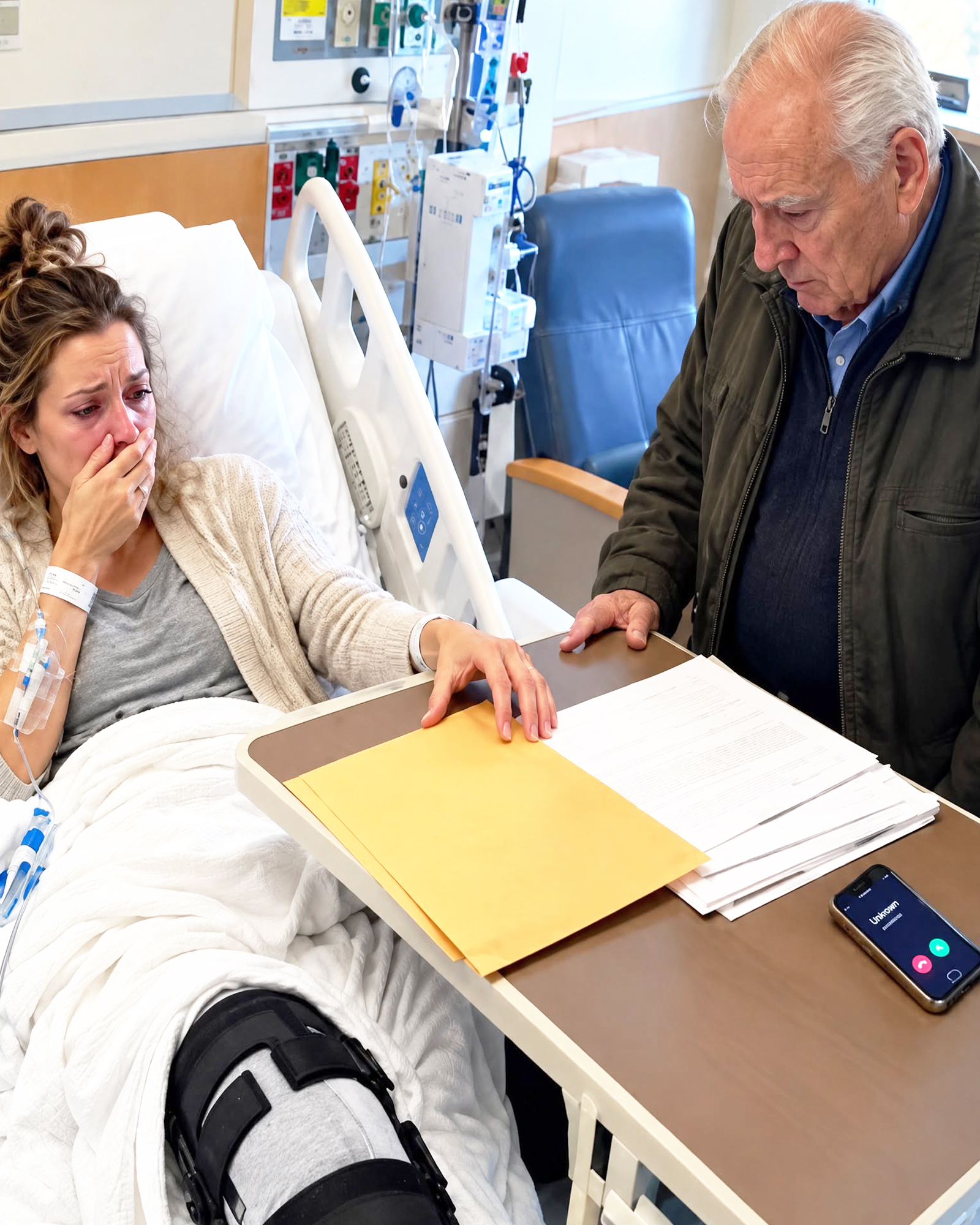
Part 1: My Mother Chose a Caribbean Cruise Over My Newborn Daughter: The first thing I heard after my car accident was my six-week-old daughter crying through my phone. The second was my mother’s voice telling me that my sister never caused emergencies like this, as though being injured in a crash was something I’d deliberately arranged to inconvenience her. I was lying in a hospital bed with my leg immobilized and my ribs aching every time I breathed. My doctors were still evaluating my injuries, and all I could think about was Lily, my newborn daughter, who was
temporarily staying with an emergency sitter. “Mom, please,” I whispered. “I need you to take Lily for two days while I arrange proper care.” My mother appeared on the video call wearing oversized sunglasses, with a suitcase standing behind her. She looked more irritated than concerned, even though she’d just been told her daughter had been taken to the hospital after a serious accident. “Meredith, I already told you. I’m leaving for my Caribbean cruise.” “Your granddaughter is six weeks old. I can’t even get out of this bed by myself.” “And what exactly am I supposed to do?
Cancel a vacation I’ve been planning for months?” I stared at her, struggling to understand how she could discuss vacation plans while my baby cried in the background. I’d spent my entire adult life believing that family members showed up for each other, especially when someone was frightened or helpless. “I’m not asking you to cancel your whole trip,” I said. “Just help until I can find someone qualified to stay with Lily.” My mother sighed.
“Your sister never has these emergencies. Claire knows how to organize her life.”
The comparison was so familiar that, under different circumstances, I might have apologized automatically. Claire had always been the daughter who needed understanding, while I was expected to solve problems without asking anyone to inconvenience themselves.
For years, I’d accepted that arrangement because I believed being dependable was something to be proud of. Whenever Claire struggled with bills or my mother needed help covering expenses, I stepped in without keeping score.
Nine years earlier, I’d started sending my mother money when she claimed she couldn’t manage her housing expenses. What began as temporary assistance became a monthly transfer of $4,500, covering rent, bills, repairs, and whatever other problems appeared.
Over nine years, those payments had totaled $486,000.
I had worked long hours and accepted demanding projects to maintain that support. Whenever I considered reducing it, my mother reminded me how fortunate I was to have a successful career and how difficult life was for everyone else.
Now I was the one who needed help.
And she couldn’t spare two days.
“Mom, I’ve paid your expenses for nine years,” I said quietly. “I’m asking you to help me once.”
Her expression hardened immediately.
“Don’t weaponize generosity, Meredith.”
“I’m not. I’m trying to explain why I thought I could depend on you.”
“You’ve always had plenty of money. Don’t act as though helping your mother has ruined your life.”
Before I could answer, I heard Claire speaking somewhere behind her.
“Mom, tell her no. She always makes everything about herself.”
I closed my eyes.
My sister apparently knew about the accident, yet her only concern was making sure I didn’t interfere with their plans. Neither woman had asked how badly I was hurt or whether Lily was safe.
Something inside me finally changed.
For years, I’d confused being needed with being loved. I’d convinced myself that if I continued supporting my family, they would naturally support me when the time came.
But the moment I needed something that couldn’t be solved by sending money, I became an inconvenience.
“All right, Mom,” I said.
She sounded relieved.
“Good. Hire someone. You can afford it.”
“I will.”
I ended the call before she could say anything else.
For several minutes, I lay quietly while the hospital equipment hummed beside my bed. Then I called Lily’s sitter, reassured her that I was arranging additional help, and began contacting licensed professionals who could care for my daughter while I recovered.
Once I confirmed that Lily would have safe, reliable care, I made another call.
This one was to my attorney.
“I need to stop the recurring payments to my mother,” I told him.
He hesitated.
“The $4,500 monthly transfer?”
“Yes.”
“Is this temporary?”
I looked at the photograph of Lily on my phone. She was sleeping peacefully in her little white blanket, completely unaware that her grandmother had refused to help when we needed her most.
“No. I want the payments stopped effective immediately, subject to anything I’m legally obligated to pay.”
My attorney confirmed that he would review the arrangements and contact the bank about the voluntary transfers. He also asked whether I wanted to reconsider after I’d recovered from the shock of the accident.
“I’ve been reconsidering for nine years,” I answered. “Today is simply the first time I’ve acted on it.”
When the call ended, I felt frightened but strangely relieved.
My mother had told me to hire someone instead of expecting family to help. I’d taken her advice, and now the money I’d spent supporting her lifestyle would be available for my daughter’s care and my recovery.
A few hours later, someone knocked gently on my hospital room door.
I expected a nurse.
Instead, my grandfather stepped inside.
He looked at my injured leg, the hospital paperwork scattered across the table, and the exhausted expression on my face. Then he pulled a chair close to my bed and placed an old envelope beside my phone.
“Grandpa?”
He studied me for a moment.
“Your father worried this day would come, Meredith.”
My breath caught.
My father had been gone for years, and Grandpa rarely spoke about the private conversations they’d shared before his death.
“What do you mean?”
Grandpa rested his hand on the envelope.
“He saw how much you were carrying for your mother and Claire. He tried to warn us that one day, you’d need someone to carry something for you.”
I looked down at the faded handwriting on the front.
It was my father’s.
And when Grandpa told me why he’d kept that envelope all these years, I realized my family had been hiding a painful truth from me long before the accident.
Part 2: The Letter My Father Left Behind
My grandfather sat beside my hospital bed with an old envelope resting between us. I recognized my father’s handwriting immediately, but I couldn’t understand why Grandpa had kept the letter hidden for so many years.
“Your father gave me this before he died,” Grandpa explained. “He was worried about the way your mother and Claire depended on you.”
I looked at the envelope, then back at him.
“Why didn’t you tell me?”
“Because I thought things would change. Your father believed you were carrying too much responsibility, but I kept telling him that families sometimes needed one strong person to hold everything together.”
Grandpa lowered his eyes.
“I was wrong.”
I carefully opened the envelope. Inside was a handwritten letter, its edges slightly yellowed with age, and seeing my father’s familiar handwriting made my throat tighten before I’d even finished reading the first paragraph.
Dad had always been proud of my independence. He encouraged me to work hard, build a career, and create a secure future, but he’d also worried that my willingness to help others would eventually become something they expected rather than appreciated.
One passage made me stop.
Meredith, being capable doesn’t mean you must carry everyone else’s burdens. I hope you never mistake being useful for being loved.
I read those words twice.
For nine years, I’d sent my mother $4,500 every month without demanding anything in return. Whenever Claire needed financial help, my mother reminded me that I was the successful daughter and that helping family was simply what responsible people did.
I had believed her.
Even after Lily was born, I’d continued the payments while adjusting to motherhood, sleepless nights, and the expenses of caring for a newborn. I never imagined my family would refuse to help me during the one emergency I couldn’t manage alone.
Grandpa watched me fold the letter.
“Your father saw the pattern before any of us wanted to admit it.”
“Then why did everyone let it continue?”
He took a moment before answering.
“Because it was easier to let you solve the problems than to ask your mother and Claire to take responsibility for themselves.”
His answer hurt because it was so simple.
For years, every family gathering had followed the same routine. My mother complained about bills, Claire described another financial setback, and eventually someone looked toward me as though the solution had already been decided.
Sometimes I offered help before they even asked.
I’d become so accustomed to preventing arguments that I rarely questioned whether the problems were truly mine to solve. When I paid a bill, everyone relaxed, and for a little while, I felt appreciated.
But appreciation never lasted long.
There was always another expense.
Another emergency.
Another reason I was expected to give more.
“I thought they loved me,” I whispered.
Grandpa reached for my hand.
“They may love you in their own way, Meredith. But love doesn’t excuse the way they’ve treated you.”
I looked toward the hospital window, remembering my mother’s sunglasses and the suitcase behind her. She had known I was injured and unable to care for my six-week-old daughter, yet she’d seemed more concerned about missing her cruise.
“She didn’t even ask whether I was going to be okay.”
Grandpa’s expression tightened.
“I know.”
“I asked for two days.”
“I know, sweetheart.”
That was when I finally started crying.
I hadn’t cried when the ambulance arrived or when the doctors examined my injuries. I’d been too frightened about Lily and too focused on arranging care to let myself think about what had happened.
But sitting beside my grandfather, holding my father’s letter, I could no longer pretend my mother’s refusal was just another disappointing conversation.
Grandpa waited until I could speak again.
“Have you arranged help for Lily?”
“Yes. Her sitter is staying with her until the licensed nurse arrives, and I’ve arranged additional care while I’m recovering.”
“Good. And what about you?”
I hesitated.
It was such an ordinary question, but I couldn’t remember the last time someone in my family had asked it without immediately mentioning something they needed.
“I don’t know yet.”
“Then we’ll figure that out too.”
I shook my head.
“Grandpa, I don’t want you paying for everything.”
He gave me a gentle smile.
“I didn’t offer to take over your finances. I offered to be here.”
Those words stayed with me.
My father had spent years trying to teach me that love wasn’t measured by how much money someone gave. Somehow, I’d forgotten that lesson while becoming the person everyone called whenever a bill needed paying.
Grandpa stayed while I spoke with Lily’s nurse and confirmed the arrangements for the next several days. He helped me organize my hospital paperwork and made sure I understood the doctor’s instructions without trying to make decisions for me.
For the first time since the accident, I felt less alone.
Then my phone began ringing.
Mom.
I let it ring.
A second call followed almost immediately, then a third. When I finally checked the messages, none asked about my injuries or Lily’s well-being.
The first demanded to know why the usual transfer had been stopped.
The second said Claire was worried about her upcoming lease renewal.
The third accused me of deliberately creating problems while my mother was trying to enjoy her vacation.
I showed the messages to Grandpa.
He read them silently before handing the phone back.
“Now you know what they’re most afraid of losing.”
I stared at the screen.
It wasn’t me.
It was the money.
A few minutes later, my mother called again. This time, I answered and put the phone on speaker so Grandpa could hear.
“Meredith, you can’t just cut us off,” she began. “Claire’s lease renewal is in two weeks, and my insurance payment is due on the first. Do you understand what you’ve done?”
I looked at my father’s letter resting beside the hospital paperwork.
“Yes, Mom,” I answered. “For the first time in nine years, I think I do.”
She started arguing, but I interrupted her.
“The payments are stopping. I need my money for Lily’s care and my own recovery.”
“You’re being selfish!”
“No. I’m taking responsibility for my own family.”
I ended the call before she could continue.
Grandpa sat quietly beside me, and I felt the unfamiliar combination of guilt and relief settle over my chest. I’d finally said the words I’d been afraid to say for nearly a decade.
Then someone began arguing with a nurse outside my hospital room.
I recognized the voice immediately.
Claire.
And when the door opened, my sister marched inside wearing expensive travel clothes, her face filled with anger.
She didn’t ask whether I was hurt.
She didn’t ask about Lily.
Instead, she pointed at my phone and demanded, “Are you out of your mind? Mom’s card just got declined, and you think you can get away with this?”
Part 3: My Sister Came to the Hospital for the Money, Not for Me
My sister stood in the doorway of my hospital room, wearing expensive travel clothes and an expression of complete outrage. I was still recovering from a serious car accident, but Claire seemed far more concerned about the fact that our mother’s credit card had been declined.
“Are you out of your mind?” she demanded. “Mom is sitting in the airport crying because she can’t pay for everything, and you’re lying here acting like some kind of victim!”
I stared at her, wondering whether she’d even noticed the bandage around my leg or the hospital equipment beside my bed. She hadn’t asked how I was feeling, whether my injuries were serious, or who was caring for my six-week-old daughter.
“Hello to you too, Claire,” I said quietly.
She folded her arms.
“Don’t start with that attitude. You know exactly why I’m here.”
“Yes,” I replied. “I think I finally do.”
For years, I’d defended my younger sister whenever anyone questioned her choices. I told myself she was sensitive, that she struggled with responsibilities I handled more easily, and that helping her was simply part of being a good older sister.
But looking at her now, I realized how little she understood about my life.
She knew I earned a comfortable income, but she never asked how many hours I worked to maintain it. She knew I paid our mother’s expenses, but she’d never seemed curious about what those payments meant for my own savings or future.
“Claire, I was in a car accident,” I said. “I couldn’t get home to my newborn daughter, and I had to arrange emergency care from a hospital bed.”
“I know that.”
“Then why haven’t you asked whether we’re okay?”
She looked away.
“Obviously you’re okay. You’re sitting here talking to me.”
Grandpa shifted in his chair beside the bed, but I raised my hand slightly to show him I wanted to answer.
“The doctors are still treating my injuries. I can’t care for Lily on my own right now, and Mom refused to help because she didn’t want to miss her cruise.”
Claire sighed.
“Mom planned that vacation months ago. You can’t expect everyone to cancel their lives whenever something happens to you.”
I felt something inside me settle.
For nine years, I’d rearranged my own life whenever my mother or sister needed financial help. I’d taken on extra work, delayed personal plans, and quietly transferred money because I believed their emergencies deserved my immediate attention.
Yet when I needed two days of help, I was accused of expecting too much.
“I’m not asking either of you to cancel anything anymore,” I said. “I’ve hired professional care for Lily, and I’ll manage my recovery with the support I’ve arranged.”
“Then what’s the problem?”
“The problem is that I’m no longer paying your expenses.”
Claire’s expression changed immediately.
“My expenses? What are you talking about?”
“Mom just told me your lease renewal is coming up. Apparently, that’s one of the reasons she’s angry about the transfer stopping.”
Claire looked toward Grandpa.
“Can you believe this? She’s making everything about money!”
Grandpa stood slowly.
“Claire, you came into a hospital room demanding money before asking whether your sister was all right.”
My sister blinked.
“That’s not fair.”
“Neither is expecting Meredith to support two households while she struggles to care for her own child.”
Claire shook her head.
“She’s successful! She has money. Why shouldn’t she help her family?”
Grandpa’s voice remained calm.
“Because helping someone and being responsible for their entire life are two different things.”
For a moment, Claire seemed genuinely confused.
I realized she’d grown so accustomed to receiving financial assistance that she no longer considered it a favor. Somewhere along the way, my generosity had become part of her budget, and my right to stop had disappeared from her expectations.
“I’ve sent Mom $4,500 every month for nine years,” I told her. “That’s $486,000, Claire.”
She looked uncomfortable but quickly recovered.
“And you could afford it.”
“That’s not the point.”
“Then what is?”
I looked at the photograph of Lily beside my bed.
“The point is that I have a daughter who needs me. I have medical bills, recovery expenses, and responsibilities that belong to my own household.”
Claire rolled her eyes.
“So now that you have a baby, the rest of us don’t matter?”
I took a slow breath.
“You matter. But that doesn’t mean you’re entitled to my income.”
Grandpa nodded, and I noticed Claire glance toward him again. She seemed to be waiting for him to tell me I was being unreasonable, just as our mother had done whenever I questioned another financial request.
Instead, he reached for the old envelope on my bedside table.
“Your father worried this would happen,” he said.
Claire frowned.
“What does Dad have to do with this?”
“He worried that Meredith would spend her life taking care of everyone else while nobody thought to take care of her.”
Claire stared at the envelope, then turned back to me.
“So you’ve been sitting here talking about us behind our backs?”
I almost laughed.
Even now, she was more concerned about being criticized than about what my father had tried to tell me.
“No, Claire. I’ve been learning that I don’t have to earn my place in this family by paying for it.”
Her face reddened.
“Fine. If that’s how you feel, maybe Mom and I should stop speaking to you.”
The threat would once have terrified me.
I used to believe that keeping my family close meant agreeing to whatever they asked. Now I understood that a relationship maintained only through financial support wasn’t the kind of relationship I wanted my daughter to grow up accepting.
“That’s your decision,” I answered. “But I’m not restarting the payments.”
Claire grabbed her handbag.
“You’ll regret treating us like this.”
I watched her walk toward the door.
“I’m sorry you’re upset,” I said. “But I won’t apologize for taking care of Lily.”
She left without saying goodbye.
When the door closed, I realized my hands were trembling. Standing up to my sister had been harder than I’d expected, even though I’d spent years imagining what I might say if I ever found the courage.
Grandpa returned to his chair.
“Are you all right?”
I looked at him.
“I think so.”
He squeezed my hand.
“You don’t have to solve the whole family today, Meredith. Right now, your job is to recover.”
I nodded, feeling exhausted but relieved.
Then my phone lit up again.
A message from Mom.
Claire told me what happened. I can’t believe you embarrassed your sister while she’s already under so much stress.
I stared at the screen, waiting for the familiar guilt to return.
Instead, I noticed what the message didn’t contain.
There was no question about my injuries.
No mention of Lily.
Not even a simple hope that I was getting better.
I placed the phone facedown.
For the first time in nine years, I wasn’t going to answer a demand simply because someone in my family was unhappy with me.
But I also knew that ending the payments was only the beginning.
The harder part would be learning how to live without the guilt they’d taught me to carry.
Part 4: The First Time I Put My Daughter Before Their Demands
After Claire stormed out of my hospital room, I sat quietly with my father’s letter resting on my lap. My sister had threatened to stop speaking to me, and my mother was furious about the canceled payments, yet neither had asked whether my six-week-old daughter was safe.
For nine years, their disappointment had been enough to make me change my mind. This time, I was frightened by the silence that might follow, but I was even more frightened by the thought of teaching Lily that love meant sacrificing herself until nothing remained.
Grandpa watched me carefully.
“You’re thinking about calling them, aren’t you?”
I looked down at my phone.
“Part of me wants to explain everything again. Maybe if they understood how scared I was after the accident, they’d realize why this hurt so much.”
He shook his head gently.
“Meredith, they already know you were in an accident. You don’t have to convince someone that an injured mother deserves help.”
His words made me think about the hours I’d spent trying to persuade my own mother to care for her granddaughter. I had offered to pay every expense, arrange transportation, and make the situation as convenient as possible, as though asking her to help for two days were an unreasonable burden.
And when she refused, I’d still felt guilty for upsetting her.
A nurse entered to check my vital signs and ask about my pain. While she examined my leg, Grandpa stepped outside to give us privacy, promising to return after speaking with the hospital staff about my recovery arrangements.
Once the nurse left, I called Lily’s caregiver.
My daughter was sleeping peacefully after her feeding, and the licensed postpartum nurse had arrived to take over the next shift. Hearing that everything was under control brought tears to my eyes, although this time they came from relief rather than disappointment.
“Would you like me to send you a picture?” the nurse asked.
“Please.”
A moment later, my phone displayed Lily curled beneath a soft blanket, her tiny fingers resting beside her cheek. I studied her face and realized how close I’d come to spending the day arguing with my family instead of making the arrangements she actually needed.
I sent a message thanking the caregivers and confirming the schedule for the following morning.
Then I opened my banking app.
The recurring transfer to my mother was no longer scheduled. For the first time in nine years, the money that normally disappeared from my account each month would remain available for my own household.
I stared at the screen for several minutes.
Four thousand five hundred dollars.
It was an amount I’d stopped questioning because sending it had become as routine as paying the electricity bill. Yet over nine years, those transfers had totaled nearly half a million dollars, money I’d earned while working long hours and repeatedly postponing plans for myself.
I wasn’t angry that I’d helped my mother when she needed assistance. What hurt was realizing that temporary support had quietly become a permanent obligation, one I was apparently forbidden to reconsider.
My phone rang again.
Mom.
I hesitated before answering.
“Meredith, Claire told me how you treated her,” she began. “She’s extremely upset, and now I have to deal with that on top of everything else.”
I closed my eyes.
“Mom, I’m still in the hospital.”
“I know where you are. That doesn’t excuse being cruel to your sister.”
“Did Claire tell you I asked whether she knew how badly I was hurt?”
My mother paused.
“She said you were being dramatic.”
I looked toward the window, where the afternoon sunlight fell across the hospital parking lot. Somewhere beyond those buildings, my daughter was being cared for by people I’d hired because my family had refused to help.
“I’m recovering from a car accident, Mom. Lily is six weeks old, and I needed someone to care for her while I couldn’t.”
“You’ve already hired someone, haven’t you?”
“Yes.”
“Then I don’t understand why you’re punishing us.”
There it was again.
In my mother’s mind, paying for professional care should have solved my immediate problem without changing anything about her financial support. She couldn’t understand why her refusal mattered when I’d managed to find another solution.
“I’m not punishing anyone,” I answered. “I’m changing what I can afford to take responsibility for.”
“You’ve never complained about the money before.”
“I know. I should have discussed the arrangement much earlier.”
Her voice sharpened.
“So this is my fault?”
“I’m not interested in assigning blame for every decision we’ve made. I’m telling you the monthly payments have ended.”
She began listing upcoming expenses, including her insurance payment and Claire’s lease renewal. I listened without interrupting, noticing that every concern involved money and not one involved my recovery.
Finally, I spoke.
“Mom, you’ll need to make arrangements for those bills. I have my own responsibilities now.”
“You’re choosing your daughter over your mother?”
The question stunned me.
Lily was a newborn who depended entirely on the adults caring for her. My mother was an adult who had received substantial financial assistance for almost a decade, yet she was speaking as though the two had competing claims on my loyalty.
“Yes,” I said. “When my baby needs care, she comes first.”
My mother went silent.
Then she said something I’d heard many times before.
“After everything I’ve done for you, this is how you repay me?”
I felt the old guilt rise, but I didn’t allow it to decide my answer.
“I appreciate what you did for me growing up. But raising me doesn’t mean I owe you unlimited financial support for the rest of my life.”
She ended the call.
I stared at the dark screen, surprised by how much the conversation had exhausted me. Setting a boundary hadn’t erased my love for my mother, and it certainly hadn’t made the years of family history disappear.
But for the first time, I understood that loving someone didn’t require agreeing to every demand they made.
Grandpa returned a few minutes later carrying a cup of tea.
“Another difficult conversation?” he asked.
I nodded.
“She thinks I’m abandoning her.”
He sat beside me.
“Are you?”
“No. I’m just not paying for everything anymore.”
“Then let that be enough.”
I held the warm cup between my hands, thinking about how much time I’d spent trying to make everyone comfortable with my decisions. My mother and Claire might never agree that I had the right to stop supporting them, but their approval wasn’t necessary for me to protect my own future.
That evening, my attorney called with an update.
The voluntary transfer had been canceled, and he confirmed that the relevant financial arrangements were being reviewed. He also recommended that I keep records of any requests or threats connected to the change, particularly while I was recovering.
I thanked him and ended the call.
For the first time since the accident, I felt as though my life was beginning to belong to me again.
Then I looked at my father’s letter.
One sentence stood out more clearly than all the others.
I hope you never mistake being useful for being loved.
I folded the page carefully and placed it back inside its envelope.
I knew my mother and sister were angry, and I suspected they would remain that way for some time. But I also knew something had changed permanently.
I was no longer willing to buy peace at the expense of my own security.
Three weeks later, when I finally returned home to Lily, I would discover just how different life could feel when I stopped treating everyone else’s problems as my responsibility.
Part 5: I Finally Stopped Paying for My Family’s Love
Three weeks after the accident, I finally returned home to my daughter. My leg was still healing, and I couldn’t move around as easily as I wanted, but the moment I saw Lily sleeping peacefully in her crib, I felt something I hadn’t experienced in years.
Relief.
The house was quiet, with none of the constant phone calls asking me to solve another financial emergency. A licensed postpartum nurse helped me establish a routine that allowed me to recover while making sure Lily received the attention and care she needed.
For the first time in my adult life, I was spending my energy on the family I’d created rather than trying to hold everyone else’s life together.
It wasn’t an easy adjustment.
Some mornings, I reached for my phone expecting another message from my mother about an overdue bill. Other times, I caught myself wondering whether Claire had managed to renew her lease or whether Mom had found a way to cover her insurance payment.
For nine years, those concerns had been part of my daily routine.
Now they were responsibilities I was learning to leave where they belonged.
My mother didn’t contact me during the first two weeks after I returned home. I suspected she was waiting for me to feel guilty enough to apologize and restore the monthly payments, just as I’d done whenever our previous disagreements involved money.
But I didn’t call.
Instead, I followed my doctor’s instructions, attended my appointments, and spent the time between feedings resting whenever Lily slept. It felt strange to put my own needs on the calendar without first checking whether someone else needed something from me.
One afternoon, while I was sitting beside Lily’s crib, my phone finally lit up with a message from Mom.
The refrigerator stopped working. I need you to send money for a replacement.
I read it twice.
There was no greeting.
No question about my recovery.
Not even a mention of the granddaughter she’d refused to care for when I was in the hospital.
I waited for the familiar guilt to arrive, the feeling that I was being selfish unless I immediately fixed the problem. It came, but it was quieter than before, and for the first time, I recognized it as a habit rather than an obligation.
I placed the phone on the table.
Then I returned to Lily.
A second message arrived an hour later, asking why I hadn’t responded. When another demand followed, I decided I needed distance from the cycle of requests and accusations, so I blocked my mother’s number for the time being.
My hands trembled afterward.
I still loved her, and some part of me hoped she would eventually understand why I’d stopped sending money. But I couldn’t keep allowing every conversation to become a negotiation over how much of my life I was expected to give away.
Claire didn’t contact me either.
I thought about the way she’d entered my hospital room, furious over the canceled payments and completely unconcerned about my injuries. For years, I’d excused her behavior because she was my younger sister, but being older didn’t mean I had to remain responsible for her choices forever.
I couldn’t force either of them to change.
I could only change what I was willing to accept.
Grandpa began visiting every Sunday.
He usually arrived with coffee and something small for Lily, then settled into a chair on the porch while I rested nearby. Sometimes we talked about my father, and other times we simply watched the afternoon light move across the yard.
He never pressured me to reconcile with my mother.
He didn’t tell me to forget what had happened or insist that I should forgive everyone because we were family. Instead, he asked how my recovery was progressing and whether the care arrangements were working.
One Sunday, I brought my father’s letter outside.
“I’ve been reading this again,” I told him.
Grandpa looked at the envelope.
“Your father would be glad you kept it.”
I ran my fingers over the handwriting.
“I wish he’d known I finally understood what he was trying to tell me.”
Grandpa smiled gently.
“I think he always hoped you would.”
I looked toward the house, where Lily was sleeping under the nurse’s supervision.
“Sometimes I wonder whether I’m being too harsh.”
“Because you stopped paying?”
“Because I stopped answering. Because part of me feels relieved that Mom and Claire aren’t calling every day.”
Grandpa took a moment before responding.
“Meredith, you can love people and still need distance from the way they treat you.”
I let his words settle.
For most of my life, I’d believed that a good daughter answered every call, paid every bill she could afford, and never allowed her family to struggle if she had the means to help. I had never stopped to consider whether those expectations were fair or whether anyone would do the same for me.
The accident had answered that question in a way I couldn’t ignore.
My mother had chosen her cruise.
Claire had chosen to defend her.
And I’d been left in a hospital bed, frightened for my newborn daughter, arranging help from strangers because the people I’d supported for years refused to inconvenience themselves.
Yet those strangers had shown me something important.
The caregivers I’d hired had been professional, attentive, and dependable. They had helped Lily through the hours when I couldn’t be there, giving me the peace of mind I needed to focus on recovering.
Their work reminded me that asking for help wasn’t a weakness.
I simply needed to ask people who were willing and able to provide it.
As the weeks passed, my strength slowly returned. I began taking short walks around the house, preparing simple meals again, and enjoying quiet mornings with Lily without the constant anxiety of another financial request.
The money I’d previously sent away each month now helped cover childcare, medical expenses, and savings for our future. I no longer felt compelled to explain why my daughter and I deserved that security.
One evening, after Grandpa had gone home, I sat beside Lily’s crib and watched her sleeping.
Her tiny fingers curled around mine when I gently touched her hand.
I thought about the kind of mother I wanted to become.
I wanted Lily to grow up knowing she could ask for help without feeling ashamed. I wanted her to understand that generosity was a choice, not a debt she owed simply because someone else expected it.
Most of all, I wanted her to know that love should never depend on how much she could provide.
My accident had nearly taken away the chance to watch my daughter grow up. In the frightening days that followed, I’d discovered how little support I could expect from the people I’d spent years protecting.
But I’d also discovered that I was capable of making a different choice.
I didn’t need to stop loving my mother to stop financing her life.
I didn’t need to hate Claire to refuse responsibility for her bills.
And I didn’t need their approval to build a secure, peaceful home for my daughter.
For nine years, I’d been the person everyone depended on, the one who quietly fixed problems before anyone else had to face them.
Now I was simply Meredith.
A mother recovering from an accident, learning to trust her own decisions, and building a future that didn’t require sacrificing herself to keep everyone else comfortable.
I kissed Lily’s forehead and turned off the bedside lamp.
For the first time in years, I wasn’t lying awake wondering what my family would need from me tomorrow.
I was looking forward to discovering what tomorrow might bring for my daughter and me.