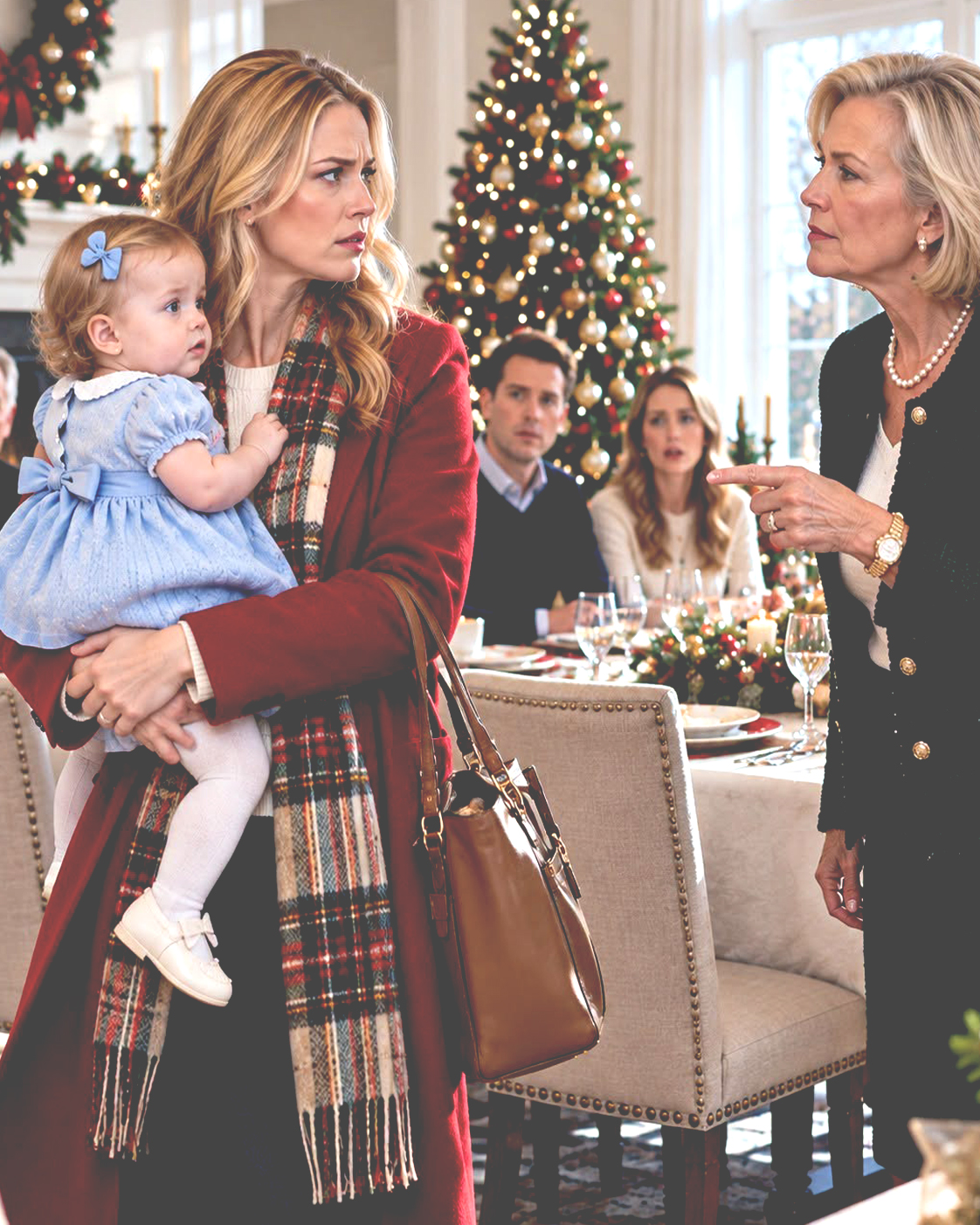
The Christmas Eve I Almost Regretted Coming Home: The first sign that Christmas Eve would be difficult came when my mother looked at my baby’s dress and asked why I hadn’t bothered to buy her something nicer. I was standing in the entryway of my childhood home in Spokane, Washington, holding my eleven-month-old daughter, Willa, against my shoulder. Snow covered the front lawn, and the windows glowed with Christmas lights. Inside, the house smelled of roasted turkey, fresh bread, and the cinnamon candles my mother always bought in December.
Everything looked beautiful. Unfortunately, beauty had always mattered more to my mother than how anyone felt inside her home. “Is that really what Willa is wearing for the photographs?” she asked, studying my daughter’s pale-blue knitted dress. I looked down at Willa, who was happily playing with a loose strand of my hair. “Yes, Mom. I think she looks lovely.” My mother, Patricia Hensley, adjusted the pearl necklace resting above her expensive green blouse. “I sent you a link to a perfectly nice children’s boutique. You could have ordered something appropriate.” “The dress
you showed me was almost two hundred dollars.” “And Christmas only comes once a year.” I held back a sigh. “Willa doesn’t know what her clothes cost. She’s warm, comfortable, and happy. That’s what matters.” My mother gave me the familiar disappointed expression I had spent thirty-three years trying to avoid. “Well, I suppose we all have different standards.” There it was. The same message I had heard since childhood, dressed up in slightly different words. I was never quite polished enough, successful enough, or careful enough to satisfy her expectations.
My name is Audrey Hensley. At thirty-three, I was rebuilding a life that looked nothing like the one I had imagined.
My marriage had ended the previous spring. My father had passed away shortly afterward, and I had moved into a modest apartment with Willa while working full-time as an interior designer.
Money was tight, and some nights I fell asleep wondering how I would manage everything.
But Willa made the difficult days worthwhile.
Her bright eyes, contagious laughter, and habit of reaching for my face whenever I looked tired reminded me that I still had something wonderful to protect.
My mother rarely saw things that way.
To her, my divorce was embarrassing, my apartment was too small, and my daughter’s ordinary clothes were another indication that I wasn’t living up to the family image.
“Audrey, I’m so glad you’re here.”
My younger sister, Brooke, appeared from the kitchen and wrapped one arm around me.
She kissed Willa’s cheek.
“Look at this beautiful girl. That blue is perfect on her.”
I smiled gratefully.
“Thank you.”
Brooke glanced toward our mother before lowering her voice.
“Try not to let her get to you tonight.”
I was about to answer when something caught my attention.
Across the room, my mother picked up a cream-colored envelope from the fireplace mantel. When she noticed me watching, she quickly slipped it beneath a stack of Christmas cards.
The movement seemed strangely deliberate.
Before I could ask about it, my aunt called everyone to dinner.
I followed the family into the dining room, unaware that the envelope contained words my father had written specifically for me.
And that my mother had spent months hoping I would never read them.
A Christmas Dinner That Became Too Much
For the first twenty minutes, dinner was almost pleasant.
My cousins talked about their holiday plans. My aunt described a recent trip to Montana. Brooke entertained everyone with stories from her elementary school classroom.
Willa sat in her high chair beside me, enjoying small pieces of soft vegetables.
Then she dropped her spoon.
My mother looked over immediately.
“Audrey, please don’t let her make a mess.”
I retrieved the spoon and wiped Willa’s hands.
“She’s learning to feed herself, Mom.”
“There are ways to teach children proper manners.”
“She’s eleven months old.”
My mother returned to her meal without responding.
A few minutes later, Willa reached toward my water glass. I moved it away, but her little fingers caught the edge of the tablecloth, tipping the glass onto the table.
Water spread across the white linen.
I immediately stood to clean it.
“I’m sorry. I’ll take care of it.”
Brooke reached for a towel.
“It’s just water. I’ve got it.”
But my mother pushed back her chair.
“Honestly, Audrey, can’t you keep your daughter under control for one evening?”
The conversation stopped.
I felt everyone’s attention settle on us.
“Mom, it was an accident.”
“There is always an excuse, isn’t there? First the dress, then the noise, and now this.”
Willa sensed the change in everyone’s voices and began to fuss.
I lifted her from the high chair.
“She’s a baby. She doesn’t understand what she’s doing yet.”
My mother shook her head.
“That attitude is exactly why children grow up believing they can do whatever they please.”
I tried to remain calm.
“We’re not going to argue about a glass of water.”
But my mother wasn’t finished.
“You know, Audrey, I worried about you from the beginning. Your marriage was already struggling when you decided to have a child, and now you’re trying to manage everything alone.”
My face grew warm.
“My marriage has nothing to do with Willa spilling water.”
“It has everything to do with your choices. You never listen when someone tries to guide you.”
My aunt quietly said my mother’s name, hoping to end the conversation.
Instead, Patricia looked directly at me.
“Your father spent his entire life making excuses for you. If he were sitting here tonight, perhaps even he would finally admit that you need to be more responsible.”
Those words hurt more than anything else she had said.
My father, Thomas Hensley, had been the gentlest person I knew.
He wasn’t perfect, but he had always made me feel welcome, even when I arrived home with disappointing news.
He was the one who called after my divorce and reminded me that a marriage ending did not mean my life had failed.
He was the one who held Willa for the first time and whispered that she was the best Christmas present our family could ever receive.
And now my mother was using his memory to criticize me.
I adjusted Willa against my chest and reached for her diaper bag.
“We’re going home.”
My mother stared at me.
“Don’t make a scene, Audrey.”
“I’m not making a scene. I’m taking my daughter somewhere she can enjoy Christmas without being criticized for acting like a baby.”
“Nobody has said anything terrible to her.”
I looked into Willa’s sleepy eyes.
“Maybe she doesn’t understand the words yet, but someday she will. And I’m not going to teach her that being loved means accepting humiliation.”
I turned toward the hallway.
Then Brooke stood.
“Audrey, wait. There’s something Dad wanted you to have tonight.”
The Envelope My Mother Didn’t Want Me to Find
I stopped beside the front door.
“What are you talking about?”
Brooke looked toward our mother.
Patricia’s expression changed immediately.
“Brooke, this is not the time.”
“Actually, Mom, it is. Dad specifically asked for it to be given to Audrey on Christmas Eve.”
My heart began beating faster.
“Asked for what?”
Brooke hesitated.
Then I remembered the envelope on the mantel.
I walked back into the living room, moved the Christmas cards, and found it.
My name was written across the front.
Audrey.
I recognized my father’s handwriting instantly.
He had a habit of writing capital letters slightly larger than necessary, something I used to tease him about when he addressed birthday cards.
Seeing that familiar handwriting again made my throat tighten.
“Where did this come from?” I asked.
My mother looked away.
“Your father wrote it shortly before he passed.”
“And you’ve had it this entire time?”
“He wanted you to receive it at Christmas.”
I examined the envelope.
The flap had been carefully resealed.
“Did you open this?”
Nobody answered.
Finally, Brooke spoke.
“Mom read it months ago. I found out when I asked whether she had put it somewhere safe.”
I looked at my mother.
“You opened a letter Dad wrote to me?”
“I needed to understand what he was trying to say.”
“Then why did you hide it when I arrived?”
Her hands trembled slightly.
“Because I knew how you would react.”
I could barely believe what I was hearing.
“You knew how I would react to my own father’s words?”
She lowered her eyes.
“Some of what he wrote was difficult.”
“Difficult for whom?”
My mother remained silent.
Brooke stepped closer.
“Audrey, Dad wanted you to read it. Whatever it says, those words belong to you.”
I sat on the couch with Willa curled against me.
For months, I had wished I could hear my father’s voice one more time.
Now I was holding something he had written while knowing he wouldn’t be there to explain it.
I carefully opened the envelope.
Inside were three pages of handwritten stationery.
And the first sentence nearly brought me to tears.
The Words My Father Had Been Afraid to Say
The letter began with a memory.
My beautiful Audrey,
If you’re reading this on Christmas Eve, I hope the house smells like cinnamon, your sister is laughing too loudly, and someone has already eaten the cookies meant for Santa.
I smiled through my tears.
Dad had always been the person sneaking cookies from the kitchen.
I continued.
I wish I could be sitting beside you tonight. There are things I should have told you years ago, and I don’t want to leave them unsaid.
When you were little, I used to tell you to ignore your mother’s criticism because I thought that was the easiest way to keep peace in our home.
I see now that asking you to remain quiet wasn’t protecting you. It was asking you to carry discomfort that the adults should have handled.
I stopped reading.
For years, whenever my mother criticized my grades, my appearance, or my decisions, Dad had quietly encouraged me not to take it personally.
He loved me deeply.
But he rarely challenged her directly.
I had never realized how much he regretted that.
Brooke sat beside me.
“Keep reading,” she whispered.
I nodded.
You were never the disappointment you sometimes believed yourself to be.
You were a thoughtful little girl who tried too hard to make everyone happy, and you grew into a woman who still questions herself whenever someone disapproves.
When you told me you were expecting Willa, I noticed how frightened you looked. You worried about your marriage, your finances, and whether you would be a good mother.
But I wasn’t worried about your ability to love that little girl.
I was worried that you might believe she needed the same impossible perfection you were taught to chase.
My eyes filled again.
Then I reached the sentence that changed everything.
“Audrey, if keeping this family together ever requires you to make your daughter feel as small as you once felt, I want you to be brave enough to walk away—even if the person you must walk away from is your own mother.”
The room became completely quiet.
I looked up.
My mother was sitting in the armchair across from me, staring at the floor.
She had read those words months earlier.
She knew exactly what Dad had wanted me to understand.
And still, she had criticized my daughter that evening.
I returned to the letter.
Your mother has good qualities, and I know she loves her family. But somewhere along the way, she began believing that controlling every detail was the same as caring for people.
I should have challenged that belief more often.
I hope she finds the courage to change, but whether she does or not, you must never measure your worth by her approval.
Willa doesn’t need a flawless mother. She needs someone who will listen to her, respect her feelings, and make home a place where she can be herself.
And Audrey, please remember that standing up for your daughter doesn’t mean you have stopped loving your family.
It means you have learned that love should never require you to abandon yourself.
I’m proud of the woman you’ve become. I always have been.
Love, Dad.
I lowered the pages into my lap.
Willa reached toward the paper, fascinated by the movement.
I kissed her forehead and held her closer.
My father had given me something I didn’t even know I needed.
Permission to stop trying to earn the love that should have been freely given.
The Apology I Had Waited Years to Hear
For a long moment, nobody spoke.
Then my mother wiped her eyes.
“I never intended for things to happen this way.”
I looked at her.
“You knew what Dad wrote. You knew he wanted me to read it tonight.”
She nodded.
“Yes.”
“And you still tried to hide it.”
“I was ashamed.”
That surprised me.
My mother rarely admitted feeling anything other than disappointment or frustration.
“Ashamed of what?”
She glanced toward the letter.
“Because your father was right about me, and I didn’t want you to know that he had seen it too.”
Brooke quietly moved closer.
My mother continued.
“I spent years believing I was preparing you girls for the world. I thought if I pushed you to do everything properly, nobody would ever look down on you.”
“But you were the person who made me feel looked down on,” I replied.
She closed her eyes.
“I know that now.”
I shook my head.
“You criticized Willa’s clothes before we’d even taken off our coats. Then you made me feel like a terrible mother because she spilled water.”
“I was wrong.”
“You were. And hearing you say that doesn’t erase everything.”
“I understand.”
For the first time in my life, she didn’t follow her apology with an explanation of why I had somehow caused the problem.
She simply sat there.
Then she said something I had never expected.
“I don’t know how to be different overnight, Audrey. But I don’t want Willa growing up afraid of disappointing me the way you did.”
I looked down at my daughter.
She had fallen asleep against my shoulder.
“Then things have to change.”
My mother nodded.
“Tell me what you need.”
I took a breath.
“First, I need you to respect me as Willa’s mother. You don’t get to criticize her appearance, compare her to other children, or make her feel that she has to behave perfectly to deserve affection.”
“All right.”
“Second, you cannot use Dad’s memory or our family relationships to make me feel guilty when I disagree with you.”
“I won’t.”
“And third, I’m still taking Willa home tonight. I need time before I’m ready to come back.”
My mother’s eyes filled again.
But she didn’t argue.
“I understand, sweetheart.”
That small response meant more than she probably realized.
For once, she had allowed me to make a decision without trying to change it.
The Christmas Gift My Father Left for His Granddaughter
As I gathered our belongings, my mother disappeared into the study.
She returned carrying a small wrapped package.
“Your father bought this for Willa before he became ill. He asked me to save it for her first Christmas.”
I carefully removed the wrapping paper.
Inside was a soft gray stuffed elephant with floppy ears and a little blue ribbon around its neck.
I remembered Dad holding a similar toy in a department store months earlier.
He had laughed and said every little girl deserved a favorite stuffed animal.
My chest tightened.
“He picked this out?”
“He did. He said she could take it everywhere.”
I pressed the elephant gently against Willa’s sleeping hand.
Her fingers curled around one ear.
My mother watched quietly.
“Audrey, I know I have a lot to make up for. I don’t expect you to trust me because I apologized once.”
I looked at her.
“Thank you for understanding that.”
She stepped aside to let me pass.
Outside, snow drifted slowly beneath the porch light.
Before I reached the car, she called my name.
“Your father was very proud of you. He told me that more times than I can count.”
I turned around.
“I wish you had told me sooner.”
Her expression softened.
“So do I.”
I drove home with Willa sleeping peacefully in the back seat, her new elephant tucked beside her.
My father’s letter rested safely in my purse.
For the first time in months, I didn’t feel quite so alone.
A Year of Small Changes
My mother’s transformation didn’t happen immediately.
During the first few weeks, she sent messages asking how Willa was doing, but she respected my request for space.
She stopped asking Brooke to convince me to visit.
She didn’t send expensive gifts to make everything seem normal.
Instead, she began seeing a family counselor.
I learned about that from Brooke, who said Mom had finally started talking about the pressure she had experienced growing up.
My grandmother had cared deeply about appearances, and my mother had spent much of her childhood trying to avoid criticism.
Understanding that helped me see where some of her behavior came from.
It didn’t excuse it.
But it gave me hope that she could change.
Our first visit happened in March at a neighborhood park.
My mother arrived carrying two cups of coffee and a small bag of homemade muffins.
She didn’t comment on Willa’s outfit.
She didn’t offer unsolicited parenting advice.
She simply sat beside me and watched her granddaughter explore the grass.
When Willa reached for a fallen leaf, Mom smiled.
“She’s curious about everything, isn’t she?”
I nodded.
“She really is.”
“Your father would have loved watching her grow.”
We sat quietly for a moment.
Then Mom added:
“I think he would be glad you’re giving her the childhood he always wanted you to have.”
I looked at her.
For once, the words didn’t feel like criticism disguised as concern.
They felt sincere.
Over the following months, our visits became more frequent.
Sometimes we met for lunch.
Sometimes she came to my apartment and helped Willa build towers from wooden blocks.
When I told her I preferred to handle bedtime routines myself, she respected that.
When we disagreed, she listened instead of treating my opinion as disrespect.
There were still uncomfortable moments.
Old habits don’t disappear simply because someone wants them to.
But my mother began recognizing those moments and correcting herself.
And slowly, I began trusting her again.
The Christmas That Finally Felt Like Home
The following December, my mother called two weeks before Christmas.
“Audrey, I’d love for you and Willa to come over on Christmas Eve. But please don’t feel obligated. I want you to decide what’s best for both of you.”
I sat quietly for a moment.
A year earlier, those words would have seemed impossible.
“I think we’d like that, Mom.”
When Christmas Eve arrived, Willa walked into my parents’ living room holding her gray elephant by one ear.
She was nearly two now, full of energy and delighted by the colorful ornaments.
My mother knelt beside the Christmas tree.
“Hello, sweetheart. Merry Christmas.”
Willa smiled and hurried toward her.
“Grandma!”
My mother opened her arms.
Watching them embrace, I felt something loosen inside my chest.
There was no criticism about Willa’s clothes.
No complaints when she laughed loudly.
And when she accidentally knocked over a small tower of wooden blocks, my mother simply helped her rebuild it.
Later that evening, I noticed a small envelope beneath the tree.
My name was written on the front.
For a second, my heart skipped.
Inside was a handwritten card from my mother.
Audrey,
Last Christmas, your father gave you the courage to protect your daughter, and you gave me the chance to understand something I had been unwilling to see.
I spent too many years believing that being a good mother meant having the answers, maintaining appearances, and correcting every mistake.
You taught me that sometimes being a good mother means listening, admitting when you’re wrong, and allowing your children to become themselves.
Thank you for giving me the opportunity to learn.
I love you and Willa more than I have always known how to show.
Mom.
I looked across the room.
My mother was sitting on the carpet beside Willa, helping her arrange the wooden blocks into a crooked little house.
When the house collapsed, they both laughed.
Nobody corrected anyone.
Nobody demanded perfection.
They simply started again.
And I realized that the Christmas I had walked away hadn’t been the night our family fell apart.
It had been the night we finally stopped pretending everything was fine.
My father’s letter hadn’t changed my mother overnight.
It had helped me find the courage to change what I could control.
And by refusing to pass old expectations on to my daughter, I had made room for something better.
That evening, as Willa climbed into my lap and rested her head against my chest, I looked at my mother and smiled.
“Dad would have loved this Christmas.”
She wiped a tear from her cheek.
“Yes, sweetheart. I think he would have.”
For the first time in years, the house felt like somewhere I belonged.
Not because I had finally become the daughter my mother wanted.
But because we were learning to love one another without asking anyone to be someone else.
Messages About Family, Love, and the Courage to Change
Children should never have to grow up believing that their value depends on expensive clothes, perfect behavior, impressive achievements, or the approval of adults who have forgotten how important kindness can be.
A parent’s responsibility is not to create a child who never makes mistakes, but to raise someone who feels secure enough to learn, explore, ask questions, and discover who they are without fearing that love will disappear.
Sometimes the people who love us have also taught us painful lessons, and recognizing that truth does not mean we must stop loving them; it means we must learn where compassion ends and healthy boundaries begin.
Keeping peace within a family should never require one person to remain silent about repeated disrespect, because genuine harmony grows from understanding and accountability rather than the expectation that everyone must pretend nothing is wrong.
An apology is only the beginning of rebuilding trust, and its true meaning becomes visible through patient listening, changed behavior, respected boundaries, and the willingness to continue doing better long after the emotional conversation has ended.
We can acknowledge the difficult experiences that shaped our parents while still deciding that the next generation deserves a different kind of childhood, one filled with reassurance, encouragement, and the freedom to be imperfect.
Walking away from an uncomfortable family gathering does not always mean abandoning the people we love, because sometimes temporary distance is what allows everyone to recognize the importance of respect and reconsider the way they treat one another.
The greatest gift a parent can offer a child is the certainty that home will remain a place of comfort even when life becomes complicated, mistakes happen, or the world outside feels demanding and uncertain.
Real family healing rarely happens through one dramatic conversation or a beautiful holiday celebration; it develops through ordinary moments when people choose patience over criticism, understanding over pride, and connection over the need to be right.
And perhaps the most meaningful legacy we can leave our children is not a perfect family history, a large inheritance, or a beautiful home, but the knowledge that they are deeply loved exactly as they are and will never need to make themselves smaller to deserve that love.