PART 1: THE BOY WHO NEVER ASKED FOR MUCH: My name is Khloe Reyes, and I’m thirty-nine years old, working as a 911 dispatcher in Pierce County, Washington. For six years, my eleven-year-old son Morgan and I had lived together in a modest two-bedroom apartment in Tacoma, building a peaceful life around routines that meant more to us than anything money could buy. Our apartment occupied the second floor of an aging brick building overlooking a parking lot and laundromat. The radiator rattled during winter, the kitchen faucet constantly dripped, and on
clear days, we could glimpse a small section of Mount Rainier through the kitchen window. Morgan was affectionate but increasingly conscious of his friends’ opinions. He hugged me tightly every morning when nobody was watching, although those hugs became quick fist bumps whenever his classmates were nearby. Dinner was our most important family tradition, regardless of how exhausting my workday had been. We placed our phones in a basket and shared one highlight and one lowlight from the day, although Morgan frequently tried to negotiate permission for two
highlights. “You’re the mom, so you can change the rules whenever you want.” “Nice try, sweetheart, but one highlight and one lowlight is still the rule.” Morgan easily found happy memories to share, whether he’d earned a good grade, scored a basketball shot, or encountered a particularly funny-looking dog. Discussing disappointments was harder because he’d learned early in life that revealing unhappiness could sometimes lead to losing the people and places he depended on. I’d never married, and after years of waiting for the life I’d imagined, I decided to become a foster parent. I first encountered Morgan seven years earlier at a holiday party organized by a foster agency in a Lutheran church in Tacoma. He was four and a half, wearing an oversized sweatshirt, with untidy dark curls and unusually serious brown eyes. While other children played games, he sat alone on the edge of a stage because an older child had taken his ten game tickets. Instead of giving him replacement tickets, I bought him a giant chocolate-chip cookie for three dollars. I sat beside him while he slowly ate it, sensing that companionship mattered more to him than participating in the activities. After finishing, Morgan carefully folded the plastic wrapper into a tiny square and placed it in his pocket. Then he thanked me and unexpectedly asked whether I was a mother.
“Not yet.”
He studied me thoughtfully before offering an answer I would remember forever.
“I think you’d be good at being somebody’s mom.”
His caseworker, Theresa Kim, later explained that Morgan had entered foster care at two because his mother struggled with addiction and his father wasn’t involved. He’d experienced four placements in two and a half years and had become so accustomed to leaving that he rarely unpacked his belongings.
I contacted Theresa the following morning, and four months later, Morgan moved into my apartment. Two years afterward, a Tacoma judge finalized his adoption, officially making him Morgan Reyes.
He eventually framed the cookie wrapper from our first meeting and hung it in his bedroom. For Morgan, that small piece of plastic represented the day someone finally noticed him.
Years later, Morgan became fascinated with Whitman Elementary School’s annual fall fair. He spent two weeks discussing the games, pizza, prizes, and enormous cookies, debating whether chocolate chip or M&M would be the better choice.
The fair raised money for school field trips, and most activities cost only a dollar or two. However, Whitman was a Title I school where seventy-eight percent of students received free or reduced-price lunches, meaning even inexpensive entertainment remained beyond some families’ budgets.
The evening before the fair, I found Morgan counting the money he’d saved in a coffee can decorated with a Seattle Sounders sticker. His savings totaled twelve dollars and forty cents, collected from birthday gifts, returned soda cans, and a five-dollar bill he’d found in a parking lot.
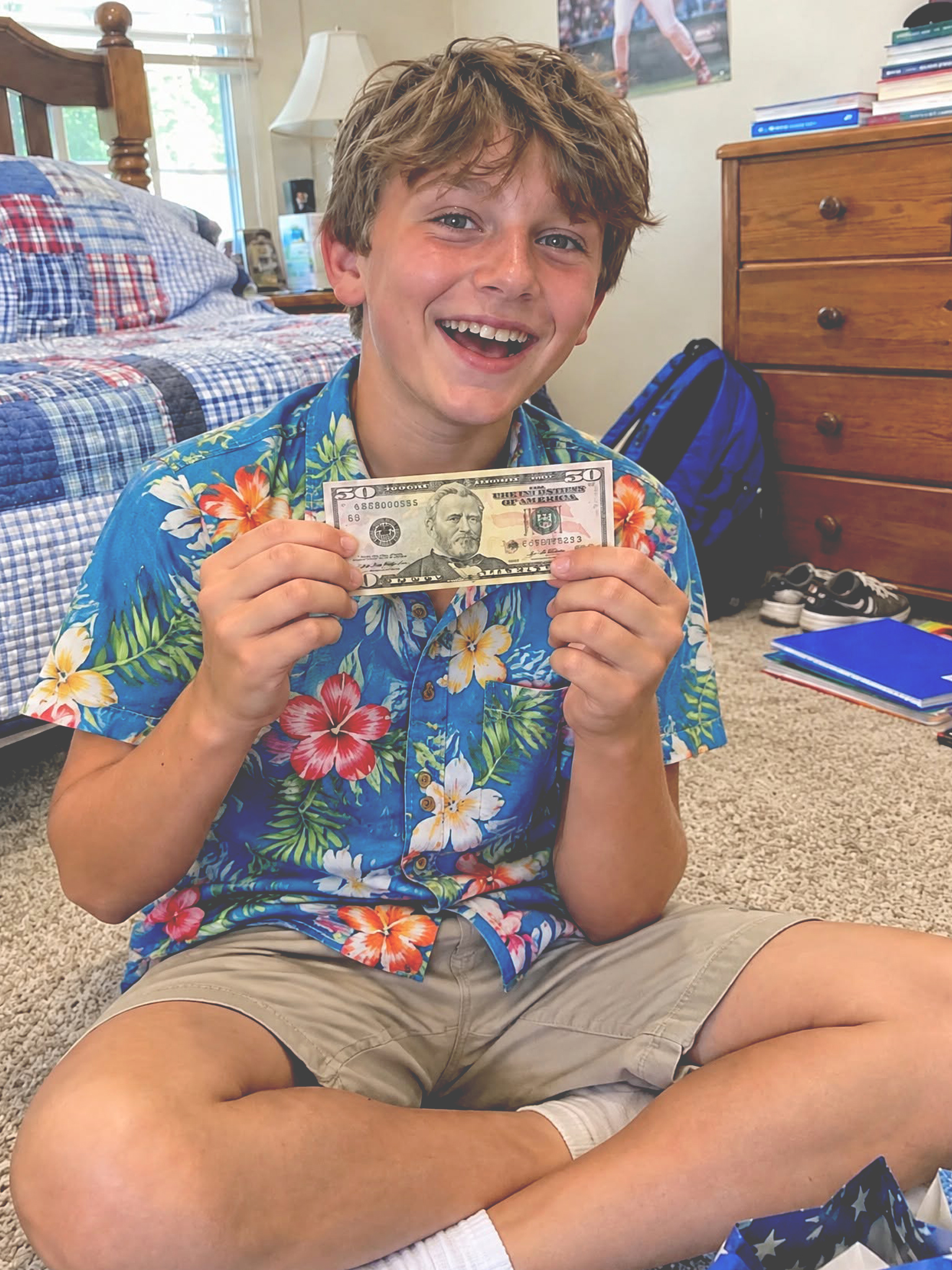
I’d recently earned extra money working overtime during a severe windstorm, so I handed him a fifty-dollar bill. His eyes widened as I explained that he could spend it however he wanted.
“What if I waste it on something stupid?”
“Then you’ll have learned a fifty-dollar lesson.”
Morgan grinned, thanked me, and carefully packed the money for school the following morning. Neither of us imagined that his decision about how to spend it would change our family forever.
PART 2: THE FIFTY DOLLARS THAT MADE HIS TEACHER CRY
On the morning of Whitman Elementary’s fall fair, Morgan carefully tucked his fifty-dollar bill into his backpack alongside his savings. He checked the zipper several times before leaving our apartment, determined not to lose the money he’d been so excited to receive.
When I dropped him off, his friend Jaylen was standing near the school entrance, so Morgan offered me a fist bump instead of our usual hug. I jokingly warned him not to spend everything on cookies, and he laughed before running toward the building.
I went to work at the emergency dispatch center and quickly became absorbed in the day’s calls. Between a highway collision, an elderly woman who’d fallen, and a teenager worried about his younger brother swallowing a battery, I’d almost forgotten about the fair.
At 2:18 that afternoon, my phone rang while I was eating lunch in the break room. The caller ID displayed Whitman Elementary, and my experience handling emergency calls immediately made me fear something had happened to Morgan.
His fifth-grade teacher, Bernadette Quinn, answered in an unusually strained voice. She’d taught at Whitman for twenty-six years and was normally composed, but that afternoon she began crying before explaining why she’d called.
“Mrs. Quinn, is Morgan hurt?”
“No, Khloe. He’s completely fine, but I need you to come to school as quickly as possible.”
She confirmed that Morgan had brought fifty dollars to the fair and asked whether I’d given him the money. When I said yes, she struggled to contain her emotions before telling me that I needed to see what he’d done with it.
I informed my supervisor about the family emergency and drove to Whitman, imagining every possible explanation. Perhaps someone had stolen Morgan’s money, he’d gotten into an argument, or he’d spent it on something that had caused trouble.
Mrs. Quinn was waiting outside the gymnasium wearing a cardigan decorated with orange pumpkins. Her eyes were red, and she silently directed me toward the double doors when I asked where Morgan was.
Inside, the gym was crowded with children enjoying carnival games, face painting, pizza, and a bouncing inflatable play area. Orange and black streamers hung from the basketball hoops, and the smell of popcorn filled the room.
I eventually spotted Morgan sitting on the bottom row of the bleachers, surrounded by approximately fourteen children. He wasn’t eating pizza, holding prizes, or enjoying the games, but every child around him had something from the fair.
Some held slices of pizza or enormous cookies, while others displayed tickets and small toys. One little boy had a tiger painted on his face and carefully held a goldfish in a plastic bag.
For an instant, I feared the children had pressured Morgan into buying everything for them. Then I noticed his peaceful smile, the same expression he’d worn when the judge finalized his adoption.
Mrs. Quinn explained that she’d watched Morgan purchase fifty tickets when the fair opened at eleven-thirty. Instead of visiting the games, he’d walked directly to the bleachers where children without spending money usually gathered.
Every year, some students remained there throughout the fair because their families couldn’t afford tickets, had forgotten to provide money, or were dealing with difficult circumstances. Mrs. Quinn had occasionally purchased food or tickets for them, but she’d never truly considered what it felt like to sit there watching everyone else.
Morgan had joined the children, divided his tickets among them, and then spent his own twelve dollars purchasing additional tickets. He’d helped everyone get pizza, cookies, or opportunities to play while refusing to buy anything for himself.
I was overwhelmed by his generosity, but Mrs. Quinn explained that the money wasn’t the main reason she’d called. Something Morgan had said to a quiet boy named Eli Parker had affected her even more deeply.
Eli was ten years old and had recently arrived at Whitman after entering his fourth foster placement that year. He lived at Harbor House, a temporary group home, and rarely spoke to anyone.
When Morgan offered him tickets, Eli refused to accept them. Instead of insisting, Morgan sat quietly beside him before returning with a giant cookie.
Eli eventually accepted the gift and asked why Morgan was being so kind. Mrs. Quinn began crying again as she repeated my son’s explanation.
“When I was four, I didn’t have any tickets either. A lady sat beside me and bought me a giant cookie, and eventually she became my mom.”
Only then did I understand that Morgan hadn’t simply given away his money. He was offering other children the same kindness that had once changed his own life.
PART 3: THE COOKIE THAT BROUGHT TWO BOYS TOGETHER
I crossed the gym toward Morgan, struggling to control my emotions as I approached the bleachers. When he noticed me, his smile briefly disappeared because he worried that spending all his money on other children might have disappointed me.
He explained that I’d told him to purchase whatever made him happy, but he wasn’t certain whether he’d made a foolish choice. I knelt in front of him and gently asked whether helping the other children had brought him happiness.
Morgan looked around at the students enjoying their food and prizes before answering. His expression softened as he realized that seeing them included in the celebration had meant more to him than any game or cookie.
“Yes, Mom. It made me really happy.”
I embraced him tightly, and for once, he didn’t glance around to check whether his friends were watching. He simply hugged me back while the other children continued enjoying the fair.
Beside Morgan sat Eli, still holding his enormous cookie without opening it. His cautious expression reminded me of Morgan at the holiday party seven years earlier, when he’d been uncertain whether anyone could be trusted.
I introduced myself and reassured Eli that the cookie belonged to him. Morgan added that nobody would take it away because Mrs. Quinn wouldn’t allow anyone to mistreat him.
Eli slowly removed the red ribbon, unwrapped the plastic, and tasted a small piece. Then he broke the cookie in half and offered one portion to Morgan, explaining that Morgan hadn’t bought anything for himself.
“You didn’t get a cookie, so you should have some of mine.”
Morgan accepted the gift, and the two boys quietly ate together on the bleachers. Afterward, Eli folded the wrapper into a small square and placed it in his pocket, exactly as Morgan had done years earlier.
That evening, Morgan and I sat down for spaghetti at our kitchen table. He was exhausted after staying late to help the PTA volunteers dismantle booths and accompanying Eli to the Harbor House van.
I asked why he’d chosen not to save even one ticket for himself. Morgan admitted that he’d originally planned to buy two cookies, pepperoni pizza, and tickets for several carnival games.
He showed me a crumpled shopping list he’d written before the fair. However, his plans changed when he entered the gym and noticed children sitting on the bleachers, watching everyone else enjoy themselves.
“There were so many kids sitting there, Mom. They looked the way I felt at that holiday party when nobody noticed me.”
Morgan explained that he’d never forgotten sitting alone on the stage after another child took his tickets. What stayed with him most wasn’t the cookie itself, but the fact that I’d noticed him and chosen to sit beside him without making him feel pitied.
When he saw Eli sitting alone in an oversized jacket, he recognized the same fear and loneliness he’d once experienced. He couldn’t enjoy the games while knowing another child felt invisible.
“My highlight today was sitting with Eli. My lowlight is that he still has to go back to Harbor House.”
His words remained with me long after he went to bed. I’d been licensed as a foster parent for seven years, but after adopting Morgan, I’d allowed my license to expire because I feared disrupting our stable life.
Our apartment was small, my work schedule was demanding, and money was limited. Yet I also knew that my greatest hesitation came from the possibility of loving another child who might eventually be taken away.
That night, I kept thinking about Eli’s cautious expression, the cookie he’d shared, and the wrapper he’d carefully saved. At three in the morning, I found Theresa Kim’s number in my old contacts.
When she returned my call on Monday, I asked about Eli Parker. Theresa explained that he’d entered foster care at six and had experienced four placements in the current year alone.
His most recent foster family had returned him after two months because they believed he was too withdrawn to form attachments. He’d spent five weeks at Harbor House, and without another placement, he might soon be transferred to a residential facility in Yakima.
I asked Theresa what would be required to renew my foster license. She described background checks, additional training, a home study, and potentially finding a larger apartment.
Then she reminded me that Morgan’s feelings mattered just as much as my intentions. Bringing Eli into our household could give Morgan a brother, but another failed placement could hurt both boys.
I understood the risks, yet I couldn’t stop thinking about the child who’d carefully saved a cookie wrapper because someone had finally shown him kindness.
PART 4: THERE IS ALWAYS ROOM
That evening, I told Morgan about my conversation with Theresa and explained that Eli might eventually be transferred to a residential facility in another city. I admitted that I was considering renewing my foster-parent license, but I wanted to know how Morgan felt before making any decisions.
He immediately asked whether Eli might be allowed to live with us. I explained that the process would involve many professionals and that there was no guarantee the placement would work.
Eli had experienced repeated rejection and might struggle to trust us, while Morgan would need to share my attention and possibly his bedroom. I wanted him to understand that welcoming another child would change the life we’d carefully built together.
Morgan considered everything before asking permission to share two highlights at dinner. His first was that I’d considered helping Eli rather than simply feeling sorry for him, and his second was that he already knew what answer he’d give.
“There’s room, Mom. There’s always room, just like you told me when I first came here.”
I remembered Morgan’s first evening in our apartment, when he’d arrived carrying his belongings in a black garbage bag. Although I’d prepared a bedroom with a rocket-ship comforter and an empty dresser, he refused to unpack because he feared being moved again.
I’d assured him that he could use the dresser and that we’d pack his belongings together if he ever needed to leave. It took three weeks before he finally felt comfortable enough to unpack.
Renewing my license and preparing for Eli took three months. I completed forty hours of refresher training, underwent background checks and home visits, and searched for a larger apartment.
In January, we found a three-bedroom apartment in Tacoma’s Stadium District with a small backyard and a kitchen overlooking a cherry tree. The rent was $180 higher each month, so I arranged an additional work shift every other week.
Morgan voluntarily chose the smaller bedroom, insisting that Eli deserved the room with the window. During the approval process, Theresa arranged supervised visits twice weekly at Harbor House.
Our first visit was quiet, with Eli sitting at one end of a worn couch while Morgan sat at the other. They played Uno for an hour without exchanging many words, but neither seemed uncomfortable with the silence.
During later visits, Eli gradually began discussing school, a dog he’d once owned, and the broken basketball hoop at Harbor House. By our fifth visit, he asked Morgan whether the woman who’d given him a cookie really had become his mother.
“Yes, but it took some time.”
“How much time?”
Morgan answered patiently, understanding why Eli needed reassurance. During our ninth visit, Eli brought out the folded wrapper from the cookie Morgan had purchased at the fair.
He explained that he’d kept it because the moment mattered to him. Morgan revealed that his own cookie wrapper was framed on his bedroom wall and promised Eli could see it if he came to live with us.
Eli moved in on a cold Saturday in February, arriving in Theresa’s agency minivan with his belongings inside a black garbage bag. Morgan immediately helped him carry the bag into the house, refusing to let him face the unfamiliar situation alone.
I’d prepared Eli’s bedroom with a navy-blue comforter decorated with white stars and a dresser waiting for his belongings. He placed the garbage bag in the corner and sat on the bed, clearly uncertain whether he could trust the arrangement.
“What happens if I have to leave?”
Morgan sat beside him before I could respond. He repeated the words I’d once spoken when he first arrived in our home.
“Then we’ll pack everything together. But until that happens, there’s room here. There’s always room.”
That evening, we ate spaghetti around our kitchen table, now furnished with a third chair that didn’t match the others. Morgan introduced our dinner tradition of sharing a highlight and a lowlight, but I assured Eli that participating was optional.
After listening to us, Eli quietly asked whether he could share two highlights instead. Morgan reminded me that I was allowed to change the rules, so I agreed.
“My first highlight is having a bedroom with a window. My second is that somebody finally sat down beside me.”
His words reminded me that making someone feel welcome didn’t always require extraordinary gestures. Sometimes it began with a person willing to stay.
PART 5: THE KINDNESS THAT KEPT GROWING
A year and a half after Eli moved into our home, his adoption was finalized on a sunny Tuesday in June. The ceremony took place in the same Tacoma courtroom where Morgan had officially become my son, and the judge even remembered him.
When she jokingly asked whether Morgan had come to adopt someone himself, he answered that he had, in a way. Moments later, the judge announced that Eli was officially Eli Reyes, and both boys embraced without caring who was watching.
Eli was now eleven, while Morgan was twelve, and their personalities couldn’t have been more different. Morgan was energetic and talkative, while Eli preferred quiet activities and carefully folded his napkins into neat triangles.
They shared a passion for basketball and a dislike of the Lakers, although they disagreed about almost everything else. They argued over television programs, household chores, and whether pineapple belonged on pizza, behaving like brothers who’d always lived together.
Eli framed the cookie wrapper from the school fair and hung it beside his bedroom window overlooking the cherry tree. Morgan helped him position the frame, and the two wrappers became matching reminders of how their family had grown.
Some habits from Eli’s earlier experiences remained. He occasionally kept an arm around his dinner plate, although he did so less frequently as he became more comfortable trusting that nobody would take his food.
One evening, he admitted that he’d received a C on a mathematics test and had been afraid I’d become angry. Instead of criticizing him, I thanked him for being honest and assured him that a disappointing grade wouldn’t change how I felt about him.
“Are you really not mad at me?”
“No, sweetheart. I’m glad you trusted me enough to tell me.”
Eli smiled with genuine relief before announcing that telling me the truth was his highlight for the day. I realized how much progress he’d made because he could finally discuss something disappointing without expecting rejection.
That autumn, Whitman Elementary prepared for its annual fall fair, complete with orange decorations, carnival games, and enormous cookies. Morgan had moved on to middle school, but he asked to return as a volunteer while Eli attended fifth grade in Mrs. Quinn’s classroom.
The night before the fair, I discovered both boys sitting on Eli’s bedroom floor counting money they’d saved for two months. Their earnings included birthday gifts, returned cans, money from Morgan mowing neighbors’ lawns, and Eli walking Mrs. Patterson’s dog for two dollars per walk.
Together, they’d collected seventy-three dollars and fifteen cents. Morgan explained that they wanted enough money to help every child who couldn’t afford the fair, especially because Mrs. Quinn expected more students to need assistance that year.
Eli added that they wanted each child to receive two cookies rather than just one. Their determination made me smile, and I reached into my wallet for another fifty-dollar bill.
“You’re our favorite mom,” Morgan announced.
“I’m also your only mom.”
Eli smiled and repeated the familiar answer that had become part of our family.
“That still counts.”
The following morning, I volunteered at the cookie table while Morgan and Eli purchased approximately $123 worth of tickets. Instead of heading toward the games, they walked directly to the bleachers where eighteen children were sitting without money to participate.
The boys joined the group rather than standing over them, then began distributing tickets and helping everyone enjoy the activities. They treated the children as friends instead of making them feel like recipients of charity.
At the far end of the bleachers sat a girl of about seven, wearing a jacket too thin for October. Her hair was braided untidily, and she watched the festivities with her knees pulled close to her chest.
Eli noticed her and approached my cookie table carrying six dollars. He purchased two enormous M&M cookies, each wrapped in plastic with a red ribbon, before returning to sit beside the girl.
For a while, he simply kept her company without demanding conversation. Eventually, he offered her one of the cookies, and after a hesitant exchange, she accepted it with a small smile.
From across the gym, I couldn’t hear their conversation, but I recognized what Eli was doing. He was giving another child the same patient kindness that Morgan had once offered him.
That evening, I asked Eli what he’d said to the girl. He explained that she’d wanted to know why a stranger would buy her a cookie, and he’d answered by telling her about his brother.
“Someone sat beside Morgan when he was little, and later Morgan sat beside me. I told her that’s how it works. Someone helps you, and then you pass that kindness along.”
Morgan looked at Eli proudly before turning toward me with a familiar request. He wanted permission to share two highlights at dinner, even though our family had already changed that rule long ago.
“Mom, can I have two highlights tonight?”
“Everyone gets two highlights now, sweetheart. That’s our rule.”
Morgan smiled and admitted that he simply enjoyed hearing me say it. Looking at my two sons across the table, I understood that the fifty dollars I’d given Morgan years earlier had become something far more valuable than a day of entertainment.
It had helped bring Eli into our family and taught both boys that kindness could create opportunities for people who felt forgotten. The cookies themselves were temporary, but the feeling of being noticed and welcomed had stayed with them.
Years earlier, Morgan had sat alone at a holiday party until I joined him. He later offered that same companionship to Eli, who was now passing it along to another child.
Our family had grown because someone had chosen to sit beside a lonely boy instead of walking past him. And as I watched Morgan and Eli laughing together, I knew the greatest lesson they’d learned was one they would continue sharing.
Sometimes changing someone’s life begins with nothing more complicated than noticing they’re alone, sitting beside them, and making sure they know there’s room.