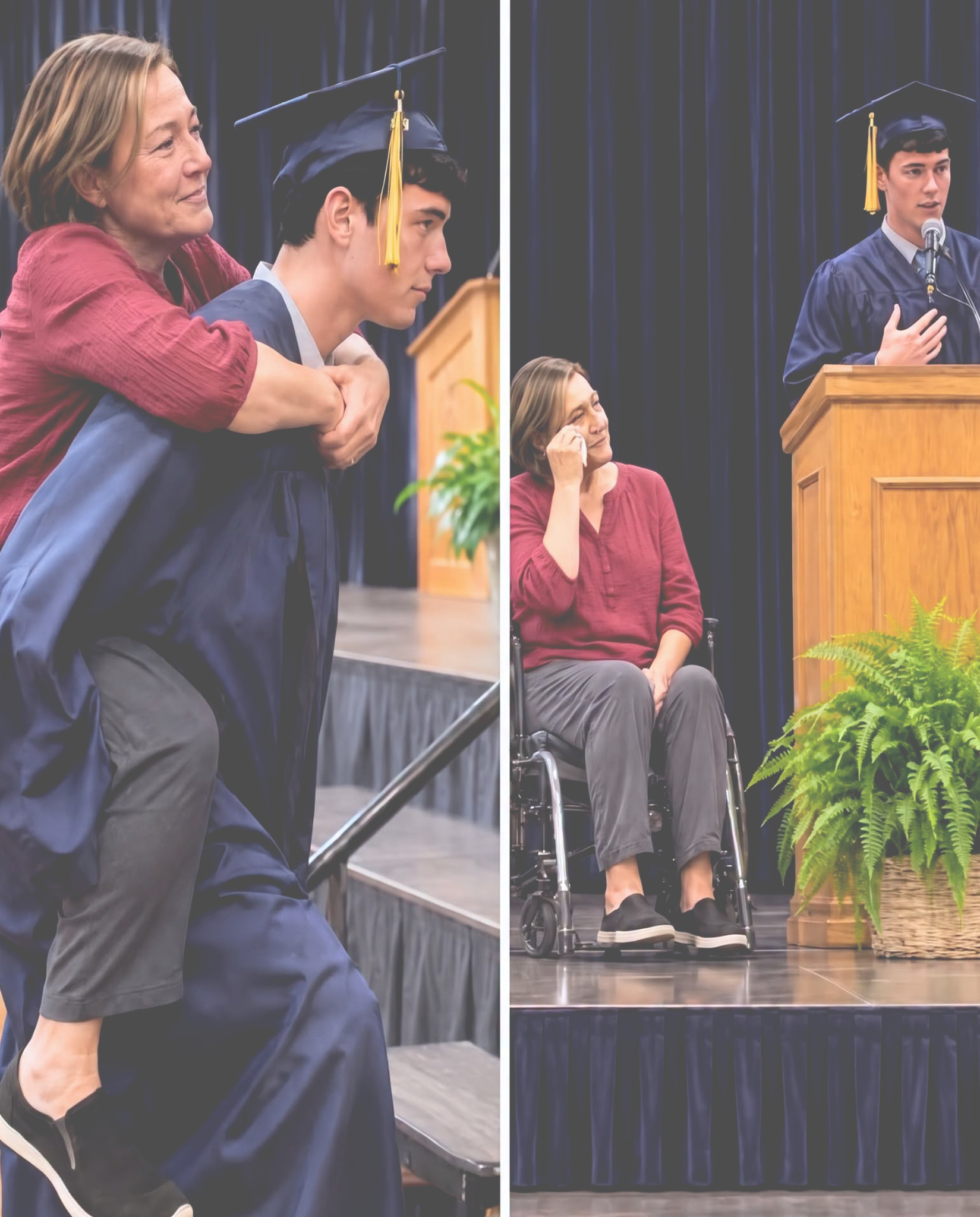
Part 1: The Secret My Son Kept Until Graduation Day: I believed my son Caleb’s high school graduation would be one of the happiest moments of my life. Instead, when he unexpectedly carried me from my wheelchair onto the stage and announced that he’d been hiding something, I discovered how close he’d come to losing everything he’d worked for. “Mom, there’s something I haven’t told you. I almost didn’t graduate.” His confession left me speechless because Caleb had always been a responsible student who took his education seriously. As he began explaining what
had happened during his final year, I realized he’d been struggling with problems he’d deliberately kept from me. I’m fifty-one years old, and I’ve used a wheelchair since Caleb was twelve. A serious automobile accident left me paralyzed from the waist down, changing nearly every aspect of our lives. I still remember waking in the hospital and learning that I would never walk again. The diagnosis was devastating, but the emotional challenges became even greater when my husband, Daniel, decided he couldn’t accept our new circumstances. “This isn’t the life I wanted. I deserve
something different.” Shortly afterward, Daniel left our marriage, forcing me to adjust to my disability while raising our son alone. I spent many sleepless nights worrying about how I would support Caleb and manage the responsibilities that had once seemed ordinary. During my recovery, Caleb often sat beside my hospital bed, sometimes making paper airplanes to entertain himself. Although he was too young to understand everything, he knew that his father wasn’t coming home.
Over time, I learned new ways to cook, clean, and handle household tasks from my wheelchair. I eventually found remote employment managing customer accounts, which allowed me to earn an income while remaining available for my son.
The salary was modest, and our finances were often difficult. Some months, I had to postpone certain expenses until my next paycheck, but I worked hard to ensure Caleb had everything essential.
When he was younger, he occasionally asked why we couldn’t take vacations like his classmates. I explained that we needed to be careful with money, and he usually responded with a reassuring smile.
“That’s alright, Mom. We can have fun together at home.”
We spent many evenings watching movies and sharing popcorn, creating happy memories without spending much. I believed Caleb understood that I was doing everything possible to give him a good childhood.
By his senior year, he’d become an excellent student with strong grades and ambitious college plans. He also worked part-time at a nearby grocery store, initially taking only a few afternoon and weekend shifts.
I worried that employment might interfere with his education, but Caleb insisted that earning his own money made him feel more independent. Whenever I offered to cover his expenses, he reminded me that he was growing older.
“Mom, I can’t expect you to pay for everything forever.”
Around October, his routine began changing noticeably. He started arriving home after nine in the evening, reheating leftovers before spending several more hours completing assignments at the kitchen table.
Occasionally, I woke during the night and discovered that his bedroom light was still on. One morning, I found him asleep with his head resting on an open textbook.
“Caleb, sweetheart, you can’t keep exhausting yourself like this.”
He assured me that college applications, scholarship essays, and school assignments were keeping him busy. When I suggested reducing his work hours, he insisted that his grades were fine and that he could manage everything.
Over the following months, however, he became thinner and increasingly withdrawn. He rarely spent time with friends, and some mornings he looked so exhausted that I worried he might be ill.
A few weeks before graduation, his English teacher, Grace, contacted me and requested a conversation. She assured me that Caleb remained on track to graduate, although she emphasized that he’d experienced an unusually demanding year.
“Please make sure he’s getting enough rest. He’s been working much harder than you realize.”
Her serious tone troubled me, but she didn’t explain the full situation. Since Caleb continued insisting that everything was under control, I convinced myself that his exhaustion was simply part of preparing for college.
Graduation morning finally arrived, and I wore my favorite blue blouse decorated with small white flowers. When Caleb entered my bedroom wearing his graduation gown, I felt overwhelmed by pride.
“How do I look, Mom?”
“Like someone who’s about to make me incredibly proud.”
He smiled and told me he hoped he’d already accomplished that. I laughed, unaware that the ceremony would reveal something far more significant than his academic achievements.
We arrived at the school early, and I found a place near the stage while Caleb joined his classmates, Ethan and Marcus. He appeared unusually nervous, but I assumed he was simply excited about receiving his diploma.
When the principal called his name, I raised my phone to record the moment. Caleb stood and began walking toward the stage, but halfway there, he suddenly changed direction and approached my wheelchair.
“Mom, I want you up there with me.”
Before I could fully understand his plan, he carefully helped me onto his back and carried me toward the stage while his friends brought my wheelchair. The audience began applauding as he settled me beside him and accepted his diploma.
Then Caleb took the microphone and turned toward me with an expression I’d never seen before.
“Mom, I’ve been keeping something from you, and I think it’s time you heard the truth.”
When he admitted that he’d nearly failed to graduate, I realized the exhaustion I’d witnessed at home had been hiding a much more serious struggle.
Part 2: The Struggle That Almost Cost My Son His Diploma
Standing beside Caleb on the graduation stage, I struggled to understand how my hardworking son could have come so close to failing his final year of high school. He had always earned strong grades, completed his assignments responsibly, and spoken enthusiastically about attending college.
Caleb looked toward the audience before explaining that his senior year had been far more difficult than anyone realized. While his classmates were preparing for graduation, he had been balancing an increasingly demanding job with schoolwork and college applications.
“Everyone thought I was having a normal senior year, but I was working more hours than I told anyone, especially my mom.”
He explained that the situation had begun during the previous summer when he accepted additional shifts at the grocery store. Initially, he worked only a few extra hours each week, but eventually he began staying late on several evenings, sometimes until the store closed.
I stared at him because he’d repeatedly assured me that his schedule remained manageable. Whenever I asked about his late arrivals, he’d blamed homework, scholarship applications, or school activities.
“Caleb, you told me you were only working a few afternoons and weekends.”
He lowered his head and admitted that he hadn’t been completely honest with me. After finishing his shifts, he often returned home exhausted but still needed to complete assignments and prepare for examinations.
Some nights, he slept only a few hours before getting up for school. As the weeks passed, the constant exhaustion began affecting his concentration, and he occasionally fell asleep during lessons.
His grades gradually declined as he missed assignment deadlines and struggled to keep up with his classmates. Instead of asking for help, he convinced himself that working harder would eventually solve the problem.
“I thought I could handle everything if I just kept pushing myself. I didn’t realize how badly things were getting.”
His English teacher, Grace, was among the first to notice the changes. She became concerned about his exhaustion and warned him that his academic performance was beginning to put his graduation at risk.
His mathematics teacher, Thomas, expressed similar concerns after Caleb fell behind in his coursework. By the time they understood the seriousness of his situation, he was struggling in two subjects and had come dangerously close to missing the requirements for graduation.
I remembered finding him asleep over his textbooks and repeatedly encouraging him to rest. At the time, I’d believed he was simply overwhelmed by the ordinary pressures of senior year.
Caleb explained that Grace and Thomas had helped him create a plan to complete his missing assignments and improve his grades. They also encouraged him to reduce his working hours and focus on finishing school successfully.
“I wouldn’t be standing here today without my teachers. They helped me when I didn’t know how to ask for help.”
He looked toward Grace and Thomas, who were watching from the audience. Both appeared emotional as he thanked them for refusing to give up on him.
I wanted to ask why he’d hidden everything from me when he knew I would have helped. Before I could speak, however, Caleb mentioned a conversation I’d almost forgotten.
“Mom, do you remember when Aunt Linda came over for coffee last spring?”
I nodded slowly, remembering my younger sister’s visit. We’d discussed Caleb’s approaching college education and the financial challenges that tuition, housing, textbooks, and other expenses would create.
During that conversation, I’d admitted how exhausted I felt from working so much. I’d also confessed that I wished I could eventually reduce my working hours, although I didn’t see how that would be possible while paying for Caleb’s education.
I had believed my son was upstairs completing homework and couldn’t hear us. Now, standing on the graduation stage, I learned that he’d overheard every word.
“You said you wished you could slow down someday, but you couldn’t because you still had to pay for my future.”
My eyes filled with tears as I realized how deeply that conversation had affected him. Caleb explained that he’d begun taking additional shifts because he wanted to ease the financial pressure I’d carried for years.
The money he earned wasn’t intended for a car, expensive clothes, or the latest electronics. Instead, he’d been quietly saving it so that when he left for college, I might finally have enough breathing room to work fewer hours.
“I know my savings won’t be enough for you to retire, Mom. I just wanted you to have a little less to worry about.”
I covered my mouth, overwhelmed by the realization that my son had nearly sacrificed his own health and education trying to make my life easier. For years, I’d worried that my accident had deprived him of opportunities other children enjoyed, never imagining that he felt responsible for protecting me from our financial difficulties.
Then Caleb reached inside his graduation gown and removed a folded sheet of paper. He explained that his savings alone couldn’t cover the cost of college, so he’d spent months searching for another solution.
“I knew I needed scholarships, so I started applying to universities. Actually, I applied to fifty colleges.”
I stared at him in disbelief because I had no idea he’d submitted so many applications. Caleb admitted that some universities had rejected him, while others offered financial assistance that still left significant expenses.
He continued applying, writing essays, gathering recommendation letters, and carefully tracking deadlines with help from his teachers. Despite the exhaustion and academic difficulties, he hadn’t abandoned his dream of attending college.
Then Caleb unfolded the paper, looked directly at me, and prepared to reveal the result of those fifty applications, a secret that would change everything I’d been worrying about.
Part 3: Twenty Scholarships and a Mother’s Tears
Caleb stood beside my wheelchair, holding the folded paper that contained the results of his college applications. I could see how nervous he was, but there was also a quiet excitement in his expression that made me realize he had something extraordinary to share.
“Mom, I wanted to tell you everything when I knew it would work out. Of the fifty colleges I applied to, twenty offered me full scholarships.”
For several seconds, I couldn’t understand what he’d just said. I’d spent years worrying about how we would afford his education, and now he was telling me that twenty universities were willing to cover the cost.
“Twenty colleges? Caleb, are you serious?”
He nodded, smiling through his tears as he explained what the scholarships included. The offers covered tuition, housing, meals, and other major educational expenses, removing much of the financial burden I’d feared would follow us for years.
“Twenty, Mom. I still have to decide which school to attend, but you won’t have to pay for everything.”
The audience erupted into applause, but I could barely hear it over my own emotions. I kept thinking about the countless evenings I’d worked late, calculating bills and wondering whether I could somehow afford to send my son to college.
Caleb explained that receiving those offers hadn’t been easy. He’d spent months researching universities, completing applications, writing personal essays, and requesting recommendation letters while struggling to keep up with his regular schoolwork.
Some universities had rejected him, and others had offered financial assistance that wouldn’t cover all his expenses. Nevertheless, he’d continued applying because he was determined to find a way to pursue his education without placing additional pressure on me.
Grace and Thomas had eventually helped him organize his applications and recover his declining grades. Their encouragement had been especially important when exhaustion made him question whether he could finish everything before graduation.
Caleb turned toward his teachers and thanked them again for recognizing that he needed support. Grace wiped tears from her cheeks, while Thomas smiled proudly from his seat.
Then my son knelt beside my wheelchair and gently took my hand. His expression became serious as he began reminding me of moments from our lives that I’d never considered particularly remarkable.
“Mom, do you remember how you always came to my school events, even when getting there was difficult?”
I nodded because attending those events had always mattered to me. Sometimes transportation was complicated, and getting ready took longer than it once had, but I never wanted Caleb to feel that his achievements weren’t important.
“And do you remember how you worked late but still found time to help me with homework?”
“Of course, sweetheart. You’re my son.”
Caleb squeezed my hand and explained that he’d never forgotten those evenings. He remembered how tired I often looked, even when I insisted that everything was fine and encouraged him to concentrate on his education.
He admitted that he’d made serious mistakes by hiding his exhaustion and allowing his grades to suffer. Although he was proud of earning the scholarships, he understood that he’d risked his health and nearly jeopardized the future he’d been trying to protect.
“I should have told you what was happening. I shouldn’t have pushed myself until I almost failed, but I wanted you to know that everything you sacrificed mattered.”
His words made me cry harder because I had never expected him to repay me for raising him. I wanted him to have opportunities, friendships, and experiences that would allow him to build a fulfilling life.
Caleb stood and faced the audience, explaining that his father had left after my accident. He described how I’d learned to manage daily responsibilities from a wheelchair while continuing to work and care for him.
“My mom raised me alone after my father left. She had to learn how to do almost everything differently, but she never stopped making sure I was taken care of.”
He spoke about the meals I’d prepared, the school supplies I’d purchased, and the encouragement I’d offered whenever he felt discouraged. To him, those ordinary acts represented years of determination that deserved recognition.
“People congratulate me for working hard, but my mom worked hard for years before I was old enough to understand what sacrifice meant.”
I looked around the auditorium and saw parents, teachers, and students listening closely. Many were visibly emotional, but Caleb seemed focused entirely on making sure I understood what he wanted to say.
“Mom, you spent your life making sure I had a future. Now I want you to enjoy yours, too.”
He paused before telling everyone that the graduation belonged to both of us. His diploma represented not only his achievements but also the years we’d spent supporting each other through circumstances neither of us had chosen.
“We made it, Mom. Now we both have a chance to build the lives we’ve dreamed about.”
Grace rose from her seat, followed by Thomas and Principal Robert. Within moments, the entire auditorium was standing, applauding as Caleb placed the microphone aside and wrapped his arms around me.
“I’m so proud of you, Caleb.”
He hugged me tighter, and I could feel him crying against my shoulder.
“I’m proud of you too, Mom.”
Yet even as I celebrated his remarkable achievement, I knew there was something important we needed to discuss once we were alone, because I never wanted my son to believe that loving me meant sacrificing himself.
Part 4: The Conversation We Needed to Have
After the graduation ceremony ended, Caleb and I remained near the auditorium while families gathered to take photographs. Several parents approached us to congratulate him, and I could see that my son’s speech had touched more people than either of us expected.
Grace and Thomas eventually joined us, offering their congratulations and explaining how hard Caleb had worked to overcome his academic difficulties. Grace described him as one of the most determined students she’d ever taught, although she admitted that his exhaustion had genuinely frightened her.
“There were moments when we worried Caleb was pushing himself beyond what he could handle. I’m grateful he finally accepted our help.”
I thanked both teachers for supporting my son when he hadn’t felt comfortable telling me what was happening. Although I was proud of his achievements, hearing how close he’d come to missing graduation reminded me that his determination had carried a serious cost.
That evening, Caleb and I sat together at our kitchen table with his scholarship letters spread between us. I carefully examined each offer, still finding it difficult to believe that twenty universities had offered to cover his major educational expenses.
We reviewed the tuition arrangements, housing allowances, meal plans, and other benefits included in the awards. Caleb explained that he hadn’t yet selected a university because he wanted to compare the opportunities before making his final decision.
For the first time in years, I could imagine him attending college without our family being overwhelmed by enormous educational expenses. The relief was extraordinary, but there was something more important I needed him to understand.
“Caleb, I’m more grateful than I can possibly explain, but we need to talk about what happened this year.”
He looked up from the scholarship letters, and his expression immediately became serious. I reached across the table and took his hand, wanting him to know that I wasn’t angry about his desire to help me.
“I never wanted you to make yourself sick trying to take care of me. Your health and education should never have been put at risk because you were worried about my finances.”
Caleb lowered his eyes and admitted that he’d known I would object to his working so many hours. He explained that seeing me exhausted after long workdays had made him feel helpless, especially after overhearing my conversation with Aunt Linda.
“I just hated seeing you so tired, Mom. I wanted to do something that would make your life easier.”
I understood his intentions, but I needed him to recognize the difference between caring about someone and assuming responsibility for their entire life. He was my son, and I wanted him to experience the freedom to study, spend time with friends, and discover what kind of future he wanted.
“Your responsibility was to be my son, Caleb. You were never supposed to carry the responsibility of being my parent.”
His eyes filled with tears, and he admitted that he’d been afraid of disappointing me if he couldn’t solve our financial problems. I reminded him that his worth had never depended on how much money he earned or how many sacrifices he made.
I also explained that although my disability had changed how I managed everyday tasks, it hadn’t taken away my ability to make decisions about my own life. If I needed assistance, I could ask for it, just as he needed to tell me when he was struggling.
“I’m still your mother, sweetheart. I can make decisions about my own future, and you don’t have to protect me by keeping important things secret.”
Caleb nodded slowly, acknowledging that he’d handled the situation poorly. He admitted that he should have told me about his declining grades, excessive work hours, and the warnings he’d received from his teachers.
“I’m sorry I kept everything from you. I thought I was helping, but I understand why you’re upset.”
I assured him that I forgave him and appreciated the love behind his actions. Nevertheless, I made him promise that we would communicate honestly whenever either of us faced a problem that seemed too difficult to manage alone.
“No more hiding things like this, Caleb. Whatever happens, we’ll talk about it together.”
He smiled and agreed, visibly relieved that our conversation hadn’t damaged our relationship. We returned to the scholarship letters, and for the next hour, we compared universities and discussed the opportunities each one offered.
One particular college seemed especially appealing because of its academic programs and the generous scholarship package. However, I noticed that Caleb kept setting its letter aside whenever we discussed the distance between the university and our home.
“Caleb, is this the school you really want to attend?”
He hesitated before admitting that it was one of his favorite choices. When I asked why he seemed reluctant, he confessed that he was worried about moving so far away and leaving me alone.
“I want to go there, Mom, but I don’t know how you’ll manage without me.”
His answer made me realize that even after everything we’d discussed, he still felt responsible for my well-being. I gently pushed the letter back toward him and reminded him that I’d spent years learning to live independently.
“Then don’t turn down an opportunity you want because you’re worried about leaving me. I want you to choose the future that’s right for you.”
Caleb studied the letter again, and I saw his uncertainty begin to fade. For the first time that evening, he seemed to be considering college as an exciting opportunity rather than another responsibility he needed to manage.
As we continued comparing his scholarship offers, I realized that helping Caleb move forward would require one more important change: teaching him that he could love me deeply without being afraid to build a life of his own.
Part 5: A Future We Could Both Look Forward To
In the weeks following graduation, Caleb and I continued discussing his college options, carefully comparing the opportunities offered by the twenty universities that had awarded him full scholarships. Although we still had important decisions to make, the fear that had surrounded his education for years had finally begun to fade.
I wanted him to choose a university because it offered the education and experiences he genuinely wanted. After everything he’d endured during his senior year, I was determined that his next chapter wouldn’t be shaped by guilt or anxiety about leaving me behind.
One evening, Caleb returned to the kitchen table with several scholarship letters and asked whether I was certain he should consider schools far from home. I could tell that he was still struggling with the idea of moving away, even though some of his most promising opportunities were located in other cities.
“Mom, I know you said you’d be fine, but what if something happens and I’m not here to help?”
I reminded him that I’d been managing my disability for years and that I had people I could contact whenever I needed assistance. His concern came from love, but I didn’t want him to confuse caring about me with being responsible for every challenge I might face.
“Caleb, I want you to build a life you’re excited about. You don’t have to stay close to home just because you’re worried about me.”
He listened quietly before admitting that leaving would feel strange after everything we’d experienced together. Since Daniel had abandoned our family, Caleb and I had depended heavily on one another, and the idea of living apart represented a major change for both of us.
I understood his feelings because I would miss him terribly. Nevertheless, watching him become independent was something I’d hoped for since he was a little boy sitting beside my hospital bed with his homemade paper airplanes.
Our circumstances hadn’t suddenly become perfect after graduation. I still worked remotely managing customer accounts, and we continued watching our expenses carefully because financial stability required planning and discipline.
However, knowing that Caleb could attend college without overwhelming educational debt changed how I viewed our future. For the first time in years, I could imagine making decisions about my own life without constantly calculating how much money his education might require.
I also began thinking differently about the sacrifices I’d made while raising him. I’d always considered them part of being his mother, but his graduation speech helped me understand how closely he’d watched my efforts and how deeply they’d influenced him.
At the same time, I wished he’d never believed he needed to repay those sacrifices. His success and happiness were enough for me, and I wanted him to understand that he didn’t owe me his health, freedom, or future.
Last weekend, we went out for breakfast together, enjoying a quiet morning without rushing to school or work. We talked about college, his friends, and the possibilities ahead, and I noticed how much more relaxed he seemed now that graduation was behind him.
When we finished eating and approached the restaurant exit, Caleb instinctively reached for the handles of my wheelchair. He’d developed that habit over the years, always wanting to make things easier whenever we went somewhere together.
“I’ve got you, Mom.”
I smiled and gently stopped him, reminding him that I was perfectly capable of moving my wheelchair myself. He stepped beside me instead, accepting that I didn’t always need assistance simply because he wanted to provide it.
“I can manage, sweetheart.”
“I know, Mom.”
That brief exchange meant more to me than he probably realized. Caleb had spent so much of his childhood worrying about how to help me that I wanted him to become comfortable allowing me to do things independently.
We continued toward the exit together, talking about ordinary things as we always had. Yet I couldn’t stop thinking about how much our relationship had changed since the day he carried me onto the graduation stage.
That morning, he’d lifted me from my wheelchair because he wanted us to share one of the most important moments of his life. In front of an entire auditorium, he’d revealed his struggles, acknowledged his mistakes, and expressed gratitude for the years we’d spent supporting each other.
His twenty scholarships were an extraordinary achievement, and the money he’d saved represented genuine generosity. Nevertheless, neither of those things was the greatest gift he gave me that day.
What mattered most was knowing that my son had opportunities ahead of him that once seemed financially impossible. He could pursue his education, discover his interests, form new friendships, and eventually build a future that reflected his own ambitions.
I had spent years worrying that my accident and Daniel’s departure had deprived Caleb of the childhood he deserved. His graduation helped me recognize that although our lives had been difficult, we’d also built a relationship grounded in love, determination, and mutual respect.
Still, I couldn’t ignore the painful lesson hidden beneath his remarkable achievement. Caleb had nearly lost his chance to graduate because he’d believed that protecting me meant hiding his struggles and carrying responsibilities that were never supposed to be his.
I was proud of his compassion, but I never wanted him to sacrifice his well-being to prove how much he loved me. If our experiences had taught us anything, it was that sharing our difficulties was far healthier than silently trying to overcome everything alone.
As we prepared for his next chapter, I made myself a promise to encourage his independence rather than allow my own fears to hold him back. I wanted him to know that he could always come home, ask for help, or share his worries without feeling that he’d disappointed me.
And I wanted to give myself permission to enjoy the years ahead, too. I was still a mother, still capable of making my own choices, and still entitled to dreams that extended beyond simply getting through another difficult month.
My son had carried me onto the graduation stage because I couldn’t walk, but the most meaningful thing he gave me was the knowledge that we could finally move toward our futures without allowing fear to control us.
Caleb had a life filled with possibilities waiting for him, and for the first time in many years, I truly believed that I did, too.