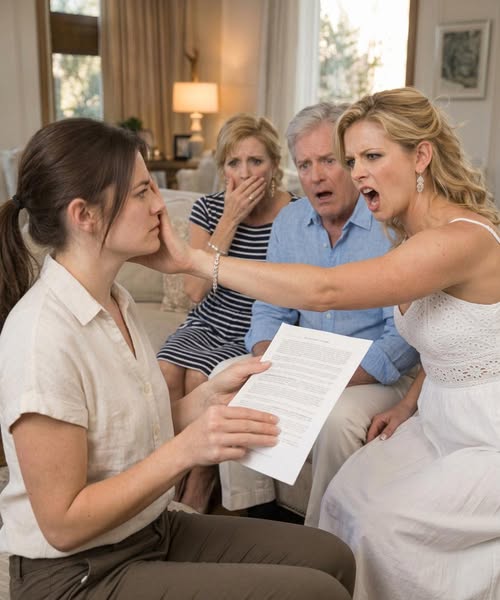
Even Vanessa flinched at that.
“Read it out loud,” my father said, trying to regain control.
“No,” I said. “I’ll read it.”
I unfolded the pages and recognized my grandmother’s neat slanted handwriting from the scanned copy attached by her attorney.
She wrote that she had watched our family for years and understood one truth clearly: kindness had been mistaken for weakness, and responsibility had been punished rather than rewarded. She wrote that one daughter had been raised to believe consequences were optional, while another had been expected to carry every burden quietly and call it loyalty. She didn’t mention our names at first, but she didn’t need to. By the second paragraph, my mother was staring at the floor.
Then came the part that made Vanessa’s face stiffen.
Grandma wrote that the house money was given to me not simply because I handled money responsibly, but because I had shown steadiness under pressure, care without performance, and the ability to build a future rather than demand one. She wrote that a home should belong to the person willing to protect it, maintain it, and make it a place of peace. Then she added a sentence I will never forget:
Property cannot heal a character defect. Giving more to the one who takes will only teach them to take bigger things.
Vanessa shot to her feet so fast her knees struck the table. “She wrote that about me?”
I lowered the letter. “You tell me.”
My mother whispered, “This is cruel.”
“No,” I said quietly. “This is accurate.”
My father tried one last tactic, the legal one. Men like him always believe procedure can rescue them from truth. “Whatever Eleanor believed, families settle matters privately. There’s no need to escalate this with attorneys.”
I almost admired how quickly he pivoted. Ten minutes earlier he wanted transfer papers. Now he wanted privacy.
I folded the letter and slid it back into the envelope. “That option ended when Vanessa hit me and both of you supported her.”
Vanessa let out a sharp laugh. “Oh please. One slap and now you’re a victim?”
I looked straight at her. “No. Years of this, and now I’m done being available for it.”
That was the real turning point. Not the document. Not the trust. Not even my grandmother’s words. It was that sentence. Because for the first time, I heard myself clearly. I wasn’t standing there to persuade them. I wasn’t negotiating for scraps of respect. I was informing them that their access to me was changing.
My mother’s eyes filled with tears, but I knew that look. She used tears like a sales tactic. “Claire, don’t do this. We can work this out.”
“How?” I asked. “Tell me specifically. Does Vanessa apologize? Do you admit demanding my house was wrong? Do you admit you’ve treated me like the emergency contact for a family that never shows up for me?”
Silence.
I nodded once. “That’s what I thought.”
I picked up my bag and car keys. My cheek still stung, but not as much as it had fifteen minutes earlier. Pain shifts when clarity arrives. At the doorway I turned back and said the one thing I had spent years being too afraid to say.
“If any of you contact my lender, my realtor, the county recorder, or try to present yourselves as having authority over my property, my attorney will respond. Not me.”
My father scoffed weakly. “You have an attorney now?”
“Yes,” I said. “Because Grandma made sure I’d be protected from family.”
Then I left.
The drive back to my new house felt surreal at first. My hands shook on the steering wheel. At a red light I caught my reflection in the mirror and saw the faint mark on my cheek. I should have cried. Instead I laughed once under my breath, because the absurdity finally hit me. They truly believed I would hand over a house. They believed my work, my savings, my discipline, and even my grandmother’s support could all be redirected toward Vanessa because that was the family pattern: take from Claire and explain later—or never.
But patterns break when one person refuses the script.
When I got home, I unlocked the front door and stepped into the quiet living room that still smelled like fresh paint and cardboard boxes. I sat on the hardwood floor with my back against the wall and looked around. Mine. Not because someone handed me a dream life, but because I built a real one. Mine because I worked for it. Mine because my grandmother, clear-eyed until the end, recognized something no one else in that family wanted to admit: I wasn’t the extra daughter. I was the dependable one, and dependable people deserve protection too.
Over the next week, the messages began. First from my mother, pretending she wanted “peace.” Then from my father, calling the trust “divisive.” Then from Vanessa, cycling through anger, self-pity, and insults in three messages. I didn’t reply to any of them directly. My attorney sent one formal notice: all future communication about the property must go through counsel. After that, the messages slowed quickly. Funny how fast bullies retreat when access disappears and documentation begins.
Months later, I painted the kitchen myself. I planted herbs on the back porch. I hosted a small dinner for friends who had genuinely celebrated when I got the keys. Real support looks different from family obligation. It asks how you’re doing. It brings food when you’re overwhelmed. It celebrates without calculating what it can take later.
Vanessa still tells people I “stole” what should have been hers. Let her. People who hear the full story usually fall silent for a moment, then ask the only question that matters: how did they think they could get away with that?
The answer is simple. They thought I would remain the version of me they were used to—the one who kept peace at her own expense, the one who accepted being less so everyone else could stay comfortable.
They were wrong.
And that house? It became the first place I ever lived without the echo of someone else’s demands bouncing off the walls.
Be honest: if your own family crossed a line like this, would you cut them off completely, or give them one last chance to change?