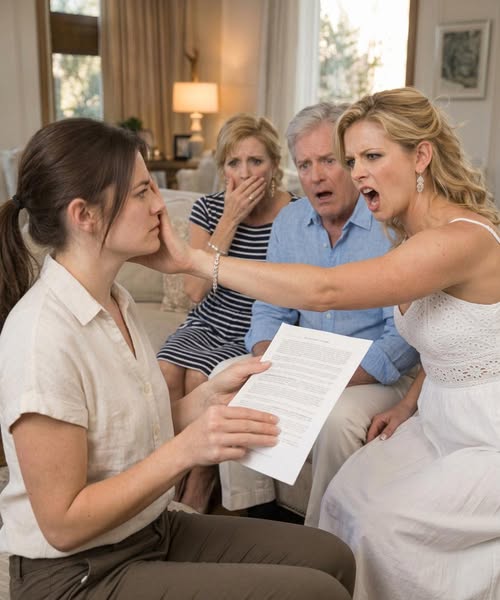
“I’ll crush your arrogance—you’re giving that house to me!” she screamed.
I touched my face in disbelief. My mother rushed to Vanessa’s side instead of mine. “Claire, look what you made her do.”
My father pointed at me like I was the problem. “Stop provoking your sister and sign the transfer papers when the lawyer prepares them.”
I looked at all three of them and felt something inside me turn cold. Then, slowly, I opened my handbag and pulled out a sealed envelope I had brought just in case. I placed one document on the coffee table between us.
Vanessa grabbed it first.
As my parents leaned in to read, the color drained from all three of their faces at once, because that house was not legally reachable by any claim they thought they could force on me.
The silence that followed was the kind that makes every small sound feel amplified.
I could hear the wall clock ticking. I could hear Vanessa’s quick, shallow breathing. I could hear my father shift in his chair as he reread the first paragraph of the document, hoping it might somehow say something different the second time.
It didn’t.
The document wasn’t a bluff. It was a certified legal notice from the estate attorney who had handled my grandmother Eleanor’s affairs. Attached behind it was a notarized copy of a trust amendment and a memorandum of intent signed eight months before her death. Yes, the house had been bought partly with my savings—but the final down payment came from a protected distribution from Grandma Eleanor’s family trust. The funds had been released specifically to me as the sole named beneficiary for primary residential ownership. There was also a clear restriction: if I were pressured, coerced, or manipulated into transferring the property to an immediate family member within five years of purchase, the trust could trigger legal intervention and reclaim the asset into a holding structure managed by the attorney.
My grandmother had anticipated this.
Vanessa looked up first. “This is insane.”
“No,” I said. “This is careful.”
My mother snatched the second page and scanned it quickly, her lips moving silently over the words. “Why would your grandmother do something like this?”
I met her gaze. “Because she knew exactly how this family operates.”
That made my father slam his palm against the armrest. “Watch your tone.”
“My tone?” I said. “Vanessa just slapped me while both of you demanded my house.”
Vanessa tossed the papers back onto the table. “Grandma was senile near the end.”
That was a lie, and everyone in the room knew it. Eleanor Whitmore had remained sharper than most lawyers I’d met. She and my grandfather had built a successful chain of furniture stores, sold them before the market shifted, and spent the last decade quietly observing the family with a sharpness that made people uneasy. She rarely raised her voice, which was exactly why her disappointment carried weight. Vanessa hated that Grandma refused to fund her impulsive lifestyle. My parents hated that Grandma asked blunt questions about debt, money, and accountability.
And me? I was the granddaughter who visited without asking for anything. I drove her to appointments when I could. I stayed for coffee. I listened.
Six months before she died, she asked me something while we sat in her sunroom.
“If I help you buy a house,” she had said, “would you actually live in it, or would your family find a way to turn it into a circus?”
I thought she was joking then. I understood now.
“She loved me too,” Vanessa snapped, though even she sounded uncertain.
I took a breath. “Grandma left you money once. Twenty thousand dollars when you said you needed help getting back on your feet. You spent it on a luxury SUV lease, two handbags, and a resort trip with Ethan.”
Vanessa’s face flushed. “That is none of your business.”
“It became everyone’s business when you came back asking for more,” I said.
My father stood up now, full of bluster. “None of that changes the fact that this family should support each other.”
I almost smiled at the hypocrisy. “Support works both ways. Did either of you offer to help with my closing costs? My inspection fees? The months I worked overtime to save for this? Did anyone ask if I was exhausted? If I was proud? If I needed support?”
No one answered.
Because the truth was ugly and simple. In our family, Vanessa had always been treated like an investment, and I had always been treated like a resource.
When Vanessa got pregnant at nineteen, my parents emptied part of their retirement account to help her. When she quit a job after four months because her manager “didn’t respect her energy,” they covered her rent. When she maxed out two credit cards, they blamed the economy. When I worked my way through college, they called me independent and acted as though independence meant I didn’t deserve support anymore.