The Weight of an Uninvited Guest. Chapter 1: The Armor of Illusion: Jennifer tore the dark brunette wig off my wife’s head right in the epicenter of our only son’s wedding reception. She didn’t do it in a dimly lit hallway. It wasn’t a clumsy accident born of too much champagne. She executed the maneuver right there on the elevated wooden stage, illuminated by the blinding, theatrical halogen lights of a sprawling, multi-million-dollar oceanfront estate in Charleston, South Carolina. Hundreds of affluent guests were watching. Jennifer flashed a perfectly bleached smile, radiating the smug satisfaction of someone who had just delivered the punchline to a brilliantly orchestrated joke. The synthetic hair tumbled to the polished mahogany floorboards, lying there like a dead bird. And the woman standing frozen before that sea of designer suits and silk gowns was my wife, Mary—a woman who had spent the last six agonizing months locked in brutal, trench-warfare combat with stage three ovarian cancer. If you ask me what haunts my sleep the most about that specific second in time, it wasn’t the scattered, confused laughter that rippled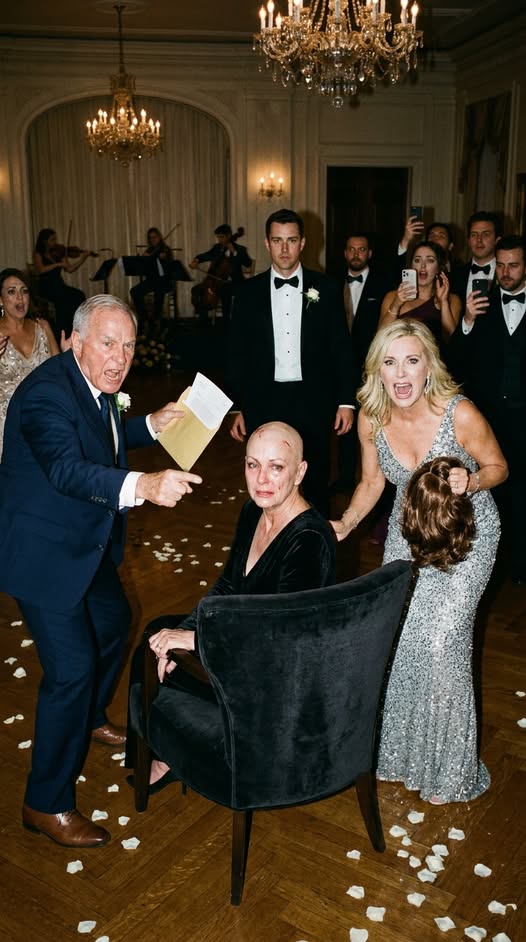
through the crowd. It was the deafening, cowardly silence of my son. But for you to truly comprehend how a familial bond shatters so publicly, I have to wind the clock back a few hours, to the oppressive afternoon humidity before we ever stepped foot onto that stage. I still feel the phantom echo of that room going dead quiet, not a silence born of reverence, but the slimy, uncomfortable quiet of cowards waiting to see if it was socially acceptable to keep laughing.
My story doesn’t detonate at the microphone. It began quietly, insidious and slow, when Mary and I first approached the grand wrought-iron gates of the estate where Lucas’s wedding was being hosted.
The property was a monstrous marvel of southern coastal architecture, perched arrogantly right on the edge of the Atlantic. Floor-to-ceiling glass doors stood wide open, inviting the pale blue ocean inside. Every conceivable surface was suffocating under cascades of imported white Phalaenopsis orchids. The banquet tables were draped in stiff, impossibly thick Belgian linen. Crystal flutes of vintage champagne were filled without a single pause by a phantom army of servers who glided across the floors, terrified of disrupting the curated perfection of the air.
I served in the United States military for nearly four decades. I retired as a Colonel. I have stood at rigid attention in the Pentagon, at Arlington, in ceremonies far more rigid and formal than this low-country pageant. Yet, standing in that cavernous ballroom, breathing in the scent of sea salt and exorbitant wealth, I felt entirely like an uninvited trespasser.
Mary navigated the flagstone path beside me. I could feel the feather-light pressure of her fingers resting on my forearm. She wasn’t holding on because she was weak, but because the neuropathy from her chemotherapy treatments required her to find an external center of gravity. Half a year of aggressive oncology protocols had stripped the padding from her frame. The brisk, confident strides she once possessed were now deliberate, calculated steps. But my Mary still stood with the posture of a queen.
That morning, in the cramped bathroom of our mid-tier hotel, she had spent an agonizing hour in front of a fogged mirror. Her hands trembled slightly as she applied spirit gum, meticulously adjusting the lace front of her wig.
“I refuse to give Lucas a reason to worry about me on the biggest day of his life,” she had whispered, meeting my eyes in the mirror when I gently suggested we could request seats near the back, away from the chaos.
The wig was a conservative dark brown, trimmed neatly into a bob—virtually identical to the hairstyle she possessed before the toxic chemical drips began. To the casual observer, you wouldn’t notice a damn thing. But I knew. I knew the exact number of early mornings she dragged herself out of bed, exhausted to her marrow, just to ensure that synthetic armor sat flawlessly on her scalp. I knew she had spent weeks practicing her gait down the sterile, fluorescent-lit corridors of the oncology ward so she could keep her chin elevated when facing her son’s new, affluent circle. That was Mary’s core operating system. She abhorred the idea of her suffering becoming someone else’s inconvenience.
When we reached the perimeter of the primary seating area, a young hostess holding a leather-bound clipboard looked up. Her eyes did a quick, assessing sweep of my off-the-rack navy suit. She offered a tight, mandated smile.
“And you are?” she inquired, her tone laced with polite boredom.
“Harrison,” I replied, my voice carrying the gravel of a man used to giving orders. “The groom’s father.”
Her smile glitched. It froze for a microsecond before rebooting into its proper, deferential place. “Oh. My apologies. Right this way, sir.”
She escorted us to the front row, but her body language screamed that we were being positioned out of biological obligation, not because our presence was genuinely desired.
I took a tactical scan of the room. Jennifer’s bloodline had arrived in full force. Men in bespoke Italian tailoring checking Rolex Daytonas; women draped in raw silk letting out sharp, confident barks of laughter. It was the specific acoustic signature of people who inherently believe the earth belongs to them.
Jennifer held court near the elevated dais where the vows would be exchanged. She was encased in a stark white designer gown that caught the ambient light so fiercely it almost hurt to look at her. When Lucas approached her, she clamped a hand onto his bicep—not a gesture of affection, but of ownership. Like she was appraising a valuable thoroughbred she had just acquired.
Lucas spotted us. For a fleeting fraction of a second, his gaze locked onto Mary’s frail silhouette. He gave a sharp, clinical nod.
That was the extent of his greeting. He didn’t cross the room. He didn’t embrace the woman who gave him life. He didn’t ask if her joints ached from the travel.
I ground my back molars together but kept my mouth shut. In the military, you learn swiftly that sometimes a man’s silence broadcasts a louder failure than any verbal complaint.
Mary smoothed her dress and lowered herself into the folding chair, her hands resting symmetrically in her lap. “It’s a beautiful venue, Arthur,” she whispered, staring out through the glass at the crashing surf. I knew she was desperately trying to force her brain to focus on the aesthetics, ignoring the freezing temperature of our reception.
Directly behind us, a cluster of women stood in a tight circle. Their voices carried the piercing, unbothered volume of old money.
“I heard a rumor the groom’s mother was essentially on her deathbed recently,” one voice noted, dripping with morbid curiosity.
“I know,” another replied. “I believe it’s late-stage something-or-other. Frankly, I find it baffling they permitted her to attend. Events of this caliber require a certain aesthetic. It’s just… depressing to look at.”
A soft, choral giggle followed the remark. I didn’t need to rotate my shoulders to identify the ringleader. It was Eleanor, Jennifer’s mother.
Mary heard every single syllable. I knew she did because her fingers instantly dug into the fabric of her skirt, her knuckles turning white. A heavy beat passed. Then, she consciously relaxed her grip, raised her hand, and patted the edge of her wig as if adjusting it were merely a nervous tic.
“I’m entirely fine, Arthur,” she breathed, though her eyes remained locked on the ocean.
I gave a curt nod. Up by the altar, Jennifer was huddled with a trio of her bridesmaids. They were scanning the room, evaluating the floral arrangements and the guests with predatory eyes. One of the women in a blush-pink dress nudged Jennifer, leaning in to whisper something directly into her ear while staring blatantly at our row.
Jennifer’s neck snapped in our direction. Her gaze tracked over the crowd and landed heavily on Mary’s hair. She stared for three seconds too long.
Then, she smiled.
It wasn’t a greeting. It wasn’t polite. It was the cold, calculating grin of a sniper who had just found a target in their crosshairs. A detail had been logged away, a weakness identified, ready to be weaponized for entertainment later.
A cold dread coiled in my gut. I didn’t know the exact parameters of the ambush yet, but my instincts were screaming.
Chapter 2: The Coward at the Bar
The ceremony initiated roughly twenty minutes later. The sprawling crowd settled into their designated velvet-cushioned chairs. A string quartet stationed near the manicured garden began weeping out a classical piece. Every angle of the event had been aggressively stage-managed, resembling a sterile editorial spread in a bridal magazine rather than a union of two souls.
Jennifer glided down the aisle. Lucas stood waiting beside the officiant. I threw a sideways glance at Mary. She was studying our son with an intensity that broke my heart, her eyes shimmering with a glassy, unshed pride. In the soft afternoon light, the hollows of her cheeks seemed to vanish, and I caught a vivid glimpse of the vibrant, unstoppable woman I had married forty years ago—the woman who adamantly believed that blood and family were the ultimate shield against the world’s cruelty.
The vows were expedited. Promises were murmured into microphones. The crowd erupted into applause, and a fresh wave of champagne was mobilized.
We transitioned to the dinner reception. Enormous circular tables lined the sprawling teak balcony overlooking the Atlantic. The setting sun bled across the water, painting the sky in violent shades of bruised purple and liquid gold. It was the kind of lighting that tricks the human brain into believing it is bearing witness to a perfect, flawless reality.
But my military-trained eyes were locked onto the fractures in the facade.
Jennifer and her affluent family swept between the tables like conquering monarchs. They threw their heads back in booming laughter, slapped the backs of local politicians, and traded humble-brags about offshore investments and wintering in the Alps. Lucas trailed half a step behind them. He didn’t look like a proud son eager to introduce his parents to his new life. He looked like an insecure pledge who had miraculously infiltrated an elite fraternity and was terrified of violating the dress code.
Virtually no one approached Mary. A handful of guests offered tight, obligatory nods as they passed our table, but they actively navigated their conversations around her, treating her like an invisible, uncomfortable specter.
Every ten minutes, I watched Mary reach up, her frail hand hovering near the nape of her neck to adjust the thin silk scarf and check the hairline of her wig. Not because it was slipping. It was a physical manifestation of her mounting exhaustion, an anxiety tic she only displayed when her battery was running dangerously close to zero.
“I’m going to intercept Lucas,” I grumbled, pushing my chair back.
Mary reached out, her cool fingers grazing my wrist. “Arthur, please. Don’t manufacture an awkward situation for him today.”
That was Mary. Always absorbing the shrapnel so others wouldn’t get scratched. Even when her own body was betraying her by the minute, her only concern was the preservation of her son’s ego.
“I’ll be brief,” I promised.
I navigated the labyrinth of linen-draped tables until I spotted Lucas. He was holding court near the open-air mahogany bar, flanked by three of Jennifer’s groomsmen—young men with slicked-back hair and trust funds. One of them barked a punchline, and the group erupted into synchronized, braying laughter.
“Lucas,” I said.
My voice wasn’t loud, but it possessed a specific density. He flinched, sloshing his amber drink, and turned around.
“Dad.” His smile was brittle, his eyes darting nervously to his friends.
I closed the distance, standing shoulder-to-shoulder with him. “Your mother is running on fumes. You need to come to the table and sit with her for ten minutes. Give her some grace.”
Lucas shifted his weight, his gaze deliberately avoiding mine, focusing instead on a passing waiter. “Dad, come on. Half the state’s congressional district is in this room. I have to network. I have obligations.”
“She gave you life, Lucas,” I said, the ice creeping into my tone. “She is your paramount obligation.”
He let out a heavy, exasperated sigh. Before he could formulate an excuse, one of Jennifer’s groomsmen—a kid named Preston with a jawline sharper than his intellect—leaned into our airspace.
“Hey, Mr. Harrison,” Preston drawled, swirling the ice in his scotch. “I saw your wife from across the room. She looks completely fine. Honestly, she’s a trooper just for showing up.”
Another groomsman chuckled, lowering his voice into a conspiratorial whisper that wasn’t nearly quiet enough. “To be brutally honest, I’m genuinely shocked she didn’t just stay home. After all the dramatic hospital stints… it’s kind of a buzzkill vibe, you know?”
I felt my heart rate slow down to a steady, lethal rhythm. My hands curled into loose fists at my sides. I waited for Lucas to react. I waited for my son, the boy I taught to throw a baseball and respect his elders, to slam his drink down and demand an apology from the spoiled aristocrat who just insulted his dying mother.
Lucas just stared at his scotch. He didn’t offer a single syllable of defense.
In that pathetic silence, the truth clicked into place. My son had completely surrendered his moral compass. He was desperately trying to solidify his rank among these people, and the path of least resistance was to let them trample over the woman who raised him.
I didn’t say another word. I turned my back on the coward at the bar and marched back to our isolated table.
Mary was sitting exactly where I left her, her spine rigid, her hands folded, radiating a quiet dignity the rest of the room could never comprehend. I sat down heavily beside her, the sour taste of betrayal coating my tongue.
A sharp screech of microphone feedback suddenly pierced the ambient noise of the reception.
Jennifer was standing on the elevated wooden stage near the band, a wireless microphone clutched in her manicured hand. The room fell into a hushed, expectant silence.
“Thank you all for being here today to witness our love story,” she projected, her smile blinding under the stage lights. The crowd offered a polite ripple of applause. “Family is the absolute foundation of my life. So, I thought it would be incredibly touching if Lucas’s mother came up here to share a few words of wisdom with us.”
The entire ballroom pivoted. Hundreds of pairs of eyes locked onto our table.
My stomach plummeted. Mary froze. We hadn’t been briefed on any speeches. We were explicitly told earlier that only the Best Man and the Maid of Honor would be taking the microphone. This was an unscripted deviation.
Jennifer’s voice echoed again, maintaining its sugary tone, but I could hear the razor blade hidden inside it. “I am absolutely positive Mrs. Mary has a wealth of thoughts she’d just love to share with the crowd.”
Mary looked at me, her eyes wide with a sudden, spiking panic.
“I can handle this,” she whispered, her voice trembling slightly.
She pushed herself up from the chair. Her movements were agonizingly slow, her joints stiff from the toxins in her bloodstream, but she forced her shoulders back. I watched Jennifer tilt her head from the stage, her eyes dropping immediately to the top of Mary’s head.
And then, leaning casually into the microphone, Jennifer made sure the tables closest to the stage heard her next thought.
“Actually, I’ve been dying to know,” Jennifer chuckled, a light, mocking sound. “In this brutal ocean humidity… doesn’t your hair just make you sweat?”
A smattering of snickers broke out from the VIP tables.
The blood roared in my ears. I gripped the edge of the linen-covered table so hard the wooden underside splintered into my thumb. Mary didn’t stop. She kept walking forward, straight into the firing squad, and I realized with a sickening certainty that the psychological torture was only just beginning.
Chapter 3: The Cruelest Joke
Mary navigated the distance to the stage one agonizing step at a time. The pace was glacial, but her determination was forged from iron. As she ascended the three short wooden stairs, the aggressive, unshielded stage lights washed over her pale blue dress, illuminating her in a stark, unforgiving glow.
To the uniformed observer, she was simply an elderly, fragile woman making her way to the microphone to bless her son’s union. But I knew the precise physiological cost of that walk. I knew the burning in her calves, the nausea swirling in her stomach, the sheer willpower required to keep her chin parallel to the floorboards.
The ambient chatter of the ballroom died down entirely. A few guests rotated their chairs, leaning forward with predatory curiosity. The ubiquitous glow of smartphones began to pop up like fireflies in the dark as people prepared to record the spectacle.
Mary came to a halt beside her new daughter-in-law. Jennifer handed over the microphone but deliberately refused to yield the space. Instead of stepping back to allow Mary the spotlight, Jennifer hovered inches away, invading her personal space, leaning in with a voyeuristic intensity.
Mary grasped the microphone with both hands to stabilize her tremors. For the first ten seconds, the speakers broadcast nothing but the heavy, labored rhythm of her breathing. She wasn’t searching for words; she was fighting her failing lungs for the oxygen required to project them.
“Thank you… all for joining us this evening,” Mary finally began. Her voice was a fragile, papery whisper, barely cutting through the distant crash of the ocean waves, but the sheer quiet of the room allowed it to carry.
“Lucas is my only child. I have prayed for a day like this since he was a little boy.” She paused, her chest rising and falling visibly. “I wish you both a future filled with peace.”
It was a masterclass in brevity and grace. Mary despised public speaking even when she was healthy.
A smattering of polite, golf-clap applause echoed through the room. Mary lowered the microphone and began to pivot, desperate to retreat to the safety of our table.
That was the moment Jennifer executed her strike.
“Oh, wait! I really think you should stay up here for a photo,” Jennifer declared, her voice booming over the speakers.
Mary froze. Jennifer snaked an arm around Mary’s fragile shoulders, effectively pinning her in place under the blistering lights.
“It really is sweltering up here, isn’t it?” Jennifer announced to the crowd, casting a theatrical glance at the ceiling. “The sea breeze is just whipping everything around.”
A few obedient guests offered a nervous chuckle.
Jennifer raised her free hand toward the crown of Mary’s head, miming the motion of tucking a stray hair back into place. “Here, Mary, let me just fix this for you…”
It happened with terrifying, fluid speed.
I saw Jennifer’s fingers dig into the synthetic fibers at the base of Mary’s skull. There was a sharp, aggressive downward tug, followed immediately by a violent pull upward.
The spirit gum ripped free from Mary’s scalp with a sickening shhhk sound. The dark brunette wig detached completely.
Jennifer didn’t let it fall. She kept her arm elevated, holding the hairpiece suspended in the air like a grotesque trophy.
The ballroom was plunged into a vacuum of absolute silence. The stage lights beat down mercilessly on Mary’s exposed head. The sparse, wispy patches of graying fuzz. The angry red friction burns from the lace front. The undeniable, geographical map of a woman engaged in a fight to the death with cancer. All of it laid bare, instantly broadcasted to hundreds of staring eyes.
Mary’s body went completely rigid. Her hands remained clasped in front of her stomach, exactly where they had been when she held the microphone. She didn’t shriek. She didn’t scramble to cover her naked scalp with her hands. She simply stood there, paralyzed in the blinding light, stripped of her armor.
For three seconds, the room couldn’t compute what had happened.
And then, the laughter began.
It started at Jennifer’s family table—a few drunken, bewildered snorts from people who genuinely thought this was a pre-planned comedy bit. Jennifer herself threw her head back and let out a bright, ringing laugh. She shook the wig slightly in her hand.
“Oh my gosh!” Jennifer gasped into her own lapel microphone, her tone dripping with mock innocence. “I had absolutely no idea it would pop off that easily!”
A louder wave of laughter cascaded from her bridesmaids. Somewhere in the back rows, a flashbulb went off as a guest captured the humiliation in high definition.
I whipped my head around to locate Lucas. My son was standing a mere twenty feet away, hovering near the edge of the dance floor. He had a direct, unobstructed view of the stage. He had seen his bride assault his mother.
I waited. My muscles coiled like a spring. All it would take was one step. One explosive, furious movement from my son to charge that stage, tear the microphone from that monster’s hand, and shield the woman who birthed him.
Lucas didn’t move a muscle.
He stared at Mary’s exposed scalp, his face flushing a deep crimson. And then, he physically turned his back to the stage, staring down at his expensive leather shoes, desperate to distance himself from the radioactive fallout. He calculated the social cost of defending his dying mother in front of his wealthy new in-laws, and he chose to abandon her to the wolves.
Up on the stage, Jennifer was reveling in the spotlight. “Actually,” she giggled, leaning toward the crowd, “maybe the aerodynamic look is better for this humidity anyway!”
The laughter swelled, crueler now.
But Mary still didn’t speak. She didn’t weep. I locked onto her eyes from across the room. There was no panic in her gaze. There was only the hollow, desolate devastation of a woman realizing that, at the pinnacle of her son’s life, her suffering had been converted into a punchline.
I stood up.
The wooden legs of my chair scraped violently against the floorboards. The sound wasn’t electronically amplified, but it possessed a jagged, violent frequency that sliced right through the laughter. Several heads whipped around to look at me.
I stepped out from behind the table. I didn’t run. I didn’t shout. I began to march toward the stage with the slow, terrifying, rhythmic cadence of an artillery commander walking into a live fire zone.
The evening was no longer a wedding. It was a battlefield. And I was about to scorch the earth.