I woke to the smell of polished mahogany and the suffocating, powdery sweetness of lilies pressing against my lungs. At first, I did not open my eyes. It wasn’t because I didn’t want to, but because some invisible, terrifying force held my eyelids shut as if they had been welded together with lead. I tried to twitch my fingers. Nothing. I tried to curl my toes. Nothing. I tried to move my tongue, to wet my dry lips, to make even the softest sound. Nothing. My body was a cold, unyielding statue, but my mind was violently awake, screaming inside a flesh prison that wholly refused to answer my commands. Then, I heard the prayers. A low, trembling voice recited scripture somewhere nearby. Soft shoes shuffled over marble floors. A woman sniffled delicately. A man cleared his throat and whispered, “Only forty-five. Massive heart attack. A terrible thing for the Pendleton family.” Terror sliced through my consciousness like jagged ice. I was not in a hospital bed. I was not in the sprawling master bedroom of my Kentucky estate. The darkness around me was absolute, airless, and the space was so incredibly narrow that my shoulders were tightly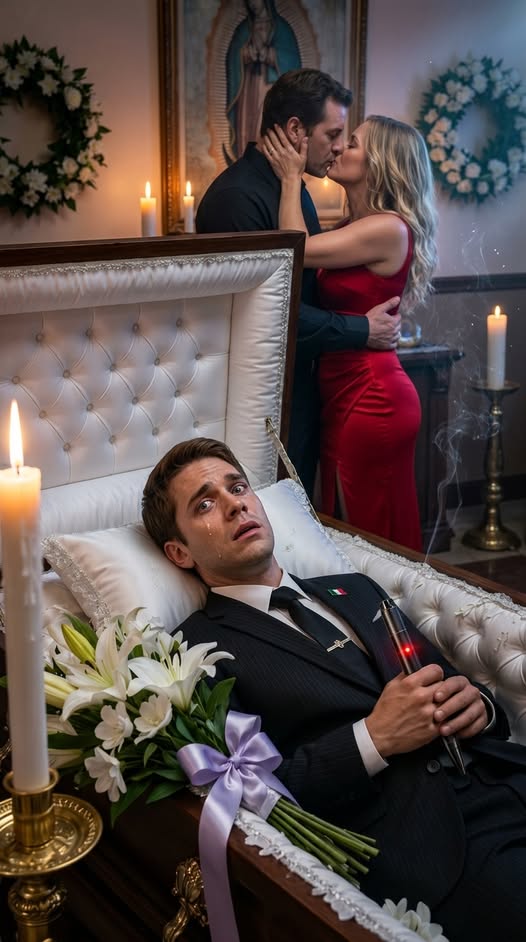
pressed against both sides. I was inside a box. My own coffin. I, Arthur Pendleton, the sole heir and CEO of **Pendleton Reserve**, one of Kentucky’s oldest and most ruthless bourbon dynasties, was being mourned alive inside a luxury funeral home in Louisville. My mind clawed backward through the fog of memory, desperate for an anchor. The night before, at the estate outside Lexington, I had felt that familiar, creeping weakness again. For three weeks, my body had betrayed me in strange, subtle ways—a sudden numbness in my fingertips, an unnatural heaviness in my
chest, blinding waves of dizziness during board meetings. My wife, Victoria, fifteen years my junior and beautiful in a careful, flawlessly expensive way, had brought me a cup of tea right before bed. “Drink it, sweetheart,” she had murmured, her cool fingers brushing the hair away from my
sweating forehead. “Dr. Vance said this herbal blend will calm your heart rate and finally help you sleep.” Dr. Harrison Vance. My lead cardiologist. My fraternity brother. My best friend since our days at Yale. I had trusted him implicitly. I had trusted her. So, I drank the bitter tea. Then came the heavy dizziness. Then, the suffocating dark. Now, trapped inside the velvet-lined coffin, I felt a pair of hands smooth the lapels of my tailored suit. Victoria’s signature perfume—a custom blend of bergamot and vanilla—slipped through the tiny space around my face, sweet and
nauseating.
“Almost over, my love,” she whispered.
There was no grief in her voice. There was only a chilling, absolute satisfaction.
“Soon, we’ll finally be rid of you.”
Another voice answered her, pitched low and masculine. Harrison.
“The paralytic worked perfectly. No one questions a respected, board-certified cardiologist when he signs off on a sudden cardiac arrest in a chronically stressed executive. Especially not one with Arthur’s relentless workload.”
Victoria gave a soft, breathy laugh that made my paralyzed blood run cold. “What time is the cremation?”
“Six o’clock sharp,” Harrison replied smoothly. “Once he’s ash, there’s nothing left to examine. No toxicology report. The distilleries, the Swiss accounts, the Nashville penthouse, the life insurance payout—it all becomes entirely manageable.”
*Cremation.*
The word echoed in the dark chamber of my skull. They were going to burn me alive.
I tried to scream. I threw every ounce of my willpower into tearing open my own throat, trying to force even a single vocal cord to vibrate. I tried to force one finger to scratch against the satin lining.
Nothing moved. I was a ghost haunting my own corpse.
The funeral continued around me like a grotesque, macabre performance. I listened as Victoria accepted condolences. I heard her fake tears when the board members came near the casket. She played the shattered, fragile widow flawlessly, standing guard over the living man she had conspired to murder.
Then, the murmurs died down. The heavy coffin lid began to close.
Darkness swallowed me completely.
*Click.* The first metal latch locked into place.
*Click.* The second.
*Click.* The third.
The air instantly thickened, growing stale and hot. My paralyzed body was being lifted. I felt the swaying motion of the casket on a rolling cart. I was being carried toward the fire, wide awake in the dark, with absolutely no way out.
I couldn’t know it then, while I lay suffocating beneath layers of mahogany and silk, but a seemingly insignificant mistake in the kitchen trash back at my estate had just put the very first crack in my wife’s perfect murder.
That morning, my younger brother, Declan Pendleton, had arrived uncharacteristically early to the estate.
Declan had not been allowed to see me before the funeral home removed my body. Victoria had smoothly insisted it was “too traumatic” for the family. Harrison had assured everyone that the heart attack had been sudden but entirely peaceful. The private night nurse had mysteriously been sent home early the night before because Victoria wanted “quiet, uninterrupted time” with her ailing husband.
None of it sat right with Declan.
Declan and I had not always been close. The Pendleton family had entirely too much money and too many generational secrets for brotherhood to remain a simple thing. I had inherited the iron-fisted leadership of **Pendleton Reserve**, while Declan had spent his adult years being dismissed by the board as the reckless younger son who preferred restoring vintage motorcycles and making bad investments.
But beneath the corporate warfare and the holiday dinners spent on opposite sides of long tables, Declan knew me.
He knew Arthur Pendleton did not die easily. I did not surrender to stress. I did not ignore glaring physical symptoms for weeks without ordering an army of specialists to run tests. I certainly did not let my body collapse quietly while sitting beside my wife and her favorite doctor.
I would later learn that Declan walked through the mansion that morning with a kind of quiet, radiating anger that made the estate staff actively avoid his eyes. The house looked entirely too clean. Too perfectly arranged for a sudden tragedy. Fresh white floral arrangements had already replaced the ones in my master bedroom. The bedsheets had been entirely stripped and bleached. The tea tray was completely gone.
Almost gone.
In the massive catering kitchen, an older housekeeper named Mrs. Gable stood beside the marble sink, nervously twisting a dish towel in her weathered hands.
Declan stopped in the doorway. “What is it, Mrs. Gable?”
She looked fearfully toward the hallway before speaking. “Mr. Declan, I really don’t want any trouble.”
“That usually means trouble already exists,” he replied, stepping closer.
Her eyes filled with conflicted tears. “Your brother was asking for you last week.”
Declan’s posture stiffened. “He was?”
“He pulled me aside in the study. He told me if anything ever happened to him, I should call you first. Before the lawyers. Before his wife.”
Declan went completely still. “Why didn’t you?”
“Mrs. Pendleton confiscated his phone yesterday afternoon. She said he needed absolute screen-free rest. Dr. Vance told the entire staff not to disturb him under any circumstances.”
Declan’s jaw hardened.
Mrs. Gable lowered her voice to a terrified whisper. “And… there was something in the trash this morning. In the service pantry. I thought it was odd.”
Declan didn’t wait. He bypassed her and walked straight to the service pantry, where the large industrial kitchen trash bag had not yet been taken out by the groundskeepers. He pulled on a pair of yellow dish gloves and tore the bag open.
At first, there was nothing unusual. Gourmet coffee grounds. Soiled paper towels. Empty floral packaging. A broken porcelain teacup wrapped in the morning newspaper.
Then, Declan saw it.
A small, amber glass vial. It had no obvious medical branding. At the bottom of the bag was a torn pharmacy sticker, wet from spilled herbal tea but still partially readable.
*Vecur—*
Declan stared at it. He knew very little about prescription medicine, but he knew enough about the world to understand that ordinary sleep herbs did not come in hidden glass vials with aggressively torn labels.
He took out his phone and called the one person he trusted more than any corporate attorney on the Pendleton payroll: Dr. Meredith Collins.
Meredith was a brilliant senior toxicologist at the University of Kentucky Medical Center. She had dated Declan for two volatile years, ended it because she claimed he was “emotionally allergic to adulthood,” and somehow remained the only person on earth who could call him an idiot without making him throw a punch.
She answered on the third ring. “Declan, unless you are actively bleeding, under arrest, or finally apologizing for Thanksgiving, this is a bad time.”
“I found a medical vial in Arthur’s kitchen trash,” he interrupted, his voice tight. “The partial label says *Vecur*-something.”
The line went dead silent.
“Spell exactly what you see,” Meredith demanded.
He did.
Meredith’s tone shifted from annoyed to clinical ice. “Vecuronium?”
“What is that?”
“It’s a high-grade paralytic.”
Declan’s blood went cold. “What kind of paralytic?”
“The kind used during major surgical anesthesia to completely stop all muscle movement. It does not make you unconscious by itself, Declan. It paralyzes the respiratory system and the skeletal muscles. You’re completely awake, but you look dead.”
Declan looked slowly toward the mansion’s grand foyer. At the ornate funeral program resting on the console table. At the elegant, embossed words: *Private Cremation Service, 6:00 p.m.*
“Declan,” Meredith said sharply, panic bleeding into her voice. “Why are you asking me about this?”
He could barely draw breath into his lungs. “Because my brother is being cremated in less than an hour.”
For half a second, there was only the static of the cellular connection.
Then Meredith screamed into the phone. “Stop it! Stop the cremation right now!”
Inside the box, the temperature was rising.
I felt the subtle shift in the environment as the rolling cart transitioned from the carpeted viewing room to the concrete floors of the crematorium wing. The air around me grew stifling. Sweat pooled in my collar, but my body refused to shiver or gasp. The absolute sensory deprivation was maddening. My brain fired frantic, electric signals to my limbs—*Move! Thrash! Kick!*—but the vecuronium held my nervous system hostage.
I heard the heavy, industrial hum of the cremation furnace powering up. The low vibration rattled through the wheels of the cart and straight into my spine.
I was going to burn. I was going to feel the flames consume my skin, my clothes, my flesh, and I wouldn’t be able to make a single sound.
Outside the box, in the hallway leading to the incinerator, Victoria stood near the entrance, dressed in immaculate black silk, one hand pressed delicately to her chest while Pendleton executives murmured their final condolences. Harrison stood securely by her side, projecting the image of a dignified, grieving friend.
Then, the heavy double doors of the funeral home crashed open.
Even through the thick mahogany of my casket, I heard the commotion.
“Stop the cremation!” a voice roared.
*Declan.*
My heart, beating at a slow, chemically suppressed rhythm, seemed to scream in my chest.
Victoria’s voice drifted through the wood, flashing with sharp irritation before perfectly masking itself in grief. “Declan, please. This is highly inappropriate. This is not the time.”
“Get out of my way, Victoria,” Declan snarled. I heard the scuffle of shoes. Two funeral attendants tried to physically block him.
“Sir, you can’t go back there!” one of them shouted.
“My brother might be alive!” Declan bellowed.
The muffled acoustics of the room erupted into sheer chaos. I heard the collective gasp of the mourners.
Harrison moved first, his voice dripping with condescending medical authority. “Declan, listen to me. You’re in a state of severe shock. This is the bargaining stage of grief.”
I heard the sickening thud of Declan shoving Harrison against the wall. “What exactly does vecuronium do, Harrison?”
Silence fell over the room like an anvil.
Though I couldn’t see it, I knew Harrison had frozen. That fraction of a second of hesitation was all Declan needed.
The funeral director’s frantic voice cut through the tension. “Mr. Pendleton, I assure you, the cremation sequence has not officially begun, but we cannot have this disruption—”
“Open the coffin,” Declan ordered.