This is the chronicle of my own private coup d’état—the precise, calculated moment I stopped being a patient, suffering tenant in my own life and became the cold, unflinching architect of a dynasty’s destruction. They thought the towering stone walls of Vanguard Estate were thick enough to stifle the truth; they didn’t realize that even the oldest, most stubborn granite eventually fractures under the immense weight of a secret as heavy as mine. The late afternoon sun over Vanguard Estate was a brilliant, deceptive gold, casting long, menacing shadows across a sprawling flagstone patio that smelled of expensive charcoal, roasted meats, and the sharp, chemical salt-tinge of a heated infinity pool. To anyone else, this was the undisputed social event of the season—the annual Vanguard summer gala in the heart of elite Connecticut society. To me, it was a suffocating gauntlet of vicious whispers and the biting chill of a family that viewed my very existence as a technical error in their grand blueprint of corporate success. I sat in my custom-built wheelchair at the edge of the patio, the weight of the rigid carbon-fiber leg brace on my left leg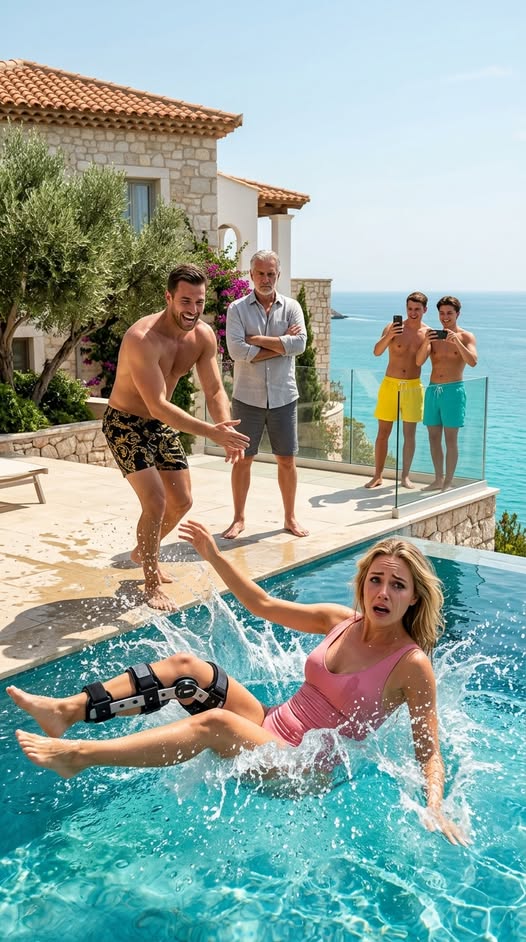
feeling less like a medical device and more like a lead anchor chained to my flesh. It wasn’t a prop for sympathy. It wasn’t a lifestyle choice. It was a $30,000 marvel of modern biomechanical engineering designed exclusively to stabilize a lower spine that had been violently shattered in a car “accident” exactly twelve months ago. I was the ghost in the corporate machine, a former Senior Structural Analyst who could no longer stand on her own two feet, forced to live in a sprawling mansion built by a man who only valued what he could crush or construct with his bare hands.
“STOP PLAYING DEAD FOR SYMPATHY!” My father, Richard Vance, didn’t even bother to look at me as he bellowed the words. He stood aggressively by the massive, industrial-grade outdoor grill, a crystal glass of twenty-year-old scotch gripped tightly in one hand and a silver spatula in
the other. He was the undisputed king of Vanguard Construction, a ruthless man who fundamentally believed that physical weakness was a deep moral failing. To Richard, a shattered spine was just a “delay in the project schedule,” and after a year, he had definitively decided that the project
of my physical recovery was over-budget and severely behind time. “Victoria, take those damn metal contraptions off and help your brother with the catering coolers,” Richard sneered, his booming voice easily carrying over the smooth live jazz and the hollow, sycophantic laughter of our
extended cousins. “You’ve been sitting in that chair playing queen for an entire year. The doctors said you needed ‘rehab,’ and in this family, rehab means moving, not mooching! You’re just trying to guilt-trip me into carving out a larger share of the inheritance by acting like some tragic
Victorian invalid. It’s pathetic, and it ruins the image of the Vanguard brand.” I gripped the rubberized armrests of my chair, a cold dread coiling in my gut as my knuckles turned stark white. “Dad, the nerve damage is localized at the L4-L5 level. I literally cannot feel my left foot today. The
sudden weather change caused severe spinal inflammation—the physical therapist explicitly said—”
“The physical therapist is a glorified thief taking my hard-earned money to watch you sit on a rubber yoga ball!” Richard snapped, finally turning his massive frame to face me. His eyes were hard, flinty, and completely devoid of the warmth a father should inherently have for a child who had nearly died on a highway. “You’re a Vance. We don’t break; we rebuild. And if you refuse to rebuild yourself, you’re just debris to be swept away.”
My older brother, Bradley, walked by, intentionally bumping the heavy rubber wheel of my chair with his hip, rocking me violently and nearly tipping me over onto the hard stone. He was the heir apparent—brash, athletic, and possessed of a deep-seated cruelty that Richard constantly mistook for “leadership qualities.” Bradley looked down at my expensive leg brace with a sneering disgust that bordered on the pathological.
“Sure, Vic,” Bradley mocked, leaning down to aggressively yank a cold beer from a nearby ice bucket. “And I’m the Pope. You’re just lazy. You realized that if you stay glued to that chair, you don’t have to pull your weight at the firm anymore. You get to sit in the central AC while I’m out sweating at the job sites. It’s the ultimate scam, and frankly, it’s insulting to those of us who actually work for a living.”
I swallowed the lump of humiliation in my throat and looked away, my eyes desperately finding the new “lifeguard” I had adamantly insisted on hiring for the massive party. He was a broad-shouldered man in his late forties, dressed in a simple red polo shirt and standard board shorts, sitting quietly in the high wooden chair with a streak of white zinc covering his nose. To my arrogant family, he was just “Harrison,” a faceless temp-agency hire, a “nobody” paid a meager hourly wage to watch the drunk executives’ kids splash around.
To me, he was Dr. Harrison Sterling—the brilliant Chief of Orthopedic Surgery at the city’s top trauma center and the exact man who had performed the grueling, twelve-hour three-level fusion on my shattered spine.
I had hired him undercover because I was absolutely terrified. I understood architectural systems; I saw the dangerous stress fractures forming rapidly in our family dynamic. I knew the aggressive “tough love” narrative in my house was reaching a lethal boiling point. I knew that in their cold, calculating eyes, my medical reality was just a barrier to their convenience, and they were the type of men who routinely removed barriers with heavy demolition tools.
Bradley leaned down closely, his hot breath smelling strongly of bitter hops and pure malice. He whispered directly into my ear, “I’m sick and tired of looking at that brace, Vic. It’s a pathetic eyesore. Today, we’re going to see if you can really swim, or if you’re exactly as much of a manipulative liar as I think you are.”
Bradley’s heavy, calloused hand moved swiftly toward the steel lock on my wheelchair’s manual brakes, and for the very first time, I saw the true, murderous predatory intent reflecting in the pristine blue water of the pool—a dark, empty look that clearly said he didn’t care if I ever came back up for air.
The horizon violently tilted as the heavy steel brakes clicked open with a sharp, echoing metallic snap.
“Bradley, don’t,” I gasped, my heart hammering against my ribs like a trapped bird. “I can’t balance without the chair. The knee hinge isn’t locked into a standing position!”
“Then learn to fly, little sister,” Bradley grinned, his handsome face twisting into a mask of sadistic, unhinged glee.
It wasn’t a gentle nudge. It wasn’t a drunken, playful shove between siblings. Bradley took a deliberate half-step back and delivered a full-force, calculated kick with his heavy leather boot directly to the carbon-fiber hinge of my leg brace. I heard the sickening, explosive crack of the expensive composite material—the very thing holding my fragile spine in alignment—shattering instantly under the immense force.
Before I could even draw breath to scream, his large hands were firmly on the top handles of my wheelchair, and with a violent, grunting heave, he sent me spiraling off the edge of the flagstones and directly into the ten-foot deep end of the infinity pool.
The water was a brutal shock of ice that instantly stole the air from my burning lungs. I sank like a stone. My legs were completely dead weight, entirely unresponsive and heavy, and the broken, jagged shards of the destroyed brace acted like a lead ballast, dragging me aggressively toward the smooth blue-tiled floor of the pool. The hydrostatic pressure began to mount painfully in my ears, and the bright summer sunlight above quickly became a shimmering, unreachable, rippling ceiling of gold.
Above the surface, peering through the chlorine distortion of the water, I saw the blurry silhouettes of my own blood.
My cousins were laughing. They were literally holding up their iPhones, capturing the “hilarious prank” in high definition for their social media feeds. My father, Richard, stood a mere ten feet away, his thick arms casually crossed over his broad chest, the thick grill smoke swirling around his head like a dark, demonic shroud. He didn’t move an inch. He didn’t reach for the emergency life ring mounted on the stone wall. He didn’t even drop his glass of scotch.
“Let her struggle a bit,” I heard Richard’s muffled, distorted voice vibrating through the water, sounding exactly like the final judgment of a cold, indifferent god. “Maybe the shock of the cold will finally wake up her lazy ‘nerves’ and her work ethic. She needs to realize right now that nobody is going to carry her through this life. It’s time for the Vance ‘sink or swim’ test.”
Bradley stood right at the edge of the coping, laughing so hard he had to lean his hands on his knees. “Look at her! She’s doing the dramatic ‘drowning’ act now! Give her a damn Oscar! She’s so committed to the fake bit she’s actually letting herself sink to the bottom!”
I tried desperately to kick, but my frantic brain’s electrical signals hit a solid brick wall of scar tissue at the base of my spine. I clawed wildly at the water with my arms, my chest burning in agony as my lungs pleaded for oxygen, the carbon dioxide building up in my bloodstream until my peripheral vision began to sparkle with dark, dancing stars. I watched the tiny bubbles of my last remaining breath rise rapidly to the surface—silver pearls of my life escaping—and I realized with a terrifying, ice-cold clarity that my family wasn’t waiting for me to magically swim.
They were waiting for me to disappear.
They desperately wanted the messy “problem” of the broken daughter permanently solved. A “tragic drowning accident” at a crowded pool party was the perfect, clean corporate solution to an inconvenient, expensive heir. It would be a clean tax write-off. My vision began to rapidly dim at the edges, the bright Connecticut sun turning into a distant, fading spark of a world that simply no longer wanted me in it.
As my hand fell completely limp against the smooth bottom tiles of the pool and the velvety darkness began to pull me under, a massive, silent wake violently broke the surface above, and a dark shadow dived downward with the terrifying speed and precision of a hunting shark.
I didn’t feel the physical impact when he hit the water, but I immediately felt the hands.
They weren’t the panicked, fumbling, inexperienced hands of a teenager working a minimum-wage summer job. They were firm, clinical, and possessed of a terrifying, measured, and absolute strength. Dr. Harrison Sterling didn’t just grab me; he swiftly executed a flawless aquatic chin-lock, perfectly stabilizing my neck and cervical spine even as he hauled my limp, water-logged body upward toward the fading light. He moved through the heavy water with an incredible efficiency that suggested he had spent as much time navigating dangerous ocean currents as he had in the sterile operating room.
We broke the surface, and I instantly choked, a foul mix of chlorinated water and bitter bile burning my throat as I gasped for air. Harrison swam me quickly to the concrete deck, but he didn’t just carelessly dump me over the edge. He used the lip of the pool to hoist me up with a practiced grace that kept my torso and spine perfectly, rigidly straight.
“Call 911! Right now!” Harrison roared. His voice wasn’t a frantic request; it was an absolute command that sliced through the blaring jazz music and the drunken laughter of the party like a heavy steel guillotine.
“Hey, back off, kid!” Bradley yelled, swaggering over with a fresh, dripping beer in his hand, his handsome face flushed pink with the arrogant thrill of his successful “prank.” “She’s perfectly fine. She’s just holding her breath to make us look bad in front of the guests. You’re ruining the entire vibe of the party, ‘lifeguard.’ Put her back in her wheelchair and go get me a dry towel.”
Harrison didn’t even deign to look at him. He laid me flat on the warm concrete, his highly trained fingers already dancing rapidly across the base of my skull and tracing down my vertebrae in a high-speed, critical neurological assessment. He was physically checking for a “step-off,” a subtle ridge in the bone that would indicate a fresh, catastrophic fracture.
“I said call a goddamn ambulance!” Harrison repeated, his icy gaze finally snapping up to lock onto Bradley.