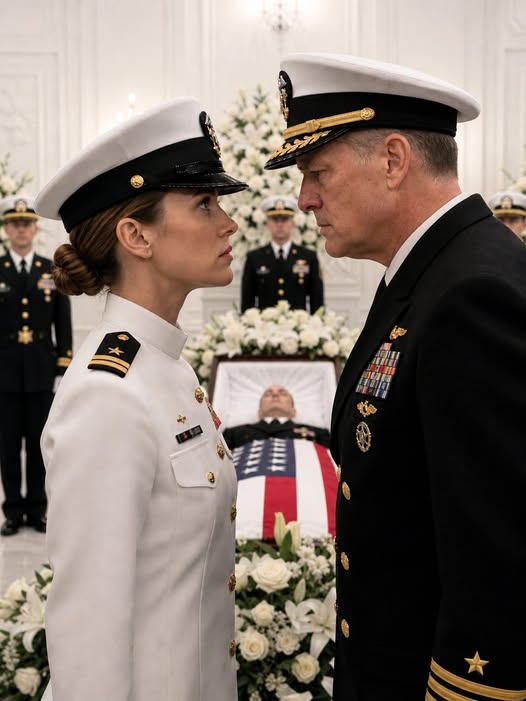
I left the house wearing it.
Three weeks later, my parents sold that house.
Just like that.
To them, it was just property.
To me, it had been everything that never lied.
“It’s just a house,” my mother said.
I didn’t argue.
Some people don’t recognize value unless it’s loud.
I went back to base.
Tried to move on.
Tried to believe that the ring was all I had left of him.
I was wrong.
Three weeks after the funeral, I attended a military ceremony.
Formal. Structured. Predictable.
Until it wasn’t.
I was standing in conversation when someone behind me said,
“Where did you get that?”
I turned.
A general stood there.
Not looking at me.
Looking at my hand.
At the ring.
“What was your grandfather’s name?” he asked.
“Thomas Hail.”
The color drained from his face.
“We need to talk.”
And in that moment—
Everything I thought I knew about my grandfather began to fall apart.
PART 3 — The Name He Never Used
We stepped away from the crowd, into a quieter corridor where the noise of the ceremony softened into something distant and irrelevant. The general didn’t speak right away. He studied the ring again, as if confirming something he wasn’t ready to say out loud.
“Take it off,” he said finally.
I hesitated for a second, then slid the ring from my finger and handed it to him. He turned it slowly, angling it toward the light until the faint engraving inside became visible. His jaw tightened.
“Where did you say you got this?”
“It belonged to my grandfather,” I said. “Thomas Hail.”
He exhaled slowly, like a man stepping into a memory he had kept sealed for too long.
“That’s not the name we knew him by.”
I felt something shift in my chest.
“What do you mean?”
He looked up at me, his expression no longer formal, no longer distant.
“You’re standing here because of a man most people think never existed.”
I didn’t interrupt.
Because something in his tone told me not to.
“There was a unit,” he continued, his voice quieter now, controlled but heavy with history. “Small. Specialized. Not something you’d find in standard records. They handled operations that weren’t meant to be public. Your grandfather was part of it. Not just part of it—he led it.”
The words didn’t settle immediately.
“They called him Hail?” I asked.
The general shook his head.
“No. That was after. Back then, he had a different name. One we were told not to repeat unless absolutely necessary.”
A pause.
“Carter.”
The name didn’t mean anything to me.
But the way he said it did.
“What did he do?” I asked.
The general looked down at the ring again.
“There was a mission,” he said. “High-risk. No support. Everything went wrong halfway through. Communications were cut. Extraction failed. The kind of situation where you don’t expect anyone to come back.”
My throat tightened.
“And he did?”
The general nodded slowly.
“He brought six men out. Two injured. One unconscious. Carried them, rotated them, kept them moving through terrain that should have stopped all of them. When they finally reached the extraction point, he stayed behind long enough to make sure they got out first.”
“Why didn’t anyone know about this?” I asked.
“Because it wasn’t meant to be known,” he replied. “Officially, the mission didn’t happen. Off the record… it changed how we approached operations like that for years.”
I tried to connect the man he was describing with the one I had known—the quiet figure in a worn chair, drinking cheap coffee, fixing things that didn’t need to be replaced.
It didn’t match.
Or maybe it did.
In a way I hadn’t understood before.
“He was recommended for the Medal of Honor,” the general continued. “Twice.”
“What happened?”
“It never went through. Politics. Classification. Too many details that couldn’t be made public without exposing other operations. In the end, they gave him something smaller and told him to forget the rest.”
I let out a breath I didn’t realize I’d been holding.
“And he did?”
The general looked at me for a long moment.
“No,” he said. “He just stopped talking about it.”
That sounded more like him.
“What about the ring?” I asked.
The general handed it back carefully.
“That wasn’t issued,” he said. “That was earned.”
“How?”
He hesitated.
Then spoke more quietly.
“There was a man on that mission who didn’t make it. Close friend. Your grandfather took his ring before they separated, said he’d return it to his family.”
“And did he?”
The general’s eyes didn’t leave mine.
“No one ever found them.”
The words settled heavily between us.
“What are you saying?” I asked.
“I’m saying that ring is the only proof that part of that story exists outside classified files,” he replied. “And the fact that he kept it all these years… means he never stopped carrying that responsibility.”
I looked down at the ring in my hand.
It didn’t feel like an object anymore.
It felt like weight.
“Why are you telling me this?” I asked.
“Because you’re wearing it,” he said. “And because if anyone deserves to know who he really was… it’s you.”
I didn’t have a response for that.
Not one that felt enough.
“There’s more,” he added.
Of course there was.
“There’s a recognition process being reviewed right now,” he said. “Unclassified citations. Delayed honors. His name—his real name—came up again recently.”
My chest tightened.
“You mean—”
“I mean it’s possible,” he said carefully. “That what was denied before might finally be acknowledged.”
The ceremony behind us resumed, voices rising again, announcements continuing as if nothing had shifted.
But everything had.
I looked at the ring one more time before putting it back on.
This time, it didn’t just feel grounding.
It felt earned.
Not by me.
But carried forward.
When I turned back toward the main hall, the general spoke again.
“Your grandfather didn’t live quietly because he had nothing to say,” he said. “He lived quietly because he had already done everything that needed saying.”
I nodded.
Because for the first time—
I understood him.
And I understood why he never explained himself.
Some lives don’t need to be told loudly to matter.
Some are built in silence—
And only revealed when someone finally knows where to look.
PART 4 — The Papers No One Wanted Found
The ceremony continued behind him, but nothing in it held his attention anymore. The applause, the speeches, the formal rhythm of recognition—all of it felt distant, like sound traveling through walls. What stayed with him instead were the last words his grandfather had spoken in that hospital room, words that had seemed incomplete at the time but now carried a precision he couldn’t ignore.
The ring knows better than the papers.
It hadn’t been a metaphor. It had been direction.
The next morning, he was already on the road back to Ohio. The drive felt shorter than it should have, not because of distance, but because his mind never left its destination. By the time he reached the old neighborhood, the air felt colder than he remembered, the kind of cold that settled into quiet spaces rather than moving through them.