A sealed envelope.
And a worn leather folder.
He didn’t open them there.
Instead, he replaced the panel, stood up, and left the house without looking back. Some things demanded space before they could be understood, and that house—no matter how much had changed—still carried too much of what he wasn’t ready to process all at once.
He sat in his car before opening anything.
The envelope came first.
His name was written across it in familiar handwriting. Not printed. Not labeled. Written with intention. That alone told him this wasn’t something meant to be found by anyone else.
He opened it carefully.
Inside was a single sheet of paper, nothing more.
If you’re reading this, it means you didn’t ignore what didn’t make sense.
There was no greeting. No explanation. Just that line, direct and unmistakably his grandfather’s voice carried through ink.
He read on.
Some things were never written down where they could be found. That was the rule. But not everything can stay buried forever.
The words were measured, controlled, the same way his grandfather had always spoken—never more than necessary, never less than exact.
If the ring is with you, then you already know enough to decide whether to keep going. If you choose to stop here, burn what’s in your hand and walk away. No one will come looking.
He paused there, feeling the weight of that sentence more than the rest.
Choice.
Always choice.
If you choose otherwise, open the folder. But understand this—once you do, you don’t get to unknow it.
He sat back in the driver’s seat, the paper resting against his palm, the silence around him pressing in just enough to make the decision feel real. That was how his grandfather had always done things—never forcing direction, only making sure you understood the consequences of choosing one.
He reached for the folder.
There wasn’t hesitation anymore.
Not really.
When he opened it, the contents didn’t overwhelm him with volume. There weren’t stacks of documents or pages meant to confuse. Instead, everything inside felt deliberate. Selected. Reduced to only what mattered.
Photographs.
Maps.
Fragments of reports.
Nothing labeled in a way that would make it obvious to someone unfamiliar with what they were looking at. But the structure was there, hidden in the arrangement, waiting for someone who knew how to read between details rather than rely on explanations.
Coordinates were marked without titles. Dates were listed without events attached. Names had been blacked out, then partially restored in pencil, as if someone had gone back later and decided certain parts deserved to be remembered.
Then he found the photograph.
Seven men stood together, not in formation, not posed for ceremony, but captured in a moment that felt unplanned. Their uniforms were worn in a way that suggested use rather than display. Their expressions carried something quieter than pride—something earned.
His grandfather stood in the center.
Younger.
Unmistakably him.
On the back of the photograph, written in faded ink, was a name.
Carter.
The same name the general had spoken.
That was the moment it stopped being something he had been told.
And became something he could no longer deny.
At the bottom of the folder, beneath everything else, there was one final document. Unlike the rest, it was clean, typed, structured in a way that suggested it had once belonged somewhere official before being removed.
A citation review.
Delayed recognition.
Language that had been revised, reconsidered, brought forward again after years of silence.
And at the bottom—
A date.
Recent.
Too recent to ignore.
He leaned back slowly, the folder resting in his lap, the ring pressing heavier against his finger than it ever had before. What his grandfather had left behind wasn’t memory. It wasn’t sentiment.
It was evidence.
Not for the world.
Just for someone willing to see it.
And now—
That responsibility had shifted.
The photograph remained in his hand as he looked at it again. Seven men. Six who returned. One who didn’t. A story that had never been finished, not because it had been forgotten, but because something had interrupted its ending.
The ring had never been returned.
Not because it had been lost.
But because there had been no one left to return it to.
He closed the folder slowly, the movement deliberate, controlled, the way his grandfather would have done it.
Because now—
This wasn’t about uncovering the past anymore.
It was about deciding what to do with what had been left unfinished.
And whether he was willing to carry it forward.
PART 5 — The Ending He Chose to Finish
He didn’t return to base right away. Not because he was hesitating, but because he understood something with complete clarity now—what had been handed to him wasn’t something he could file away and move past. The ring, the folder, the conversation with the general… none of it belonged to the past anymore. It had been placed in his hands for a reason, and ignoring it would have been the only real mistake left to make.
So instead of going back, he followed the only direction that still made sense.
The address buried in the documents led him to a federal records office tucked into an unremarkable block of buildings, the kind designed to be overlooked. Inside, everything moved with quiet precision—voices low, footsteps controlled, information handled carefully but never fully revealed. When he requested access to the citation review, the process began the way all processes do: verification, waiting, resistance dressed as protocol. But when the staff member noticed the ring as he turned it unconsciously in his hand, something shifted. Not enough to draw attention, just enough to move his request forward.
He was taken into a smaller room.
The file they gave him was thin.
That was the first thing that stood out. For something that had carried so much weight for so long, the official version barely existed. It was structured, careful, and accurate—but incomplete. It described leadership, risk, and survival in clean language, while leaving out the parts that had never been meant to exist outside of memory.
He read it once. Then again.
Then he closed it.
“What’s missing?” he asked.
The man across from him didn’t answer immediately.
“The details that were never cleared,” he said eventually. “The parts that couldn’t be released without exposing more than just one story.”
In other words—the truth.
He didn’t argue.
Because he already had it.
Not in official form, but in fragments that had been left behind deliberately—coordinates without explanation, names partially erased, a photograph that said more than any report ever could. He placed the folder on the table and opened it, sliding the image forward.
“Then we start with this,” he said.
The man studied it carefully, his expression tightening just enough to confirm what he already suspected.
“Give me time,” he said.
Time.
It was the one thing his grandfather had never asked for.
And the one thing he had never been given.
Three weeks later, the review was reopened.
Not publicly. Not yet.
But officially.
That was enough.
In the days that followed, he did what his grandfather had always done—he paid attention. He went back through everything, not searching for something new, but making sure nothing had been misunderstood. The scattered details began to align. Routes became paths. Timelines became sequences. And eventually, everything pointed to one place.
The final point.
The place where six men made it out—
And one didn’t.
It took time to confirm the location. Records had shifted, coordinates adjusted just enough to blur certainty without erasing it completely. But the pattern held. And when he finally stood there, it didn’t feel dramatic. There were no markers, no signs, nothing to suggest anything had ever happened.
Just land.
Still.
Unchanged.
He stood there for a long time, the photograph in his hand, the weight of everything settling in a way that no ceremony ever could. Six men had walked away from this place. One had not. And for years, that absence had remained exactly where it was—unfinished.
He knelt down slowly, pressing his hand into the ground, not because he expected to find something, but because it felt like the only way to acknowledge what had been left behind.
“I found it,” he said quietly.
There was no answer.
There didn’t need to be.
He reached into his pocket and took out the ring. For a moment, he held it there, turning it just enough for the faint engraving inside to catch the light. It had never belonged to his grandfather. It had been carried. Protected. Waited on.
He placed it into the earth and covered it carefully.
Not as a gesture.
But as a return.
When he stood again, something had shifted—not around him, but within him. The weight hadn’t disappeared. It had settled into something steadier, something complete.
Two months later, the recognition was approved.
Not the full story.
Not everything.
But enough.
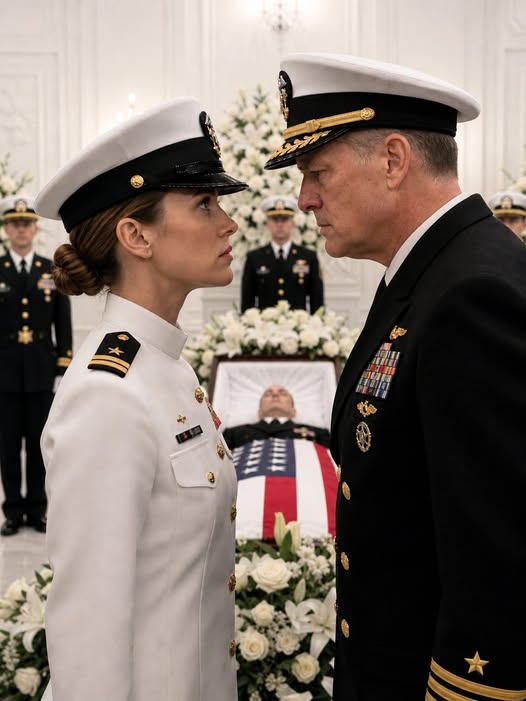
The ceremony was smaller this time. Quieter. When his grandfather’s name was read—both of them—the room didn’t react with surprise. It reacted with something deeper.
Respect.
Because some names don’t need explanation.
They carry their own meaning.
Afterward, the general found him again.
“You finished it,” he said.
He shook his head slightly.
“No,” he replied. “I just returned what wasn’t mine to keep.”
The general studied him for a moment, then nodded.
“That’s exactly what he would have done.”
That night, he didn’t stay for the reception. He left early, driving without music, without distraction, letting the silence settle the way it needed to. At some point, without thinking, he glanced at his hand.
The ring was gone.
And for the first time—
It felt right.
Because what his grandfather had left behind was never meant to be held.
It was meant to be carried—
Until someone understood where it truly belonged.